Авторы публикации
Dear friends, we are with you again and are very happy to meet you again! After the summer break, the team of the Ukrainian Institute of Politics returns with renewed energy, new ideas, and a new issue of public analytics. The new political season promises to be full of unexpected events. For those who need more in-depth analysis, a broader factual base, confidential risk assessments, and forecasts for management decision-making, we are ready to offer professional analytical products in a closed format. We remind you that additional analytical products of the Ukrainian Institute of Politics are available for organizations, businesses, and private clients: Weekly Intelligence Brief, Geopolitical Risk Reports, Executive Briefings, as well as special analytical materials and forecasts upon individual request. For additional information, please contact us at: uiamp2012@gmail.com or by phone: +38 (093) 757-75-65.
WEEKLY SUMMARY:
UKRAINIAN DIMENSION.
(24–31 August 2026)
The visit of CIA Director John Ratcliffe to Moscow (25 August 2026) has so far not led to the resumption of constructive peace negotiations on settling the war in Ukraine. On the contrary, the situation is moving to a new level of escalation. Russia is raising the stakes and accompanying political threats against Ukraine and its Western partners with aerial terror.
At the same time, the absence of a diplomatic breakthrough does not yet mean an end to contacts: after John Ratcliffe’s visit, the negotiation process noticeably intensified. On 31 August, President V. Zelensky held a detailed telephone conversation with D. Trump’s representatives Steve Witkoff and Jared Kushner. The parties discussed the situation on the front and began coordinating the timing of their visit to Ukraine, which is expected to focus on finding further ways toward a peaceful settlement. On the same day, U.S. Treasury Secretary Scott Bessent met with Russian Minister Anton Siluanov on the sidelines of the G20 meeting and warned that until the war ends, Moscow cannot count on an easing of economic pressure, the conclusion of new agreements, or the restoration of full-fledged cooperation with the United States.
Thus, the CIA Director’s visit may have given an impetus to the intensification of subsequent U.S. contacts with both the Russian and Ukrainian sides. However, there are still no signs of positions converging or preparations for a specific compromise: the United States is likely continuing to probe the limits of possible concessions by the parties while simultaneously increasing pressure on Moscow, whereas the Russian leadership is responding to diplomatic activity by further raising the military and political stakes.
Russian politicians have sharply intensified their nuclear rhetoric. Immediately after the departure of the American delegation, Russia conducted tests of a strategic nuclear missile. At the same time, the Russian Foreign Ministry declared its readiness to strike British military facilities “both on the territory of Ukraine and beyond its borders,” accusing London of supplying the Armed Forces of Ukraine with weapons and technologies for attacks on Russian territory.
In parallel, Russia resumed intensive shelling of Ukrainian cities. The new exhausting tactic of almost round-the-clock Russian attacks is now aimed not simply at destroying Ukrainian logistics, but at round-the-clock pressure, exhausting air defenses, and exerting psychological pressure on the population and businesses. The main targets of such attacks have primarily been Kyiv and the Kyiv region. From 27 August and as of 31 August, Kyiv and the region have already been under almost continuous attacks by Russian drones for five days. Moscow has shifted from periodic nighttime strikes to multi-day exhaustion of the capital: jet-powered UAVs are now launched in fragmented waves day and night, forcing the air defense system to constantly expend resources and the city to repeatedly halt metro services, transport, the operations of enterprises, shopping centers, and government institutions.
The Russian Ministry of Defense officially announced preparations for new “massive strikes” against Ukraine’s energy infrastructure. In Moscow, they are presented as a response to Ukraine’s campaign of symmetrical strikes against Russian economic infrastructure: oil refineries, oil and gas facilities, as well as logistics centers of the largest retail chains Wildberries and Ozon, which Ukraine accuses of servicing the Russian war economy. In August alone, Ukrainian forces attacked Russian oil refineries at least 21 times, while since mid-July eight of the ten largest Wildberries warehouses and a number of Ozon facilities have been hit.
Moscow’s demonstrative aggressiveness is linked not only to its desire to intimidate Ukraine and force it to accept Russian conditions for ending the war, but also to the approaching elections to the Russian State Duma (voting will take place on 18–20 September 2026). On the eve of the federal campaign, it is important for the Kremlin to demonstrate to its own electorate that the war is developing according to a controlled scenario, that the Russian leadership retains the initiative and is capable of responding harshly to Ukrainian strikes, despite increasingly noticeable problems with security, fuel, and the functioning of civilian infrastructure inside Russia itself.
At the same time, after the elections to the Russian State Duma, the Russian leadership may have its hands largely “untied” to make unpopular decisions that the Kremlin prefers not to bring into the public sphere before the elections. This could include, for example, a new wave of mobilization, further restrictions on the civilian sector, and shifting the economy to a more fully-fledged wartime footing. The Kremlin will also have the opportunity to calibrate escalation depending on Washington’s reaction. The short political window between the Russian State Duma elections on 20 September and the U.S. midterm elections on 3 November 2026 becomes the most dangerous period. During this time, Moscow may deliberately intensify military pressure on Ukraine, calculating that new strikes, losses, and destruction will directly influence the U.S. election campaign.
At the military level, the advantage in individual technological segments continues to shift from one side to the other without creating a strategic turning point on the front. While at the beginning of the summer Ukraine’s advantage in the middle strike zone (covering the operational depth of the enemy’s rear from 10 to 50 kilometers from the line of combat contact) allowed it to carry out systematic strikes with “Hornet” drones against Russian facilities in Crimea and along the “Novorossiya” highway, by the end of August the initiative had temporarily shifted to Russia due to the mass use of jet-powered UAVs. However, such technological advantages usually last for one or two months, after which the adversary adapts, increases interception capabilities, or deploys its own technological solution on the battlefield.
Although Ukraine has generally managed to slow the Russian offensive, it has not gained the capability to launch a strategic counteroffensive. Throughout 2026, Russian forces managed to capture only Rodynske and, probably, complete the occupation of most of the city of Chasiv Yar (in Donetsk region), but no large-scale operational breakthrough occurred. At the same time, there remains a high risk of losing Kostiantynivka, while fighting has begun for Dobropillia (in Donetsk region) and Orikhiv (in Zaporizhzhia region).
If the current balance is maintained, by the spring of 2027 the war between Russia and Ukraine will most likely develop into a total confrontation between the rear areas. Both sides will continue to strike energy, industrial, transport, and commercial infrastructure, seeking to provoke humanitarian and economic crises and undermine the social resilience of the population. In other words, they will seek to compensate for the absence of a decisive result on the front through the internal destabilization of the adversary.
This logic could be reversed by a political decision by one or several key leaders willing to take responsibility for ending the war and the domestic risks associated with it. However, under the current conditions, such a scenario appears extremely unlikely: the positions of the parties remain incompatible, while the political cost of compromise for each participant continues to be perceived as higher than the cost of further escalation.
In Ukraine’s domestic politics, the struggle continues for control over the main financial flows and key state institutions between the anti-corruption vertical and the presidential system of power. The NABU and SAPO operations “Forrest Gump” and “Themis,” launched on 19–20 August, by the end of the month had developed into a large-scale offensive against political, banking, administrative, and judicial connections affecting the government’s inner circle.
At the same time, President Volodymyr Zelensky is so far winning another round of confrontation over the position of Defense Minister with former head of the ministry Mykhailo Fedorov and the anti-corruption and socio-political structures supporting him. Attempts to keep M. Fedorov at the head of the Ministry of Defense or disrupt the appointment of a new head of the ministry failed. M. Fedorov’s video address calling for preparations for elections to begin, published on 18 August immediately before the Verkhovna Rada vote on the new Ministers of Defense and Foreign Affairs, became the main instrument of public pressure on the President and Parliament. The street protests and new NABU investigations in the “Forrest Gump” and “Themis” cases (effectively a continuation of the “Midas” case), aimed at striking the leadership of the Office of the President of Ukraine, state bodies, and the management of the state-owned Sense Bank, can also be included in this context. But they failed to disrupt the vote or force the President to reverse his decision. Y. Khmara (an authoritative general and former head of the SBU’s elite Alpha special unit) was appointed Minister of Defense of Ukraine on 19 August 2026 with the support of a broad consensus of 312 MPs. President V. Zelensky thus outplayed M. Fedorov and ignored his pressure, while the possibility of returning to the position was effectively completely ruled out for the former minister.
After his defeat, M. Fedorov effectively retreated to the international arena, accepting an offer to become an adviser to Italian Defense Minister Guido Crosetto on defense innovation. Italy became one of the countries where the former Ukrainian minister received the most visible public support. But politically, this step looks like a tactical retreat by M. Fedorov within Ukraine and the transfer of part of his activity to the international level, where he expects to preserve his political weight, external ties, and the possibility of subsequently returning to Ukrainian politics.
However, M. Fedorov has effectively established himself among the four most influential political figures in Ukraine, alongside Volodymyr Zelensky, Valerii Zaluzhnyi, and Kyrylo Budanov, becoming an independent political figure with fairly high electoral potential. After his dismissal, the level of public trust in Mykhailo Fedorov (65%) increased by as much as 30 percentage points, and he is now 2nd in the trust rating after former Commander-in-Chief V. Zaluzhnyi (70%), while ahead of Head of the Office of the President K. Budanov (62%) and President V. Zelensky himself (59%). If presidential elections were held, M. Fedorov (15.7%) could potentially overtake K. Budanov (8.5%) and confidently take 3rd place after V. Zelensky (26%) and V. Zaluzhnyi (17.4%) (data from the Rating Sociological Group dated 20–21 July 2026). Such electoral potential could in the future allow M. Fedorov to form his own political force and seek to create an influential faction in the future Parliament, depending on the results of future elections.
Ukraine’s defense budget deficit has reached $27 billion. President Volodymyr Zelensky officially confirmed this figure, explaining that the war has become critically more expensive and that the Ministry of Defense was forced to bring forward and spend in the first half of the year funds allocated for the second half of the year (in particular, for the mass production of drones and the procurement of air defense systems). Of this amount, around $20 billion is urgently needed by the end of the year for current military personnel payments and payments to the families of those killed, while another $8–10 billion is required for advance weapons contracts for the beginning of next year. As the main way out of this financial deadlock, Kyiv is proposing to the European Union a “frontloading” mechanism — bringing forward and paying out this year part of the €90 billion European loan originally scheduled for subsequent periods.
_____________________________
Visit of CIA Director John Ratcliffe to Moscow.
On 25 August 2026, CIA Director John Ratcliffe made an unannounced visit to Moscow — the first publicly known visit by the head of U.S. intelligence to Russia since 2021. The trip was prepared under conditions of heightened secrecy: even some senior representatives of the U.S. administration were not informed about it in advance, while the CIA and the White House initially declined to disclose its agenda. J. Ratcliffe met with Director of the Russian Foreign Intelligence Service Sergei Naryshkin and FSB Director Alexander Bortnikov, but there was no meeting with Russian President Vladimir Putin. At Washington’s request, Ukraine refrained from strikes on Moscow during the visit in order to ensure the security of the American delegation.
The very format of the trip indicates the extremely closed nature of the discussions. Working contacts between the American and Russian intelligence services continue even without personal visits, so the CIA Director’s arrival in Moscow may have been necessary either to convey information and proposals that the parties did not consider possible to discuss by telephone or through other remote channels, or to reach preliminary agreements that required personal confirmation of J. Ratcliffe’s authority as D. Trump’s representative. The possibility that classified documents, technical materials, or other special cargo were delivered aboard the American military transport aircraft cannot be ruled out.
The exact objectives of the visit are still not reliably known, but several versions have appeared in foreign media. The Wall Street Journal and Politico reported that J. Ratcliffe may have conveyed a warning about the inadmissibility of Russian provocations against NATO countries, primarily the Baltic states, and may also have demanded that Moscow limit its military and economic support for Iran. Possible prisoner exchanges and the restoration of channels of cooperation between the intelligence services were also discussed. Donald Trump described the trip as “semi-routine” and publicly rejected suggestions that it was connected with the threat of a Russian attack on NATO or an attempt to enlist Moscow in putting pressure on Iran. According to Axios, J. Ratcliffe proposed holding a trilateral meeting between D. Trump, V. Putin, and V. Zelensky and tried to determine whether the heads of the Russian intelligence services were capable of influencing the Kremlin’s position. At the same time, he conveyed the American assessment of the military situation to the Russian side and urged Moscow to reach an agreement before its position could potentially deteriorate. On 28 August, U.S. representatives briefed V. Zelensky on the substance of the Moscow contacts and the proposal to hold a trilateral summit.
In all likelihood, the visit was comprehensive in nature and was aimed primarily at probing the Russian leadership’s readiness to return to peace negotiations and discuss possible concessions. At the same time, the CIA Director may have conveyed the U.S. position to the Russian leadership, including warnings, demands, and an assessment of the further consequences of refusing negotiations. It cannot be ruled out that the firmness of the American message may have irritated Moscow and become one of the reasons for the demonstrative escalation that followed.
J. Ratcliffe’s visit did not lead to the resumption of negotiations or a reduction in escalation. Immediately after the departure of the American delegation, Russia intensified military pressure: it conducted demonstrative tests of strategic weapons, resumed massive strikes on Ukraine, and launched a multi-hour campaign of jet-powered drone attacks against Kyiv and the Kyiv region. Moscow also announced preparations for new strikes on Ukraine’s energy infrastructure and intensified threats against the United Kingdom and other Western partners of Ukraine.
Intensification of Russian strikes on Ukraine’s rear infrastructure.
Russia has sharply intensified its attacks on Ukrainian cities. The main targets of the new air campaign have been Kyiv and the Kyiv region.
From 27 August and as of 31 August, Kyiv and the region have already been under almost continuous attacks by Russian drones for five days. Moscow has shifted from nighttime package strikes to multi-hour exhaustion of the capital: jet-powered UAVs are launched in fragmented waves day and night, forcing the air defense system to constantly expend resources and the city to repeatedly halt metro services, transport, the operations of enterprises, shopping centers, and government institutions. On 27 August alone, air raid alerts were declared 13 times in Kyiv, the attack on 28–29 August lasted more than 28 hours, while the strikes on 30 and 31 August remained almost continuous. During the first four days of this campaign, Russia launched around 1,500 drones, a significant proportion of which were directed at the capital region.
The destruction of logistics, warehouse, and industrial infrastructure remains an important military objective for Russia, but it has now been supplemented by aerial terror as an instrument of psychological and socio-economic pressure: constant air raid sirens, the inability to fully begin the working day, overloading of the transport system, and the gradual exhaustion of the population.
From 27–31 August, residential and non-residential buildings, a gymnasium, a school, a medical facility, a sports complex, a café, vehicles, warehouses, and facilities belonging to major retail chains were damaged in Kyiv. During August, facilities belonging to the largest retail and logistics companies were damaged or destroyed: Fozzy Group (“Silpo,” “Fora,” and Fozzy), Epicentr, NOVUS, Varus and KOLO, Rozetka, Nova Poshta, Roshen, Comfy, Avrora, Auchan, and others. Strikes on distribution centers led to disruptions in the supply of certain goods, including in NOVUS and ATB stores.
In the Kyiv region, residential buildings, shops, warehouses, and other infrastructure were damaged in the Bucha, Brovary, and Boryspil districts. The most severe consequences resulted from the strike on an ammunition depot in the village of Mila, Bucha district, on 28 August, which caused a large-scale secondary detonation: 38 people were killed, including residents of a nursing home, around 20 people were injured, four are listed as missing, around 50 buildings were damaged, and hundreds of residents were evacuated. Criminal proceedings were opened under the article on official negligence over the storage of ammunition in close proximity to residential areas. A similar incident occurred quite recently — on 6 July in Vyshneve, where a Russian strike on a warehouse belonging to one of the Ukroboronprom enterprises also caused a detonation: 9–10 people were killed, almost 300 houses were damaged, 91 of them were completely destroyed. The repetition of the tragedy shows that the necessary conclusions were not drawn after Vyshneve.
On the morning of 31 August, the attacks continued: warehouses and a residential building were damaged, and four people were injured. The new Russian tactic is aimed at simultaneously exhausting air defenses, disrupting normal life in the multimillion-person capital, and increasing pressure on the Ukrainian leadership amid U.S. attempts to resume the negotiation process.
In connection with the change in Russian strike tactics and the shift to prolonged attacks by jet-powered drones, Kyiv has begun reviewing its existing security protocols, as repeated air raid alerts are effectively paralyzing the normal functioning of the capital.
The Kyiv Defense Council appealed to the Cabinet of Ministers with a proposal to ease the curfew by allowing the movement of transit freight transport and passengers arriving at railway stations at night; to change the operating regime of businesses and certain medical, educational, and municipal institutions during prolonged air raid alerts; to review restrictions on vehicle traffic across bridges; and also to keep the “green” metro line and train traffic across the Pivdennyi Bridge operating.
Ahead of 1 September, administrations of Kyiv schools began informing parents and students about new rules: in most educational institutions, students in grades 6–11 are being transferred to remote or blended learning, while students in grades 1–4, primarily in schools equipped with shelters, will continue in-person education.
Anti-corruption offensive: from the “Mindich case” to “Forrest Gump” and “Themis.”
On 19 August 2026, NABU and SAPO announced a large-scale anti-corruption special operation called “Forrest Gump.” According to investigators, a criminal organization involving a current and a former Member of Parliament, representatives of the Office of the President, state bodies, and the management of the state-owned Sense Bank ensured the laundering of UAH 150 million in cash. The money was brought into official financial circulation through a chain of controlled companies and bank accounts and was used to post bail for former Energy Minister German Galushchenko — a suspect in the “Midas” case, also known as the “Mindich case.”
Bail for G. Galushchenko was posted by four companies: Tetras Optima LLC — UAH 54 million, Giran Contract — UAH 87 million, Skyt Retail — UAH 5 million, and Pelet Service — UAH 4 million. According to available data, at least UAH 87.86 million of the total amount passed directly or in transit through Sense Bank. A SAPO prosecutor stated in court that the cash used to arrange the bail was provided by Timur Mindich, after which the group moved it through companies and banking infrastructure, giving the money the appearance of legal origin.
Among the key figures in the investigation were former Deputy Head of the Office of the President Iryna Mudra, Member of Parliament Vadym Stolar, former Member of Parliament and former head of Ukrbud Maksym Mykytas, businessman Vasyl Astion, as well as representatives of the Ministry of Justice and the management of Sense Bank. The name “Forrest Gump” appeared after the publication of an intercepted conversation in which one of the participants compared registering some of the questionable transactions in the names of his own children to the naivety of the protagonist of the film of the same name.
By 31 August, the investigation had already led to specific personnel and procedural consequences. On 19 August, V. Zelensky dismissed I. Mudra from the Office of the President. On 25 August, the High Anti-Corruption Court ordered her detention for 60 days with the possibility of posting UAH 20 million in bail, although SAPO had requested UAH 150 million; subsequently, bail for the former official began to be paid in several installments. M. Mykytas was placed in custody with the alternative of UAH 30 million in bail, while the head of Metrobud, Valentyn Yelizarov, was given bail of UAH 20 million. The court-ordered UAH 7 million bail was posted for Oleksandr Dubovyk, Director General for Legal Affairs at the Office of the President.
Vadym Stolar was notified in absentia of suspicion under five articles of the Criminal Code of Ukraine, including the creation of a criminal organization, misappropriation of property, and money laundering. At the time of the searches and notification of suspicion, the MP was outside Ukraine. This increases the political significance of the case, since V. Stolar’s parliamentary group “Vidnovlennia Ukrainy” is part of the system of the informal parliamentary majority and regularly provides the authorities with the votes they lack when adopting key decisions.
On 28 August, NABU and SAPO expanded the circle of suspects, notifying influential businessman and former member of the Dnipropetrovsk Regional Council Vasyl Astion of suspicion. According to investigators, the organizers used his informal connections within the judicial system to obtain decisions in the interests of controlled companies. V. Astion is also accused of participating in the laundering of funds intended to post bail for a suspect in the “Midas” case. Thus, the investigation continues to move from the direct executors of financial transactions toward the people who provided the organization with political, judicial, and business connections.
On 20 August, NABU and SAPO made public the second part of the investigation, called “Themis,” dedicated to the raider seizure of enterprises and real estate. According to investigators, a current and a former Member of Parliament, together with representatives of the Office of the President, the Ministry of Justice, judges, and hackers, used forged documents and court decisions, fictitious debts, and interference with state registers. Members of the organization allegedly seized corporate assets worth more than UAH 248 million and attempted to gain control over real estate in Kyiv worth more than UAH 207 million. One episode involved properties in the center of the capital worth more than UAH 500 million, while, according to investigators, at least $514,000 was allocated to finance illegal operations.
By the end of August, Operation “Themis” had reached the judicial system directly. It became known that as early as 19 August, NABU and SAPO conducted searches involving Ihor Dashutin, Chairman of the Administrative Court of Cassation within the Supreme Court, and Larysa Rohach, Chairwoman of the Commercial Court of Cassation. The official results of these investigative actions have not yet been disclosed, but the very fact that the investigation has reached the heads of two cassation courts confirms that this involves a significantly broader infrastructure of influence than the initial bail-laundering scheme.
A separate target of the operation was the state-owned Sense Bank. The government terminated the powers of Supervisory Board Chairman Mykola Hladyshenko and initiated the suspension of Chairman of the Management Board Oleksii Stupak. SAPO demanded that A. Stupak be placed in custody with the alternative of posting UAH 150 million in bail, but as of 31 August, the court’s final decision had not been publicly announced. On 25 August, the bank temporarily suspended the Director of the Financial Monitoring Department and blocked her access to corporate systems. At the same time, the National Bank launched an unscheduled inspection of Sense Bank, an assessment of the professional suitability of its management, and the collective suitability of the Supervisory Board.
Since 24 August, the NBU has begun inspecting other financial institutions through which bail was posted for defendants in HACC proceedings for compliance with financial monitoring legislation. Thus, “Forrest Gump” creates a precedent for reviewing the entire banking infrastructure used for posting large bail amounts. At the same time, the government instructed that preparations for the privatization of Sense Bank be accelerated, stating that the proceeds could be directed toward defense needs. Formally, this is presented as cleaning up the bank and reducing the state’s presence, but politically, the accelerated sale is also becoming part of the struggle for future control over the asset.
Pressure is also increasing around the State Financial Monitoring Service and its head, Filipp Pronin. During the period from 2025 to May 2026, the agency headed by him compiled almost 600 reports on suspicious transactions by Sense Bank clients totaling UAH 32 billion and transferred them to law enforcement agencies. At the same time, NABU had previously accused the State Financial Monitoring Service of effectively engaging in an “Italian strike” — formally complying with requests without providing the necessary amount of data or genuine assistance to investigations. Opposition MPs demanded that the government suspend F. Pronin, placing political responsibility on him for the fact that the financial control mechanism failed to prevent the laundering of UAH 150 million.
However, as of 31 August, F. Pronin has not been notified of suspicion directly within the framework of the “Forrest Gump” or “Themis” operations, and no decision has been made to dismiss him.
The mechanism of bail for German Galushchenko has also not yet been formally reviewed. If NABU and SAPO are able to prove the illegal origin of the UAH 150 million, investigators will have grounds to seek the recovery of these funds, a change in the preventive measure, and the return of the former minister to custody.
The anti-corruption vertical is effectively using a two-stage strategy. First, the large bail amounts forced the defendants in the “Midas” case to seek significant sums and thereby expose associated companies, bank accounts, business contacts, and people willing to provide the money. At the second stage, NABU and SAPO strike at the identified infrastructure: the companies through which the funds were transferred, the management of the state-owned bank, officials of the Office of the President, MPs, businessmen, and judicial connections that ensured the stability of the entire group.
At the same time, the presidential vertical still retains the ability to limit the political damage. V. Zelensky promptly dismissed I. Mudra, while the government changed the management of Sense Bank and accelerated preparations for the bank’s sale, demonstrating its readiness to carry out a personnel purge on its own.
Situation surrounding former Defense Minister Fedorov.
After an unsuccessful attempt to return to the position of Defense Minister, M. Fedorov shifted part of his professional activity to the international level. On 28 August, during a visit to Rome, he accepted an offer to become an external adviser to Italian Defense Minister Guido Crosetto on defense innovation. In his new role, M. Fedorov will advise the Italian Defense Ministry on the development of drones, autonomous systems, air defense, and the defense tech sector, using Ukraine’s experience of technological warfare. After the meeting in Rome, the former minister returned to Ukraine: his representatives separately emphasized that he is not moving to Italy, will continue to live in Kyiv, and will work on Ukrainian defense technology projects.
Within Ukraine, this step is perceived ambiguously. On the one hand, G. Crosetto’s invitation confirms international recognition of M. Fedorov’s expertise and could open additional channels of cooperation, investment, and access to the European market for Ukrainian defense-tech companies. On the other hand, accepting a position as an adviser to a foreign government shortly after the conflict with the President looks like a tactical retreat in the domestic confrontation and an attempt to preserve political weight through the support of foreign partners. Additional questions are raised by the fact that a person who until recently had access to sensitive information about the state of the Armed Forces of Ukraine, procurement, and Ukrainian military technologies will be advising a foreign defense ministry, although M. Fedorov’s representatives assure that his work does not involve the transfer of state secrets or restricted information.
Overall, the likelihood of a compromise between former Defense Minister M. Fedorov and President V. Zelensky is currently decreasing and remains unlikely. Since there is no urgent need for this on the President’s part. Zelensky managed to appoint his own Defense Minister, Y. Khmara, and stated that he had offered Fedorov various positions four times and therefore no longer intends to make concessions to him. A compromise is possible only if Fedorov himself makes certain concessions to V. Zelensky, which currently appears unlikely.
Protests over Fedorov’s dismissal are now declining, largely because Fedorov himself did not support or lead them. Therefore, there is currently no significant threat of large-scale protests to the authorities.
The President and his administration will for now try to preserve Fedorov’s team within the Ministry of Defense and implement those of his ideas and initiatives that do not disrupt the political balance but remain advantageous and prominent in informational and political terms. Preserving the team creates the appearance that the authorities are preserving Fedorov’s entire legacy.
In the future, part of this team may gradually be removed, although this cannot be stated with certainty. It is possible that they may still be able to work together, at least with some of them. For now, the authorities are demonstrating that all of Fedorov’s developments in the field of drones, strike systems, and army modernization will be preserved. Fedorov himself was removed, but his team, which directly implemented these achievements, will remain within the Ministry of Defense and continue to put his productive ideas into practice.
The new Defense Minister, Yevhen Khmara, is also trying to preserve the continuity of the military-technological course. In particular, he has advocated continuing the reform of defense procurement and retaining key specialists from Fedorov’s team — First Deputy Minister Oleksii Vyskub and Deputy Minister Mstyslav Banik. Deputy Ministers Serhii Boiev and Vasyl Shkurakov, as well as State Secretary Ivan Turchak, have continued working within the ministry. At the same time, Khmara is forming his own management vertical and establishing direct cooperation with the new Commander-in-Chief of the Armed Forces of Ukraine, M. Drapatyi.
The reaction of Western partners to M. Fedorov’s dismissal is noteworthy and has gone through two distinct stages. After Mykhailo Fedorov’s dismissal in mid-July 2026, a significant part of the European defense technology community expressed support for him or concern over his dismissal. After Fedorov’s call to hold elections during the war, made on 18 August, the attitude became significantly colder. Support for his military and anti-corruption reforms remained, while the idea of immediately resuming the electoral process received virtually no open public support.
Italian Defense Minister Guido Crosetto demonstrated the most visible support for Fedorov. He said that he called Fedorov the day after his dismissal and offered him a position as his adviser in Rome: “When do you want to come to Rome and work with me as an adviser?” Crosetto described the offer as an expression of “respect and friendship” and called Fedorov a man who “completely rewrote the rules of the game on the battlefield.”
After Fedorov’s call to hold elections during the war, the situation changed significantly. None of the key Western governments publicly supported the initiative. Der Spiegel noted that with his video statement, Fedorov “irritated even allies.” France’s Le Monde described the reaction to his initiative as a “cold reception.” Sean Pinner, an expert at the Center for European Policy Analysis (CEPA), concluded that Fedorov’s election campaign was doomed to failure because the practical and legal obstacles to holding a vote during the war remain insurmountable.
Sociology.
According to data from a survey by the Rating Sociological Group conducted on 20–21 July 2026, V. Zelensky currently leads all his rivals in the first round of the election. If presidential elections were held in the near future, Volodymyr Zelensky would receive the highest support among all respondents — 22.3% (or 26.1% among those who intend to vote and have decided on their choice). Valerii Zaluzhnyi ranks second — 14.9% (17.4%), Mykhailo Fedorov third — 13.4% (15.7%), followed by Kyrylo Budanov — 7.2% (8.5%).
However, if we consider the data from the KIIS survey (period: 16–31 July), in terms of trust, three potential rivals in the presidential election have already clearly emerged for V. Zelensky: Valerii Zaluzhnyi, Mykhailo Fedorov, and Kyrylo Budanov.
In the trust rating, the President trails all three, with the leaders being:
- Valerii Zaluzhnyi — trusted by 66%, distrusted by 24%, trust balance +42 percentage points, unknown to 3%.
- Mykhailo Fedorov — trusted by 63%, distrusted by 16%, trust balance +47 percentage points, unknown to 14%.
- Kyrylo Budanov — trusted by 61%, distrusted by 22%, trust balance +39 percentage points, unknown to 9%.
- Volodymyr Zelensky — trusted by 56%, distrusted by 38%, trust balance +18 percentage points.
All three potential rivals have not only a higher level of trust than the incumbent President. But, very importantly, they also have a higher trust balance — it is precisely this indicator that reflects the scale of the potential negative rating and the depth of electoral rejection. Zelensky’s stands at only +18 percentage points, compared with +47 percentage points for Fedorov, +42 percentage points for Zaluzhnyi, and +39 percentage points for Budanov. This means that each of them is capable of posing real competition to the President and, if they reach the second round, potentially overtaking him.
Given this balance of positions, if presidential elections were held in Ukraine now, it is highly unlikely that Volodymyr Zelensky would be able to win in the second round. Moreover, given the sharp decline in his rating and loss of trust, his party would no longer be able to form a single-party majority in the new Parliament. According to data from a survey by the Rating Sociological Group (June 2026), if parliamentary elections were held in the near future, the hypothetical “Valerii Zaluzhnyi Party” would receive the highest support — 18% of the vote. In second place would be the hypothetical “Volodymyr Zelensky Party” (16%). In third place would be the hypothetical “Kyrylo Budanov Party” (12%). A hypothetical party of Fedorov himself was not included in the survey at that time. In practice, the hypothetical Zelensky party would, at a minimum, have to form a coalition and take into account the positions of other political forces when making key decisions.
Combat operations.
Over the past week, Russia captured around 20 km² of Ukrainian territory and now controls 116.973 thousand km², or 19.38% of Ukraine’s territory. The pace of the Russian offensive has slowed significantly in 2026. According to the Ukrainian analytical project DeepState, in January–July Russian forces occupied around 806 km², compared with 2,396 km² during the same period in 2025. Russia’s territorial gains decreased by approximately 66%, or almost threefold. At the same time, the intensity of combat operations increased: the number of Russian assaults rose from 5–5.5 thousand per month at the beginning of the year to 8 thousand in July.
During 2026, Russian forces managed to capture Rodynske and, probably, complete the occupation of most of Chasiv Yar in the Donetsk region, but no large-scale operational breakthrough occurred. Ukraine generally managed to slow the Russian offensive but did not gain the capability to launch a strategic counteroffensive.
The main successes of the Armed Forces of Ukraine are concentrated at the junction of the Dnipropetrovsk, Zaporizhzhia, and Donetsk regions, in the area of Velyka Novosilka, Oleksandrivka, and Huliaipole.
The initial objective of the Ukrainian counteroffensive was most likely the liberation of Velyka Novosilka or Huliaipole, but this objective was not achieved. The Armed Forces of Ukraine managed to stabilize the situation on the border of the Dnipropetrovsk and Zaporizhzhia regions and temporarily halt the penetration of Russian forces into the Dnipropetrovsk region.
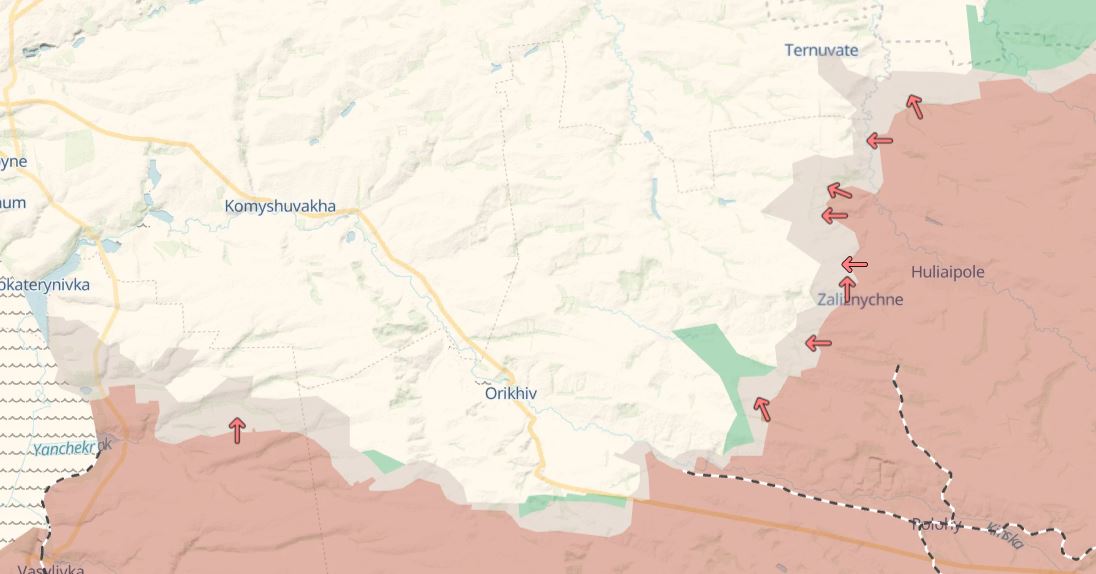
West of Huliaipole, the Russian army continues to advance, creating a threat to the flank of the Orikhiv fortified area. Russian forces are preparing to storm Orikhiv and are already attempting to penetrate the city. Thus, the Ukrainian counteroffensive slowed the Russian advance in the south but did not stop Russia’s offensive in the Zaporizhzhia region.
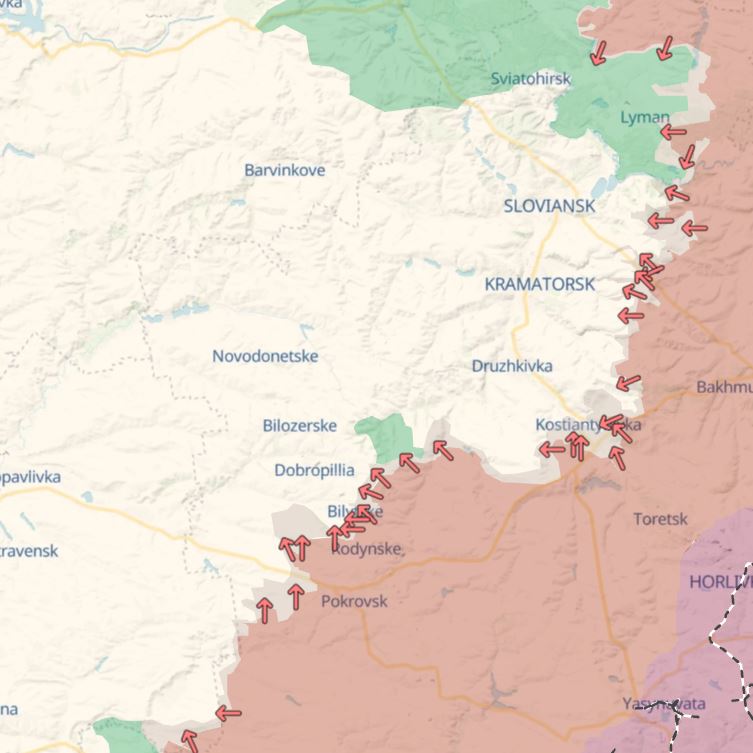
In the Donetsk region, the most difficult situation remains around Kostiantynivka, Dobropillia, and on the approaches to Kramatorsk and Sloviansk. There remains a high risk of losing Kostiantynivka, while fighting for Dobropillia has begun. In the Kharkiv region, fighting continues in the Kupiansk area. On these fronts, the front line is changing slowly, but the intensity of the fighting and the use of drones remains high.
A separate crisis zone for the Armed Forces of Ukraine remains the northern border areas of the Kharkiv and Sumy regions, where the threat of local breakthroughs persists, cross-border clashes continue, and massive Russian shelling remains ongoing.
According to Deputy Head of the Office of the President Pavlo Palisa, Ukrainian intelligence has information that the Russian military leadership has been tasked with preparing plans for offensive operations in the direction of Kyiv and Chernihiv. At present, Russia does not have sufficient available reserves to carry out such an operation. However, by 2028, the necessary forces could be formed through additional mobilization, expanded military production, and the accumulation of personnel, creating a long-term threat of a renewed offensive in northern Ukraine.
Maps of combat operations.
(According to Deep State map)
Donetsk region.
Zaporizhzhia region.
Ruslan Bortnik, Oksana Krasovskaya
for the Ukrainian Institute of Politics
Friends, we remind you that additional analytical products of the Ukrainian Institute of Politics are available for organizations, businesses, and private clients: Weekly Intelligence Brief, Geopolitical Risk Reports, Executive Briefings, as well as special analytical materials and forecasts upon individual request. For additional information, please contact us at: uiamp2012@gmail.com or by phone: +38 (093) 757-75-65.