The conflict in the Middle East continues to set the tone for the entire world geopolitics, primarily in terms of the state of oil and gas markets and, as a result, the price situation in the world, and, in particular, in Europe and Ukraine. One of the main factors of strategic tension in the region remains the vulnerability of key transport and energy routes, primarily the Strait of Hormuz. At the same time, the war in Iran became a manifestation of growing divisions within the Western camp of the Allies. European countries have rejected US President Donald Trump's call for military escorts for ships in the Strait of Hormuz.
Against the backdrop of the war in Iran, negotiations on Ukraine have actually stalled, President of Ukraine Volodymyr Zelenskyy announced a new round of consultations between the Ukrainian delegation and the American side in the United States on March 21. The Kremlin made it clear that the Russian side would not participate in these meetings, that is, we are talking about a bilateral American-Ukrainian format. After the previous rounds, the strategic positions of the parties have not converged, and the key dispute still rests on the territorial issue, on the Russian demand for the Donetsk region, which Ukraine rejects. Moscow, judging by public signals, proceeds from the fact that further movement depends on the ability of the United States to convince Ukraine to make more painful compromises.
Conflict in the Middle East.
The Iranian side announced that the Strait of Hormuz is closed to tankers and ships belonging to the opponents (the United States, Israel and their allies). Iran also began to charge a fee for passage through the Strait of Hormuz. At least nine tankers passed near the Iranian island of Larak within range of the IRGC naval forces. In one case, the ship's operator paid about $2 million for permission to pass through the strait.
US President Donald Trump reacted emotionally to Iran's actions. "It's not even fair on their part. We have already won! They have no right to continue what they are doing," Trump said.
About 20-21 million barrels of oil per day (about 20% of world consumption) pass through the Strait of Hormuz . Due to the blockade, supplies have significantly decreased, which threatens to increase prices for oil and diesel fuel. Brent oil prices have risen sharply, exceeding $100-110 per barrel. In monetary terms, due to the closure of the strait, the flow of energy resources worth about $1-1.3 billion per day is under threat, not counting indirect effects in the form of rising prices, insurance costs and market destabilization.
Donald Trump's attempt to turn the crisis around the Strait of Hormuz into a test of allied loyalty has shown that in a conflict in the Middle East, the closest partners of the United States are not ready to automatically follow Washington. Allies have effectively rejected US President Donald Trump's call for military escorts for ships in the Strait of Hormuz. The United Kingdom, France, Germany, Italy, the Netherlands, Japan and Canada limited themselves to a joint statement in support of freedom of navigation and condemnation of Iranian attacks, but without commitments to direct military participation. Germany took an even tougher stance: Defense Minister Boris Pistorius bluntly stated that Germany "is not a party to this war" and the Bundeswehr will not participate in it.
NATO Secretary General Mark Rutte said that the military alliance is discussing with its allies how to reopen the Strait of Hormuz. But Italian Prime Minister Giorgia Meloni said that the issue of sending a mission to the Strait of Hormuz while the war is going on is not being considered. As a result, Washington finds itself in a situation where it is forced to either act alone or reduce its level of ambition.
The prolongation of the Middle East crisis is beginning to acquire a pronounced domestic political dimension for US President Donald Trump on the eve of the congressional elections in the fall of 2026. The war in Iran not only failed to bring quick foreign policy victories, but also increased pressure on key socio-economic indicators within the United States. The joint operation of the United States and Israel against Iran creates the risk of a split within the Republican camp itself (between the representative of MAGA and the more conservative wing of the Republicans). Although Trump's actions in Iran are still approved by a majority (about 76-77%) of Republicans, according to a YouGov poll, the issue of Iran has not yet brought political dividends to Trump: 36% approve of his actions in the Middle East, while 56% oppose it. The overall level of approval of Trump's activities is only 38%, while 59% Americans do not support it. The economic agenda remains especially sensitive: the net approval rating of the president's economic policy dropped to -29%, which is the worst indicator in the history of observations. The cost of living remains the most critical zone, with the level of disapproval reaching 67% with only 26% support.
An additional pressure factor is the rise in fuel prices. Since the beginning of the escalation in late February, the average price of gasoline in the United States has increased by about 30%, or about 84 cents per gallon, reaching $3.79-3.8 per gallon, the highest since the fall of 2023. This directly increases inflation expectations and hits electoral sentiment, especially at a time when the economic agenda remains key for American voters.
In this logic, prolonging the conflict objectively works against Trump, creating an "expensive crisis" for him within the country. The Pentagon has asked the White House to approve a request to the US Congress for more than $200 billion to fund the war. In the first weeks, the United States has already spent from 20 to 25 billion dollars on the war in Iran.
Despite the fact that Donald Trump has consistently positioned himself as the "president of peace," the Middle East conflict has already directly affected the United States through the deaths of American military personnel and the growing risk of deeper military involvement. The United States has begun deploying additional forces to the Middle East and is simultaneously considering sending thousands more troops to expand military operations in the region. For Trump, this is a politically toxic situation that will negatively affect the electoral support of his team in the run-up to the congressional elections.
Apparently, Tehran also understands the combination of risks for Trump , which is interested not in a rapid escalation, but in a controlled prolongation of the conflict, which makes it possible to increase economic and political pressure on the US administration. Iran demands reparations from the United States and the withdrawal of American troops from the Persian Gulf countries as a condition for ending the war in the Middle East Middle East and has already moved to implement this threat, striking at the Qatari Ras Laffan complex, the world's largest center for the production of liquefied natural gas. The attack led to disruptions in the Qatari LNG sector.
Thus, the war in Iran threatens to become protracted, which in turn will cause a large-scale global energy crisis, as well as a shortage of air defense missiles, including for Ukraine, which, in general, plays into the hands of Moscow.
The energy crisis in Europe may provoke sentiment in favor of a partial easing of anti-Russian sanctions. Belgian Prime Minister Bart De Wever, according to the Financial Times, called on the EU to start negotiations with the Russian Federation not only to end the war in Ukraine, but also to normalize bilateral relations in order to regain access to cheaper oil and gas. At the same time, within Belgium itself, this position has been criticized: Foreign Minister Maxime Prévost opposed it, and European Commissioner for Energy Dan Jorgensen confirmed that the course to abandon Russian energy remains in force.
At the current stage of the Middle East War, Moscow is interested in avoiding a direct public escalation with Washington, especially given the relatively more flexible line of the Donald Trump administration, which seeks to maintain dialogue with Russia and at the same time weaken its strategic rapprochement with China, as well as with Iran. Russia can support Iran only to the extent that it does not lead to a direct confrontation with the United States and does not worsen its own negotiating position on Ukraine and a huge range of American-Russian issues. The same applies by and large to China's support – it is possible primarily as long as it does not create significant risks of a direct clash with the West. Such support is expressed primarily in political rhetoric, diplomatic support at international venues, criticism of the actions of the United States and its allies, as well as in certain forms of economic and technological interaction. At the same time, we are talking more about indirect or hard-to-track forms of cooperation, for example, the supply of dual-use goods, critical resources, logistics support or financial schemes. Therefore, in March 2026, the Russian Federation officially expressed solidarity with Iran, condemning the strikes of the United States and Israel, but maintained cautious rhetoric. Russian officials, including representatives of the Foreign Ministry and the Security Council of the Russian Federation, criticized the actions of the United States, calling them "unfair" and called for a diplomatic solution, but the Kremlin avoids open military involvement. The Russian Federation has assured the United States that it does not transfer intelligence to Iran. At the same time, the so-called "axis of evil" of the Russian Federation-Iran-China cannot be considered monolithic, since each element in it acts solely on the basis of its national interests. And the level of mutual support between these countries may vary depending on the specific international situation and the balance of benefits. So far, it brings more political and economic bonuses than risks.
Ukraine seeks to use the Middle East crisis as a window of opportunity to increase its own subjectivity and usefulness for Western allies.
Ukraine's role in the Middle East crisis looks indicative against the backdrop of Washington's ambivalent position. On the one hand, the Trump administration is not interested in publicly emphasizing dependence on Ukrainian aid, since Ukraine itself remains a difficult and unfinished conflict for the United States, from which the White House seeks to politically distance itself. US President Donald Trump said on March 13 that the United States does not need Ukraine's help to shoot down Iranian drones in the Middle East.
But on March 20, President of Ukraine Volodymyr Zelensky said that Kyiv had received a request from the United States to provide expert support for the American military in the Middle East and the Persian Gulf. Also, according to him, similar requests are being worked out from European partners whose forces are deployed in the Middle East.
During a visit to the UK, Zelensky said that Ukraine had already sent military experts to the Middle East to counter Iranian drones. 228 Ukrainian air defense specialists have been working in Qatar, the UAE and Saudi Arabia for more than a week, helping to shoot down Iranian drones, Zelensky reports. They are also working with Kuwait and Jordan.
According to V. Zelensky, Ukraine is capable of producing at least 2 thousand interceptor drones daily. It is possible to produce more – but it depends on investment. Ukraine needs about 1000 interceptors per day, and we can export at least another 1000 per day to our allies.
Zelensky is actually demonstrating to the West that Ukraine is not only a recipient of aid, but also a country capable of exporting new technologies and competencies in the field of modern warfare. This increases Kiev's international subjectivity, but at the same time emphasizes a new asymmetry: Ukraine, itself in a state of protracted war, is forced to provide useful services to the United States and its partners even where Trump's Western allies themselves are acting much more cautiously.
Peace talks on Ukraine.
Against the backdrop of the war in the Middle East, negotiations on Ukraine have actually stalled, Volodymyr Zelensky announced a new round of consultations between the Ukrainian delegation and the American side in the United States on March 21.
It is preliminary known that from the Ukrainian side, Kyrylo Budanov, head of the Office of the President of Ukraine, Rustem Umerov, Secretary of the National Security and Defense Council of Ukraine, David Arakhamia, head of the Servant of the People parliamentary faction, as well as Serhiy Kyslytsya, First Deputy Minister of Foreign Affairs of Ukraine, will participate in the negotiations.
The Kremlin, through the press secretary of the President of the Russian Federation Dmitry Peskov, made it clear that the Russian side would not participate in these meetings, that is, we are talking about a bilateral American-Ukrainian format, and not about a full-fledged continuation of the trilateral track.
After the previous rounds, the strategic positions of the parties have not converged, and the key dispute still rests on the territorial issue, primarily on the Russian demand for the Donetsk region, which Kiev rejects. Against this background, Moscow, judging by public signals, proceeds from the fact that further movement depends not so much on it as on the ability of the United States to convince Ukraine to make more painful compromises. demonstrating that Washington considers the Ukrainian position to be the main obstacle to advancing the process. Trump criticized Zelensky again. According to him, it is "much more difficult to make a deal" with him than with Putin. "I am surprised that Zelensky does not want to make a deal. Tell Zelensky to make a deal because Putin is ready to make a deal. It's much harder to make a deal with Zelensky," the U.S. president said in an interview with NBC News. Trump also declined to comment on whether the U.S. had accepted Ukraine's assistance in drone interception technology.
Therefore, the main point of the meeting on March 21, most likely, will not be an attempt by the United States to separately discuss with Kiev the limits of possible concessions and understand what tools of pressure or persuasion the White House is ready to use further. The next stage of negotiations will depend on this: whether the process will remain in a protracted pause mode or Washington will try to force it through tougher bilateral work with the Ukrainian side.
At the same time, the Ukrainian side will seek to build negotiations in such a way as to prevent the United States from fixing strict and formalized obligations for Ukraine on any specific concessions, primarily territorial. Ukraine's tactics in this configuration are likely to be to maneuver between a willingness to continue dialogue and a reluctance to move on to legally or politically irreversible solutions. In other words, Kiev will try to buy time, translate the discussion into more general formulas and avoid such agreements that could then be presented as an already agreed Ukrainian position.
German Chancellor Friedrich Merz, in his speech to the Bundestag, demanded that Trump have a place for Europe at the negotiating table on Ukraine.
Merz called it "unacceptable" that the United States and Russia will decide the future of Ukraine "over the heads of Ukrainians and Europeans." "I also told the American president that from the very beginning we will sit at the table and negotiate about what the security guarantees for Ukraine can be," he said.
The European Union has not participated in all recent rounds of peace talks on Ukraine. Merz himself had also previously opposed negotiations with Russia.
Parliamentary crisis in Ukraine.
In Ukraine, the parliamentary crisis continues to deepen, which is increasingly affecting the manageability of the entire political system. President Vladimir Zelensky's half-joking phrase about sending deputies who do not want to work to the front was indicative. "There may be different desires and different attitudes towards them, but we have martial law and we need to defend our state. And therefore, MPs will either have to serve in parliament in accordance with Ukrainian legislation, or I am ready to discuss with representatives of parliament the law on changes in mobilization so that deputies can go to the front," Zelensky said.
While this was largely figurative and politically demonstrative rhetoric, it reflects the growing tension between the Office of the President and the Verkhovna Rada. In practice, it is impossible to implement such a scenario without changes in the legislation on mobilization, which means without the votes of the people's deputies themselves, which makes such an idea virtually unrealizable.
In fact, Zelensky is trying to solve another problem in this way – to distance himself from the failures of the bills necessary for cooperation with the IMF, and to show that the Parliament is acting contrary to the interests of the President. This is all the more convenient since the Verkhovna Rada remains an extremely unpopular institution, and deputies are increasingly acting as "whipping boys", on whom it is convenient to shift responsibility for failures in public administration. At the same time, it is the current, protracted convocation of parliament that is probably the most powerless and limited in its influence in the entire history of Ukraine.
According to estimates, from 100 to 140 deputies are involved in various investigative cases, more than 10 are in prison, and about 60 deputies would allegedly like to leave parliament ahead of schedule, although the real scale of disappointment is likely to be even higher. vote, as well as an unwillingness to take responsibility for toxic and unpopular decisions, primarily related to tax increases and other painful reforms.
That is why in recent weeks there have been signs of a protracted blocking of the work of the Verkhovna Rada and a kind of parliamentary "strike", which is already threatening the normal functioning of certain state institutions. Nevertheless, despite signs of the collapse and degradation of the parliamentary majority, issues of a strategic and patriotic nature – including the extension of mobilization and martial law – are likely to be supported. In other words, the parliament is less and less able to vote on complex political and socially toxic decisions, but so far it retains the ability to make the most basic decisions for the functioning of the state and war.
The parliamentary crisis is increasingly shifting from a purely political to a fiscal one. The inability of the Verkhovna Rada to vote directly begins to threaten the sustainability of Ukraine's external financing. First of all, we are talking about the fulfillment of IMF conditions, since it is the adoption of tax and institutional measures agreed with the Fund that remains one of the prerequisites for the continuation of the financing program.
The IMF, in the updated EFF program, has directly fixed a structural beacon for Ukraine: to adopt a package of tax measures for 2026-2027 by the end of March, as well as to appoint a new permanent head of the State Customs Service.
The day before, the Rada had already failed one of the key bills of this package - No14025, which concerned the taxation of income received through electronic (digital) platforms.
Now the Ministry of Finance has presented a broader large tax package that should replace failed decisions and signal to the IMF that the authorities are ready to fulfill their obligations.
According to the discussed version of the package, from January 1, 2027, it is proposed to introduce mandatory registration of individual entrepreneurs as VAT payers if their annual turnover exceeds UAH 4 million; expand the taxation of digital platforms such as OLX, Bolt, Uber and others, where the income of individuals should be taxed at about 10% (5% personal income tax + 5% military fee), and the platforms themselves will transfer data to the tax authorities; to cancel the previous exemption for parcels from abroad, leaving the VAT exemption only for purchases up to 45 euros instead of the previous 150 euros; And also to maintain the military tax in the amount of 5% after the end of martial law. In addition, the expansion of income control through special accounts and tax access to data, as well as new rules for individual entrepreneurs of different groups, are being discussed. The main part of the norms should come into force from 2027, although some provisions may come into force as early as November 2026.
EU leaders failed to unblock 90 billion euros of loan to Ukraine.
EU leaders have not yet been able to finally unblock the €90 billion aid package for Ukraine, as Hungary, led by Prime Minister Viktor Orban, with the support of Slovakia, continues to link the coordination of this decision with the restoration of stable oil supplies through the Druzhba pipeline. The current tough position of Viktor Orban has not only a foreign policy, but also a pronounced domestic political logic, parliamentary elections are to be held in Hungary in April. In this configuration, the link between assistance to Ukraine and the launch of Druzhba is addressed primarily to his own electorate: Orban seeks to show himself as a politician who does not "give money to Kyiv", but bargains hard with Brussels and protects Hungarian energy interests. That is, the formula "90 billion in exchange for oil" works as an element of Orban's pre-election campaign within Hungary itself.
Against this background, the European Commission is already making it clear that it will look for workarounds or alternative procedures if Hungary continues to delay the process. The head of the European Commission, Ursula von der Leyen, has already publicly made it clear that Brussels will look for a workaround mechanism if Budapest continues to block the process. After the summit, she said that the EU would still find a way to provide the €90 billion promised to Ukraine, and European Council President António Costa called Hungary's behavior unacceptable.
The European aid package of about 90 billion euros (military and financial components combined), which is equivalent to about 45 billion euros per year, covers most of the budget deficit (about 50-55 billion dollars). The rest of the financing should be covered by the programs of the International Monetary Fund, other international organizations and individual states. financing for the period 2026-2027 is 135.7 billion euros, provided that Russia's war of aggression ends in 2026.
Maintaining European and broad Western financial support is a key task for the Ukrainian Government. The United States is no longer perceived as the main donor, and Kiev proceeds from the fact that under Trump, the stake is primarily on Europe. Washington is no longer perceived as a source of large-scale and unconditional support in the same volumes. In the Ukrainian perception, the United States remains an important political partner and military-strategic player, but no longer the main financial guarantor of the country's stability. Against this background, it was Europe that became Kyiv's first external financier and the main anchor of macro-financial stability.
Course of hostilities.
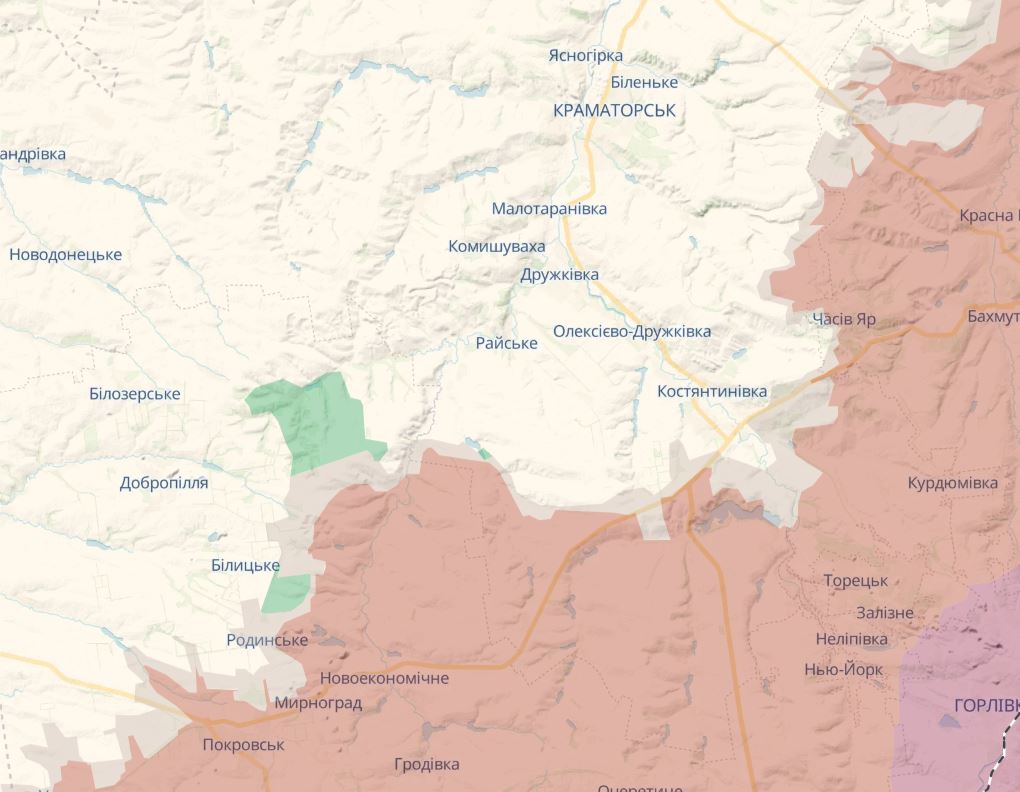
This week, after a short pause, Russian troops gradually began to resume the current offensive, starting the spring-summer campaign. So in a week, the Russian Federation captured almost 30 more square kilometers. Ukrainian territory. In total, 116,600 square kilometers (19.3%) have now been captured.
In recent weeks, there have been no large-scale offensive Russian operations. Now Russian troops have problems with the controllability of units after restricting access to some of the Starlink systems, which temporarily complicated their coordination.
At the same time, the Russian army continues to advance in certain directions - for example, west of the city of Gulyaipole in the area of the village of Zheleznichnoye in the Zaporozhye region, as well as west of the village of Poddubny in the Donetsk region (south of the village of Ivanovka), as well as in the area of Pokrovsk (Grishino district) and in the area of the Slavyansk-Konstantinovskaya agglomeration and Lyman in the Donetsk region.
Ukraine, for its part, carried out several local counterattacks - on the border of the Zaporizhzhia-Dnipropetrovsk regions - in the area of the village of Ternovate, near the border of the Dnipropetrovsk and Donetsk regions near the village of Ivanivka, in the south in the direction of Gulyaipole (Zaporozhye direction), as well as in the area of Pokrovsk (Donetsk region).
Ukrainian counteroffensive actions are more tactical in nature and are mainly aimed at clearing the "gray zones" and leveling the front line. These seepage zones, where there was no stable control before, are gradually narrowing, including due to the withdrawal of individual units or their regrouping closer to their base positions. During these counterattacks, not a single large settlement was liberated - even large villages in these areas remain outside the stable control of the Ukrainian side.
The Ukrainian army is now partially outperforming the Russian army in terms of unit control speed thanks to the use of Starlink and American communication systems. This difference is also noticeable in the effectiveness of the use of drones: many Russian drones also used Starlink terminals, and disabling them reduced the effectiveness of Russian strikes. As a result, the Russian army is experiencing a tactical crisis in command and communication suspend Russian offensive operations and limit deep penetrations of Russian units in several directions (the border of the Zaporizhzhia and Dnipropetrovsk regions, as well as partially on the border of the Dnipropetrovsk-Donetsk regions).
Map of hostilities.
Donetsk region.
Sociology.
According to the data of March 1-8, 2026 of the Kyiv International Institute of Sociology (KIIS), as of early March, trust in President V.Zelensky returned to previous indicators and amounted to 62% (in February 2026 it was 53%). The level of distrust was 32% (41% in February), and the balance of trust-distrust was +30%.
Only 12% of Ukrainians (10-12% during 2025) believe that elections should be held even before the end of hostilities. Another 13% believe that elections can be held after a ceasefire and security guarantees. Compared to December 2025, the share of such people has decreased from 23%. That is, there are even fewer of those who were held after the truce with security guarantees.
From December 2025 to March 2026, from 59% to 69%, there are now more of those who believe that elections should be held only after the final peace agreement and the complete end of the war.
Between the end of January and mid-February 2026, there was a significant decrease in the share of those who are ready to endure the war for as long as necessary. If at the end of January there were 65% of them, then in mid-February it was already 52%. In March 2026, we asked this question again to understand whether the trends will continue.
As you can see, the survey in March confirms the identified negative dynamics, but without further deterioration (at least for now). 54% of Ukrainians are ready to endure the war as long as necessary. At the same time, 28% of citizens talk about a shorter period (several months to half a year).
The vast majority of Ukrainians – 71% – do not believe that the current negotiations will lead to sustainable peace in Ukraine. 25% believe.
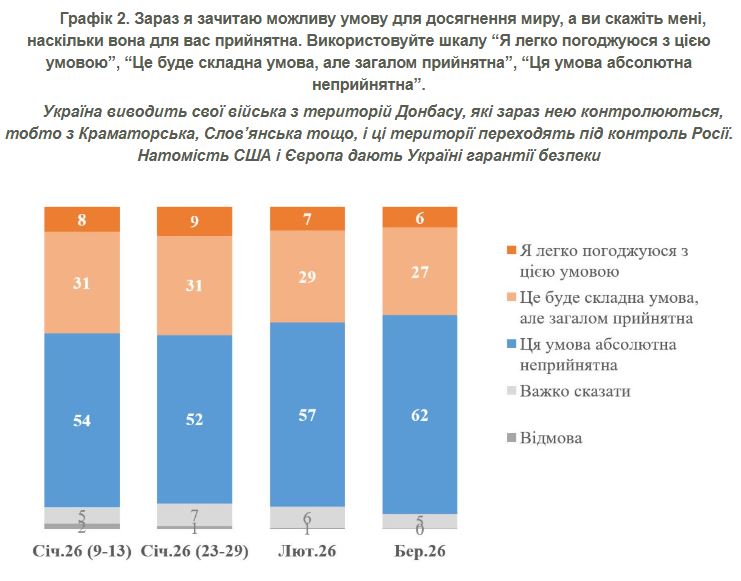
62% of respondents consider it categorically unacceptable to transfer the entire Donbas under Russia's control in exchange for security guarantees. At the same time, 33% are ready for such a concession (although most of them admit that this is a difficult condition). Another 5% could not decide on their opinion.
Compared to mid-February 2026, from 57% to 62%, there were a little more categorically against. The share of those who agreed in February is 36%, now it is 33%.
In general, society in Ukraine demonstrates a paradoxical combination:
Growing trust in the authorities, a decrease in readiness for compromise scenarios, and at the same time, war fatigue is progressing. That is, the political window for negotiations remains extremely narrow: Ukrainians are still ready to wait, but they do not want temporary solutions, but a final and sustainable result.
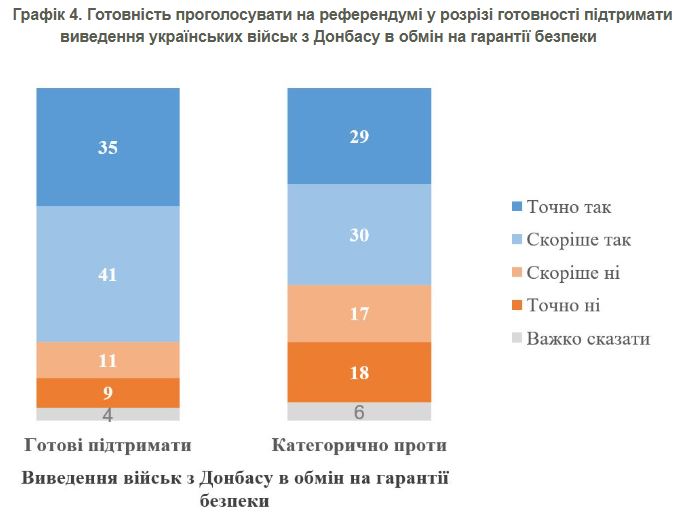
A relative majority of Ukrainians support the idea of holding a referendum. Although there is a trend towards a worsening attitude towards this idea. So, compared to mid-January 2026, there are fewer supporters of such an initiative from 55% to 50%.Since January 2026, KIIS has been asking whether Ukrainians are ready to withdraw troops from Donbass in exchange for security guarantees from the United States and Europe. The latest published results relate to the period up to mid-February 2026, and according to them, 57% of Ukrainians considered such a proposal categorically unacceptable. At the same time, 36% were ready to approve it (although mostly reluctantly). The idea of a referendum much more supported by those who are already ready to approve the withdrawal of Ukrainian troops from Donbass in exchange for security guarantees. Among them, 71% have a positive attitude towards the idea of a referendum (25% are against). Among those who are categorically against such a proposal on Donbass, 39% support the idea of a referendum, 48% are against, and 13% have an uncertain attitude. 31% of respondents answered that they would definitely take part in the referendum if it were held. Another 33% answered that they would rather take part. That is, a total of 64% express their readiness to vote, although only half of them are firmly going to do so. A third of respondents (30%) noted that they would rather or definitely not take part in the voting.
Those respondents who are ready to support the withdrawal of Ukrainian troops from Donbass are more ready to vote in the referendum. Yes, 35% of them are definitely ready to vote, 41% are rather ready to vote (76% in total). Among those who are categorically against such an "agreement", 29% will definitely vote and another 30% are more likely to vote (a total of 59%).
The positive or negative result of the referendum largely depends on the wording of the question. With a "correctly" constructed text, it is possible to significantly influence the perception of voters. Sociology shows that the majority of Ukrainians reject the withdrawal of troops from the Donbass in exchange for security guarantees, especially in conditions where guarantees from the United States do not look convincing. However, if sensitive elements are not directly emphasized or "packaged" in positive language, the likelihood of receiving approval in a popular vote increases significantly.
As part of a conditional experiment, KIIS offered the following version of the question: "Do you support the establishment of peace by approving an agreement with the United States and Europe, which provides: Ukraine's membership in the EU in 2027, territorial compromises, reliable security guarantees and an economic recovery plan?» The wording is built around positive emphases – peace, early accession to the EU, reliable guarantees and economic recovery. At the same time, the potentially painful aspect – "territorial compromises" – is vaguely and without specification. As a result, the issue formally describes the parameters of the peace agreement, but contains elements of inaccuracy and can be viewed as manipulative.
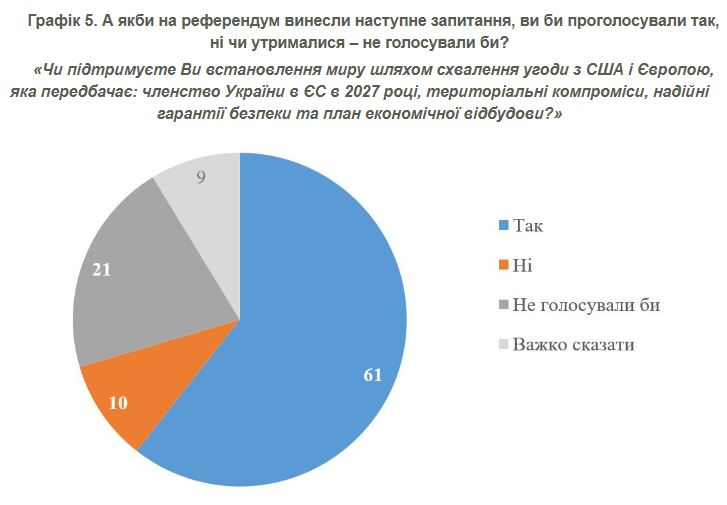
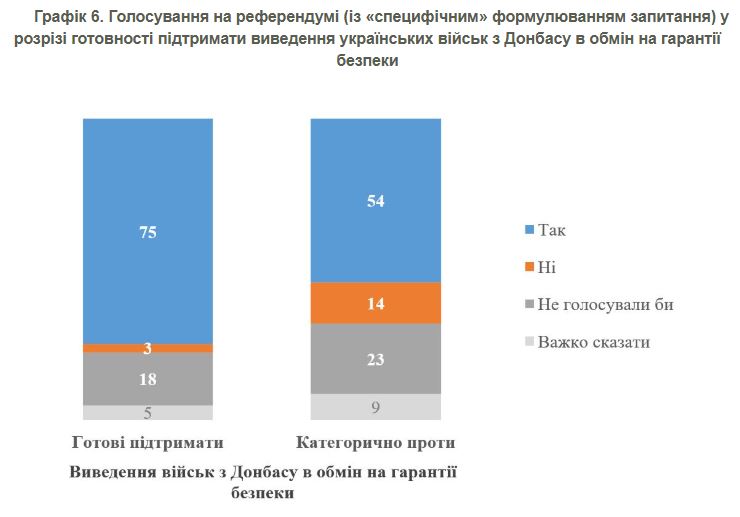
According to the data of such modeling, 61% of respondents would be ready to vote "for", 10% - "against", the rest were undecided or did not plan to participate. If we recalculate the result only among those who would come to vote, the share of support would be about 86%, and against - 14%. It is noteworthy that even among those who are categorically against the exchange of Donbass for security guarantees, 54% would be ready to vote "for" in the context of such a wording. And only 14% are against.
Ruslan Bortnik, Oksana Krasovskaya
for the Ukrainian Institute of Politics