The "besieged fortress" regime as the basic strategy of Ukraine until the fall of 2026
Ukraine is actually moving to a model of strategic defense - both at the front and in the foreign policy circuit. This means simultaneously containing Russian pressure on the front line, primarily in the Donbas, and US pressure on the negotiation track. In fact, the "besieged fortress" mode is turned on. The President of Ukraine directly designated this period as difficult: until September, the country will be under increased military and diplomatic pressure. At the same time, he does not demonstrate readiness for fundamental concessions - in particular, to discuss the withdrawal of troops from Donbass or to quick compromises within the framework of peace negotiations.
The time horizon of this strategy is not accidental. It is directly tied to internal dynamics in the United States: until the fall, when the United States will be completely absorbed in the congressional elections. Zelensky, apparently, still expects that after the "American political fork" there may be a window of opportunity - primarily due to the strengthening of the role of the Democrats in Congress and their possible pressure on the Trump administration to restore part of the aid to Ukraine. as early as August, the United States may withdraw from the negotiation process. This further strengthens the logic of the current period as a phase of waiting and containment, in which Ukraine relies not on quick peace agreements, but on maintaining stability until the intra-American balance changes.
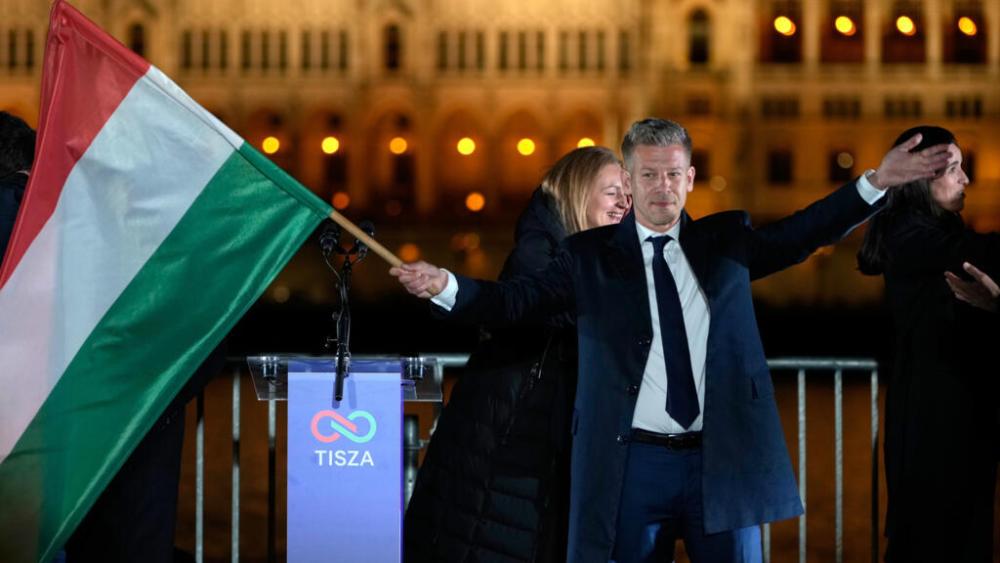
The defeat in Hungary of the party of the incumbent Prime Minister Viktor Orban and the victory of opposition leader Peter Magyar looks like a tactical gain for Ukraine. First of all, this means the potential unfreezing of a loan of €90 billion by the EU, as well as the unblocking of a number of decisions on European integration, which were previously systematically slowed down by Budapest. However, the situation is not unambiguous: Magyar himself opposes the accelerated accession of Ukraine to the EU, against the supply of weapons and insists on the return of frozen funds from the EU budget to Hungary. This means that bargaining between the new Hungarian leadership and Brussels is inevitable ahead, and its outcome is not yet obvious.
Nevertheless, this event weakens the positions of both US President Donald Trump in Europe and Russian President Putin, since Orban was one of the key points of support within the EU for them, through which it was possible to influence Brussels' decisions and block individual initiatives. is becoming more consolidated in support of Ukraine, but at the same time more inclined to a tough confrontation with both Moscow and Washington. This forms a new configuration: neither Trump nor Putin has any real tools to influence the EU from within. Accordingly, it is less likely that Europe will be ready to support Trump's peace initiatives on Ukraine. Against this background, the risks of exacerbation of transatlantic contradictions are increasing. The situation in the Middle East remains an additional factor here. Against the backdrop of unsuccessful negotiations, the United States is increasing pressure in the region, including the formation of a second contour of the blockade of the Strait of Hormuz. The apparent disadvantage of getting bogged down in the Iran conflict further undermines Trump's foreign policy credibility, both globally and in Europe in particular. Under these conditions, the logic of the "wait-and-see strategy" is strengthening for Ukraine - continuing the course of "waiting out Trump", minimizing concessions and maintaining the current line until the political balance in the United States changes.
Until autumn, we should hardly expect serious changes in the political course of Ukraine. The space for political dialogue and compromise remains extremely narrow. The negotiation process is likely to continue to be reduced to secondary issues without reaching meaningful agreements, gradually fading away.
The Ukrainian authorities are betting on waiting and strengthening European support. The key line is strategic patience until the elections to the US Congress, with a parallel stabilization of the internal system of governance and attempts to form new military-political alliances in Europe.
Within the country, the policy of strengthening fiscalization, tightening control and mobilization processes, as well as making decisions that are unpopular with society and necessary to obtain external funding will continue. The situation in the Parliament will remain unstable, but so far relatively manageable.
At the front, further pressure from Russian troops is expected, which will push Ukraine towards a tougher defensive model. The most vulnerable areas remain the Donetsk region (the areas of Pokrovsk and Kostiantynivka), the Zaporizhzhia direction (the Gulyaipole area), the border area of the Sumy region, as well as the Kupyansk area in the Kharkiv region, where there is a high probability of an increase in the offensive activity of the Russian Federation.
The "Besieged Fortress" regime is a transition to strategic defense at the front and in international relations.
We are talking about the double logic of deterrence: repelling Russian pressure in the Donbas and US pressure on the negotiation track. Last week, President Volodymyr Zelenskyy directly indicated that the country is facing an extremely difficult period: Ukraine is entering a phase of increased pressure - military and diplomatic - until September, and in August the United States may withdraw from the negotiations. "In my opinion, these people are definitely not ready to end the war... But if Russia chooses the path of de-escalation, then I believe that the trilateral meeting will take place. And they will try to hold it in April, May or June. I think these are the key months for them. And I think that it will be very difficult for us until September. This period of spring and summer will not be easy, both politically and diplomatically. There may be pressure on Ukraine. And it will also be on the battlefield," Zelensky said.
The president also directly indicates that if the pressure does not yield results, the United States may withdraw from it before the congressional elections. At the same time, a resource problem is also recorded - a shortage of Patriot air defense missiles. According to Zelensky, deliveries continue, but much slower than required.
Separately, he denies the possibility of territorial concessions to Ukraine in the Donbass, pointing not only to military, but also to political and social consequences: "Our withdrawal from Donbass opens up opportunities for the Russian Federation to occupy our most protected territories without losses. Someone says that it takes a year and a half to build new fortifications. But everyone forgets: first of all, it is a year and a half. And even if it is smaller, any fortifications in the field, and not in urban buildings, are completely different things. It can never be such a strong defense.
The exit opens up space in the Russian Federation for big maneuvers. They can go both to Kharkov and to the Dnieper, destroying our cities. And two big cities will be under threat, which, by the way, generate most of our GDP. So many people died there... The moral state of our army will definitely deteriorate. There will definitely be a split in society. The army, which, of course, will not support such steps, individually – society individually. And the disunity of society is what Putin's main goal is. In addition, now 200 thousand people live in the territories of Donbass that we defend. Going out does not mean saving something. You have turned out and without any guarantees, you can lose everything. And this is a great risk.»
At the same time, Zelensky emphasizes that he maintains a direct channel of communication with Donald Trump, despite public criticism from the United States. Zelensky said that he is one of the few people who tell US President Donald Trump what they think. He called his relationship with Trump good.
"Who has a better relationship with Trump than me? I think we have a good relationship because I'm one of the few people who tells him what he thinks. Few people can tell the US president that he is not always right," the Ukrainian leader said. Thus, Ukraine simultaneously maintains a tough position on key issues (primarily Donbass) and makes it clear that it maintains working contact with Washington, despite increasing pressure and criticism from the American administration.
Political maneuvers around the Easter truce only increase the sense of degradation of the peace process.
The trilateral format of the US-Ukraine-Russia negotiations continues to be on pause after its postponement due to the Middle East crisis: at this stage, first of all, bilateral contacts between Washington and Kyiv and Washington with Moscow continue.
The Easter cease-fire was initially seen as part of a broader diplomatic combination: a short-term truce would be followed by a meeting of the parties to negotiate a framework agreement for a 30-day ceasefire. However, the negotiations failed. Ukraine insisted on an energy and logistical truce to protect infrastructure, while Moscow offered a limited option - a short-term geographical ceasefire along the front line. As a result, the parties limited themselves to unilateral steps: Russia announced a truce for 32 hours, Ukraine mirrored it, but without reference to Russian conditions.
Against this background, uncertainty remains with the American negotiation track. President of Ukraine Volodymyr Zelensky said at a press conference with Norwegian Prime Minister Jonas Gahr Støre in Oslo that Kyiv has not yet received confirmation of the visit of US Special Presidential Envoys Steve Whitkoff and Jared Kushner: "No, we have not received any confirmation when they will arrive. They told me at the very beginning of April... It was a positive conversation between us and they confirmed that they would come." He also stressed the political significance of such a visit: "I think it is fair that they come to us because they have been to Moscow many times, and it is also important to give such a signal to our society, which survives, and therefore we are waiting for them."
Earlier, the Ukrainian President invited the American negotiating delegation to Kyiv for discussions on ending the war.
At the same time, Zelensky demonstrates increasingly harsh rhetoric against the American side, directly pointing to a distorted perception of the Russian position. He said Whitkoff and Kushner had "spent too much time" with Putin and trusted him, which prevented the Trump team from "really understanding what Russia wants."
Responding to the remark of US Vice President J.D. Vance that the negotiations are reduced to "bargaining for a few square kilometers," Zelensky stressed: "In part, the Americans believe that [Donbass] means nothing to us," while adding that we are talking about strategically important territories, and Russia will not stop, but can move on - in the direction of the Dnieper and Kharkiv. Separately, he emphasized the problem of trust: "I spoke about it publicly. Have we heard the reaction of the United States to Russia demanding an end to this? The problem is that they trust Putin. And it's a pity." Vance himself was also criticized: "The vice president, with all due respect, did not take part in the negotiations. I think that if he did, he would have a better understanding of what a piece of land is and what is the real territory of Ukraine... So far, Ukraine does not have strong security guarantees to talk about other steps." In this logic, Zelensky again raises the issue of long-term security guarantees, including the military presence of allies:
Zelensky directly says that he wants to achieve the deployment of US and European military bases in Ukraine as part of post-war security guarantees. "If we are talking about reliable security guarantees, then this means that we need appropriate air defense systems ... I believe that if there is an American military base in Ukraine or a joint base of America and Europe, then we will have fewer risks." Recall that from the security guarantees discussed at the talks, it is said that the United States can give Ukraine obligations equivalent to Article 5 of NATO. At the same time, the deployment of the American military on the territory of Ukraine was not openly discussed. The Russian Federation continues to oppose any troops of NATO countries in Ukraine. The negotiation process remains fragmented and unstable, and the positions of the parties diverge.
Unstable balance in the Parliament, the Tymoshenko case and dissonance in the Ukrainian leadership.
The parliamentary crisis is gradually being partially stabilized, which is largely the result of a situational link between the head of the Servant of the People faction David Arakhamia and the head of the President's Office Kyrylo Budanov. The key task is to restore the manageability of the Verkhovna Rada and ensure the fulfillment of obligations to donors (IMF, EU, World Bank) to unblock funding.
In particular, a number of bills aimed at fulfilling these conditions have recently been adopted. Among them are changes in tax legislation, including the taxation of digital platforms (such as OLX), as well as the abolition of the exemption for duty-free import of parcels worth up to 150 euros. In particular, the Verkhovna Rada adopted a package of obligations to the IMF and the EU: a draft law on the extension of the increased military levy for three years after the end of the war (#15110), a draft law on the delimitation of powers between the levels of public administration (#14412, first reading, within the framework of the Ukraine Facility), a draft law on the automation of collections and digitalization of enforcement proceedings (#14005), as well as a draft law on the implementation of the EU and Energy Community acquis norms in the market sphere electricity (#12087-d). A separate law was adopted to bring the accreditation system in line with EU standards (#12221).
In general, only a part of the obligations to donors has been fulfilled at the moment: through the IMF - 1.5 out of 4 requirements, the World Bank - 1 out of 4, the EU - 3.5 out of 14. Nevertheless, even this partial progress allows us to expect to maintain financial stability in the short term.
At the same time, the general vector of state policy, despite the war conditions, is increasingly shifting towards increased fiscalization - through the expansion of the tax base and an increase in the burden on the population and business.
Within the parliamentary field, the process of ousting redundant centers of influence and purging potentially independent players capable of forming alternative coalitions continues.
The internal instability of the Parliament still remains: the confrontation of competitive groups in the parliament has not disappeared, and the mono-majority of the Servant of the People is not able to independently ensure decision-making. In fact, the votes are held through informal coalitions and situational agreements, which reflects the ongoing crisis of governability, despite attempts to stabilize it.
Against this background, NABU and SAP have completed an investigation against the head of the Batkivshchyna party, Yulia Tymoshenko, in the case of bribing deputies, and the materials have already been submitted to court. The sanction of the article provides for 5 to 10 years in prison. Behind the scenes, it is being actively discussed that the process can develop in an accelerated mode. In the event of a guilty verdict and real imprisonment, this will become an important political precedent. In fact, we are talking not just about a legal case, but about the transition of the situation to the political plane, where one of the systemic heavyweights of Ukrainian politics, the leader of Batkivshchyna, who has his own stable influence in parliament, is under attack.
At the same time, pressure is being recorded on other groups, including deputies from the former Opposition Platform for Life (Platform for Life and Peace, Restoration of Ukraine), who previously provided situational votes for the adoption of laws together with the Servants of the People. This indicates increased pressure from the anti-corruption vertical and the opposition on pro-government unions in the Parliament.
Hidden competition for influence and control over the management system is intensifying within the Ukrainian authorities, against the background of which the new head of the President's Office, Kyrylo Budanov, is consistently building his own political subjectivity.
The head of the President's Office, Kyrylo Budanov, actually demonstrated loyalty to the strategic course of the United States, at the same time emphasizing its systematic nature: he called Donald Trump's actions "as consistent as possible", noting that "six months before his cadence, a program document was developed for him - it, as I remember now, has 838 pages. And everything he does was clearly described, calculated and explained - for what and why. He clearly follows this course." At the same time, Budanov takes an extremely tough position on the outcome of the war, rejecting intermediate scenarios: only victory or defeat is possible - "there is no middle option."
Separately, he forms an independent position on sensitive internal issues of religion. In particular, with regard to the Ukrainian Orthodox Church (UOC), he told the journalist: "When you say "MP", it is a bit of manipulation. This is the UOC. They removed the prefix "MP". This is a fact," and also stressed the inadmissibility of coercive decisions: "Forcibly doing something in the spiritual sphere has never brought results."
Budanov also demonstrates autonomy in relations with the President, rejecting the version of his appointment as head of the OP for fear of competition and emphasizing his readiness for internal disputes: he said that he is not afraid to argue with Volodymyr Zelensky if he is confident in his position.
In general, this positioning points to Budanov's attempt to consolidate himself as a separate political figure, without dissolving in the system built earlier, and not allowing it to completely absorb him.
Budanov operates within a much more limited institutional framework than his predecessor Andriy Yermak, who previously managed to build a centralized system of governance and subordinate key contours of influence. Not having a comparable level of authority and control over the apparatus, the new head of the OP, apparently, seeks not to dissolve in the existing structure and not to be absorbed by it, but to show his own political line and individuality.
The European Union will seek to finalize a €90 billion loan to Ukraine as soon as possible.
According to the speaker of the European Commission, Balázs Ujvari, the first tranche of the loan to Ukraine is planned to be issued in the second quarter of 2026, and reports of postponement to the second half of the year were called a "technical error." The European Commission emphasizes that it "remains committed to making the first payment" and intends to "fulfill the terms of the loan one way or another."
The election defeat of Hungarian Prime Minister Viktor Orban, who systematically blocked the financing package, does create a window to speed up the process. The winner of the election, Peter Magyar, took a more pragmatic stance, saying: "Orbán's government agreed on this loan in December on the condition that Hungary would not contribute together with the Czech Republic and Slovakia; The decision has already been made, so I don't know why it should be revised again." In general, for Ukraine, this looks like a tactical victory: the risk of Budapest blocking decisions is reduced, which potentially opens the way to both a loan and the promotion of certain elements of European integration. However, the situation remains ambiguous: Magyar himself opposes the accelerated accession of Ukraine to the EU, against the supply of weapons and insists on the return of frozen funds from the EU budget to Hungary. The transfer of power, internal restructuring and negotiations between Budapest and Brussels will be accompanied by Magyar's attempts to fix more favorable conditions for Hungary. This means that the unblocking of decisions on Ukraine will not happen automatically, but as part of a broader deal within the EU.
Hostilities.
Russia is gradually increasing the pace of the offensive at the front. Over the past week, Russian troops have captured about 40 square kilometers of Ukrainian territory and currently control 116,757 thousand square kilometers (19.34%).
In general, the dynamics are accelerating: in March, Russian troops occupied 27% more territory than in February - about 160 square kilometers. In total, these three areas account for about two-thirds of all attacks. The largest advance was recorded in the Gulyaipole direction - 24% of all occupied territories, which corresponds to an increase in activity in March. This is followed by the Sloviansk (19%) and Pokrovskoye (15%) directions.
The situation in the border area of the Sumy region stands out separately: this area accounts for about 13% of all territories lost by Ukraine, with a share of assaults of only about 2%, which indicates a more vulnerable defense in this direction. According to estimates, Russian forces have recently occupied about 150 square kilometers here, continuing the formation of the so-called "buffer zone" along the state border.
Advance is recorded in several areas at once: in the area of Myropillia (northeast of Sumy), as well as in the area of Maryino and Novodmitrievka (southeast of Sumy). In the area of Novodmytriivka and neighboring Pokrovka, the zone of control is expanding, which indicates movement towards Krasnopillia, located on the highway leading to Sumy from the southeast.
Buffer alliance: Ukraine, Turkey, Britain and Norway.
Ukraine is increasingly turning towards Europe, trying to gain a foothold in the new security system and forming situational alliances to strengthen its own military stability. In this context, the idea of a conditional "buffer union" – Ukraine, Turkey, Great Britain and Norway – is taking shape. In fact, we are talking about an attempt to create an alternative security architecture – a kind of "mini-NATO" against the backdrop of the lack of prospects for full-fledged accession to the Alliance. The logic of the project is built around military balance: the combined potential of these countries allows us to talk about the possibility of strengthening European security even in the face of uncertainty with US support. The emphasis is not on offensive scenarios, but on the creation of a sustainable deterrence system - control of the seas, protection of airspace and strengthening the land component. At the same time, we are not talking about a formal alliance, but about a flexible coalition model that can be formed through bilateral and multilateral agreements. The practical content of this line is already visible. The UK is preparing the largest military aid package, including up to 120 thousand drones of various types, long-range strike systems, reconnaissance and naval drones, as well as hundreds of thousands of artillery shells and thousands of air defense missiles.
The elections in Hungary deprive Trump and Putin of support within the EU.
On April 12, the parliamentary elections in Hungary ended with the defeat of the party of the incumbent Prime Minister Viktor Orban (Fidesz) and the victory of the opposition Tisza force led by Peter Magyar. Over the past years, Orban has remained a key ally of US President Donald Trump in Europe and at the same time a channel of influence for Moscow within the EU.
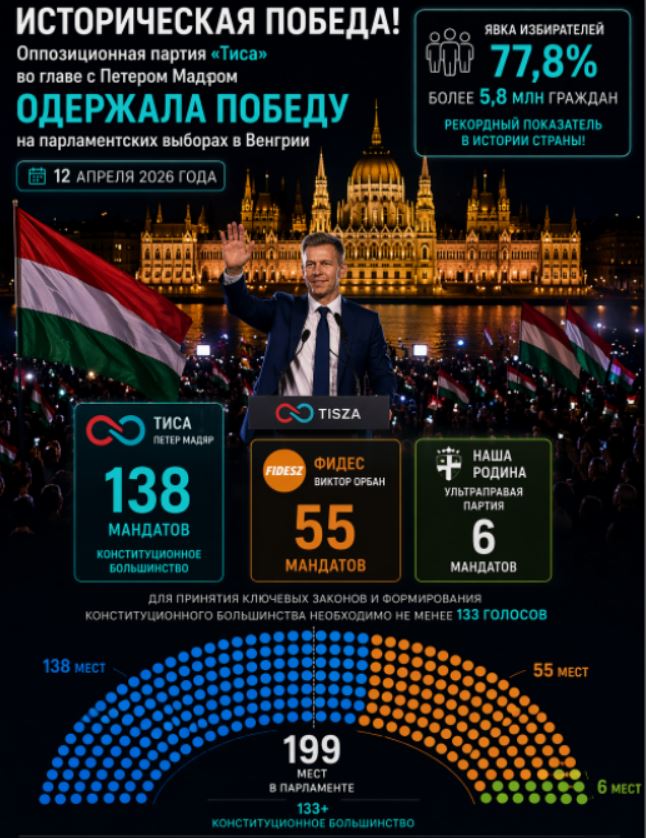
It is important that US support for Orban was open and demonstrative. Donald Trump publicly supported his election campaign, and US Vice President J.D. Vance visited Hungary, which effectively turned the election into a broader struggle for influence in Europe. In this sense, the result of the vote was a political blow to Trump's positions in the European direction. Orban's defeat weakens the position of both US President Donald Trump in Europe and Russian President Vladimir Putin, since Hungary was one of the key points of support within the EU, which could create the impression that it was possible to somehow influence the decisions of Brussels. Now the reliance on Hungary as an instrument of influence within the EU - from sanctions policy to energy issues - is largely nullified.
The Kremlin's reaction was also indicative. Press Secretary of the President of the Russian Federation Dmitry Peskov said that Russia did not send congratulations to the new leadership of Hungary, stressing that the country remains "unfriendly."
As a result, Europe could potentially become more consolidated in its support for Ukraine, but at the same time more inclined to confrontation with both Moscow and Washington. This forms a new configuration: neither Trump nor Putin has any real tools to influence the EU from within. This reduces the likelihood of European support for Trump's peace initiatives on Ukraine, but also creates the prerequisites for a new escalation. In particular, against this background, the risks of exacerbation of transatlantic contradictions are increasing.
The Middle East conflict continues to divide Western allies.
The United States and Iran failed to agree at the talks in Islamabad: the key stumbling block remains Tehran's nuclear program, which refused to give clear guarantees against the creation of nuclear weapons. Against the backdrop of the failure of negotiations, the United States is increasing pressure in the region, including the formation of a second contour of the blockade of the Strait of Hormuz. This unfavorable involvement in the Iranian conflict further undermines Donald Trump's foreign policy credibility, both globally and within Europe.
At the same time, tensions within NATO are growing. Trump's meeting with NATO Secretary General Mark Rutte in Washington, according to the press, turned into a tough and conflicting conversation. The US president sharply criticized allies for the refusal of a number of European countries to support the United States and Israel in the war with Iran, and also made it clear that he expects more active actions from Europe, including on the issue of the Strait of Hormuz. At the same time, the White House officially denied the existence of any demands on the allies.
Bilateral relations between the United States and key European allies are becoming a separate area of conflict. In an interview with Corriere della Sera, Trump called Italian Prime Minister Giorgia Meloni's behavior "unacceptable," accusing her of indifference to the risks of Iran acquiring nuclear weapons. The reason was her criticism of Trump's statements about the Pope, who called for an end to wars. Trump himself, in turn, accused the pontiff of "ignorance" of foreign policy issues. After that, the Pope made it clear that he did not intend to succumb to pressure. Meloni initially opposed Italy's participation in the conflict and had previously denied American aircraft the use of a base in Sicily. Italian Prime Minister Giuseppe Meloni was considered one of Trump's closest allies in Europe, she was even positioned as a kind of mediator between the EU and its administration.
Ruslan Bortnik, Oksana Krasovskaya
for the Ukrainian Institute of Politics
Friends, we remind you that order additional:
Weekly Intelligence Brief, B. Geopolitical Risk Reports Executive Briefings on issues of interest to you can contact us by e-mail: uiamp2012@gmail.com or by phone: +38 093 757 7565.