Авторы публикации
WEEKLY SUMMARY:
THE UKRAINIAN DIMENSION.
(October 5–12, 2026)
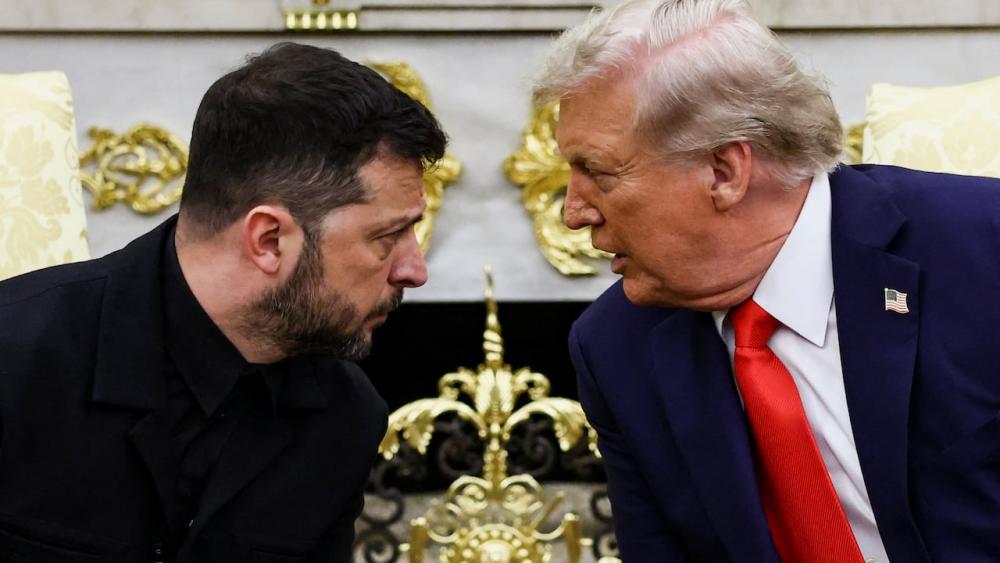
A new political crisis is emerging around Ukraine, linked to the gradual divergence of Kyiv’s and Washington’s strategic interests. Recent statements by US President Donald Trump, especially his call to replace incumbent Ukrainian President Volodymyr Zelensky, are influencing not only the Ukrainian government’s negotiating position but also the expectations of Ukraine’s political elites, Moscow’s strategic calculations, and the behavior of European allies.
Meanwhile, the campaign ahead of the US congressional elections (November 3, 2026) and rising diesel prices amid the Middle East crisis are creating additional domestic political problems for the Trump administration. The US president is seeking to shift part of the responsibility for America’s energy crisis onto the Russia–Ukraine war, portraying it as one of the causes of higher fuel prices. Yet these circumstances are more likely accelerators of a deeper process: Washington’s reassessment of the costs and benefits of US involvement in the war in Ukraine. For the Trump administration, Ukraine is an important but not the only foreign-policy priority. The Middle East, energy security, competition with China, the state of the US economy, and domestic political constraints establish Washington’s own hierarchy of priorities. If maintaining the previous level of pressure on Russia begins to conflict with other US interests, the White House has an incentive to revise elements of its policy regardless of Kyiv’s position. In this logic, the Russia–Ukraine war is gradually becoming one instrument in a broader bargaining process.
The US president’s main task over the next three weeks is to minimize Republican electoral losses amid rising fuel prices, driven in part by the US war against Iran. At the same time, Ukraine continues striking Russian oil refineries, regarding them as a means of weakening Russia’s military and economic potential. Kyiv is attempting to turn the unilateral concession demanded of it into a reciprocal exchange. Ukrainian President V. Zelensky has declared his readiness to halt strikes on Russian refineries only in exchange for an end to Russian attacks on Ukraine’s energy infrastructure.
Under these circumstances, Washington is demonstrating a willingness to obtain economic benefits from cooperation with Russia without making them directly conditional on first ending the war in Ukraine or achieving sector-specific ceasefires (on which Ukraine insists).
Washington’s agreements with Moscow concerning Russian diesel fuel have become the first practical manifestation of this divergence. The announced October 9 deliveries of approximately 300,000 tonnes of diesel in October, followed by additional volumes, together with the temporary easing of US sanctions restrictions until April 2027, have limited potential to bring US prices down quickly. This establishes a precedent for partial normalization of US–Russian relations while fighting continues and simultaneously weakens the previous negotiating framework, under which sanctions pressure on Moscow was supposed to remain until a political settlement was reached. The Americans have separated the issue of lifting sanctions on Russia from the question of ending strikes on Ukraine’s energy infrastructure and shipping.
For Russia, this opens the possibility of restoring export revenues and easing sanctions pressure over a longer period. Crucially, Russia is receiving sanctions relief without any reciprocal commitment to reduce attacks on Ukraine. Consequently, the Kremlin has no additional incentive to stop striking Ukrainian energy infrastructure unless Kyiv agrees to substantial concessions.
At the same time, the scope for rapidly and significantly lowering diesel prices in the United States remains limited. For the Trump administration, therefore, controlling the political interpretation of the fuel crisis is becoming increasingly important alongside stabilizing the market, including identifying an external party to blame if its efforts fail. Ukrainian strikes on refineries provide a convenient explanation for high prices at US filling stations, allowing part of the responsibility for the consequences of the Middle East war and White House economic policy to be transferred to Kyiv. The US president is also attempting to demonstrate major progress in negotiations between Ukraine and Russia and on October 11 announced an energy ceasefire that is not actually functioning.
The key question now is whether Trump intends to force Zelensky to change specific decisions or views a change of Ukrainian leadership as a condition for broader agreements with Russia. In the first case, harsh public rhetoric may remain a tool of negotiating pressure, and the dispute could end in a limited energy compromise. In the second, this would amount to an attempt to change the political conditions under which Ukraine participates in negotiations.
At the same time, Trump’s direct pressure produces the opposite political effect for V. Zelensky as well. A public call by a foreign leader to replace Ukraine’s president allows part of the domestic political conflict to shift from the government’s accountability to the issue of national sovereignty. Even citizens who are critical of Zelensky are not necessarily prepared to support a leadership change under external pressure, especially when it is accompanied by US agreements with Russia. The result is a dual situation: external pressure may weaken Zelensky’s position among political elites while simultaneously strengthening his public legitimacy as a leader resisting conditions imposed from abroad.
Kyiv’s principal vulnerability is its critical dependence on US intelligence and technology, which allows Washington to influence Ukrainian military strategy in line with its own economic and electoral interests, including through political coercion without formally terminating military aid. The main US levers of pressure now are not so much weapons deliveries as intelligence and satellite communications. The PURL program, through which European allies purchase US weapons, the sharing of intelligence, and access to Starlink could potentially be at risk. US intelligence provides information on concentrations and movements of Russian troops and ballistic missile launches, while Starlink supports communications, unit command, and the coordination of combat operations.
Another threat to Ukraine is the diminishing ability to align Western partners’ interests with its own military and political objectives. If the United States begins deriving economic and political benefits from normalizing relations with Russia independently of a settlement in Ukraine, Washington will have fewer reasons to maintain its previous level of pressure on Moscow. Russia, conversely, will have further incentives to maintain a hard negotiating position. European countries will face the need either to compensate for reduced US involvement or adapt to Washington’s new course. Ukrainian political elites, meanwhile, will have to reconsider their strategies as external guarantees diminish.
The most likely compromise under these circumstances would be for Ukraine to stop striking Russian oil refineries directly while shifting pressure to other elements of Russia’s military and industrial infrastructure. This would allow Kyiv to retain US support, Moscow to reduce losses in its oil-refining sector, and Trump to claim a diplomatic victory and attempt to stabilize fuel prices before the elections.
___________________________________
The US–Russia diesel deal and prospects for peace negotiations.
On October 9, 2026, following a telephone conversation with Russian President Vladimir Putin, Donald Trump announced an agreement on supplies of Russian diesel fuel to the US and global markets. Under the terms published by the US president, Russia is to provide an immediate shipment of more than 300,000 tonnes of diesel, another 500,000 tonnes in November, then 1 million tonnes and subsequently an additional 3 million tonnes. On the same day, the US Treasury Department issued a special license permitting transactions involving Russian diesel fuel until April 7, 2027, effectively temporarily easing sanctions restrictions on this segment of Russian exports.
The volumes of Russian diesel supplied are relatively small, so the agreement’s short-term economic impact on US consumers will be limited. However, the announcement that restrictions on Russian diesel supplies to international markets are being lifted could itself reduce prices by changing market expectations.
According to US officials, President Donald Trump decided to conclude the diesel agreement with Russia after Ukrainian President Volodymyr Zelensky ignored repeated requests from Washington to stop strikes on Russian oil refineries. The US side argues that these strikes contributed to rising fuel prices in the United States, directly affecting American consumers.
On October 10, Donald Trump moved from demanding an end to strikes on Russian refineries to raising the question of replacing Ukraine’s political leadership. Accusing Volodymyr Zelensky of unwillingness to reach an agreement with Russia and linking Ukrainian strikes on refining facilities to high diesel prices in the United States, the US president stated: ‘I suggest they find a new leader who can make a deal.’ Thus, disagreements over a specific military-economic issue were publicly shifted into the realm of the incumbent Ukrainian president’s political future. This was Trump’s strongest signal since the Oval Office confrontation in February 2025, when Washington temporarily suspended military assistance and intelligence sharing with Kyiv.
On October 11, Donald Trump announced an allegedly agreed energy ceasefire between Russia and Ukraine. Yet on October 12 Zelensky stated that Russian strikes on Ukrainian energy facilities were continuing. In particular, Russian forces struck a power station in Kharkiv after the US announcement. Moscow also did not confirm that such an agreement had been concluded. As of October 12, a mutual energy ceasefire was not operating in practice, and the positions of Washington, Kyiv, and Moscow on its terms remained uncoordinated. Western media later clarified that the ceasefire concerned oil refineries only, not all energy infrastructure. For Ukraine, however, such an arrangement is unbalanced: Russia has dozens of refineries, whereas Ukraine has only one, the Kremenchuk refinery, which has repeatedly suffered destruction. Under this arrangement Moscow would obtain protection for a major export industry while retaining the ability to attack Ukrainian energy infrastructure. Similar earlier statements by Trump in September about an energy ceasefire likewise failed to bring an actual halt to strikes. This approach may allow the US president to announce a result before an agreement has been reached, generating a positive signal for markets and shifting responsibility for violations onto the parties to the war.
On October 11, in an interview with US broadcaster ABC News, Volodymyr Zelensky responded to Trump’s call to replace Ukraine’s president by saying that the choice of Ukrainian leadership must be made exclusively by the people of Ukraine. ‘With all due respect to President Trump, it is our society, our people, who must choose one leader or another,’ Zelensky emphasized. He also expressed readiness to organize presidential elections on condition that Russia agree to a complete 60-day ceasefire: ‘If President Trump really wants changes through elections, I also conveyed this to his team: please tell Putin—give us two months, 60 days of a complete ceasefire, and we will organize elections.’ Zelensky added that he was ready to accept any choice made by Ukrainian citizens.
At the same time, Zelensky confirmed Ukraine’s readiness for a reciprocal energy ceasefire: Kyiv would halt strikes on Russian refineries if Moscow stopped attacking Ukrainian energy infrastructure. ‘If the Russians want us not to attack their diesel fuel, their oil refineries, we ask President Trump to send them a signal not to attack Ukraine’s energy infrastructure,’ he said. Kyiv is thus trying to turn the US demand for a unilateral concession into reciprocal obligations, preserving its tools for exerting pressure on the Russian economy while securing protection for Ukraine’s power system ahead of winter.
On October 12, speaking at the Warsaw Security Forum, Volodymyr Zelensky proposed that the United States conclude a ‘diesel agreement’ directly with Ukraine rather than Russia. He questioned whether the volumes agreed between Washington and Moscow could materially affect the global fuel market and suggested that other motives lay behind the US decision. ‘If so, why does America not make a diesel supply deal with Ukraine instead? ... We influence whether those ships move. We determine whether oil refineries operate. Let’s do it,’ Zelensky said.
In effect, the US–Russian deal undermined the Presidential Office’s central strategy for autumn 2026: securing reciprocal, ‘mirror-image’ energy and maritime ceasefires. Instead, the United States eased some sanctions restrictions on Russia without obtaining any commitments from Moscow toward Ukraine, solely within bilateral US–Russian arrangements. The principle of ‘nothing about Ukraine without Ukraine’ was thereby breached. In an interview with Axios, Volodymyr Zelensky said the agreement had come as a surprise to him, calling it ‘unfair and dishonest’ and an unjustified gift to Vladimir Putin. According to Zelensky, he had previously informed Donald Trump, Steve Witkoff, and Jared Kushner that Ukraine was prepared to halt strikes on Russian oil refineries provided Russia stopped attacking Ukrainian power plants. Trump, however, had demanded a unilateral end to Ukrainian strikes on Russian refineries and did not regard them as equivalent to Russian attacks on Ukraine’s power system.
A separate source of disagreement was the alleged threat to restrict US intelligence support for Ukraine. According to one Ukrainian official, during eight-hour talks with a US delegation in Miami on October 9, 2026, presidential special envoy Steve Witkoff and Jared Kushner allegedly warned the Ukrainian delegation that if strikes on Russian oil refineries continued, President Donald Trump might deprive Kyiv of access to US intelligence. National security advisers from the United Kingdom, France, and Germany, as well as representatives of NATO and the European Union, were also invited. During the meeting, Witkoff and Kushner informed Ukrainian representatives of Trump’s intention to speak with Russian President Vladimir Putin and remove sanctions restrictions on Russian diesel exports. US officials denied that any threat to terminate intelligence support had been made, saying that the negotiators instead stressed the United States’ status as a ‘reliable partner providing ammunition and intelligence,’ while also stating that Ukraine should not take actions ‘harmful to American consumers.’
The talks between the United States, Ukraine, and European partners in Miami ended early without specific agreements. The meeting had initially been scheduled for October 9–10, but the second day was canceled. The parties discussed possible ways to end the war, an energy ceasefire, protection of Ukraine’s energy system during winter, security of grain exports, security guarantees, Ukraine’s postwar reconstruction, and European integration. Although Witkoff described the talks as ‘constructive,’ the sides failed to reconcile their principal positions or announce practical results. On October 12 it became known that the planned visit by Steve Witkoff and Jared Kushner to Moscow had been postponed. According to rumors, the US mediators did not intend to hold another round with the Russian leadership until Ukraine’s and European allies’ readiness to accept a new joint peace proposal became clear. Thus, further progress in the negotiations was effectively suspended because of persistent disagreements among the United States, Ukraine, and European partners over the terms of possible agreements with Russia.
Overall, this development is potentially beneficial for Russia above all because it allows the Ukrainian and US–Russian negotiating tracks to be separated. Moscow wants economic cooperation with the United States, partial sanctions relief, and discussions of strategic security to proceed independently of Russia fulfilling obligations to end the war. If this principle takes hold, Russia will be able to secure concessions in individual areas without first changing its military strategy. In that case, time becomes an additional resource for Moscow: continuing the war would not prevent a gradual recovery of its foreign economic opportunities.
The central question for the coming weeks is whether the US administration can translate its domestic political interests into concrete conditions for Ukraine. The US president has no mechanism to remove Zelensky from office directly. Washington does, however, possess tools that could substantially increase the cost to Kyiv of rejecting US proposals: arms supplies, intelligence support, technological infrastructure, diplomatic assistance, and influence over European allies’ positions. The precedent of the temporary suspension of military aid and intelligence sharing after the White House confrontation in February 2025 shows that these tools can be used not only against external adversaries but also to pressure partners.
Trump’s statements about V. Zelensky are important because of their impact on Ukraine’s political elites. Zelensky still retains institutional control over the system of government, but his public support is no longer unconditional. According to KIIS data for August–September 2026, 54% of citizens trusted the president and 41% did not, while only 18% trusted him completely. Some 72% of Ukrainians believe that the president bears personal responsibility for corruption committed by people around him. And 53% believe that V. Zelensky should limit himself to his current presidential term. Against the backdrop of corruption scandals, accumulated dissatisfaction, and a lack of clear prospects for ending the war, questions about the long-term stability of the present configuration of power are naturally emerging within the political establishment. This also concerns some members of the president’s circle, for whom preserving their own positions may gradually become a priority in its own right.
Yet external pressure may not weaken V. Zelensky; instead, it may temporarily preserve the existing system of government. A paradox arises: Trump’s public attempt to bring about a change of Ukrainian president may simultaneously weaken Zelensky’s standing within the elites and strengthen the political resilience of the incumbent authorities among the public. According to a KIIS survey conducted in September 2026, 71% of citizens still oppose holding elections during the war. With the war continuing, an external demand to replace the president may be perceived not as ordinary diplomatic pressure but as an attempt to restrict Ukrainian sovereignty.
For the opposition, this creates a serious problem. Any attempt to use US pressure in the struggle against Zelensky risks being portrayed as participation in a foreign-led change-of-government scenario and as playing into Russia’s hands. Even the president’s political rivals may therefore prefer to distance themselves from Washington’s demands. As a result, Trump could inadvertently narrow the space for Ukraine’s domestic opposition while increasing distrust of Zelensky among parts of his own entourage. This could lead not to an immediate change of government but to greater insularity, concentration of decision-making, and growing internal mistrust.
Under these circumstances, Ukraine is entering a period of political wait-and-see. Ukrainian elites currently have insufficient grounds either to distance themselves openly from Zelensky or to bet unconditionally on the continuation of his rule in its present form. On the one hand, the president controls the main institutions, and no alternative center of power has emerged. On the other, a public dispute with Washington increases uncertainty about the incumbent leadership’s future resources, international support, and political prospects. Many political actors may therefore prefer to maintain formal loyalty while avoiding irreversible decisions until the positions of the United States and European capitals become clearer. The danger for Zelensky lies less in the emergence of organized opposition within the government than in the gradual decline of his entourage’s willingness to assume political risks to preserve the existing configuration.
In this configuration, European states act less as an independent counterweight to the United States than as another center for reconciling interests. Germany, France, and the United Kingdom want to prevent political destabilization in Ukraine, preserve its defense capabilities, and avert US–Russian agreements that disregard European security. At the same time, the energy crisis, rising military expenditure, and dependence on US capabilities limit Europe’s readiness for direct confrontation with Trump. The most likely approach by European capitals is therefore to maintain support for Kyiv, prevent a sharp reduction in US involvement, and persuade the Ukrainian leadership to accept certain compromises. Support for Ukrainian statehood and support for Zelensky personally may gradually become separate political questions.
On October 12, 2026, the Verkhovna Rada of Ukraine adopted draft law No. 16119, ‘On Amendments to Certain Laws of Ukraine Concerning the Educational Rights of Indigenous Peoples of Ukraine and Persons Belonging to National Minorities (Communities) of Ukraine,’ both at first reading and in its entirety. The bill received 273 votes at first reading and 266 in the final vote. Of the 266 votes for final adoption, 177 came from the Servant of the People faction, 16 from European Solidarity, 11 from Batkivshchyna, 6 from Holos, and another 56 from parliamentary groups and non-affiliated MPs. Its expedited adoption was linked to the need to fulfill agreements with Hungary ahead of the Ukraine–EU intergovernmental conference scheduled for October 13 and to enable progress on negotiating Cluster 2, ‘Internal Market,’ and Cluster 3, ‘Competitiveness and Inclusive Growth.’ Draft law No. 16119, registered in the Verkhovna Rada on October 1, 2026, became one of the key conditions of the arrangements reached with Hungary to unblock further negotiations on Ukraine’s accession to the European Union.
Hungary has already lifted its blockade of Ukraine’s progress on two negotiating clusters—No. 2, ‘Internal Market,’ and No. 3, ‘Competitiveness and Inclusive Growth’—which it had blocked for several months. On October 7, the Council of the EU Working Party on Enlargement (COELA) approved the screening results for both clusters, and EU member-state ambassadors agreed to request Ukraine’s negotiating positions. The formal opening of the clusters was tied to adoption of draft law No. 16119 by the Verkhovna Rada. Following the October 12 vote, Ukraine fulfilled this condition, creating the prerequisites for further progress in the negotiations.
As a result of the law’s adoption, schools where more than 50% of pupils are taught in a national minority language that is also an official EU language will be eligible for special status. Pupils at these schools will be able to receive education predominantly in their native language, as the Hungarian government had demanded. The changes are designed to secure the right to education in the native language and its use in teaching and school documentation, primarily for the Hungarian and Romanian minorities and potentially for Bulgarian and other national communities.
Before the vote, concerns persisted about whether draft law No. 16119 could pass because of disagreements among parliamentary and civil-society groups. Despite support at the level of the relevant parliamentary committees and pro-government political circles, some MPs sought to link its adoption to progress on draft law No. 15412, which strengthens protection of the Ukrainian language. Approximately 30 civil-society organizations also called for No. 15412 to be adopted at first reading before they would support No. 16119. However, the necessary majority was secured in the October 12 vote, and fears that the bill might be blocked did not materialize.
Hungary’s agreement to allow Ukraine to proceed with the two negotiating clusters does not, however, mean that it has agreed to Ukraine’s accession to the EU. Budapest is signaling readiness to continue negotiations while retaining the ability to make additional demands at subsequent stages of the European integration process.
Massive Russian strikes on Ukraine’s energy sector and critical infrastructure: Kyiv as the main risk area ahead of the heating season.
Over the past week, Russia continued large-scale strikes on Ukraine’s energy, transport, and civilian infrastructure while changing its missile-attack tactics. Since mid-summer 2026, Russian air strikes have shown a noticeable expansion in the range of targets. Energy infrastructure, military logistics, military command facilities, and defense-industry enterprises remain principal targets, but new categories are increasingly being added: digital and communications infrastructure, transport hubs, major warehouses, shopping facilities, and other commercial and urban infrastructure. Russia appears to be seeking the most vulnerable points where strikes can inflict maximum economic damage, disrupt daily operations in major cities and the state apparatus, create shortages, and impose additional hardships on residents. At the same time, Russian attacks are designed to increase socio-psychological pressure on Ukrainian society, creating a sense of insecurity intended to fuel dissatisfaction with the authorities, spread pessimism and hopelessness, and encourage further departures from Kyiv and other major Ukrainian cities.
Overall, Russian attacks aim not only to physically destroy Ukrainian infrastructure but also to progressively complicate the functioning of the state and economy: disrupting public services, urban transport connections, and supplies, and creating shortages and additional costs for households. In winter, the combination of these factors with interruptions to electricity, heating, and water supplies could reinforce pessimism and social discontent and prompt further departures from Kyiv and other major cities.
The most difficult situation is developing in Kyiv, where Russian strikes on energy facilities, bridges, and other critical infrastructure are accompanied by numerous emergency power outages, water-supply interruptions, and disruption of public transport, including the metro.
The situation is further aggravated by targeted strikes on energy facilities supplying electricity to Kyiv and its region. In early October, the 750 kV Kyivska main substation in the Makariv district of Kyiv region, which transmits power to the Kyiv grid hub, including electricity from the Rivne Nuclear Power Plant, came under repeated attack. Kyiv is already returning to scheduled power cuts after the summer break. Updated outage schedules published for Kyiv region on October 8 envisaged up to 14 hours a day without electricity. In Kyiv itself, power disruptions caused partial suspension of trams and trolleybuses and the shutdown of services on all three metro lines.
In early October, several Russian attacks targeted the Southern Bridge, while the Northern Bridge was damaged on October 3. The Northern and Southern bridges have become two key targets because they provide vital transport links between the banks of the Dnipro. Additional protective measures are already being introduced at these crossings, including anti-drone nets and machine-gun turrets to counter UAVs. This suggests that the threat of repeated strikes is considered long-term. These bridges are particularly vulnerable points for Kyiv: more than a third of the capital’s roughly three million residents live on the left bank, while many workplaces, administrative institutions, and urban facilities are concentrated on the right. Thus, even without physically destroying the bridges, their temporary closure can disrupt passenger and freight transport, increase pressure on remaining crossings, impede utility and emergency services, and effectively divide the city in two for several hours.
Although a complete transport collapse was avoided, the city faced major restrictions on essential services ahead of the heating season. Kyiv Mayor Vitali Klitschko advised residents with relatives or friends outside the capital to consider temporarily relocating and to stockpile drinking and utility water, food, medicines, and autonomous power supplies. He stressed, however, that he was not calling for a full evacuation of the capital, which is precisely what Russia seeks.
At the same time, a dispute between the central government and city authorities intensified over Kyiv’s readiness for winter. The president, government, and National Security and Defense Council said the city’s resilience plan had been almost entirely unimplemented, raising questions not only about protective infrastructure but also about how responsibility is divided between central authorities and the capital’s leadership. The main problem is that preparations for possible large-scale electricity, heating, and water outages had already proved insufficient by mid-October, when opportunities to remedy systemic shortcomings quickly were severely limited.
Attacks on other Ukrainian cities, energy facilities, industrial enterprises, and transport infrastructure continue. Particularly notable are the tragedies in Pryluky, Kramatorsk, and Zaporizhzhia, where the combined civilian death toll reached approximately 70.
Ukraine is building a multilayered air-defense system comprising two main air-defense echelons and a separate echelon of interceptor drones. However, mass deliveries of jet-powered interceptor UAVs are not expected before late November. According to Deputy Commander of the Ukrainian Air Force Yurii Cherevashenko, around 20 manufacturers of such aircraft are working with the military; 14 companies are conducting test flights, six have already achieved results in destroying jet-powered drones, and three designs have been deemed promising. Two aircraft have passed codification, including the Predator. Existing interceptors reach speeds of approximately 460–500 km/h; some manufacturers claim speeds of up to 700 km/h, while the Air Force considers it possible that Russian jet-powered UAVs could reach 800–900 km/h.
Situation on the Front Line.
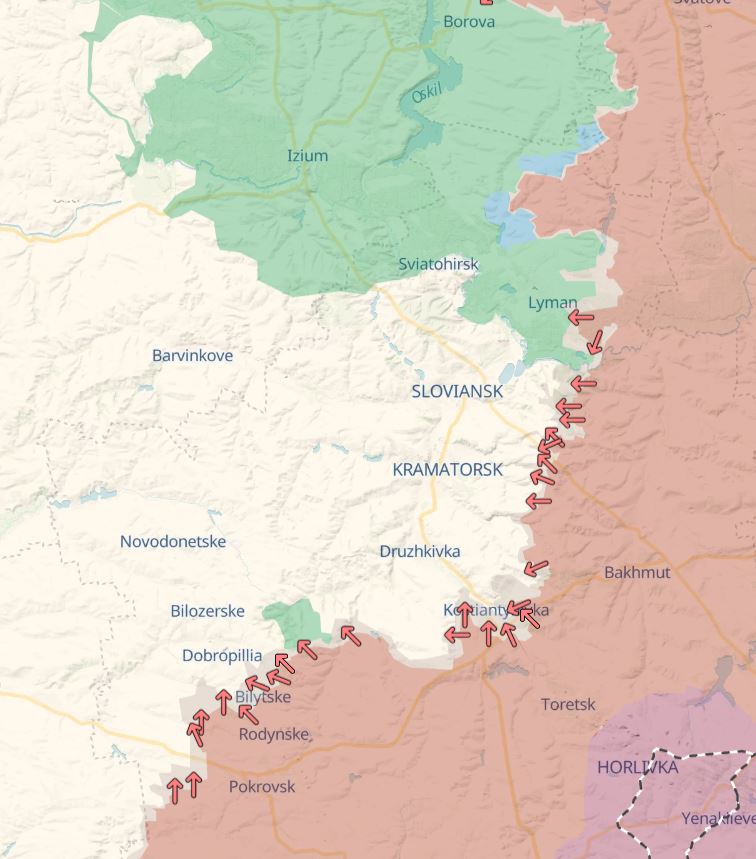
Territorial changes on the front line remain relatively limited despite the high intensity of fighting. Over the past week, Russian forces captured approximately 33 km² of Ukrainian territory. As of October 12, 2026, Russia controls approximately 117,093 km², or 19.39% of Ukraine’s territory. The most difficult situation for the Ukrainian Armed Forces remains in Donetsk region, on the Dobropillia, Kostiantynivka, and Kramatorsk–Sloviansk axes.
Dobropillia axis (Donetsk region). Russian troops are entering the outskirts of Dobropillia. Capturing the city may become Russia’s main objective before the end of 2026, opening opportunities for a further offensive toward Druzhkivka and Kramatorsk and for encircling the Sloviansk–Kramatorsk urban area.
Kostiantynivka axis (Donetsk region). Reports indicate a reduction in the Ukrainian presence in Kostiantynivka and an expansion of Russian control. According to some reports, Russian forces already occupy a substantial part of the city. Fighting is shifting toward the settlement of Oleksiievo-Druzhkivka.
Kramatorsk–Sloviansk axis (Donetsk region). Russian advances are reported in certain sectors, alongside attempts to develop an offensive from the north toward Sviatohirsk and Sloviansk.
Orikhiv and Huliaipole axes (Zaporizhzhia region). Russian groups are entering Orikhiv but have not yet established positions there. The Ukrainian Armed Forces hold the city. West of Huliaipole, Russian troops advanced 3–5 km, captured several small settlements, and are trying to outflank Orikhiv from the east and northeast.
Kupiansk axis (Kharkiv region). Russia claims almost complete control over Kupiansk-Vuzlovyi and the adjacent left-bank area. The Russian salient near Kolodiazne is also expanding.
Novopavlivka axis (Dnipropetrovsk region). Heavy positional fighting continues for Novopavlivka, without significant changes to the front line. The active phase of the Ukrainian counteroffensive in this sector has ended.
Kherson axis (Kherson region). Mutual shelling, reconnaissance and sabotage group operations, and fighting over islands in the Dnipro delta continue around Oleshky and along the river. There have been no significant territorial changes.
Maps of Military Operations.
(According to DeepState Map)
Donetsk Region.
Public Opinion in Ukraine: Growing Dissatisfaction with the Authorities, Electoral Competition, and Changing Attitudes toward Ending the War.
According to a survey by the Kyiv International Institute of Sociology (KIIS), conducted on September 12–21, 2026, 45% of Ukrainians believe events in the country are moving in the wrong direction, 40% in the right direction, and 15% are undecided. Compared with February 2024, the distribution of views has changed little: positive assessments fell from 44% to 40%, negative assessments from 46% to 45%, while the undecided share rose from 10% to 15%. Perceptions are closely linked to attitudes toward President Volodymyr Zelensky: among those who fully trust him, 61% consider the country to be moving in the right direction; among those who somewhat trust him, 54%; while among those who do not trust the president, 77% assess developments negatively.
Citizens’ emotional attitudes toward the incumbent authorities have deteriorated much more noticeably. Disappointment is felt by 44% of respondents, compared with 36% in December 2025; shame by 33%, up from 20%; anger by 20%, up from 14%; hatred by 14%, up from 11%; and indifference by 12%, up from 7%. Hope remains at 23% and compassion at 16%. Only 7% report pride, while sympathy and amusement are each mentioned by 4%. Whereas in December 2025 hope was the second most widespread emotion after disappointment, by September 2026 shame had overtaken it, and anger had moved into fourth place.
Meanwhile, 71% of Ukrainians oppose holding elections now, while 24% consider them necessary and another 4% are undecided. A majority in favor of an immediate vote—53%—is found only among citizens who completely distrust Zelensky. Even among those who somewhat distrust the president, 58% oppose elections under current conditions. At the same time, 53% believe Zelensky should limit himself to his current presidential term, compared with 46% in December 2025. Some 42% support his participation in the next election, down from 45%. Among those who fully trust the president, 85% support his running again; among those who somewhat trust him, 53%; among those who somewhat distrust him, 20%; and among those who completely distrust him, 7%.
The prevailing view in society remains that the country is moving in the wrong direction—45% versus 40%—with this assessment most pronounced among citizens who do not trust the president.
At the same time, a more pronounced negative trend is emerging in attitudes toward the authorities. Whereas in December 2025 hope was the second most common emotion after disappointment, shame has now risen to second place at 33%, hope has fallen to third (23%), and anger has moved up to fourth at 20%, ahead of compassion (16%).
Attitudes toward V. Zelensky’s political future have also changed. Whereas in December 2025 public opinion was almost evenly divided—46% favored a single term and 45% supported his participation in the next election—a majority of 53% now believe V. Zelensky should limit himself to his current presidential term. At the same time, 71% still oppose holding elections during the war.
According to another survey, conducted by the Rating Sociological Group on October 3–5, 2026, Valerii Zaluzhnyi enjoys the highest level of trust among Ukrainian political and public officials: 64% trust him and 25% distrust him, for a net trust balance of +39 percentage points. Volodymyr Zelensky is trusted by 53% and distrusted by 40%, a balance of +13 points; Kyrylo Budanov by 53% and 31%, respectively, a balance of +22 points. Mykhailo Fedorov is trusted by 38% and distrusted by 25%, while 29% have never heard of him. Yevhen Khmara is trusted by 29% and distrusted by 16%, while 43% are unfamiliar with him. Petro Poroshenko is trusted by 24% and distrusted by 70%, a balance of −46 points. Andrii Sybiha is trusted by 24% and distrusted by 18%, while 48% have never heard of him.
In a hypothetical presidential election, Zelensky retains a narrow lead over Zaluzhnyi: 22.9% versus 20.2% among all respondents and 26.7% versus 23.6% among decided voters intending to vote. They are followed by Petro Poroshenko at 7.6% and 8.9%, respectively; Mykhailo Fedorov at 7.6% and 8.8%; Kyrylo Budanov at 6.7% and 7.8%; Andrii Biletskyi at 5.4% and 6.3%; Dmytro Razumkov at 5.1% and 6.0%; Serhii Prytula at 2.4% and 2.8%; Yuliia Tymoshenko at 1.9% and 2.2%; and Yurii Boiko at 1.4% and 1.6%. Another candidate would be chosen by 4.5% of all respondents, 5.2% do not intend to vote, and another 9.2% are undecided.
Ukrainians’ expectations for winter 2026–2027 are predominantly negative. A worsening economic situation is expected by 71% of respondents, including 24% who expect a significant deterioration; 63% anticipate a worsening energy situation, including 24% expecting a significant deterioration; and 55% expect the overall situation in Ukraine to worsen, including 17% who foresee a significant deterioration. No change is expected by 17%, 18%, and 25%, respectively, while only 7%, 10%, and 12% expect improvement. Assessments of prospects on the front line are notably less pessimistic: 33% expect improvement, 30% no change, and 22% deterioration, while another 15% are undecided. Compared with the previous winter, 47% expect electricity supplies to be about the same, 39% worse, and 9% better. These figures almost exactly repeat October 2025, when the corresponding shares were 46%, 38%, and 11%.
In the presidential rankings, V. Zelensky retains a minimal lead over V. Zaluzhnyi. The gap is 2.7 percentage points among all respondents and 3.1 points among decided voters intending to vote.
However, V. Zaluzhnyi has a significantly higher net trust balance (+39 points versus +13 for V. Zelensky), while distrust of the incumbent president is substantially higher: 40% versus 25%.
This balance creates serious preconditions for V. Zelensky’s defeat in a second round if he faces V. Zaluzhnyi.
Moreover, V. Zaluzhnyi remains V. Zelensky’s only significant rival in a presidential election. Support for other potential contenders, notably M. Fedorov (7.6%) and K. Budanov (6.7%), is substantially below the two leaders’ figures.
According to the Rating Sociological Group survey conducted on October 3–5, 2026, 62% of Ukrainians believe neither side is currently winning the war, 26% see Ukraine as having the advantage, and 6% see Russia as having the advantage. When choosing between peace and victory, 50% consider peace more important than any victory, while 41% consider victory more important than any peace. Compared with June 2026, support for prioritizing victory rose from 30% to 41%, while the share prioritizing peace fell from 59% to 50%.
An end to hostilities and a negotiated compromise are supported by 57% of Ukrainians, compared with 54% in June 2026. Continuing the war until Donbas and Crimea are returned is supported by 21%, and until the line of control as of February 23, 2022 is restored by 13%; another 9% are undecided. Compared with February 2023, support for fighting until Donbas and Crimea are returned fell from 73% to 21%, while support for ending hostilities and seeking a negotiated compromise rose from 12% to 57%.
The most realistic path to ending the war is seen by 57% as a negotiated compromise involving other countries, by 26% as direct negotiations with Russia, and by only 9% as refusing negotiations and continuing the war until all territories are liberated. Since June 2022, support for fighting until all territories are liberated has declined from 59% to 9%, while preference for an international negotiating format rose from 36% to 57%. Since March 2025, however, the share supporting direct negotiations with Russia has risen from 2% to 26%, while support for the international format has fallen from 85% to 57%.
Territorial concessions for a lasting peace are considered acceptable by 56% of respondents, but only if accompanied by security guarantees from the United States and European partners, including financing for Ukraine’s Defense Forces and arms supplies. In August 2025, the figure was 59%. Some 35% oppose territorial concessions, up from 33%, while only 3% accept unconditional concessions. At the same time, 68% believe that the final decision on territorial concessions must be made by Ukrainian citizens in a nationwide referendum, 17% assign this authority to the president, and 9% to the Verkhovna Rada.
In effect, public attitudes have undergone a fundamental shift over three and a half years. Between June 2022 and October 2026, society has moved from an orientation toward the military liberation of all territories to a search for a negotiated settlement. The demand for complete territorial liberation has ceased to be the dominant position, giving way to support for ending hostilities and reaching a negotiated compromise.
Between February 2023 and October 2026, support for continuing the war until Donbas and Crimea are returned fell from 73% to 21% (−52 percentage points), while the share favoring an end to hostilities and a negotiated compromise rose from 12% to 57% (+45 points). At the same time, between March 2025 and October 2026, direct negotiations with Russia came to be viewed much more widely as a realistic path to ending the war.
Ruslan Bortnik, Oksana Krasovskaya
for the Ukrainian Institute of Politics
Friends, we would like to remind you that the Ukrainian Institute of Politics offers additional analytical products for organizations, businesses, and private clients: Weekly Intelligence Brief, Geopolitical Risk Reports, Executive Briefings, as well as special analytical materials and forecasts prepared on request. For further information, please contact uiamp2012@uiamp2012@gmail.comgmail.com or call +38 (093) 757-75-65.