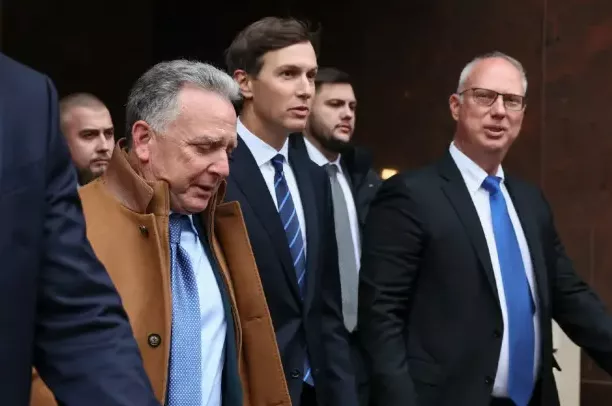
Russia’s demands at the Abu Dhabi negotiations indicate Moscow’s attempt to turn the end of the war in Ukraine into an instrument for revising the entire European security architecture. At stake are no longer only Ukraine’s territories, but also the future of NATO, the American military presence in Europe, and European nuclear deterrence.
The negotiation process between Russia, the United States, and Ukraine, which intensified in November 2026, is gradually moving far beyond its initially declared objective—the cessation of the Russian-Ukrainian war. Moscow is once again attempting to place a fundamental question at the center of the negotiations: what should Europe’s security architecture look like, who will determine its rules, and how should military-political spheres of influence be distributed between Russia and the West?
According to The New York Times, the Russian delegation at the Abu Dhabi negotiations presented an unofficial document dated November 10, 2026, containing far-reaching demands addressed to the United States and European states. These include NATO’s refusal to expand further, restrictions on the alliance’s military presence in Eastern Europe, an end to Western arms supplies to Ukraine, and new restrictions on European nuclear deterrence. According to the newspaper, the document’s authenticity was confirmed by two sources; however, the text itself has not been published and does not have the official status of a signed proposal.
It is fundamentally important that most of these demands virtually reproduce the two Russian draft treaties on security guarantees published on December 17, 2021, two months before the full-scale invasion of Ukraine. Yet Moscow is now returning to them in a completely different military-political reality—after almost five years of war, NATO’s enlargement to 32 states, and a profound change in the European balance of power.
In effect, Russia is proposing to end the war in Ukraine not through a separate peace agreement, but through a large-scale geopolitical deal on the redistribution of military-strategic influence in Europe.
Table 1
Russian Draft Treaties on Security Guarantees of December 17, 2021:
A Military-Political and Geostrategic Analysis
|
Subject of Bargaining |
Russian Demands |
Strategic Result for Moscow if Implemented |
|
NATO Enlargement |
Legal commitment to reject further NATO enlargement, including Ukraine |
Establishing restrictions on the expansion of the Western military-political bloc |
|
Post-Soviet Space |
Termination of U.S. military cooperation with former Soviet republics that are not NATO members |
Reducing American military influence on Russia’s periphery |
|
Eastern Europe |
Limiting the deployment of forces and armaments to the level of May 27, 1997 |
Revision of NATO’s military presence on the eastern flank
|
|
Missiles |
Mutual restrictions on the deployment of ground-launched intermediate-range and shorter-range missiles |
Reducing the threat of a rapid strike and restoring elements of arms control |
|
Nuclear Weapons |
Returning nuclear weapons to national territories |
Eliminating the practice of stationing American nuclear weapons in Europe |
|
Military Operations and Exercises |
Restrictions on activities in Eastern Europe, the South Caucasus, Central Asia, and border areas |
Reducing NATO’s operational freedom near Russia |
|
Strategic Dialogue |
Consultations, information exchange, hotlines |
Recognition of Russia as an indispensable party to negotiations on European security |
1. Returning to 1997: Restricting Military Power Rather Than Changing Borders
The central element of the Russian proposal remains the demand to return NATO’s military configuration to its state as of May 27, 1997—the date on which the NATO–Russia Founding Act was signed.
Since then, 16 states of Central, Eastern, and Northern Europe have joined the alliance, including Poland, Hungary, the Czech Republic, the Baltic states, Romania, Bulgaria, Finland, and Sweden. These territories constitute a significant part of NATO’s modern eastern and northern flanks.
However, the Russian demand should not automatically be interpreted as the exclusion of these states from the alliance. Most likely, such a demand is not being made. The 2021 draft primarily concerned limiting the deployment of additional foreign troops and armaments relative to the 1997 level—that is, withdrawing NATO infrastructure from these countries (units from other countries, above all the United States, Germany, and others).
The geopolitical meaning is nevertheless fairly clear: without formally demanding the withdrawal of Eastern European states from NATO (which is now practically impossible), to substantially restrict the alliance’s ability to use their territory for a permanent forward military presence.
Such an arrangement would change the actual military balance in the region. Poland and the Baltic states would retain the collective-defense commitments under Article 5 of the Washington Treaty, but the possibilities for the operational employment of allied military force on their territory would be limited.
For Russia, this would mean a reduction in the direct U.S. military presence near its borders. For Washington, it would mean losing part of its strategic deterrence infrastructure while reducing costs. For Eastern European states, it would mean greater dependence on their own defense capabilities and on the speed of reinforcement arrivals, as well as greater vulnerability to Russian military pressure.
2. Ukraine: European Integration Without Western Military Guarantees
A separate set of Russian demands is aimed at changing Ukraine’s future military-political status.
According to reports about the new document, Moscow demands an end to supplies of Western weapons and military equipment, the exclusion of Ukraine’s NATO membership, and the termination of the alliance’s military activities on Ukrainian territory.
Unlike the proposals of December 2021, these demands have a fundamentally different practical significance today.
At that time, the main issue was preventing Ukraine’s further military-political integration with the West. Now it is the possible restriction of Ukraine’s already established military capabilities and cooperation, which are supported by Western supplies, funding, personnel training, and technological cooperation.
In other words, Russia’s negotiating objective has expanded substantially: from blocking Ukraine’s future military strengthening to restricting the mechanisms that sustain its existing defense capability.
In this context, the new condition concerning Ukraine’s membership in the European Union is particularly revealing. According to NYT reports, Moscow is prepared to allow Ukraine’s European integration provided that Ukraine is excluded from the EU’s common defense policy.
This is a fairly significant adjustment to Russia’s previous position. Ukraine’s European economic integration potentially becomes a subject of compromise, whereas its military-political integration with Western structures must remain restricted.
Under such a model, Ukraine could obtain access to the European market, investment, reconstruction mechanisms, and institutional integration, but not to the full instruments of European defense cooperation.
At the same time, implementing such an exclusion would require a special legal mechanism within the EU, since the common security and defense policy forms part of its treaty system.
In strategic terms, this model resembles an attempt to separate the economic and military integration of the post-Soviet space.
But this creates a fundamental problem for Ukraine: economic integration does not in itself compensate for the lack of military guarantees, especially while substantial Russian military power remains in immediate proximity to its territory.
3. A New Nuclear Dimension: Restricting European Strategic Autonomy
The most significant addition to the Russian proposals of 2021 concerns the nuclear forces of France and the United Kingdom.
Whereas Moscow had previously primarily demanded an end to the stationing of American nuclear weapons outside the United States and the dismantling of the corresponding NATO arrangements, it is now also insisting, according to NYT reports, that Paris and London refrain from using their own nuclear arsenals to protect other European states.
This level of demands must be considered in the context of the gradual transformation of European nuclear policy.
In 2026, France stepped up its initiative for expanded European nuclear deterrence—Forward Deterrence—which provides for closer consultations and military cooperation with European partners while retaining national control over French nuclear weapons.
The United Kingdom, for its part, continues to regard its nuclear capability as an element of NATO defense. At the same time, London and Paris are deepening bilateral coordination of their nuclear forces.
It is particularly revealing that on November 10, 2026, the United Kingdom and France officially reaffirmed the further development of cooperation under the Northwood Declaration.
Consequently, the new Russian demands affect not only NATO’s existing deterrence system but also the emerging mechanisms of independent European nuclear deterrence.
Restricting British and French nuclear guarantees would increase European states’ dependence on American strategic capabilities and reduce the number of independent decision-making centers capable of authorizing a potential nuclear response. This would impose additional constraints on the development of Europe’s own strategic autonomy precisely at a time when the reliability of long-term American commitments is becoming the subject of increasingly active debate.
Moscow seeks to restrict not only U.S. military influence in Europe but also the ability of European states to independently compensate for a possible reduction in the American presence.
Figure 2
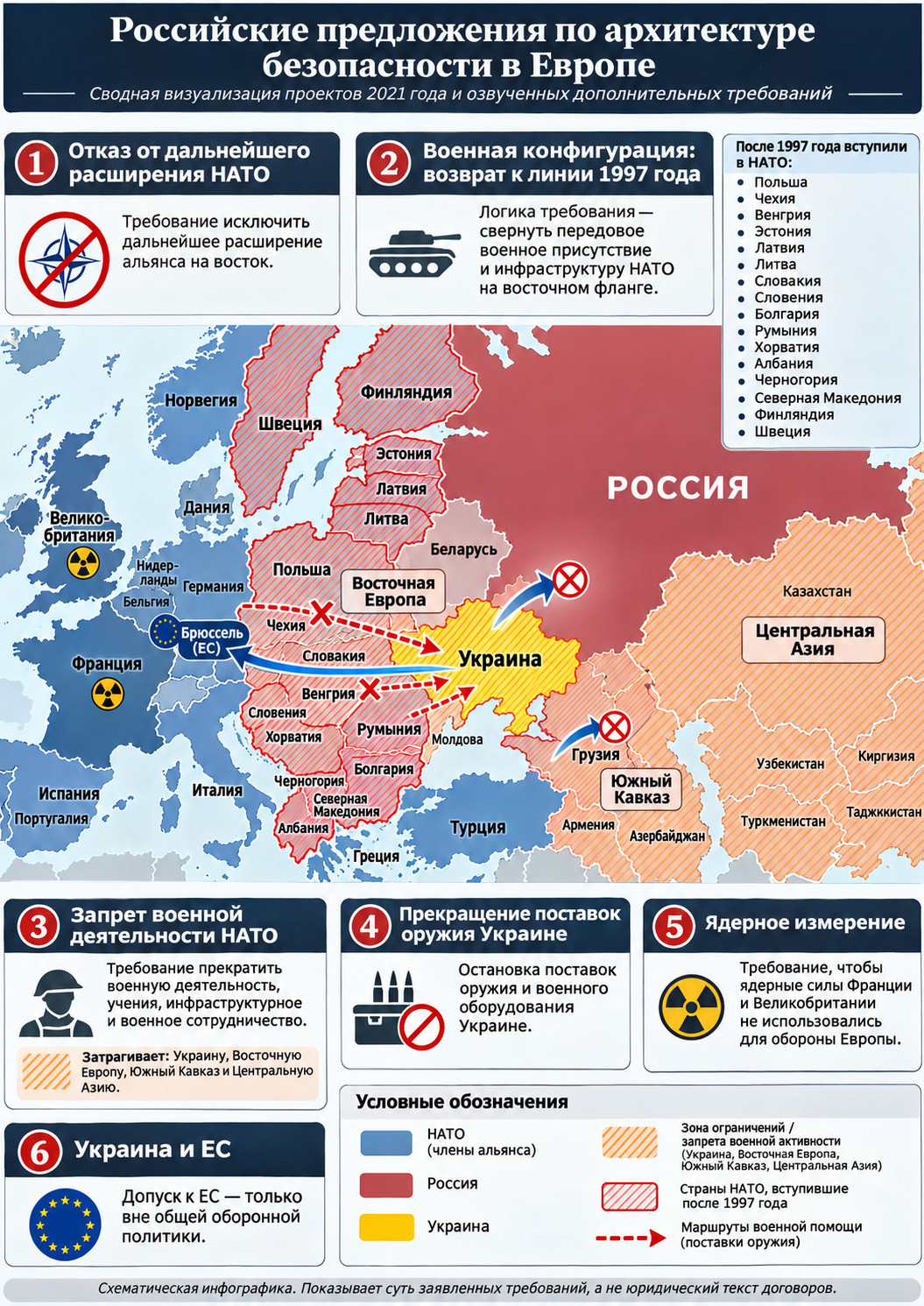
Infographic: translated labels and legend
Russian proposals for Europe’s security architecture
Summary visualization of the 2021 drafts and the additional demands reported in 2026
1. No further NATO enlargement: exclude further eastward enlargement of the alliance.
2. Military configuration: return to the 1997 baseline. Reduce NATO’s forward military presence and infrastructure on its eastern flank.
3. Ban on NATO military activity: end military activity, exercises, and military and infrastructure cooperation in Ukraine, Eastern Europe, the South Caucasus, and Central Asia.
4. End arms supplies to Ukraine: stop deliveries of weapons and military equipment.
5. Nuclear dimension: France’s and the United Kingdom’s nuclear forces should not be used to defend Europe.
6. Ukraine and the EU: EU accession only outside the common defense policy.
Legend: NATO; Russia; Ukraine; zones of military-activity restrictions; NATO countries that joined after 1997; military-aid routes.
NATO countries that joined after 1997: Poland, the Czech Republic, Hungary, Estonia, Latvia, Lithuania, Slovakia, Slovenia, Bulgaria, Romania, Croatia, Albania, Montenegro, North Macedonia, Finland, and Sweden.
Note: Schematic infographic. It presents the substance of the reported demands, not the legal text of the treaties.
4. Why Is Moscow Returning to the Demands of 2021 After Five Years of War?
At first glance, such a negotiating position appears paradoxical.
Over the years of war, Russia has failed to achieve its initially declared objectives regarding Ukraine. At the same time, NATO has expanded to include Finland and Sweden, while European states have significantly stepped up military development.
In other words, the existing military-political configuration of Europe has become less consistent with Russia’s December 2021 demands in a whole range of respects.
However, this very fact may explain Moscow’s return to its previous conditions.
The Russian leadership probably views the prolonged war as an instrument for accumulating negotiating leverage, enabling it at a certain point to exchange the cessation of hostilities for broader strategic concessions.
In this case, Ukraine’s territories are only one element of the negotiating package.
Other elements include restrictions on the U.S. military presence, the transformation of NATO, a change in Ukraine’s status, arms control, and recognition of Russia’s special security interests in the post-Soviet space.
In this logic, Moscow seeks to capitalize on the results of the war not only through territorial acquisitions but also through a long-term change in the European balance of power.
At the same time, the maximum scope of the stated demands does not necessarily reflect the minimum conditions under which Russia would agree to conclude a deal. The current Russian proposals clearly represent an opening position that allows some room for bargaining.
From the standpoint of negotiation strategy, presenting an intentionally extensive package of demands makes it possible to establish a high opening price for an agreement, expand the range of potential trade-offs, and shift the discussion from the Ukrainian context to a broader Russian-American format.
However, the question remains open as to which demands Moscow regards as negotiable and which it considers a necessary condition for ending the war.
5. The United States and Europe: Diverging Strategic Interests
The return to the Russian proposal of 2021 also intensifies structural contradictions between Washington’s interests and those of individual European states.
For the United States, the priority may be to settle the Russian-Ukrainian war, reduce financial and military-political commitments in Europe, and free up strategic resources for other theaters, above all the Indo-Pacific region.
However, agreeing to large-scale restrictions on NATO’s presence in Eastern Europe would affect the United States’ position as the leading military power on the European continent.
For the states on NATO’s eastern flank, the issue is even more immediate.
Poland, the Baltic states, Romania, and Finland regard the forward presence of allies as a crucial deterrence instrument. Its reduction would change not only the military-operational balance but also the distribution of political influence within the alliance.
A different structure of interests exists among certain Western European states, for which reducing the likelihood of a direct military confrontation with Russia may have particular strategic value.
This does not mean that European states are prepared to accept Russian demands. But it demonstrates the existence of different national costs and potential benefits associated with different settlement models.
The main problem is that a compromise acceptable to Washington within the framework of its global strategy would by no means necessarily be acceptable to the states on NATO’s eastern flank.
By proposing negotiations primarily with the United States, Russia is effectively returning to the traditional model of interstate security regulation in which states possessing the greatest military-political resources play the decisive role.
However, contemporary Europe differs substantially, institutionally, from the Europe of the Cold War. NATO and the EU have their own decision-making mechanisms, while Eastern European states have opportunities to block agreements that directly affect their security.
Therefore, even a potential Russian-American agreement would not guarantee the automatic consent of European allies.
6. Is a Grand Geopolitical Compromise Possible?
Comparing the Russian drafts of 2021 with the new demands reveals the main contradiction in the negotiations.
Moscow seeks legally binding restrictions on Western military activity in Europe and the post-Soviet space. Washington and European states must assess what reciprocal restrictions on Russian military activity could compensate for such concessions.
Yet as early as January 2022, the United States offered Russia negotiations on mutual restrictions on the deployment of offensive missiles and permanent combat forces in Ukraine, transparency measures at missile defense facilities, and the reduction of military risks.
Consequently, room for partial military-technical agreements already existed at that time.
The main problem lay in the difference between the ultimate objectives: Washington proposed regulating specific military threats, while Moscow demanded a revision of the entire regional security configuration.
Today, this problem persists, but the price of a possible agreement has risen significantly.
Any restrictions on NATO will require reciprocal Russian commitments, verification mechanisms, agreement on geographical zones, and procedures for responding to violations.
Moreover, it is impossible to establish a new security architecture on a sustainable basis solely through U.S. and Russian commitments if its most important elements directly affect Ukraine, EU states, and the European members of NATO.
A possible compromise arrangement could include mutual restrictions on certain types of weapons, transparency regimes, incident-prevention mechanisms, and special agreements on military infrastructure.
However, such arrangements are not equivalent to full recognition of geographical spheres of influence. They presuppose managed military-strategic rivalry rather than necessarily eliminating the rivalry itself.
7. Conclusion
The Russian proposals of November 2026 demonstrate that the war in Ukraine remains part of a much broader conflict over the distribution of military-political power in Europe.
Moscow is effectively returning to the negotiating baseline of December 2021, but is attempting to supplement its previous demands with the results of years of war and new restrictions on European defense autonomy.
At the center of Russia’s strategy is not so much the geographical expansion of its own territory as the effort to establish restrictions on the use of Western military force in immediate proximity to Russian borders.
At the same time, a settlement in Ukraine is becoming a potential instrument for changing military-political relations among Russia, the United States, and European states.
The main question in the forthcoming negotiations is no longer only where the ceasefire line between Russia and Ukraine will run, but what changes in the European balance of power may become the price of that ceasefire.
If Moscow continues to link the end of the war to a revision of the European security architecture, the negotiating process will face additional structural contradictions. Its outcome will depend not only on the situation at the front, but also on the ability of the United States, Russia, Ukraine, and European states to agree on mutual restrictions backed by real military-political guarantees.
In the absence of such an agreement, even a possible cessation of hostilities in Ukraine would not eliminate the strategic causes of the Russian-Western confrontation.
Conversely, a shift to negotiations on a broader security system may create new opportunities for a settlement—but would simultaneously raise its political price, increase the number of participants, and significantly complicate the achievement of a final agreement.
Thus, Moscow is proposing that the West discuss not only the end of the war but also the conditions for future strategic coexistence in Europe. It is this, rather than individual provisions concerning Ukraine’s membership in NATO or a territorial settlement, that is becoming the key dimension of the current negotiating process.
Ruslan Bortnik,
Director of UIP