This week we observed a series of developments that collectively deliver a significant information and political blow to the position of the President of Ukraine.
In particular, the former Head of the Presidential Office has been formally charged — NABU and SAP believe that Andriy Yermak, as part of the ongoing “Mindychgate” case, is involved in laundering UAH 460 million through elite real estate construction near Kyiv.
At the same time, NABU and SAP stated that the President of Ukraine has not been and is not involved in the investigation in any legal capacity (although the suspicion against Mindych does mention the President), which is generally expected given his constitutional immunity, while NSDC Secretary Rustem Umerov is involved in the case as a witness.
Despite these statements, internal opposition is already forming an alternative interpretation of the situation. In particular, MP and head of the parliamentary investigative commission Oleksiy Honcharenko points out that the case materials refer to Tymur Mindych exercising influence through personal relations with the President of Ukraine. Based on this, he shifts the focus to the substantive content of the case and argues that if the investigation reaches the President, the materials should be transferred to Parliament to potentially initiate impeachment proceedings.
The “Mindych” case has from the outset developed within the framework of a confrontation between the anti-corruption vertical (NABU/SAP) and a multi-layered anti-presidential opposition and the Ukrainian authorities over influence on key economic, security, and governance institutions. This struggle has intensified following the EU’s decision to allocate a €90 billion loan to Ukraine. Despite his formal dismissal, Yermak likely retained influence over parts of the state governance system, as the кадровая structure he built continued to function. This is why he is seen as the primary target of the investigation. In other words, the intensified activation of the “Mindych” case may be aimed at altering the internal balance of power — weakening the influence of the presidential circle over key economic flows and security structures.
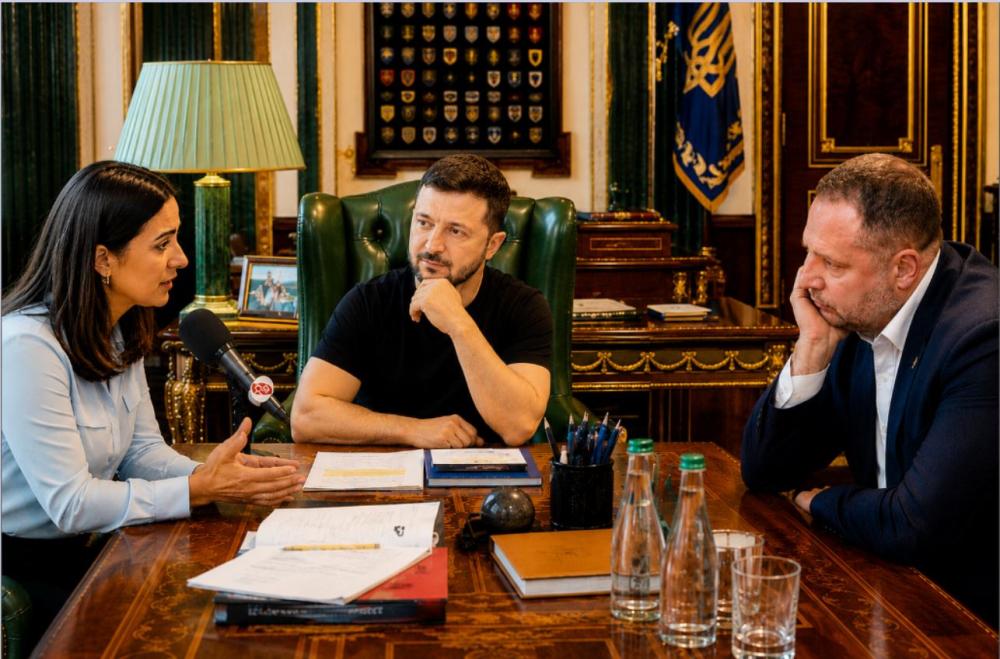
At the same time, former Presidential Office spokesperson Yulia Mendel gave a high-profile interview to American journalist Tucker Carlson, which also impacts Zelensky’s image. Mendel claimed that he had allegedly been ready to concede part of Donbas to Russia back in 2022. The Presidential Office denied these statements, noting that Mendel could not have had such information. Notably, the interview was originally recorded in English, likely in February–March 2026, and targeted at a broad Western audience. This gives it foreign policy significance and makes it appear as a form of pressure from parts of the American conservative establishment (to which Carlson belongs), oriented toward negotiations and a deal with Moscow.
Overall, the situation points to a transition into an acute phase of attempts to weaken Zelensky and his team, as well as a possible restructuring of Ukraine’s system of governance.
Pressure is forming from two directions simultaneously: from the internal anti-corruption environment (potentially backed by Western liberal elites), political and economic opposition seeking redistribution of influence and a new power configuration (control over security agencies, key economic sectors, and public procurement, as well as changes in government composition).
And from part of Western, primarily American conservative circles, oriented toward a rapid end to the war in Ukraine through компромises with Russia. At the same time, the US is interested in having such decisions formally initiated and implemented by Kyiv, with Zelensky bearing the political responsibility. However, he is not ready for this, which further increases elements of political pressure.
Against this background, the end of the three-day ceasefire and the resumption of strikes deep inside Ukrainian territory mark a return to a hard military phase. The pace of Russian advances on the фронт remains limited, but the overall level of escalation in the war remains high, including elements of nuclear coercion.
Overall, the ceasefire demonstrated the degree of process manageability by Washington. However, the May 9–11 ceasefire, tied to Victory Day, was situational and short-term and did not continue, as the sides remain far from consensus and the negotiation process continues to deteriorate.
Nevertheless, a large-scale escalation was avoided, largely due to the intervention of the key mediator — the United States. The ceasefire situation also strengthens Donald Trump’s position ahead of his planned visit to Beijing on May 13–15.
__________________
Three-day ceasefire between Ukraine and Russia.
The three-day ceasefire between Russia and Ukraine, which lasted from May 9 to May 11 inclusive, officially ended on May 12 and was not extended. At the same time, the absence of long-range strikes during this period shows that the parties are capable of reaching agreements to limit hostilities with US mediation — albeit on a short-term basis.
Overall, the situation demonstrated the manageability of the process by Washington. However, the ceasefire itself on May 9–11 (timed to Victory Day) was situational and short-term in nature and did not receive continuation, as the parties remain far from consensus and the negotiation process continues to degrade.
At the same time, a large-scale escalation was avoided — largely due to the intervention of the main mediator, the United States. The ceasefire situation between Russia and Ukraine also strengthens Trump’s position ahead of his visit to Beijing, which is already scheduled for May 13–15.
It can be noted how complex and difficult the structure of forming this ceasefire was — through a series of unilateral initiatives.
Against the backdrop of massive Ukrainian drone attacks (on some days up to 500–600 Ukrainian drones were reportedly shot down over Russian territory per day), Russia, concerned about the security of the Victory Day parade on May 9 in Moscow and other cities, announced a unilateral ceasefire for May 8–9. At the same time, Moscow did not hide that it expected reciprocal steps from Ukraine.
In turn, Ukraine, not wanting to act within the framework of Russian initiatives, proposed its own unilateral ceasefire for May 5–6. However, it was ignored by Russia — strikes continued, leading to new civilian casualties and attacks on various facilities on Ukrainian territory.
In response, Ukraine made it clear that it does not bind itself by obligations not to strike during festive events on Russian territory on May 9 and continued strikes on May 8. In turn, Russia officially threatened to launch a massive missile strike on the center of Kyiv in case of disruption of the events and unsuccessfully called on foreign diplomats to leave the city.
Additionally, Russia closed the airspace over the Kapustin Yar test site (from where launches of the “Oreshnik” missile system are traditionally carried out) and announced exercises at the Kura test range in the Ust-Kamchatsky district — one of the key sites for launching intercontinental ballistic missiles, including those with nuclear payloads.
An important component was both public and non-public threats from Moscow. The main target of pressure was not so much Ukraine, which did not respond to such signals and continued its political game, but rather Europe and the United States.
In particular, Russian Foreign Ministry spokesperson Maria Zakharova called on Western embassies to leave central Kyiv, warning of a possible massive missile strike on the capital. Russian Foreign Minister Sergey Lavrov stated: “there will be no mercy.”
Thus, after failed attempts by Russia and Ukraine to introduce unilateral ceasefire regimes, the Russia–Ukraine war once again approached a dangerous threshold of large-scale escalation.
Finally, late in the evening of May 8, US President Donald Trump announced another ceasefire — for May 9, 10, and 11, and also reported a possible prisoner exchange under the “1000 for 1000” formula.
Trump emphasized that he had not communicated directly with Putin and proposed his ceasefire initiative as a response to signals transmitted by the Russian side through communication channels.
It is known that Russian Foreign Minister Sergey Lavrov contacted US Secretary of State Marco Rubio, while Russian presidential aide Yuri Ushakov communicated through his channels with US presidential envoy Steve Witkoff and Jared Kushner. At the same time, NSDC Secretary Rustem Umerov visited the United States during the past week.
Apparently, the United States took Russia’s threats seriously or considered them a convenient повод to attempt to relaunch the negotiation process. As a result, the US exerted pressure on the Ukrainian side, and Ukraine agreed to a ceasefire model that partially takes into account Russian proposals.
Overall, the model looks as follows: Russia pressured the West, the West pressured Ukraine.
As a result, a compromise ceasefire option emerged: not fully Russian and not Ukrainian, but rather an American model — a ceasefire for May 9, 10, and 11.
At the same time, the Ukrainian leadership, understanding that agreeing to a ceasefire on May 9 could be perceived as a concession to Russia, attempted to neutralize this effect. This manifested in a form of “trolling” — a decree by the President of Ukraine allowing the parade in Moscow.
At the same time, a full ceasefire did not occur: the parties temporarily refrained from long-range strikes deep into each other’s territories, but fighting on the front line continued.
Nevertheless, large-scale escalation was avoided. Indeed, if the parties had exchanged strikes during those days, it could have given Russian “hawks” a reason to increase pressure on Putin and his inner circle to deliver a maximally harsh “retaliatory strike” against Ukraine — up to discussions of the use of nuclear weapons.
The President of Ukraine also once again stated that an American delegation may visit Ukraine at the end of May — early June. The absence of precise dates indicates that the parties do not see anything urgent in the situation and are not counting on any breakthroughs. These negotiations are rather technical, working-level processes without expectations of significant results.
At the same time, the level of tension between Ukraine and Russia remains high; in particular, the Kremlin continues to demonstrate adherence to its ultimatums. Russian presidential aide Yuri Ushakov made it clear that another round of trilateral talks between Moscow, Washington, and Kyiv currently makes no sense, as for further progress Kyiv must withdraw its troops from Donbas.
“Everyone understands, including, I would say, Ukrainian negotiators, that now Kyiv needs to take just one serious step, after which, firstly, hostilities will be suspended, and secondly, prospects will open for a serious discussion of long-term settlement. Everyone understands this, so now, frankly, persuading each other is largely a waste of time, because this step is now expected from Kyiv, particularly from Zelensky,” Ushakov said.
The statement by Russian President Vladimir Putin that the war in Ukraine may soon end should rather be interpreted as a calculation that the United States will increase pressure on Ukraine in order to achieve the withdrawal of Ukrainian troops from Donbas.
Overall, it cannot be ruled out that pressure on Ukraine may indeed intensify in the near future in order to achieve a faster cessation of hostilities. This may be linked to US domestic political logic — the approaching congressional elections and the need to demonstrate foreign policy achievements amid the crisis in the Middle East.
In this regard, signals of attempts to relaunch the negotiation process are appearing more and more frequently. In particular, unofficial discussions are circulating about a possible scenario of a temporary ceasefire along the front line (while Russia continues to demand the transfer of all of Donbas), which could be accompanied by partial concessions from the West, including easing sanctions pressure on Russia.
Such approaches are causing concern in Ukraine, as they may involve fixing the current configuration of the conflict without clear security guarantees, while simultaneously reducing financial pressure on Moscow.
Former Head of the Office of the President Andriy Yermak has been served with a notice of suspicion as part of the “Mindichgate” case.
On the evening of May 11, NABU and SAP announced that a notice of suspicion had been served to former Head of the Office of the President of Ukraine Andriy Yermak. The suspicion concerns possible involvement in laundering 460 million hryvnias obtained illegally during the construction of the “Dynasty” cottage complex in the village of Kozyn near Kyiv.
It should be recalled that earlier, on April 28, Ukrainska Pravda journalist Mykhailo Tkach published new fragments of wiretapping recordings from the apartment of businessman Timur Mindich, who is close to the Office of the President.
According to the investigation, the construction of private residences in Kozyn was financed through controlled entities, cooperatives, and companies with signs of fictitious activity. NABU claims that part of the funds was disguised, and the real owners of the property were concealed.
Along with Yermak, businessman and former business partner of the President Timur Mindich and former Deputy Prime Minister Oleksiy Chernyshov are also фигурants in the case — they have also been served with notices of suspicion.
The suspicion has been issued under Part 3 of Article 209 of the Criminal Code of Ukraine — legalization (laundering) of property obtained through criminal means. The article предусматривает imprisonment from 8 to 12 years with confiscation of property.
Part of the court hearing will be held behind closed doors. The defense requested a postponement of the case review. The court ruled that on May 12 the prosecution and part of the materials will be heard, but no preventive measure has yet been chosen.
According to Yermak’s lawyer, the case materials consist of 16 volumes of 250 pages each. The prosecution intends to request detention with the possibility of bail in the amount of 180 million UAH.
Anti-corruption bodies stated that the President of Ukraine did not and does not appear in this investigation, which is generally expected given his constitutional immunity, while NSDC Secretary Rustem Umerov проходит in the case as a witness.
Despite statements by NABU and SAP regarding the President, the internal opposition is already beginning to form an alternative interpretation of the situation. In particular, Member of Parliament and head of the relevant parliamentary commission Oleksiy Honcharenko points out that the suspicion materials state that Timur Mindich exercised his influence through personal, friendly relations with the President of Ukraine. On this basis, he emphasizes not so much the formal absence of the President in the case as the substantive content of the materials. According to his logic, if during the investigation law enforcement reaches the sitting President, anti-corruption bodies must bring the evidence collection to the level at which, in the case of any other person, a suspicion would already have been issued, and transfer the materials to Parliament for the possible initiation of impeachment proceedings.
The “Mindich” case from the very beginning has been developing in the context of confrontation between the anti-corruption vertical and the current Ukrainian authorities for control over key economic, security, and administrative institutions of the country. This confrontation significantly intensified after the EU’s decision to allocate a €90 billion loan to Ukraine.
Yermak, despite his formal dismissal, most likely continued to retain influence over part of the system of state governance. That is why he is considered the primary target in this investigation. At the same time, the President himself remains outside the direct strike for now. This can be interpreted as a signal — without directly targeting the head of state, to limit and redistribute influence within the власти.
In this context, the case can also be seen as an attempt to weaken the presidential вертикаль and Zelensky personally.
The Yermak case may become one of the most high-profile anti-corruption cases in Ukraine in recent times. Even without being a direct figure in it, the President risks incurring significant political and reputational losses — both domestically and in relations with Western partners. This is especially sensitive against the background of European integration processes, where Ukraine is trying to accelerate progress, while the EU, on the contrary, signals that this process may be lengthy.
At the same time, as long as the President is not directly involved in the case, the risks of systemic destabilization remain limited. It is rather about redistribution of influence within the власти and strengthening of external oversight — in which European partners of Ukraine may be interested.
Such a sharp intensification of the “Mindich” case, already involving Yermak, may also be seen as a kind of incentive for the President to accelerate the implementation of declared European reforms. These, in particular, are aimed at strengthening the role of the anti-corruption vertical, reducing the influence of the Prosecutor General’s Office, the SBU and other institutions, as well as personnel changes in favor of figures oriented toward the EU and the anti-corruption environment. Similar processes may also affect key sectors of the economy, primarily energy and the defense-industrial complex.
Interview of former press secretary Yulia Mendel with American conservative journalist Tucker Carlson.
Former press secretary of the President of Ukraine Volodymyr Zelensky, Yulia Mendel, gave a one-and-a-half-hour interview to American journalist Tucker Carlson. The video was published on May 11. This interview became an additional informational blow to Zelensky. Mendel actively criticizes the President, accusing him of prolonging the war and seeking to remain in power at any cost.
One of the central messages concerned the 2022 negotiations. Mendel claimed that Ukraine was allegedly ready to give Donbas to Russia during the talks in Istanbul. The Office of the President denied this. Communications advisor Dmytro Lytvyn stated: “This lady did not participate in the negotiations, did not take part in decision-making, has long not been in her right mind, and who tells her something there and whether it actually happened — it is not serious to comment.” It should be recalled that the President currently категорически opposes the withdrawal of troops from Donbas, as insisted upon by the Kremlin.
The key line of the interview was the idea that the war has lost its meaning. Mendel stated: “If the war is for joining NATO — Ukraine has no chance of joining; if against Zelensky — then he is its main beneficiary; if for the return of territories — Ukraine has been losing them for three years; if for democracy — then there is no democracy in the country now.” In her opinion, Zelensky is interested in continuing the war and is “one of the biggest obstacles to peace today,” and the end of the war should be achieved by any means.
A separate block of accusations concerns the political style and personal qualities of the president. Mendel accused Zelensky of acting, stating that he is “emotionally uncontrollable,” “changes masks,” and allegedly “does not have empathy but only plays it.” She also hinted at possible drug use, calling it an “open secret.”
Significant attention was paid to domestic politics and media control. According to Mendel, Zelensky allegedly stated that Ukrainians are “not ready for democracy” and need a tougher model of governance. She also claimed that he demanded his team to conduct “propaganda like Goebbels” and promote a positive agenda: “The most important thing is that we need 1000 talking heads. And if 1000 talking heads talk about positive things, then positive things happen, and people believe that there are positive things.” Mendel portrayed Zelensky as a “hidden evil” and a dual figure: “What the Russian army is doing in Ukraine is crimes against humanity. But this war is no longer black and white. It is dark. And even darker. We see Putin as evil. But Zelensky is also evil — just hidden. On camera he plays a teddy bear. But when the lights go out, he turns into a grizzly bear and destroys people.”
There was also criticism of the socio-political atmosphere in the country. Mendel stated that in Ukraine “everything is forbidden” and called the moment of silence at 9:00 a.m. in memory of the fallen a “strange rule,” noting that she finds it unusual that cars stop and the anthem is played at that moment.
At the end of the interview, Mendel addressed Russian President Vladimir Putin in Russian, calling on him to end the war with one decision and to stop the “drone safari” in Kherson. She described the war in Ukraine as a “war without a winner,” in which “Slavs are killing Slavs.”
After the interview was released, Yulia Mendel was added to the “Myrotvorets” database in Ukraine.
It is noteworthy that the interview was originally recorded in English (possibly in February–March 2026) and targeted at a broad Western audience, primarily American. This is fundamentally important, since the main reputational risks for Zelensky are formed in the external environment — in the eyes of Western partners, on whom Ukraine’s political, military, and financial support directly depends. Tucker Carlson is one of the most influential media figures in the United States, whose content on platforms X and YouTube regularly gathers tens of millions of views. In this context, the interview takes on not only domestic political but also foreign policy significance and appears as an element of pressure from part of American conservative circles oriented toward negotiations and a deal with Moscow.
In this form, it can be viewed as an instrument of “coercion to peace” — an attempt to push Zelensky toward a more flexible negotiating position, in which he would bear the main reputational costs of possible concessions.
The level of military escalation in the war between Russia and Ukraine remains high, with elements of nuclear blackmail.
Despite the coercion of the conflict parties by the United States into a three-day ceasefire, the overall tension has not decreased; on the contrary, it is accompanied by demonstrative signals of military escalation.
In particular, Russia conducted a successful launch of a new intercontinental ballistic missile “Sarmat,” capable of carrying nuclear warheads, which Strategic Missile Forces commander Sergey Karakayev reported to Vladimir Putin. According to him, by the end of the year the Sarmat system will be put on combat duty in the Uzhur formation.
Additionally, Putin stated the possibility of equipping the “Oreshnik” missile system with nuclear warheads and noted that work on the “Poseidon” and “Burevestnik” systems is at the final stage.
Thus, alongside tactical attempts to limit hostilities, Russia is increasing strategic pressure, demonstrating readiness for further military buildup, including the nuclear component.
Against this background, starting from May 12, Russia resumed massive strikes on Ukrainian territory, effectively returning to an intensive phase of hostilities. The strikes again affected a number of regions, primarily the east and south of the country, as well as certain infrastructure facilities in central regions. In just one night, more than 200 strike drones were launched at Ukraine, over 30 airstrikes were carried out, and more than 80 aerial bombs were dropped.
The strikes affected Dnipropetrovsk, Zhytomyr, Mykolaiv, Sumy, Kharkiv, and Chernihiv regions, as well as Kyiv and the surrounding area. Damage to energy infrastructure, residential buildings, and civilian logistics facilities has been recorded; there are wounded and dead. The situation overall confirms the transition from a short-term “ceasefire” to continued pressure by military means.
Combat operations.
The pace of Russian advances on the front remains limited. Over the past week, Russian forces captured about 25 square kilometers of Ukrainian territory and currently control 116,873 thousand square kilometers (19.36%).
Donetsk region (key offensive theater for Russia): Russian forces continue pressure in several sectors simultaneously — Sloviansk, Kostiantynivka, and Novopavlivka directions. Advances are reported in the Sloviansk direction in the areas of Dibrova, Holubivka, and Zakotne, as well as west of Hryshyne near Pokrovsk. This indicates attempts by Russia to stretch Ukrainian defenses and maintain pressure on key logistics hubs in the area.
In the Sumy region, Russian pressure continues along border areas, forcing Ukraine to redistribute resources.
Zaporizhzhia direction (Ukrainian counteractions): Ukrainian forces managed to worsen the position of Russian troops in the areas of Prymorsk and Stepnohirsk, where Russian units were pushed back and forced into defensive positions under pressure from Ukrainian counterattacks.
Against the backdrop of the US-announced three-day ceasefire (May 9–11), supported by Kyiv and Moscow, long-range strikes on rear infrastructure were effectively not carried out, which both sides acknowledged. However, fighting on the front line did not stop: artillery shelling, drone strikes, and local advances continued.
The front remains in a phase of slow movement due to seasonal factors: the absence of dense foliage (“green cover”) and unfavorable weather conditions limit the possibilities for large-scale offensives. However, Russia may move to a new phase of its summer offensive approximately from May 20, when more favorable weather conditions are expected to form.
Sociology.
A new Eurobarometer survey (conducted from March 12 to April 5, 2026, in 27 EU member states), published on the eve of Europe Day, shows fairly strong support for Ukraine among Europeans.
Thus, 76% of European respondents agree that Russia’s invasion of Ukraine poses a threat to EU security.
55% are satisfied with the EU’s response to Russia’s invasion of Ukraine.
76% (3 out of 4 respondents) believe that the EU should continue to support Ukraine until a just and lasting peace is achieved. 20% disagree; 4% are undecided.
The most supported measures are:
80% — accepting into the EU people fleeing the war;
75% — providing Ukraine with financial and humanitarian aid;
70% — imposing economic sanctions against the Russian government, companies, and individuals;
56% — financing the procurement and supply of military equipment to Ukraine.
Support for Ukraine’s accession to the EU is declining.
57% of Europeans support granting Ukraine candidate status for EU membership (down 10% over three years). At the same time, in autumn 2023 about six out of ten supported granting Ukraine candidate status (61%) (in August 2023 it was 67%).
***
According to data from the Rating Sociological Group survey conducted on April 15–17, 2026, Ukrainian society generally maintains a high level of positive attitude toward the European Union and the idea of European integration.
Thus, 72% of Ukrainians believe that Ukraine’s membership in the EU would bring significant benefits to the country. Only 18% hold the opposite view, while another 10% are undecided. Support for European integration remains high in all regions of the country: from 67% in the South to 80% in Kyiv.
At the same time, 59% of respondents overall assess Ukraine’s potential EU membership as a “good” phenomenon, and only 6% as “bad.” Another 29% take a neutral position, considering it “neither good nor bad.” The most positive attitude toward EU accession is recorded in Kyiv and western regions, although even in the East and South the majority also perceive European integration positively.
It is also notable that among supporters of Ukraine’s accession to the EU, 92% believe that the country would benefit from it, and 83% describe membership itself as “good” for Ukraine. At the same time, even among opponents, 19% acknowledge that Ukraine could still receive some benefit from EU membership, although 73% believe otherwise.
For Ukrainians, the EU today is primarily associated with peace (42%), respect for human life (39%), and democracy (29%). It is particularly notable that Ukrainians associate respect for human life with the European Union more than twice as often as residents of EU countries themselves — 39% versus 15%.
At the same time, in EU countries the Union is more often perceived through the categories of rule of law, human rights, democracy, and support for other countries. This reflects the impact of the war on Ukrainian society: for Ukraine, Europe today is primarily perceived as a space of security, preservation of life, and peace, whereas for Europeans themselves the emphasis is shifted toward institutional and legal values.
According to data from a KIIS survey conducted on April 20–27, 2026, the level of optimism in Ukraine has slightly decreased since January 2026 but remains relatively high. 63% of Ukrainians are optimistic about the future of Ukraine (66% in January). On the other hand, the share of pessimists is 25% (previously 22%).
The need to approve unpopular decisions to receive Western funding.
48% of respondents chose the option that Ukraine should approve all necessary decisions, including unpopular tax increases, in order to receive funding. Every third respondent (30%) believes that unpopular decisions and tax increases should be rejected, even if this means a lack of funds for defense or social programs. A significant share (22%) could not decide.
What is the biggest threat to Ukraine’s development — corruption in government or Russian military aggression?
54% choose corruption (in May 2024 it was 48%). 39% consider military aggression a greater threat (compared to corruption) (in May 2024 it was 36%). Another 7% could not decide (in May 2024 — 16%).
The less respondents trust V. Zelensky, the more often they identify corruption as a more important problem than the war.
Among those who “do not trust at all,” the view that corruption is the greater threat dominates (76% vs. 16% citing war). Among those who “rather do not trust,” corruption also prevails (56% vs. 37%). Among those who “rather trust” (49% vs. 46%), while among those who “fully trust,” slightly more consider war the greater threat (52% vs. 42%).
Among those who consider war the greater threat, they are significantly more optimistic about the country’s future — 72% are optimistic, 16% pessimistic. Conversely, among those focusing on corruption, 57% are optimistic and 32% pessimistic.
Willingness to make concessions on Donbas.
57% of respondents consider it categorically unacceptable to transfer the entire Donetsk region under Russian control in exchange for security guarantees. At the same time, 36% are ready for such a concession (although most admit it is a difficult condition). Another 7% could not decide.
Current indicators (as of late April) have returned to February levels.
Compared to early March 2026, the share of those categorically opposed decreased by 5% (from 62% to 57%). The share of those who agreed increased from 33% to 36%.
Who is undermining efforts to achieve peace?
A majority of Ukrainians — 60% — believe that Russia is the main actor undermining efforts to end the war. The United States follows with 14%. Ukraine is blamed by 7%, Europe by 5%, and China by 2%.
When will the war end?
17% expect the war to end as early as summer 2026. Another 14% expect it to end by the end of the year, meaning 31% believe hostilities will end by the end of 2026.
48% expect the war to end in 2027 (38% of them in the second half of 2027). 21% have no clear opinion.
How long are Ukrainians ready to endure the war?
The negative trend of decreasing willingness to endure the war as long as necessary continues in April. If in early March this figure was 54%, by the end of April it dropped to 48% (-6% in a month). Another 4% are ready to endure for one year, meaning a total of 52% indicate a relatively long-term horizon (57% in March).
The share of those willing to endure only a short period (several months to half a year) remained almost unchanged — 28% in March and 29% in April. If 16% were undecided in March, now it is 19%.
Among those willing to endure only a short period, 44% categorically reject the proposal to exchange Donbas for security guarantees from the US and Europe. Among the undecided, 49% reject such a proposal. Meanwhile, among those ready to endure as long as necessary, 69% categorically reject the idea.
Trust in security guarantees from Europe and the United States.
Compared to January 2026, trust in security guarantees from both Europe and the United States has declined. If at the beginning of the year 59% expected Europe to provide support in case of renewed aggression, now it is 52%. The share of those who do not believe in European support increased from 31% to 41%.
In the case of the United States, while in January there was parity, now the majority of Ukrainians do not believe the US will provide necessary support. The share of those who do not believe increased from 40% to 57%. The share of those who trust US guarantees decreased from 39% to 27%.
Separately, in the case of the US, compared to Europe, twice as many respondents were undecided — 16% versus 7%.
_____________________
These results of the KIIS survey indicate a narrowing of society’s overall reserve of patience: support for the state remains, but the cost of that support is becoming increasingly sensitive, requiring a more rational and demanding assessment of the actions of the authorities.
A steady and accelerating decline is recorded in the share of those willing to endure the war “as long as it takes.” For the first time since the beginning of the full-scale war, this indicator has dropped below 50% — to 48%. If previously such sentiments were more gradual in nature, now there is a noticeable acceleration in the rate of decline — since January 2026 (-17%).
There is a clear growing fatigue from the war in Ukrainian society, but a rational demand for negotiations without losing positions is also preserved.
The majority — 57% — still categorically oppose the transfer of Donbas, although since early March this share has decreased by 5%, while the share of those who allow such a concession has increased by 3%.
It can be said that society is transitioning from the state of emotional mobilization of the early years of the war to a more complex phase — limited readiness to continue hostilities, in which a firm position on key issues (in particular, refusal to make concessions on Donbas) is maintained, but the time resource during which this position can be sustained without change is decreasing.
It is noteworthy that for 54% of citizens, government corruption already appears to be a greater threat to the country’s development than Russian military aggression. At the same time, this does not actually indicate a decrease in the perception of the military threat, but rather shows that society increasingly links Ukraine’s future not only to the situation at the front, but also to the quality of governance (which, incidentally, has a significant impact on the front itself).
Attitudes toward corruption are directly linked to trust in President Volodymyr Zelensky: the lower the trust, the more often respondents identify corruption as the main threat. Against this background, even the preservation of high optimism about Ukraine’s future (63%) does not eliminate the growing irritation with internal problems of governance.
Ruslan Bortnik, Oksana Krasovskaya
for the Ukrainian Institute of Politics
Friends, we remind you that you can order additional:
Weekly Intelligence Brief, B. Geopolitical Risk Reports, Executive Briefings on issues of interest by contacting: uiamp2012@gmail.com or by phone: +38 093 757 7565.