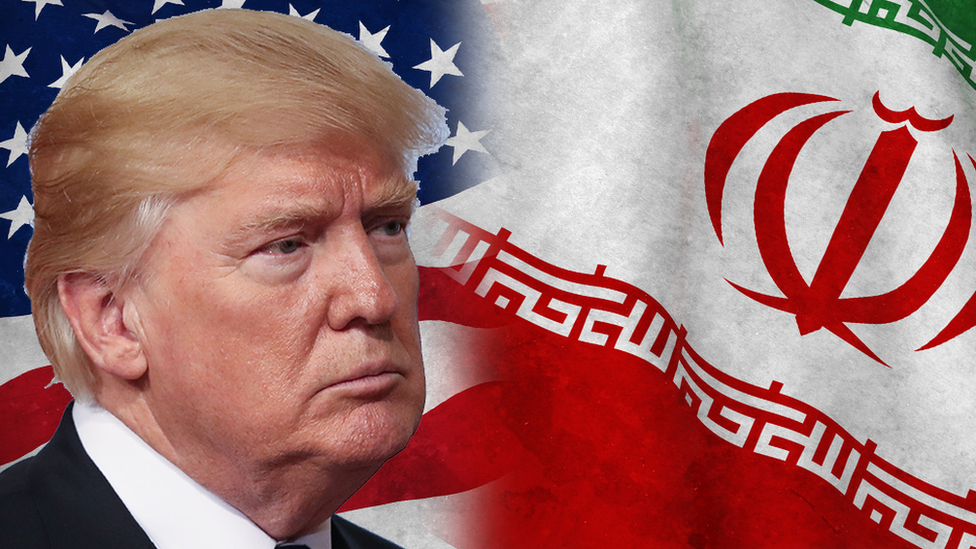
The war in the Middle East, which began on February 28, 2026 with a military operation by the United States and Israel against Iran and Tehran's retaliatory strikes, can significantly affect the situation around Ukraine. The scale of the consequences will depend on the duration of the conflict, the level of US involvement and the reaction of key global players, primarily China.
For Ukraine, the main risk is associated with the redistribution of resources and attention of Western countries. The aggravation in the Middle East can reduce the funding of allies and slow down the supply of weapons to Ukraine, as well as increase pressure on Kyiv in the negotiation process. In the event of a protracted escalation, the United States may be forced to redistribute military stocks, including missiles for Patriot systems and other air defense systems, as well as financial resources.
Rising oil and gas prices in the event of a prolonged conflict objectively plays into the hands of Russia, increasing its revenues and ability to finance the war. At the same time, this increases Europe's energy vulnerability and may intensify internal discussions in the EU about priorities for supporting Ukraine.
In the context of the war in the Middle East, the negotiation track on Ukraine may temporarily "calm down" (although technical contacts will certainly continue). The parties will closely monitor what denouement the confrontation between the United States and Israel with Iran will lead to: a quick military victory or a protracted conflict with the expansion of geography and the involvement of new actors. Russian Federation and Western allies. At the same time, Russia's growing distrust of U.S. initiatives could further complicate or even freeze the negotiation process.
Ukraine is counting on the fact that a quick and victorious US war in the Middle East can reduce the likelihood of compromise solutions in negotiations with Russia. In the event of a quick success of the United States, the positions of the "hawks" in Donald Trump's entourage may strengthen - those who oppose any concessions to Moscow and insist on maximum pressure on the Russian Federation. in which Moscow will become more inclined to make concessions on Ukraine.
But when it is actually an attempt at "regime change" in Iran, the conflict loses the scope of a short-term military campaign. The indirect involvement of global powers in the conflict – the United States, China and Russia – can give the confrontation additional escalatory dynamics and stability.
For Ukraine, the worst scenario will be a protracted war. In this case, the attention of Western allies will be switched, the volume of ammunition supplies will decrease, and the Russian Federation will be able to increase pressure at the front. In addition, this may push US President Donald Trump and European leaders to more actively persuade Kyiv to compromise.
A short-term escalation around Iran could complicate the logistics of supplying Iranian drones and components for Russia. In addition, if the conflict leads to the weakening or transformation of the Iranian regime, it could reduce Moscow's political and military-technical capabilities in the Middle East and reduce its strategic ties in the region.
At the same time, in the context of the war in the Middle East, the task of weakening the strategic rapprochement between Moscow and Beijing becomes even more urgent for the United States. Since the situation around Iran objectively increases the geopolitical importance of the Russian Federation for China , regardless of whether the conflict will be long or short-term. If energy supplies from the Persian Gulf are threatened, Moscow will become a key source of oil and gas for China. the value of the Russian-Chinese partnership for Beijing will increase even more as an insurance against potential dependence on Washington. This may also lead to increased support for the Russian Federation from China in the war against Ukraine.
Washington can weaken the ties between the Russian Federation and the PRC in two ways: either through tough pressure up to an attempt at the strategic defeat of the Russian Federation - which is counted on in Ukraine, but this is fraught with escalation, including nuclear risks; or through an attempt at a deal. The first scenario is more likely in the event of a quick and victorious US campaign in the Middle East - with the establishment of control over Iran and regime change. probably on terms that are not favorable for Kyiv. This option becomes more realistic with a protracted war in the Middle East or even a short conflict, but without regime change in Iran and a clear victory. In front of the domestic audience, especially on the eve of the congressional elections, the Trump administration will need positive foreign policy cases, which can be presented as a diplomatic victory and confirmation of the effectiveness of the MAGA (Make America Great Again) course. In this case, Washington will be interested in demonstrating success on the peace track in Ukraine in order to compensate for possible failures in the Iranian direction.
_____________________________________
The beginning of the war in the Middle East.
On February 28, 2026, the United States and Israel launched a large-scale military operation against Iran. The decision to use force was preceded by unsuccessful negotiations between the United States and Iran to limit the Iranian nuclear program. The last round of consultations in Geneva ended without progress, after which Washington made it clear that the diplomatic track was actually exhausted. According to the statement of the Special Envoy of the President of the United States Steve Witkoff, Iran reported that it allegedly accumulated enriched uranium for 11 nuclear bombs. It is known that even in the process of negotiations, the United States and Israel were already preparing in advance for a military scenario.
After the start of the strikes on Iran, the leaders of the United States and Israel said that the operation was aimed at neutralizing the threat from the Iranian regime and creating conditions for internal changes in the country. Tehran, in turn, blamed Washington for the escalation.
Iran is now being subjected to massive strikes, the main targets of the United States and Israel are missile and nuclear infrastructure facilities, command and control systems, command centers and leaders of the military-political leadership. As part of the operation against Iran, Israel launched airstrikes on the command posts of the Islamic Revolutionary Guard Corps (IRGC), including facilities where ballistic missiles were placed ready for launch. At the same time, the Israeli military attacked the positions and underground mines of the Iranian-allied Shiite movement Hezbollah in a number of areas of southern Lebanon.
On the first day of the war, the allies announced the elimination of Iran's Supreme Leader Ayatollah Ali Khamenei, as well as a number of senior officials, including the Minister of Defense and the commander of the Islamic Revolutionary Guard Corps (IRGC). US President Donald Trump also announced the sinking of 9 Iranian ships and the elimination of 48 senior officials.
In response, Iran has struck Israeli territory as well as targets in eight Arab countries in the region (including Qatar, Kuwait, the United Arab Emirates, Oman, Bahrain, Jordan, Iraq, and Saudi Arabia), targeting both U.S. and allied military bases (including facilities linked to France and the United Kingdom) and civilian infrastructure, including energy and transportation facilities.
At the current stage, Iran is concentrating strikes mainly on the infrastructure of the Persian Gulf countries, in order to create direct economic and military-political costs for these states, forcing them to influence Washington in order to stop the military operation. At the same time, Tehran seeks to increase pressure on global markets, primarily through the destabilization of energy supplies and rising oil prices, hoping thereby to increase the cost of the conflict for the United States and its allies.
Iran has carried out almost continuous strikes against US allies in the Middle East. US bases in Iraq, Kuwait, the UAE, Bahrain and Qatar, as well as ports and airports in these countries, were under attack. the largest oil terminal Ras Tanura in Saudi Arabia, as well as the Qatar Energy refinery in Ras Laffan, after which LNG production was stopped. The price of gas in Europe exceeded $500, oil rose above $80 per barrel with forecasts of growth to $100-150 in the event of a protracted war. An additional factor in the rise in prices was Iran's de facto blockade of the Strait of Hormuz, a key artery of world oil trade, through which up to a third of global maritime supplies of raw materials pass.
The international reaction turned out to be multidirectional. Great Britain, France and Germany demanded that Iran curtail its nuclear program, condemning its strikes on the territory of neighboring states. Australia, Canada, Ukraine and Lithuania supported the actions of the United States and Israel, while Russia, China and Turkey criticized them. A number of Arab countries in the Persian Gulf, which have become targets of Iranian attacks, condemned Tehran's actions and declared their right to retaliate. UN High Commissioner for Human Rights Volker Türk, representatives of the European Union, as well as Pakistan, India and Spain, called on the parties to exercise restraint and seek a diplomatic solution.
As events unfold, the strategic logic of Washington's actions is beginning to emerge: the stake is mainly placed not so much on the destruction of infrastructure, but on the "decapitation" of the regime – the disabling of key decision-making centers with the expectation of forming a new management core, more inclined to negotiations and concessions.
The allies have not yet been able to completely "decapitate" Iran's system of governance: the Iranian political and religious model of governance has demonstrated its readiness for a crisis scenario, and the basic manageability of the state has been preserved.
There is information about the possible election of Mojtaba Khamenei, the son of the deceased ayatollah, as the new Supreme Leader. At the same time, the key role in the current configuration of power, according to observers, may pass to the Secretary of the Supreme National Security Council of the Islamic Republic of Iran, Ali Larijani, who publicly declares his intention to continue the confrontation Maintaining internal control.
Israeli Defense Minister Yisrael Katz said that any new leader of Iran will be considered as a legitimate target for elimination, which increases the personalized nature of the conflict and increases the risks of further escalation. The resource of the Iranian regime's strength in the face of constant strikes and economic destabilization is objectively limited. The continuation of massive strikes by the United States and Israel with actual air dominance is gradually worsening the strategic position Iran.
A key factor that can change the dynamics of the conflict remains the possible significant losses of the United States in the war against Iran. According to official data, three combat aircraft were lost in Kuwait (Washington explains this by "friendly fire", Tehran claims that they were destroyed on its own), and 6 American servicemen were killed and 18 were wounded. If the scale of losses begins to grow, this will create domestic political pressure on the Donald Trump administration, including the risks of a decline in support ratings in the run-up to the congressional elections.
An additional factor is the assessment of the possible accelerated consumption of American stocks of anti-aircraft missiles, which in the future may affect the volume of supplies of air defense systems and ammunition to allies, including Ukraine.
An additional risk is associated with energy. The Russian Federation, as an exporter of energy resources, benefits against the backdrop of rising oil and gas prices. And in the EU, discussions may resume on the revision of energy sanctions against the Russian Federation. For example, slowing down the previously approved plan to phase out Russian gas by the end of 2027. Gas prices in Europe rose by 75% this week, reaching a multi-year high, and Qatar, one of the largest LNG exporters, suspended production. The share of crude oil supplies from the Middle East in the total volume of European imports is about 5%. At the same time, Europe's dependence on the region is much higher in the segment of petroleum products: the Middle East is the largest supplier of middle distillates to the EU, including diesel and aviation fuel, which makes the European market more vulnerable to interruptions in this category of energy resources.
Russia can become a key supplier of energy resources for China as well. If the war drags on and the blockade of oil and gas supplies from the Persian Gulf continues. But even if the United States establishes its control over the situation in Iran, the importance of Beijing's ties with Moscow will also increase as a guarantee of diversifying supplies and reducing dependence on the United States. In both scenarios, this creates the prerequisites for increasing China's support for Russia in the war against Ukraine, including a possible expansion of the supply of parts for drones and robotic systems.
In a broader geopolitical context, China has played a decisive role in the escalation around Iran. Against the backdrop of strategic economic competition between the United States and China, control over energy flows is of primary importance. Tehran remains one of the most important suppliers of energy resources for China, providing Beijing with access to relatively cheap energy resources in the context of the sanctions regime against the Russian Federation.
About half of China's oil imports come from the Middle East. Last year, the country bought an average of 1.38 million barrels of Iranian oil per day, accounting for about 13% of total seaborne imports. China is the main buyer of Iranian oil, accounting for more than 80% of its exports. China is the world's largest importer of liquefied natural gas, with about a third of its LNG imports coming from the Persian Gulf and the Middle East as a whole.
Asian countries remain the world's most dependent on oil and gas supplies from the Middle East, making them particularly vulnerable to prolonged supply disruptions amid the widening conflict over Iran.
In India , the share of Middle Eastern oil in crude oil imports rose to 55% in January, the highest level since the end of 2022, which corresponds to about 2.74 million barrels per day, amid a reduction in purchases of Russian oil. India, as the world's fourth-largest LNG importer, receives about two-thirds of its supplies from Qatar, the UAE and Oman.
Japan imports about 95% of its oil from the Middle East, with approximately 70% of these supplies passing through the Strait of Hormuz. In January, the volume of oil imports amounted to 2.8 million barrels per day, of which 1.6 million barrels accounted for Saudi Arabia, as well as the UAE, Kuwait and Qatar. Japan has strategic oil reserves equivalent to 254 days of consumption. and the share of Middle Eastern countries - Qatar, Oman and the UAE - is about 11% of imports.
South Korea, which is almost entirely dependent on energy imports, buys about 70% of its oil and 20% of its LNG from the Middle East. The country's state strategic oil reserves amount to about 100 million barrels, while the private sector has an additional about 95 million barrels of reserves.
Notably, in recent years, the United States has substantially reduced its dependence on oil from the Middle East, becoming the world's largest producer of oil and gas. According to the U.S. Energy Information Administration (EIA), last year, oil imports from the Persian Gulf countries — including Saudi Arabia, Iraq, and Kuwait — amounted to less than 0.9 million barrels per day, with total domestic demand exceeding 20 million barrels per day. moment of the hostage crisis in 1979. In addition, the United States, being the world's largest exporter of liquefied natural gas, is practically independent of LNG supplies from the Middle East. Last year, LNG imports from Trinidad and Tobago exceeded supplies from Qatar, the only Middle Eastern country from which the United States received liquefied gas.
The progress of negotiations to end the war in Ukraine.
On February 26, another round of technical negotiations on the settlement of the war in Ukraine was held in Geneva.
The Geneva round of talks was even more technical than the previous ones. In fact, it turned out to be a side track to the US-Iranian talks, which ended in failure and were also accompanied by Trump's son-in-law Donald Kushner and Special Representative Stephen Witkoff.
In Genhe, in fact, three different formats of meetings took place in parallel. In particular, a meeting of the Ukrainian delegation with the American delegation took place, there was a meeting in the Ukrainian-American-Swiss format and there was a separate meeting in the American-Russian format.
One of the main topics of negotiations between the American and Ukrainian delegations was two. The first is to provide a model for achieving a truce and peace in general. The second is an economic bloc, a reconstruction bloc. That is why the Ukrainian delegation included the Minister of Economy and his deputies. A plan for the reconstruction of Ukraine was discussed with the Americans: how much money, from what sources and for what purposes Ukraine will receive after agreeing to a truce - to restore logistics, infrastructure, energy, maintaining the army and other areas. Several models of financing from different sources are being discussed tentatively: frozen Russian assets, American investments through the Ukraine Reconstruction Fund created under the mineral agreement, as well as European financing that can be secured through Swiss banks.
A point worth paying attention to is that Kyrylo Budanov, the head of the President's Office, did not go to Geneva. There are many rumors about this. Formally, since the main focus was on the economy, the participation of the head of the President's Office did not seem mandatory. In addition, his deputy on the political line, David Arakhamia (head of the Servant of the People faction in parliament) was present(Secretary of the National Security and Defense Council and head of the Ukrainian delegation) negotiated with Steve Whitkoff and Jared Kushner. And it was allegedly decided that Budanov did not need to participate in this round, especially against the backdrop of the fact that the internal political situation in Ukraine continues to escalate, due to the fact that unspoken political competition within the framework of the yet to be announced elections is gaining momentum. For this reason, he stayed in Kyiv.
At the same time, there was a track of negotiations between Whitkoff, Kushner and the Russian side with the participation of K. Dmitriev. One gets the impression that the United States has arranged a kind of open competition – whose economic proposals will be more attractive, Ukrainian or Russian. Negotiations are demonstratively underway with both sides at once, especially in the economic bloc. At the same time, everyone officially declares that everything is "going well, that the parties are approaching a positive final outcome."
Another important topic of negotiations between the American and Ukrainian delegations was the organization of a meeting of the heads of state. The United States believes that the technical agenda as a whole has been exhausted, the main technical solutions have been prepared, and now it remains to hold a meeting of leaders, where political decisions should be made As a key event in the period from May to June 2026. It is too early to say whether this will succeed or not. But the negotiation process is entering the final stage of preparation for the meeting of leaders, which may not necessarily end with the achievement of a peaceful consensus.
It is expected that the next meeting should be held in a trilateral format (USA-Ukraine-Russia), but in connection with the outbreak of hostilities in the Middle East, the appointment of the date and place (originally planned to be held in Abu Dhabi) of these negotiations is still delayed.
In the context of the war in the Middle East, the negotiation track on Ukraine may temporarily "calm down". The parties will closely monitor the development of the confrontation between the United States and Israel with Iran, assessing its scale, duration and political consequences. The adjustment of the positions of both Kiev and Moscow, as well as Western allies, will largely depend on where the "pendulum of the Middle East" swings.
The situation around the Druzhba oil pipeline.
The EU calls on Ukraine to allow European inspectors to access the Druzhba oil pipeline. According to the publication, according to the Financial Times, President of the European Commission Ursula von der Leyen and President of the European Council António Costa made a corresponding request during a visit to Kyiv. But then the Ukrainian side refused, citing security reasons.
The Minister of Energy of Ukraine Denys Shmyhal said that the oil pipeline was damaged from the inside due to the burning of a large amount of oil after the attack of a Russian drone. According to him, the oil was actually in a state of boiling, which is why a significant part of the internal equipment, in particular the sensors, was damaged by high temperatures. Fault detection is a technical inspection to detect damage. After that, the estimate, timing and necessary resources will be determined for the repair and restoration of the possibility of full-fledged management of the oil pipeline.
Oil supplies through the pipeline to Hungary and Slovakia were stopped by Ukraine on January 27. It is known that on this day, the Russian Federation struck the Lviv region near the city of Brody - approximately in the area of the passage and branching of the branch of the Druzhba oil pipeline. The attack was aimed at an infrastructure facility - namely an oil depot, it caused a fire of oil products and heavy smoke.
Hungary and Slovakia remain highly dependent on energy imports from Russia, especially oil and gas; they import them mainly through the Druzhba pipeline and gas pipelines. By mid-2025, Hungary has increased its dependence on Russian crude oil to 86-92% of its imports, and Slovakia is almost 100% dependent on Russian supplies, especially through the Druzhba oil pipeline. In general, the situation creates serious problems for their energy security.
Due to the shutdown of the Druzhba oil pipeline, Hungary and Slovakia, which receive oil through it, blocked the supply of diesel fuel to Ukraine, According to NaftoRynok, in January 2025, the Slovak direction accounted for 9.4% of supplies, and in January of this year - 11% However, recently the sources of diesel fuel imports to Ukraine have changed slightly. Suppliers have relied on the products of the Orlen concern from Poland and Lithuania, and also bring a lot from Romania and Greece. But the suspension of diesel supplies from Slovakia and Hungary can be used by large retailers as an excuse to raise fuel prices by at least 10%.
On Monday, February 23, Slovakia also stopped emergency electricity supply. In February, Ukraine imported 147 MWh from Slovakia, which is 18% of all supplies.
Hungary is an even larger supplier of electricity to Ukraine: in February, it provided 50% of imports - 402 thousand MWh. At the same time, Hungary will not stop supplying electricity to Ukraine. According to Hungarian Foreign Minister Peter Szijjarto, electricity supplies will not stop so as not to create problems for ethnic Hungarians living in western Ukraine blocked the 20th package of sanctions against the Russian Federation and the allocation of a 90 billion loan to Ukraine.
The Ukrainian leadership perceives the reaction of Hungary and Slovakia primarily as blackmail and energy and political pressure. Officially, Kyiv is holding the frame: the interruptions are a consequence of a Russian attack, and it is logical to address claims to Moscow as the initiator of the war; this position was publicly voiced by President Volodymyr Zelenskyy, stressing that repairs "will not be fast" due to the ongoing Russian strikes on infrastructure, and urging Budapest to seek an end to Russian attacks, rather than put pressure on Kyiv.
It is impossible to establish for sure whether the suspension of transit is purely technical (due to damage) or a political decision. Most likely, there was a combination of factors: certain damage to the infrastructure created a formal reason for the management decision to suspend supplies.
The situation in the energy sector of Ukraine.
The Government expects that the stabilization of the energy system is possible as early as April - due to an increase in temperature and the end of the heating season, which will reduce the load on the networks. First Deputy Prime Minister - Minister of Energy of Ukraine Denys Shmyhal said at a briefing on March 3 that the electricity shortage had decreased to 1 GW, while in winter it was 5-6 GW. According to him, before the full-scale war, Ukraine generated more than 54 GW of electricity, now it is less than 10 GW, and about 2 GW more is imported from the EU. At the same time, peak consumption reaches about 18 GW, which forms the current deficit.
At the same time, Prime Minister Yulia Svyrydenko warned that Russia would continue to strike at the energy infrastructure after the end of winter. In this regard, the government, together with regional administrations, has already begun preparing the energy system for the next heating season. On March 3, the National Security and Defense Council of Ukraine approved resilience plans for all regions and regional centers, with the exception of Kyiv, which was given additional time to prepare the relevant documents.
Denys Shmyhal said that passive protection of the second level has already been installed at the vast majority of Ukrainian substations. According to him, concrete protective structures ("sarcophagi") have demonstrated effectiveness, withstanding numerous attacks.
According to the Ministry of Energy of Ukraine and the International Energy Agency, Ukraine's energy losses during the four years of full-scale war reached $24.8 billion, which is 12.7% of the country's total losses. In the structure of direct losses: $14.2 billion accounted for electricity generation, $2.4 billion for heat generation, $2.3 billion for the transmission system, and $0.7 billion for the distribution system. combined heat and power plants, 815 boiler houses and 354 km of heating networks.
Ukraine has lost 27 GW of generating capacity, of which 15.5 GW is due to the occupation of energy facilities, and another 11.5 GW was destroyed or damaged by shelling. A significant part of the lost capacity is due to the seizure of the Zaporizhzhia Nuclear Power Plant, the largest nuclear power plant in Europe, occupied on March 4, 2022.
Course of hostilities.
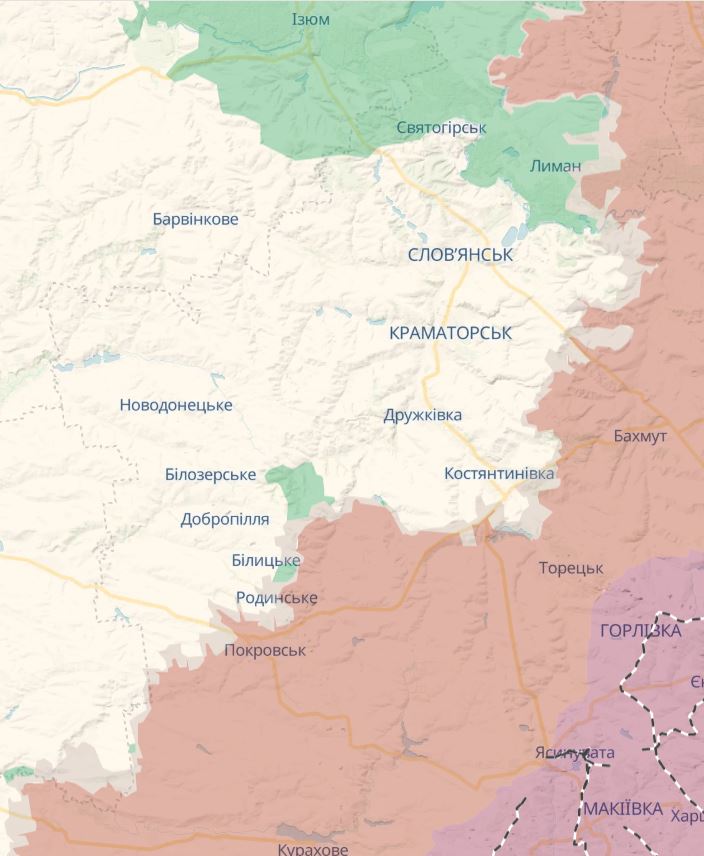
In February 2026, the increase in the occupied territory amounted to 126 square kilometers , which is half as much as in January, and the lowest figure since July 2024. Now the Russian Federation controls about 116,500 thousand square kilometers, or 19.3% of Ukrainian territory. The total number of attacks in February did not decrease significantly - the difference with January is only about 4%. The largest number of assaults falls on the Pokrov direction - 31%, followed by the Gulyai-Pole (21%), Konstantinovskoye (13%) and Lyman (7%) directions - the indicators are almost the same as in January. In terms of the advance of the Russian Federation: Pokrovsky area - 32%, Slavyansk and Kramatorsk areas - 23% and 16%, respectively (a total of 39% of all advances with 9% of the total number of attacks). The Konstantinovka direction accounted for 21% of the advances, the Sumy region - 7%.
Despite the continuing high intensity of hostilities, the line of contact has not changed significantly over the past week, and Russian forces have not been able to increase the area of territory under their control.
The Sloviansk-Kramatorsk direction and the Kostiantynivka hub in the Donetsk region remain one of the most difficult for Ukrainian troops. Ukrainian units are still holding positions, but the situation is complicated by the high density of drone and artillery strikes. Russian FPVs and reconnaissance UAVs control the front line, isolate positions and hit logistics. is gradually being eroded. Logistics through Alekseevo-Druzhkovka remains extremely risky.
From the side of the Lymanovo direction, Russian troops advanced in Markiv and near Platonovka, and Minkovka is actually not controlled by the Armed Forces of Ukraine, only small assault groups enter there for raids.
Also, Russian troops went on the offensive behind the city of Pokrovske (in the Hryshyne area), the city of Myrnohrad (in the Rivne area).
The Dnipropetrovsk direction also remains tense. On the border of the Dnipropetrovsk region, Ukrainian troops are conducting counteroffensive operations in the areas of Zlahoda, Novohryhorivka, Novomykolaivka, Stepovoye and Ternove, trying to stabilize the line of defense in this sector of the front.
Russian troops are trying to advance in the Zaliznichny area, by the end of February, Ukrainian forces left Gorkoye, which opens up the possibility of advancing along Verkhnyaya Tersa and creates a threat of cutting the defenses along the riverbed. The assault is being carried out from several directions, including from the direction of Tsvetkove, increasing the risk of semi-encirclement.
In the south, in the Gulyaipole area (Zaporozhye direction), Russian forces maintain the initiative, displacing the Armed Forces of Ukraine from a number of positions, which forces the transfer of reserves here and reduces the pace of the Ukrainian offensive in the Velikomikhailovka area and on the southern bank of the Volcha.
Map of hostilities.
Donetsk region.
Sociology.
In February 2026, Ipsos conducted a study UKRAINE POLITICAL SENTIMENT. According to the survey, 37% of respondents believe that the country is moving in the wrong direction, 29% believe that it is moving in the right direction, and 34% could not decide on an assessment. As for the assessment of the recent personnel reshuffles in the Government and the Office of the President, 45% of respondents gave them a negative assessment, 32% - positive, another 24% found it difficult to answer.
Valeriy Zaluzhny is the leader in the trust rating: 63% of respondents trust him, 22% do not trust, 15% are undecided (trust balance +41). Oleksandr Usyk is in second place with a trust index of 56%, 22% are distrustful and 22% are undecided (balance +34). The third position is occupied by Kyrylo Budanov: 55% trust, 23% do not trust, 22% are undecided (balance +32). Volodymyr Zelensky is in fourth place: 49% trust, 38% distrust, 13% undecided (balance +11).
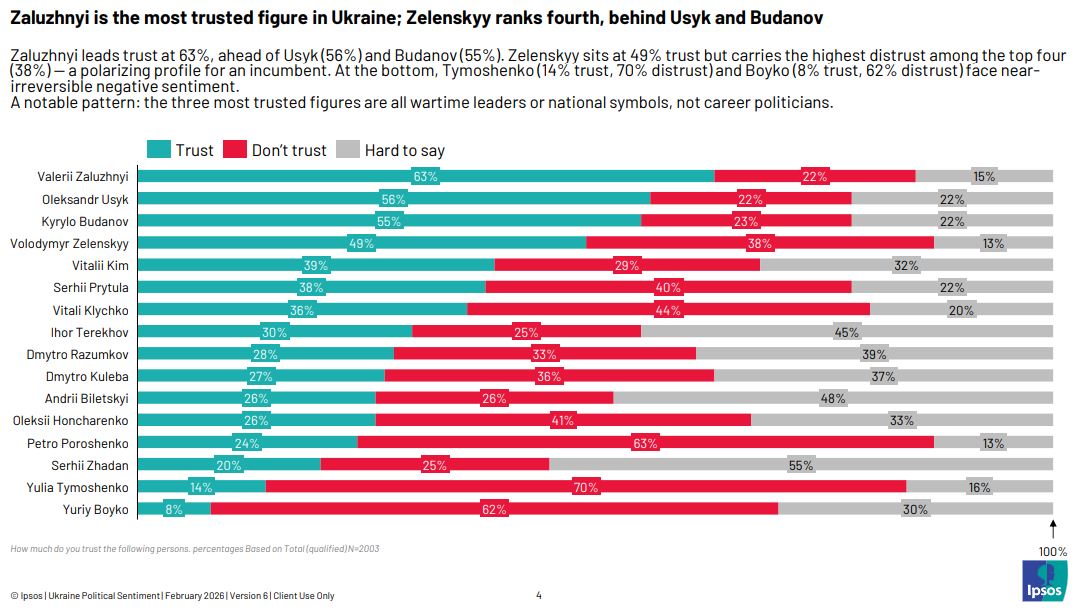
This is followed by Vitaliy Kim – 39% trust, 29% distrust, 32% undecided (balance +10); Serhiy Prytula — 38% trust, 40% distrust, 22% undecided (balance -2); Vitali Klitschko — 36% trust, 44% distrust, 20% undecided (balance –8); Igor Terekhov — 30% trust, 25% distrust, 45% undecided (balance +5); Dmytro Razumkov — 28% trust, 33% distrust, 39% undecided (balance –5); Dmytro Kuleba — 27% trust, 36% distrust, 37% undecided (balance –9); Andriy Biletsky — 26% trust and 26% distrust with 48% undecided (balance 0); Oleksiy Goncharenko — 26% trust, 41% distrust, 33% undecided (balance –15); Petro Poroshenko — 24% trust, 63% distrust, 13% undecided (balance –39); Serhiy Zhadan – 20% trust, 25% distrust, 55% undecided (balance -5); Yulia Tymoshenko — 14% trust, 70% distrust, 16% undecided (balance –56); Yuriy Boyko — 8% trust, 62% distrust, 30% undecided (balance -54).
Judging by the results of the Ipsos study, the country is in a state of moderate public pessimism. At the same time, the personnel reboot of the Government and the Office of the President has not significantly changed public sentiment. President Zelensky, although he still maintains a relatively high level of trust (49%) with a positive balance (+11%), is already 4th in the rating and is inferior to Zaluzhny, Usyk and Budanov.
It is noteworthy that a new potential competitive figure for the President, boxer Oleksandr Usyk, appears in the top three leaders in the 2nd position. Of course, the trust rating is not equal to the electoral rating, but it is still an important indicator of public sentiment.
The majority of Ukrainian citizens now oppose the withdrawal of Ukrainian troops from Donbass. According to another study by the Kyiv International Institute of Sociology (KIIS) on February 12-24, 2026.
70% do not believe that the current negotiations will lead to a stable peace. 25% believe it. The remaining 5% have not decided on their opinion. Compared to mid-January 2026, there have been no special changes on this issue over the month.
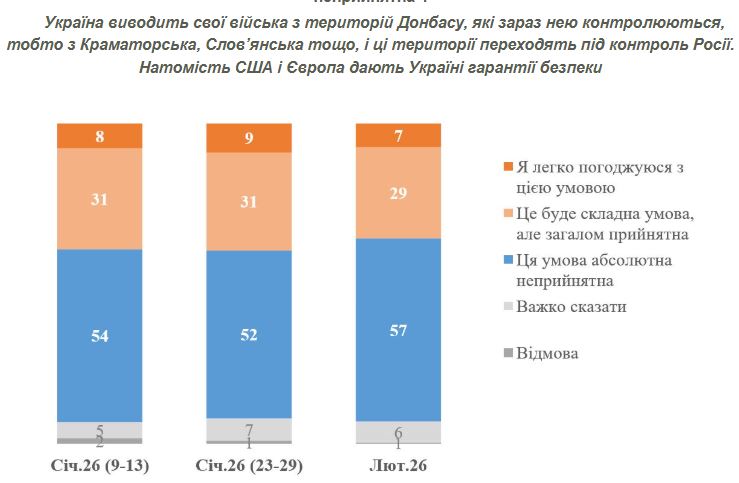
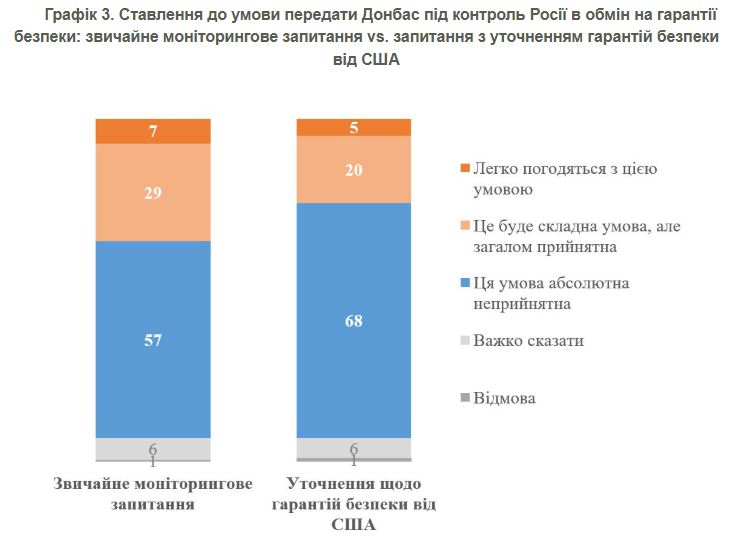
In mid-January 2026, KIIS first asked a question about the possible withdrawal of Ukrainian troops from Donbass (with the territory coming under Russian control) in exchange for security guarantees from the United States and Europe. Repeated measurements were carried out at the end of January and in mid-February 2026.
As of mid-February , 57% of Ukrainians are categorically against this option, 36% are generally ready to support it (mostly reluctantly), 7% are undecided. At the end of January, 52% were categorically against, 40% were ready to support; in mid-January, 54% and 38%, respectively.
Moreover, the balance of answers (the share is categorically against minus the share of those who are ready to agree) in mid-February is +21%, which is higher than at the end of January (+12%) and in mid-January (+15%). Moreover, if we clarify the respondents' information about the procedure and format of security guarantees from the United States, then the willingness to approve the deal decreases from 36% to 25%. From 57% to 68%, the number of those who categorically reject such an offer is growing.
The majority of Ukrainian citizens oppose the complete blocking of Telegram, but support the strengthening of law enforcement control over the platform. According to a survey by the Rating group dated March 3, 2026, 67% of Ukrainians are more or less active users of Telegram. Most often, the messenger is used by young respondents, residents of Kyiv and regional centers, as well as citizens with higher incomes.
72% of respondents believe that Telegram does not affect their personal safety in any way. Only 8% believe that the use of the messenger has a negative impact on personal safety, while 15% assess the impact as positive. On the issue of national security, opinions are more ambiguous: 35% believe that Telegram has no influence, 25% found it difficult to answer, 28% see a negative impact and 13% see a positive one.
At the same time, 76% of respondents oppose the complete blocking of Telegram in Ukraine, and only 16% support such a measure. At the same time, 52% of respondents support increased control by law enforcement agencies, while 41% are against.
Thus, increased control becomes an acceptable option for society precisely in comparison with the more radical scenario of a complete ban. Against the backdrop of public statements about a possible blockage, the regulatory proposal is perceived as a compromise and softer alternative. Probably, it was this sequence – first the discussion of closure, then the transition to increased control – that made it possible to obtain public consent to the expansion of powers, which, if the question was formulated differently, could have met with much greater resistance.
Ruslan Bortnik, Oksana Krasovskaya, Andrey Timchenko
for the Ukrainian Institute of Politics