Авторы публикации
WEEKLY SUMMARY:
THE UKRAINIAN DIMENSION.
(21–28 September 2026)
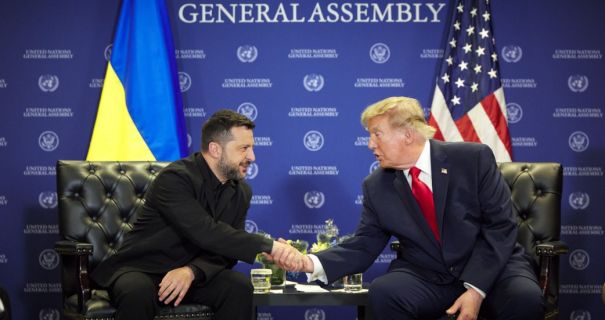
Talks between Ukrainian President Volodymyr Zelenskyy and US President Donald Trump on 22 September on the sidelines of the 81st session of the UN General Assembly in New York produced no constructive breakthrough towards a peace settlement and did not clarify the prospects for an energy truce between Ukraine and Russia. Despite Trump’s statements suggesting that an agreement between Ukraine and Russia could be reached soon, no specific agreements were announced on securing an energy truce, establishing a ceasefire, scheduling further meetings between negotiating delegations, or granting Ukraine licences to manufacture Patriot interceptor missiles. The meeting helped maintain political dialogue and avoid a public deterioration in relations between Kyiv and Washington. At this stage, Trump apparently prefers not to push Ukraine for concessions to the point of open confrontation, while publicly portraying ongoing diplomacy as steady progress towards peace in Ukraine. This tactic resembles his approach to the situation surrounding Iran and may be linked to the approaching US congressional midterm elections in November 2026. The Trump administration needs to demonstrate foreign policy results, while openly pressuring Kyiv into an agreement on Russian terms could create additional electoral risks for the president and the Republicans, given that American public sympathies in the Russia–Ukraine war remain predominantly with Ukraine. Essentially, both the United States and Ukraine are trying to maintain an appearance of political alignment without changing their own positions and approaches. The situation surrounding strikes on Russian oil refineries is illustrative in this regard. While Trump says he asked for their intensity to be reduced and claims to have obtained Zelenskyy’s agreement, Kyiv continues attacking Russian oil facilities, avoiding an outright refusal that could lead to a public confrontation with Washington.
The launch of the “Carpathian Eight” on 18 September in Bukovel reflects Ukraine’s ambition to translate its military experience, defence technologies and international significance into regional political influence. Kyiv seeks to create a platform in which it can act as one of the initiators and leaders while expanding opportunities to attract funding and advance regional integration. The format is intended to increase Ukraine’s value to the EU and NATO and strengthen its negotiating position. Unlike participation in existing groupings as an invited partner, Ukraine is seeking a role as one of the architects of a cooperative framework complementing the Visegrád Group and the Three Seas Initiative. However, the composition and results of the first summit revealed a gap between Ukraine’s ambitions and the participants’ readiness for political consolidation. Of the eight countries, only four—Ukraine, Poland, Romania and Serbia—were represented at the level of heads of state or government. Six participants endorsed the final declaration, while Czechia and Hungary did not join it. This indicates insufficient coordination of the parties’ interests and expectations during the initiative’s preparation. Hungary’s subsequent softening of its position and expressed willingness to participate in the project preserve opportunities for cooperation but do not eliminate political differences. The Serbian leadership’s contact with Vladimir Putin after the summit also underscores that participation in the format does not imply a common foreign policy.
The results of the Russian State Duma elections (18–20 September 2026), in which United Russia officially received 57.83% of the party-list vote and 349 of 450 seats—77.6% of the total—retaining its constitutional majority, give the Kremlin further grounds to present the continuation of its so-called “special military operation” against Ukraine as a policy endorsed by voters. Politically, votes for the ruling party may be interpreted as indirect support for its war policy, while the election results may be used to provide domestic political legitimacy for continuing the war.
Against this backdrop, Moscow continues to intensify military pressure on Ukraine, including through air strikes on its rear areas. Attacks on Kyiv and the Kyiv region are now becoming almost continuous: waves of 2–3 drones per hour have been recorded since late August, while during the first three weeks of September Russia deployed 2,100 jet-powered attack drones across Ukraine—an average of around 100 per day. Attacks on Kyiv primarily involve jet-powered Geran-4 and Geran-5 drones; according to Ukraine’s Defence Intelligence, the latter has a cruising speed of 450–600 km/h, a range of up to 950 km, and a 90-kilogram warhead. Alongside energy, industry, warehouses, commerce and transport, digital infrastructure—data centres and telecommunications operators’ equipment—is also coming under attack. On 23 September, infrastructure belonging to MiroHost, Pavutyna, UTELS, Domonet, Kievnet and Faust was damaged, along with the data centre at the Parkovyi Convention and Exhibition Centre; on 25 September, Datagroup reported damage to its data centre, and on 27 September, Kyivstar’s head office was hit. Over the week, attacks on data centres caused internet disruptions for approximately 100,000 users in Kyiv and the surrounding region. Ukraine’s shortage of air defence assets limits its ability to protect the capital, allowing Russia to strike directly at its centre. On 28 September, the building of the National Academy of Sciences of Ukraine on Volodymyrska Street and the Dobrobut medical centre near the Constitutional Court of Ukraine were hit. A distinctive feature of this new wave of strikes is the combination of night-time raids with regular daytime attacks, increasing pressure on air defences, disrupting business and transport, and raising the risk of mass casualties during the busiest hours of the day.
Infrastructure near Ukraine’s western border is also coming under attack. On 28 September, a drone struck near the Yahodyn border crossing in the Volyn region, on the border with Poland. According to preliminary information, the crossing itself was not damaged. An alert sounded in Poland’s Lublin Voivodeship. Strikes near border crossings increase risks to Ukraine’s cross-border logistics and heighten tensions and security risks along the border with NATO countries.
The war costs Ukraine USD 155 billion a year, according to Ukrainian Prime Minister Serhii Koretskyi. This is equivalent to 72.4% of Ukraine’s nominal GDP in 2025, which stood at USD 214.23 billion. Including Ukraine’s own spending and assistance from its partners, total expenditure over five years of war could range from USD 600 billion to USD 800 billion. Meanwhile, USD 27 billion in current requirements remains unfunded. The resource shortfall is being partially offset through government fiscal policy—tax increases, a broader tax base and stricter enforcement of mandatory payments. The state is therefore collecting part of the missing funds through additional charges on households and businesses, while increases in indirect taxes, including VAT, shift the burden onto consumers through higher prices. It would be unrealistic to regard the continuation of comparable funding levels over an extended period as guaranteed: partners’ budget constraints and potential political changes in allied countries increase the risk of reduced support. This heightens Ukraine’s financial vulnerability and makes the search for ways to end the war increasingly urgent.
_________________________
Peace negotiations. Outcomes of the meeting between Ukrainian President Volodymyr Zelenskyy and US President Donald Trump on the sidelines of the UN General Assembly in New York.
On 22 September, Volodymyr Zelenskyy and Donald Trump held talks on prospects for ending the war, an energy truce and strengthening Ukraine’s air defences. The US delegation included Secretary of State Marco Rubio, Treasury Secretary Scott Bessent, presidential special envoy Steve Witkoff and Jared Kushner. Ukraine was represented by Head of the Presidential Office Kyrylo Budanov, Head of the Foreign Intelligence Service Rustem Umerov, Foreign Minister Andrii Sybiha, leader of the Servant of the People parliamentary faction Davyd Arakhamia and Deputy Head of the Presidential Office Pavlo Palisa. Zelenskyy expressed hope that the war could end before winter. Trump praised the performance of Ukrainian troops and Ukraine’s leadership, stating that Kyiv and Moscow would be able to reach an agreement.
The talks focused on ending the war and a possible energy truce between Ukraine and Russia. Zelenskyy expressed hope that the war could be brought to an end before winter. Trump praised Ukrainian troops, describing them as good and capable fighters, and commended Ukraine’s “capable leadership.” The US president said he expected an agreement between Kyiv and Moscow but declined to disclose its possible details. He also raised the possibility of another meeting with Vladimir Putin. Asked whether the Russian leader might meet Zelenskyy on the sidelines of the G20 in Miami, Trump said: “I know he will meet. We already had a meeting in Alaska. I think he would agree to another one. I don’t know about Miami.”
Following the talks, Zelenskyy stated that Ukraine was ready for any form of energy truce with Russia, provided it was reciprocal. He stressed that the United States had not asked Kyiv to stop striking Russian facilities unilaterally. The two sides also discussed the possibility of granting Ukraine licences to manufacture interceptor missiles for Patriot systems. Zelenskyy said Trump was receptive to the licensing proposal but noted that he had received no specific response regarding missile supplies. No specific agreements were publicly announced on an energy truce, a ceasefire, a schedule for further meetings between negotiating delegations, or granting Ukraine missile production licences. The meeting nevertheless helped maintain political dialogue and avoided a public deterioration in relations between Kyiv and Washington, although it produced no breakthrough towards a settlement.
Ukrainian strikes on Russian oil refineries were a separate topic of discussion. During the meeting, Trump noted their impact on Russia and diesel prices. In a subsequent interview with Fox News, he said he had asked Zelenskyy to reduce the intensity of such attacks and claimed to have received a positive response. However, the wording of the reply quoted by Trump himself—“we will probably do that”—did not constitute an unconditional commitment. Zelenskyy, for his part, had previously stated that there had been no attempts during the closed-door talks to force Ukraine to stop striking oil refineries. On 28 September, the Ukrainian president reported new strikes on Russian defence enterprises and oil facilities in Krasnodar Krai over the preceding 24 hours. This can be interpreted as an indirect signal that Ukraine’s tactics remain unchanged: Kyiv continues its attacks while avoiding an explicit public refusal of Trump’s request, which would create additional political risks in relations with the United States.
On 26 September, Trump again portrayed the situation as progress towards an agreement, suggesting that one could be reached “before the harsh winter sets in.” Asked by a journalist whether he had discussed Patriot missiles with Zelenskyy, the US president said: “Yes. I did, and he is moving forward, and Putin is moving forward. At some point—hopefully in the not-too-distant future, perhaps even before the harsh winter sets in—they will reach an agreement.” Trump did not specify whether he meant a peace agreement, a truce or a partial ceasefire.
At this stage, Trump apparently prefers to maintain contact with Kyiv without allowing pressure for concessions on a peace settlement to escalate into open confrontation, while presenting ongoing diplomacy as movement towards peace. One possible explanation is the approaching congressional midterm elections, scheduled for 3 November 2026: the Trump administration needs to demonstrate foreign policy results while avoiding the impression that Washington is forcing Ukraine into an agreement on Russian terms. American public opinion remains generally more favourable towards Ukraine: according to a September Marquette poll, 51% of Americans view it favourably and 36% unfavourably; 35% consider military aid insufficient, while 32% believe it is at the appropriate level. Under these circumstances, openly pressuring Kyiv into concessions could create additional electoral risks for Trump and the Republicans. Maintaining the appearance of progress in negotiations despite the absence of concrete results allows Trump to sustain his image as a peacemaker president and postpone politically costly decisions.
The “Carpathian Eight”: Ukraine’s ambitions and its partners’ capabilities.
On 18 September 2026, Bukovel hosted the first summit of the Ukrainian-initiated “Carpathian Eight”—a regional political and economic platform intended to bring together Ukraine, Poland, Romania, Slovakia, Czechia, Hungary, Austria and Serbia. Kyiv views this format as a means of strengthening Ukraine’s position in Central Europe and demonstrating its increased military and political weight even before formally joining the EU. Ukraine seeks to translate its military experience, defence technologies and international importance into regional influence, while expanding opportunities to attract funding and pursue integration. As envisaged by its initiators, the platform would complement the Visegrád Group and the Three Seas Initiative, allowing Ukraine to act as one of the architects and leaders of regional cooperation. At this stage, the initiative involves establishing a political and economic platform rather than a fully fledged international organisation.
However, participation in the first summit and its outcomes revealed a gap between Ukraine’s ambitions and the participants’ readiness for political consolidation. Of the eight countries named as prospective participants, only four—Ukraine, Poland, Romania and Serbia—were represented by heads of state or government. Six countries endorsed the final declaration; Hungary and Czechia did not. Differences in the level of representation and the delegations’ authority suggest insufficient advance coordination regarding the new format’s status and its participants’ commitments.
Disagreements surfaced most publicly in relations with Hungary. The Hungarian Foreign Ministry stated that the country’s chargé d’affaires in Ukraine had merely “dropped in” at the event in Bukovel, had no authority to participate in negotiations and had not signed the final declaration. Prime Minister Péter Magyar compared the situation to “village football,” where a team was formed and someone was added to it without their consent. The diplomat’s presence therefore did not signify Budapest’s official accession to the initiative. Nevertheless, Hungary subsequently softened its position and expressed willingness to participate in the project. This leaves room for its involvement in practical cooperation, although it does not erase the initial disagreements over how the platform was established.
Czechia participated in the summit, but its delegation lacked the authority to sign the final declaration on behalf of the state. Prague was represented by a deputy speaker of the Senate and regional government representatives, who discussed business projects, cross-border cooperation, environmental issues and logistics. The absence of a Czech signature therefore primarily reflects the delegation’s limited mandate and a lack of agreement on the level of political participation. Combined with Hungary’s objections, Slovakia’s cautious position and the absence of Austria’s top leadership, this limited the scope for presenting the first summit as the establishment of a cohesive grouping of eight states.
Despite these limitations, Serbian President Aleksandar Vucic’s attendance in person was a notable tactical gain for Kyiv. Belgrade, which has traditionally maintained close relations with Moscow, demonstrated its willingness to cooperate directly with Ukraine and its European neighbours through a new regional platform. For Kyiv, this broadens its circle of partners beyond the countries that consistently support Ukraine’s position; for Moscow, it may signal a weakening of its ability to determine Serbia’s foreign policy choices.
However, Vucic’s subsequent contact with Vladimir Putin highlighted the limits of this rapprochement and can be seen as a step back following his conspicuous participation in the Ukrainian initiative. Belgrade seeks to preserve its special relationship with Russia, its prospects for European integration and its access to infrastructure, energy and investment projects involving Ukraine. Serbia has not joined sanctions against Russia, so its participation in the “Carpathian Eight” should primarily be viewed as a continuation of its balancing policy. In this context, the contact with Putin appears to be an attempt to offset the political impact of the visit to Bukovel and reassure Moscow that existing ties remain intact. Kyiv thus secured Serbia’s involvement, but not a reorientation of its foreign policy.
The most concrete basis for cooperation emerged around infrastructure, energy and reconstruction. The summit saw the announcement of more than 50 agreements worth over EUR 1 billion in total, as well as initiatives to purchase locomotives and repair railway tracks in Ukraine with USD 100 million in grant funding. At the same time, an important structural limitation of the format is becoming apparent: Ukraine puts forward the political initiative, while much of the necessary funding and institutional decision-making depends on the EU and wealthier partners. Implementation of the announced projects will therefore depend on participants’ willingness to allocate funds and undertake specific commitments.
The war costs Ukraine USD 155 billion a year, equivalent to 72.4% of its GDP in 2025.
Ukrainian Prime Minister Serhii Koretskyi stated in an interview with TSN on 27 September that total funding requirements for the war effort in 2026 amount to USD 155 billion. This includes state budget expenditure and direct military assistance from partners, including supplies of weapons, equipment and ammunition.
Funding sources have yet to be identified for USD 27 billion of this total. This therefore represents an unfunded portion of previously announced requirements, rather than new expenditure arising in September.
These requirements are exceptionally large relative to the capacity of Ukraine’s economy: according to the World Bank, Ukraine’s nominal GDP in 2025 was USD 214.23 billion. Annual funding requirements for the war effort therefore amount to almost three-quarters of the value of all goods and services produced in the country last year. This ratio illustrates the extent to which sustaining Ukraine’s defence depends on external financing and arms supplies. Faced with a funding shortfall, the government is seeking additional domestic and external resources.
The Ukrainian government has included a one-percentage-point increase in VAT, from 20% to 21%, in the draft state budget for 2027 to establish a special insurance fund that will compensate businesses for assets lost as a result of hostilities. Ukraine’s initial contribution is expected to amount to approximately USD 1 billion, while funding from partners would allow the fund to expand to USD 5 billion. According to Koretskyi, raising approximately USD 1 billion in domestic revenue as the initial state contribution to this fund will demonstrate to international partners Ukraine’s willingness to co-finance the protection of its own economy.
The Cabinet of Ministers plans to cover approximately USD 7 billion of the total USD 27 billion shortfall through sharp cuts to domestic non-military expenditure. Funding has already been suspended for several cultural programmes, road construction and certain projects under the “Resilience Plans.”
Taking into account Ukraine’s own expenditure and assistance from its partners, the country’s cumulative war costs over five years could range from USD 600 billion to USD 800 billion. It would be unrealistic to regard the continuation of comparable levels of funding over an extended period as guaranteed. Changes in governments and parliamentary majorities in France, Germany, the United Kingdom and other countries could lead to reduced assistance or stricter conditions on its provision. Even the use of frozen Russian assets could provide additional resources only for a limited period.
Public opinion.
According to a survey conducted by the Kyiv International Institute of Sociology (KIIS) on 12–21 September 2026, the main concern for Ukrainian citizens was corruption in government, cited by 50% of respondents. This was followed by large-scale missile and drone strikes—40%, a lack of professionalism and competence among the authorities—30%, low wages, pensions and other incomes—28%, the activities of Territorial Recruitment Centres—24%, rising prices—23%, and the situation on the front line—21%.
When responses are combined, 53% of respondents selected either large-scale missile and drone strikes, the situation on the front line, or both. Thus, the war as an overall source of concern is effectively on a par with corruption—53% versus 50%. However, when corruption and government incompetence are combined, the overall measure of dissatisfaction with the authorities reaches 64%, exceeding concern about the war—64% versus 53%.
At the same time, 72% of Ukrainians believe that corruption in the country has increased during the full-scale invasion, while only 6% say it has decreased. The remainder either believe the situation has not changed or were unsure how to respond. These figures indicate growing public frustration not only with individual corruption scandals but also with the quality of governance as a whole.
The question of the head of state’s political responsibility is particularly revealing. 72% of Ukrainians believe that President Volodymyr Zelenskyy bears personal responsibility for corrupt acts committed by members of his inner circle, while 25% disagree. Perceptions of responsibility correlate strongly with the level of trust in the president. Among those who “fully trust” Zelenskyy, 16% are uncertain about his responsibility, while 3% consider him responsible. Among those who “tend to trust” him, 60% believe that the president bears no responsibility. Among those who “tend not to trust” him, 57% consider Zelenskyy responsible, 23% are uncertain, and 19% do not hold him responsible. Finally, among citizens who “do not trust the president at all,” 85% consider him personally responsible for corrupt acts committed by members of his inner circle.
Corruption has effectively joined the war as one of Ukrainians’ foremost concerns. Combined dissatisfaction with the authorities over corruption and incompetence already exceeds concern about war-related risks: 64% versus 53%. This points to a broader accumulation of public frustration not only with individual corruption scandals but also with the quality of governance as a whole. Perceptions of the trend are revealing: 72% believe that corruption has increased during the full-scale war.
At the same time, President Zelenskyy is finding it increasingly difficult to distance himself from corruption scandals involving his inner circle by presenting them as the actions of individual officials of which the head of state was supposedly unaware. 72% of citizens already explicitly hold the president personally responsible for corrupt acts committed by members of his inner circle. The familiar practice of the head of state publicly distancing himself from such incidents is therefore becoming increasingly ineffective.
Combat operations.
Intense tactical fighting continues along the front line, involving attacks, counterattacks and significant losses. However, local advances by either side are not substantially changing the front line or the overall operational and strategic situation. Over the past week, the recorded net territorial change amounted to 12 km² in Ukraine’s favour. Russia now controls 117,031 km², or 19.39% of Ukraine’s territory.
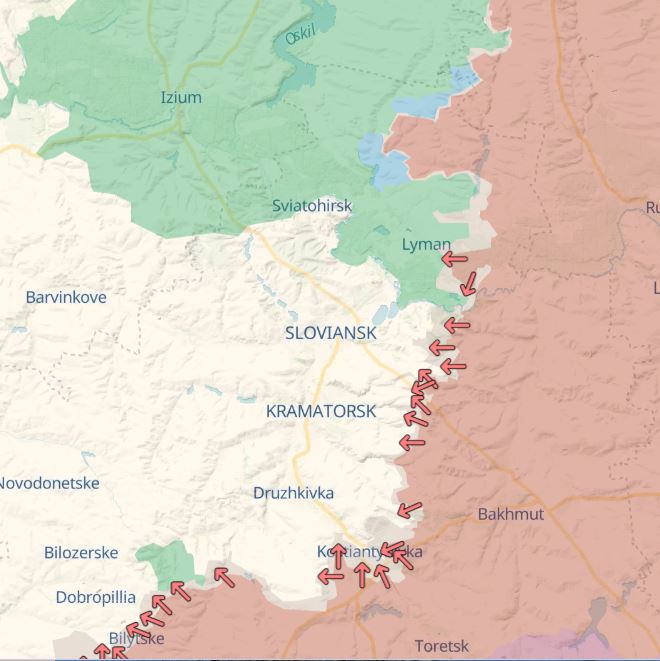
Lyman sector—Donetsk region. Ukrainian counteroffensive operations have improved the position of the Armed Forces of Ukraine on the northern approaches to Lyman. Following the liberation of Shandryholove and Derylove and the restoration of full control over Drobysheve, the operation continued further north. On 28 September, Third Army Corps commander Andrii Biletskyi announced the liberation of a further 51 km² during the third phase of Operation Vivaldi. According to him, Ukrainian forces liberated Nove, Ridkodub and Katerynivka, and restored control over Karpivka and Novomykhailivka.
Pokrovsk sector—Donetsk region. Russian troops continued making local advances around Pokrovsk and Myrnohrad. In the Dobropillia area, fighting continues for the village of Dobropillia and around Hannivka. The city of Dobropillia is not encircled; infiltration by individual Russian groups into its outskirts does not constitute an established foothold in the city.
Kostiantynivka sector—Donetsk region. Fighting continues around Kostiantynivka, with pressure on the flanks and supply routes of Ukrainian units. Further north, combat is taking place around Oleksiievo-Druzhkivka, on the approaches to Druzhkivka. Druzhkivka remains under Ukrainian control. Ukrainian control over Kostiantynivka has probably been lost or is limited to a small part of the city, although Ukraine has not yet confirmed its loss.
Sloviansk sector—Donetsk region. Russian troops are attacking from the east towards the Sloviansk–Kramatorsk urban agglomeration. The main areas of fighting are Rai-Oleksandrivka and the approaches to Mykolaivka.
Orikhiv sector—Zaporizhzhia region. Russian units continue attacking on the approaches to Orikhiv. Novoandriivka, Novopavlivka and the surrounding areas remain areas of contested control and an expanding grey zone. According to the assessment presented here, Russian forces have not established a firm foothold in Orikhiv itself.
Containing the Russian offensive around Lyman reduces the threat of an advance towards Sloviansk from the north and represents a significant operational achievement for Ukraine. If current trends continue, Russia will most likely be unable to begin fighting directly for Sloviansk and Kramatorsk before the end of the year, giving Ukrainian forces additional time to strengthen the agglomeration’s defences.
Maps of hostilities.
(According to DeepState Map)
Donetsk Region.
Ruslan Bortnik, Oksana Krasovskaya
for the Ukrainian Institute of Politics
Friends, we would like to remind you that additional analytical products from the Ukrainian Institute of Politics are available to organisations, businesses and private clients: Weekly Intelligence Brief, Geopolitical Risk Reports, Executive Briefings, as well as specialised analytical materials and forecasts upon individual request. For additional information, please contact us at: uiamp2012@gmail.com or by phone: +38 (093) 757-75-65.