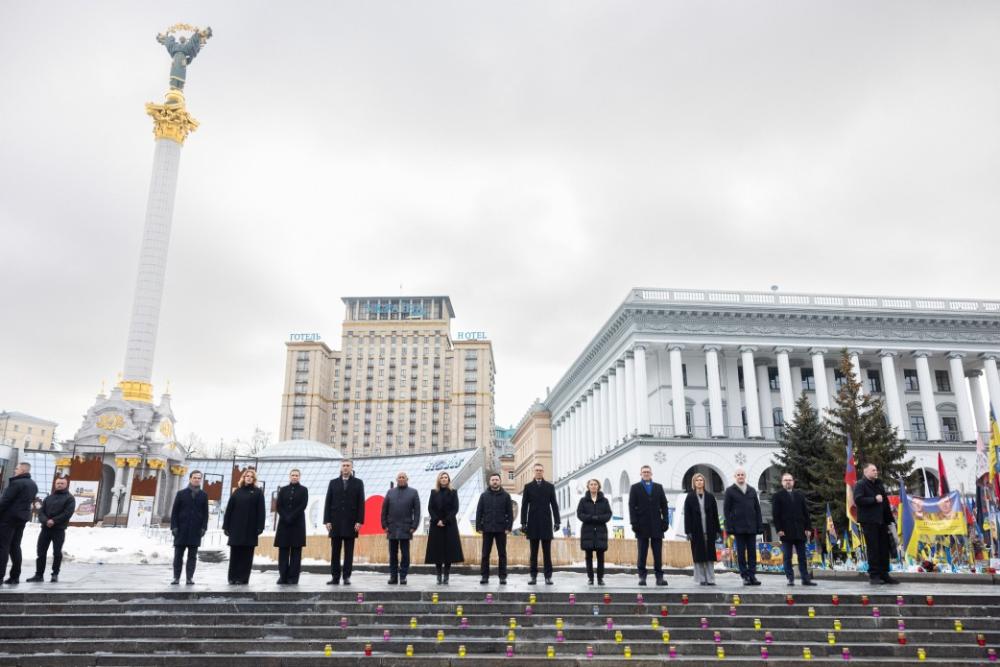
The main and fundamental result of the 2022-2026 war was that Ukraine retained its statehood, governability and basic institutional integrity. Despite large-scale destruction, colossal military and economic losses, the country remained a fully functioning state with relative political stability, albeit in a negative trend, with uncertain prospects, high military-political and social tensions, an economic crisis and a chronically difficult situation at the front. Ukraine retained control over 80.7% of its territory and about 73% of its population, and by 2025, nominal GDP approached the pre-war level of 2021 — about $200 billion. Against the backdrop of growing crises, it was possible to maintain relative socio-economic and political stability in the rear: state institutions continued to work, the budget system functioned, and the country avoided a scenario of systemic collapse — which, in the context of war and fluctuations in external support, became a key factor in curbing negative dynamics.
The preservation of the stability of the state was largely the merit of Ukrainian society, which demonstrated high solidarity and self-organization, the current government team and Western allies, who provided military, financial and diplomatic support.
At the same time, 19.3% of the territory of Ukraine remains occupied by the Russian Federation, and the country has lost more than 10 million of its citizens - some of them went abroad, some remained in the temporarily occupied territories; including, according to the UN, at least 15 thousand dead and about 41 thousand wounded among the civilian population (excluding military losses). By 2026, Ukraine has lost about $120 billion of economic output (GDP) and almost $1 trillion in fixed capital (according to the Kiel Institute for the World Economy).
Ukraine's military spending soared due to the need to repel aggression. If in 2021 Ukraine spent about $5-6 billion on defense, then in 2022 it was already $44.0 billion (34% of GDP in 2022 against 3.2% in 2021), which is 640% more than the previous year. This is the highest annual growth recorded by SIPRI since 1949, and in 2026, Ukraine's state budget expenditures on defense and security will amount to UAH 2 trillion 807.1 billion. (about $65 billion), which is equivalent to 27.2% of GDP and 60% of all budget expenditures.
The number of the defense forces of Ukraine (Armed Forces of Ukraine, National Guard, border guards, police) with the beginning of the war increased from about 250 thousand active servicemen to an estimated 700 thousand - 1 million people.
Ukraine has actually switched to the model of military fiscal mobilization: almost all of the state's own revenues are now directed to defense and the security sector. At the same time, social benefits (pensions, subsidies, assistance to IDPs), salaries to public sector employees, healthcare, education, humanitarian programs, and a significant part of public debt service are largely covered by Western financial assistance. This allows the state to maintain macroeconomic stability, but at the same time increases public debt and creates a high dependence on the regularity and volume of external financing.
At the same time, the general course of military and political events was significantly affected by the change in the political balance in the United States in 2025: the weakening of the liberal wing of the Democratic Party and the coming to power of the conservative wing of the Republican Party, led by Donald Trump, significantly changed the logic of American policy towards Ukraine. strategic calculations of the parties and the general international context of the conflict. Support for Ukraine from the main ally became more pragmatic and conditional, and later almost the entire financial burden fell on the shoulders of Europe. At the same time, the United States maintains a critical presence in the conflict in Ukraine through continued funding of intelligence and support activities in Ukraine, arms sales under the PURL program, as well as through the conclusion of the Minerals Agreement, and demonstration of readiness to provide Ukraine with broader security guarantees. At the end of the period 2022-2026, it can be stated that neither the Russian Federation nor Ukraine, together with the coalition of allies, have achieved their key strategic goals in this war. Russia failed to overthrow the Ukrainian government and establish a loyal political regime in Kiev, either militarily or politically; failed to implement a project for a large-scale territorial redistribution of the southern and eastern regions of Ukraine – the annexation of the so-called "Novorossiya" in its historical and ideological interpretation; and also failed to oust the United States and NATO from the post-Soviet space and impose a new security architecture in Eastern Europe. One of the formal reasons for the invasion the Russian Federation called the prevention of NATO's expansion to the east, excluding the possible entry of Ukraine into the Alliance. But despite this, during the two years of the war, two other previously neutral countries joined NATO - Finland (April 4, 2023) and Sweden (March 7, 2024).
In turn, the United States and its partners have not achieved the systemic weakening and internal destabilization of the Russian Federation, its strategic rearrangement or the abandonment of basic geopolitical goals. Ukraine has also failed to regain control over all occupied territories and return the borders of 1991, which over time led to the erosion of this formula as a practical goal and its gradual replacement with more pragmatic rhetoric about "peace along the front line" or freezing the conflict.
The pendulum of war and peace has not stood still for all four years – it has been constantly swinging. There were periods when the parties were extremely far from a peaceful settlement, and moments when a window of opportunity to end the war opened.
For the period 2022-2026, at least three key moments can be identified when the parties were closest to peace. The first is the Istanbul talks of March-April 2022. After the withdrawal of Russian troops from Kyiv, the parties approached the formula of the agreement: the document was initialed, the key parameters were generally agreed, and some controversial issues remained. At that moment, the issue of the threat to the existence of the Ukrainian state was actually removed from the agenda.
Ukraine had already won its strategic, existential victory – the fall of the capital was prevented, a change of political regime and the loss of statehood were not allowed. Since April 2022, the war for Ukraine has ceased to be a war for its very existence; it was already about security guarantees, territorial control and political balances.
The second critical moment is the end of summer and autumn of 2023, after the peak of Ukraine's military capabilities and the subsequent unsuccessful counteroffensive. The liberation of Kherson and a significant part of the Kharkiv region was the maximum military result of Ukraine in this war. At that time, Ukraine still controlled a significant part of the Donetsk region - such cities as Maryinka, Kurakhove, Avdiivka, Vuhledar, and Velyka Novosyolka. There has not yet been a Russian bridgehead in the Sumy region and in the area of Vovchansk and Liptsi in the Kharkiv region.
The depletion of resources on both sides, the limited prospects for rapid military assistance, and the overestimation of capabilities created conditions for covert negotiation contacts. Nevertheless, expectations of further success and political calculations did not allow this moment to be transformed into a sustainable peace process.
By 2025-2026, the parties have again approached a situation where the continuation of the war does not promise quick strategic breakthroughs. However, now the key obstacle has become the political reputations, ambitions and image of the leaders of the warring countries, for whom compromise is fraught with internal and external risks. A complete military victory - in the sense of ousting Russia from all occupied territories, including Crimea - by the end of the fourth year of the war looks unlikely, given the nuclear status of the Russian Federation, its mobilization potential and resources. In this context, Ukraine's main victory remains a preserved statehood, but its strategic value may be eroded in the event of a further protracted exhausting conflict.
By 2026, the war had finally consolidated itself in the format of a protracted conflict of attrition, where the key targets of defeat were the economic, energy, and logistics infrastructure, as well as the human and mobilization potential of the parties. The strategic dynamics shifted from attempts at quick decisive operations to the long-term exhaustion of resources, the stability of the rear, the ability to maintain military production, social stability, and international support.
The peace efforts of the new US administration led by D. Trump have not yet led to a tangible breakthrough in the peace process between Ukraine and the Russian Federation. The negotiations in a strategic sense rested on two key issues - territories and security guarantees. But, in fact, we are talking about the redistribution of the spheres of influence of the Russian Federation and Western countries in and around Ukraine. It is the lack of agreement on this fundamental framework that blocks the constructive progress of the negotiation process.
The outbreak of war and peace negotiations.
On February 24, 2022, the Russian Federation launched a full-scale war against Ukraine, which it called a "special military operation", as the President of the Russian Federation put it in his address to Ukrainians, with the aim of the so-called "demilitarization and denazification of Ukraine".
President of Ukraine V. Zelensky introduced martial law throughout the country and announced a general mobilization, including the conscription of reservists (during the 4 years of the war, this decision was made by the Parliament 18 times). All male citizens between the ages of 18 and 60 were banned from leaving the country.
President of Ukraine V. Zelensky called on world leaders to impose all possible sanctions against the Russian Federation, to provide Ukraine with large-scale military assistance.
At the beginning of the war, there was a consolidation of a huge anti-Russian front. These are, first of all, NATO countries, the countries of the Rammstein contact group on the defense of Ukraine - these are more than 65 states (political, not geographical, "Western world", which even includes individual countries of Southeast Asia: Japan, South Korea, the Philippines, etc.).
There is an intensification of disagreements between the "Western world" and the "Global South" (which even includes individual EU and NATO countries – Hungary, Slovakia, Turkey). because of the difference in the assessment of the causes of the war and the ways to end it.
Some states, in particular, China, India, South Africa and a number of other states, have taken a position of non-alignment and neutrality.
Mainly due to the significant consolidation of Ukrainian society, the blitzkrieg of the "special operation" of the Russian Federation failed. In general, such a level of resistance from Ukraine was not expected to be seen either in the Russian Federation or in the Western allied countries, where the fall of Kyiv was predicted in 4-5 days. And this significantly affected the level of military and financial support provided to Ukraine (according to various estimates, it is from $300 to $400 billion).
The war itself has entered a protracted phase, in which, at the initial stage, the key role will be played by the consolidation of Ukrainian society and the readiness to endure various adversities and crises, primarily of an energy, food and price nature.
Since the start of the Russian invasion of Ukraine in February 2022, the parties to the conflict have repeatedly attempted a diplomatic settlement. The first three rounds of Russian-Ukrainian negotiations were held in Belarus, and later were moved to Turkey. On March 10, within the framework of the diplomatic forum in Antalya, a meeting was held between the Ministers of Foreign Affairs of Ukraine and Russia Dmytro Kuleba and Sergey Lavrov, and negotiations at the level of delegations started on March 29 in Istanbul.
The essence of the Istanbul proposals was that the Russian Federation would return its troops to the borders by February 24, 2022, and Ukraine would agree to a neutral status in exchange for "real security guarantees", and the issues of Crimea and Donbas would be taken out of the negotiations and postponed for the future of the Armed Forces of Ukraine (AFU) and restrictions on their weapons. It also opposed any form of international military presence on the territory of Ukraine. Ukraine categorically rejected such conditions, citing the need to maintain its defense capability in the face of the continuing threat from the Russian Federation.
Not all Western countries were ready to support the Istanbul agreements, the United States and Great Britain opposed it. And given the presence of serious disagreements on the implementation of the agreements, between the parties to the conflict themselves (Ukraine and the Russian Federation), already in the second half of spring 2022, the negotiation process reached an impasse due to mutual distrust and insoluble contradictions.
The prospects for peace talks became even more illusory after Russia's annexation of Ukrainian regions (Zaporizhzhia, Kherson, Donetsk and Luhansk regions) and the start of systematic strikes on civilian energy infrastructure, with which the Russian authorities intended to persuade Ukraine to agree on their terms. At the same time, Ukraine's Western allies (primarily the United States under the rule of the Democratic Party and President D. Biden) emphasized their readiness to maintain it for as long as necessary.
In July 2022 (largely thanks to the efforts of Turkey), a "grain deal" was concluded to export food from Ukrainian ports, it worked for about a year. But the very fact of concluding such a deal demonstrated the precedent of partial lifting of sanctions and readiness for compromise when it comes to critically important issues of the world economy and political stabilization of the situation.
The format of the deal itself is important: Ukraine and Russia did not sign an agreement between themselves. Instead, each side entered into separate agreements with the UN and Turkey, which provided international mediation and guarantees.
At the end of 2022, the President of Ukraine V. Zelensky presented his plan for resolving the war, a 10-point plan - the "Peace Formula" of Volodymyr Zelensky. This plan, according to Ukraine's plan, was aimed at a fair end to the Russian-Ukrainian war on the basis of the UN Charter and the restoration of the territorial integrity of the country. food and energy security. The Kremlin expectedly rejected this plan.
On February 24, 2023, the PRC proposed its "position paper" (the so-called "peace plan") of 12 points. It calls for the resumption of negotiations and criticizes sanctions. At the same time, the PRC also declared respect for the sovereignty of all countries and stressed the inadmissibility of the use of nuclear weapons. The Chinese "peace plan" proposed to freeze the war along the front line, starting negotiations without conditions. Later, China and Brazil proposed a more simplified formula of 6 points. But at the time when the Ukrainian troops still retained the military initiative at the front, this option in the eyes of Ukraine and Western allies looked like "playing into the hands of the Russian Federation" and was rejected by them.
But the change in the political balance in the United States as a result of by-elections to Congress (the Republican Party began to dominate the House of Representatives) – the main donor and ally of Ukraine – leads to the fact that the process of Ukrainian financing is becoming more complicated, turning into an instrument of the election confrontation between Republicans and Democrats.
The unsuccessful Ukrainian counteroffensive in the summer of 2023 led to both a change in public opinion in the West and a decrease in military and financial support, the processes of "crumbling" occurred in many directions.
In the fall of 2023, the so-called "peace supporters" became more active, behind the scenes they begin to try to resume the negotiation process. Ukrainian skeptics have become more active both within the European Union and within the American political system, we are talking primarily about the Republicans in the United States. They advocated a reduction in aid to Ukraine. During this period, the so-called "supporters of peace" became more active, behind the scenes they began to try to resume the negotiation process. China, Turkey, Saudi Arabia, the Vatican, Brazil, South Africa and even Hungary are trying to take the role of the main negotiators between Ukraine and the Russian Federation.
In 2024, a fictitious demonstration of openness to negotiations has become characteristic of Ukraine and allied countries, the same tactics can be observed on the part of the Russian Federation. This is done in order to build the loyalty of the countries of the "Global South", which insist on an immediate cessation of hostilities and the resumption of negotiations.
Also, the main parties to the conflict (both the West and the Russian Federation) periodically test each other for their readiness to compromise, so certain scenarios for the end of the war are voiced in the press from time to time (Kolokoltsev's plan, etc.).
The year 2024 is taking place against the backdrop of the pre-election confrontation between the Democrats and Republicans in the United States. On July 21, 2024, the then President D. Biden announced his intention not to run for a second term, becoming the eighth President in US history to refuse re-election 107 days before the election. Vice President Kamala Harris becomes the new candidate from the Democratic Party. But a certain split within the Democratic Party weakened its position, as it was not possible to create a unified coalition and get the support of the leaders of the governors of swing states. As a result of the elections on November 5, D. Trump becomes the new President of the United States. In addition, the US Republican Party will control the Senate and the House of Representatives of the US Congress following the elections, although not with a significant majority.
Thus, by the end of 2024, a final change in the political balance is taking place in the United States. After four years of Democratic rule, Republicans are once again in the White House and in key positions in Congress.
US President-elect D. Trump is heading for a quick end to the war in Ukraine, his position on V. Putin's aggression is more flexible than that of his outgoing predecessor D. Biden.
During his 2024 presidential election campaign, Donald Trump said that he would "easily" end the conflict in Ukraine in 24 hours if he became president, and that he would end it even before taking office. In practice, the settlement of the war in Ukraine turned out to be a rather difficult process for D. Trump.
On February 28, 2025, Donald Trump's meeting with President of Ukraine Volodymyr Zelensky at the White House ended in a political scandal. And in early March, the US President suspended military assistance to Ukraine. The suspension affected all types of ammunition, weapons, vehicles, including those already on their way to Ukraine, as well as the exchange of intelligence.
During 2025 and early 2026, several rounds of direct negotiations took place between the United States and the Russian Federation (at least 30 at various levels) - from expert and diplomatic consultations to political contacts, including 7 meetings of US Special Representative Stephen Whitkoff with Russian President Vladimir Putin and 1 personal meeting between Trump and Putin in Anchorage, Alaska on August 15, 2025. At the same time, Ukraine and the EU often found themselves outside the framework of key consultations, which increased the distrust of European capitals towards Washington.
By the end of 2025, Trump's special envoy Stephen Whitkoff, as well as Trump's son-in-law and adviser Jared Kushner, will become the main US negotiators on Ukraine.
On November 20, the United States presented a 28-point peace plan for Ukraine. It implies a new geopolitical status of Ukraine as a non-aligned state (without the right to deploy troops of Western allies on its territory) in the Western political and economic zone of influence (the key investment manager is the United States, the possibility of integration into the EU) with the loss of part of economic (and transit) and military-political sovereignty, without strict security guarantees (without collective defense); and with the loss of part of the territories (Crimea, Donetsk and Luhansk regions, as well as large parts of Kherson and Zaporizhzhia) and humanitarian sovereignty in favor of the Russian Federation (restored rights of Russian speakers and the UOC).
The resistance of Ukraine and European allies to key points of the original draft led to the launch of adjustments. With the mediation of the UK, Germany and France, an alternative version was prepared, including 20 main points, which modifies and replaces a number of provisions of Trump's basic text.
It should be noted that the main provisions of D. Trump's plan do not quite suit both Ukraine and the Russian Federation. In particular, the Kremlin is not satisfied with the fact that it will not be able to influence the remaining 80% of Ukraine, according to this plan, this part of the country will remain in the Western zone of influence. But in order to avoid a conflict with the United States, both sides demonstrate openness to negotiations. At the same time, in fact, both the Russian Federation and Ukraine expect to pit the opponent against Trump, forcing him to be the first to abandon the terms of the American peace plan.
At this stage, it is possible to identify the main problematic issues for the parties to agree on: territories (Ukraine is required to withdraw troops from all Donbass) and security guarantees (the Ukrainian authorities demand "reliable security guarantees" from the United States). Refusal to join NATO and coordination of the size of the Ukrainian army. The issue of ownership of the Zaporozhye nuclear power plant also remains controversial.
The political positions of Ukraine and the Russian Federation regarding peace negotiations and the end of the war have changed several times throughout the war.
From the original plan to overthrow the Ukrainian government and the demands to recognize Crimea as Russian, and the so-called "DPR" and "LPR", to make confederal subjects within Ukraine. Russia moved to the direct annexation of territories after the failure of the negotiation process in Minsk, and then in Istanbul.
For its part, Ukraine, after Russia's annexation of Ukrainian territories, abandoned the original conditions for the return of the situation to the period of February 24, 2022 and demands the complete de-occupation of Ukrainian territory within the borders of 1991, including the return of Crimea to Ukraine. In 2024, the start of negotiations was allowed if the Russian Federation withdraws troops to the borders by February 24, 2024. as well as increasing Russian pressure at the front, Ukraine is forced to discuss the cessation of hostilities along the front line (which was unacceptable at the beginning of 2024). But the Russian Federation is already demanding the complete withdrawal of Ukrainian troops from the unoccupied territories of Donbass.
Course of hostilities.
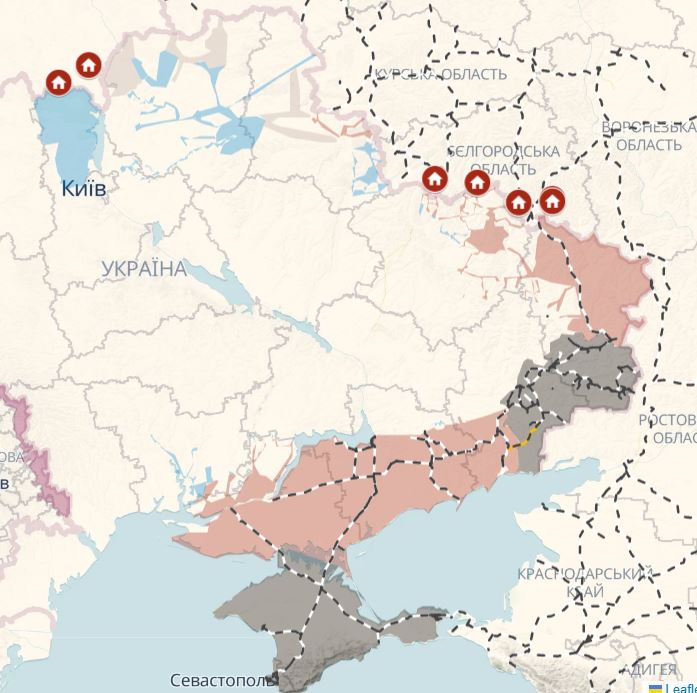
At the peak of the offensive (end of March 2022), Russia controlled 165 thousand square kilometers of Ukrainian territory, about 27% of the total territory. Initially, the main efforts of the Russian troops were concentrated on the rapid capture of large cities, primarily in the northern direction - Kyiv and Kharkiv, Sumy, Chernihiv, which in the end the Russian Federation failed to implement.
After the start of the Istanbul talks (March 29), as well as the obvious defeat in northern Ukraine, the Russian Federation decided to change plans and concentrate its main efforts in the east and south of Ukraine. The Russian Federation realized that the tactics of military blackmail, which were supposed to force the Ukrainian elites to capitulate, did not work. The Russian Federation was not ready for this course of events due to its incorrect assessment of the state of Ukrainian society and elites.
In early April 2022, the leadership of the Russian Federation announced the so-called "goodwill gesture" and Russian troops were completely withdrawn from the Kyiv, Chernihiv, Zhytomyr and Sumy regions. Part of these forces was transferred to eastern Ukraine to develop an offensive in the Donbass. The change in the tactical goals of the Russian Federation in Ukraine meant the failure of the so-called "special operation" to force the surrender of the government of Ukraine and the temporary abandonment of the occupation of the entire territory of the countries. At the same time, the strategic goal of the Russian Federation has been preserved - the military defeat of Ukraine and forcing the United States to a new division of geopolitical zones of influence.
With the beginning of autumn 2022, Ukraine managed to seize the military initiative and the RF Armed Forces began to suffer defeats at the front. In September, the Armed Forces of Ukraine launched a counteroffensive in the Kharkiv region, as a result, the cities of Balakliya, Kupyansk and Izyum, and the city of Vovchansk were liberated.
On September 21, after a rapid counteroffensive of Ukrainian troops near Kharkiv, Russian President Vladimir Putin announced partial mobilization in the Russian Federation. Also, the so-called "referendums" on the entry of the Donetsk, Luhansk, Zaporozhye and Kherson regions of Ukraine into the Russian Federation were held very quickly. Despite this, in November 2022, Ukrainian troops liberated the city of Kherson. By the end of 2022, the Ukrainian military had liberated 7% of the territory of Ukraine occupied since the beginning of the full-scale invasion.
But by the end of 2022, the war had entered an uncertain stage for Ukraine - new victories for the Armed Forces of Ukraine are becoming more and more difficult to achieve, and Russian military pressure after mobilization began to increase again, and this is happening against the backdrop of statements about the reduction of military stocks in the United States and other NATO countries - key allies and suppliers of Ukraine.
The war has become more and more total, it has lost all the features of the so-called "colonial operation". The situation with Russian strikes on infrastructure and energy has also seriously deteriorated, in connection with which Ukraine and its allies are suffering additional losses.
At the beginning of 2023, Ukraine manages to maintain a relatively stable situation at the front, as well as strong support from allied countries that were in anticipation of a large-scale counteroffensive by Ukrainian troops in the south of the country (following the example of Kharkiv and Kherson in the fall of 2022), which in fact did not demonstrate a significant result.
Throughout 2023, Ukraine and the Russian Federation have been waging a war of attrition to a greater extent than for territory. For all the activity of the opposing forces, the front line changed insignificantly by only 200 square kilometers in favor of the Ukrainian troops due to the salient in the area of the village of Rabotino in the Zaporozhye region.
But by the beginning of 2024, after the failure of the counteroffensive and the decline in Western aid, the military initiative at the front passes to the Russian Federation. The dynamics on the southern front of the Donetsk region has acquired a pronounced negative dynamics for Ukrainian troops, where the speed of advance of Russian troops could reach (up to 50-79 square kilometers per day) in a number of areas. The Russian Federation has captured such cities as Maryinka, Avdiivka, and Vuhledar. A Russian bridgehead was created in the Sumy region and in the area of Vovchansk and Liptsi in the Kharkiv region.
In August 2024. Ukraine undertook an unexpected operation in the Kursk region. In the Kursk direction, Ukraine concentrated its most trained and combat-ready units, which made it possible to achieve significant success in a short advance into the territory of Russia in a short time. In particular, 52 settlements were occupied, including the strategically important city of Sudzha. At the peak of the offensive in August 2024, the Ukrainian army controlled 823 square kilometers of the territory of the Kursk region, another 416 square kilometers were in the gray zone. The concentration of significant forces of the Armed Forces of Ukraine in the Kursk region led to the weakening of Ukrainian positions in other directions and created conditions for the intensification of offensive actions of the Russian Federation in the Donetsk, Kharkiv, Sumy, Dnipropetrovsk and Zaporozhye regions. Russian troops came close to Konstantinovka, increasing pressure on the Ukrainian defenses. The most difficult situation for the Armed Forces of Ukraine has developed in the area of the Pokrovsko-Myrnograd agglomeration, which has become a key hub of hostilities in the Donetsk direction. At the same time, Ukraine failed to hold the Kursk bridgehead : by July 2025, it was almost completely abandoned.
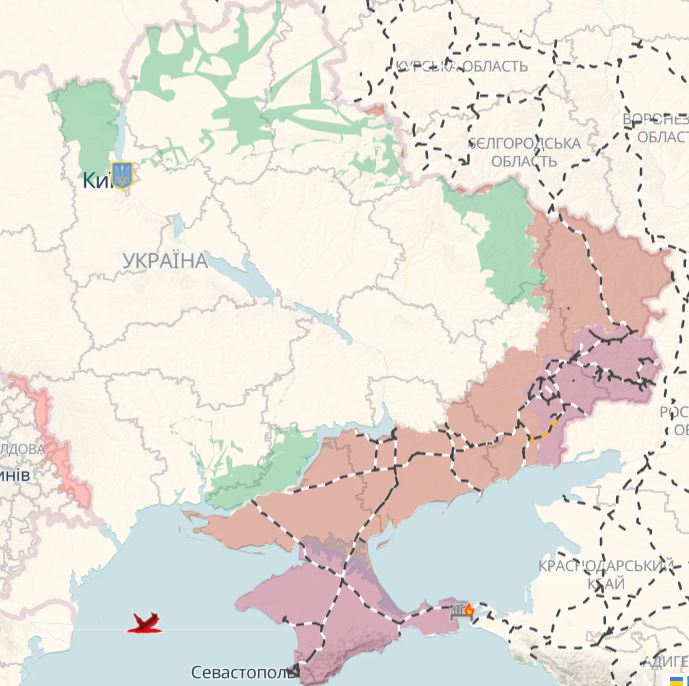
In 2025, the Armed Forces of Ukraine (AFU) finally switched to strategic defense, and the tactical offensive initiative was assigned to the Russian army. But the Russian army was unable to achieve a turning point in the war, opportunities for deep and rapid breakthroughs into the territory of Ukraine due to the maintaining strategic balance of resources and technologies between the parties to the conflict. The advance of Russian troops in Ukraine has accelerated significantly in 2025, as the Russian Federation realizes its numerical and resource advantage. Currently, the Russian Federation has captured about 116,500 km2 (19.3%) of Ukrainian territory. If for the whole of 2024, the Russian Federation captured about 3300km2, then as of December 2025. – is already about 4300 km2.
During 2025, Russian troops established control over Kurakhove, Velyka Novosyolka and Toretske in the Donetsk region. Chasiv Yar is at the stage of almost complete capture. In the areas of Pokrovsk and Myrnohrad, Ukrainian forces control only small areas of the territory, fighting continues there.
Map of hostilities in Ukraine as of April 3, 2022 DeepStateMap.
Map of hostilities in Ukraine as of February 22, 2026 DeepStateMap.
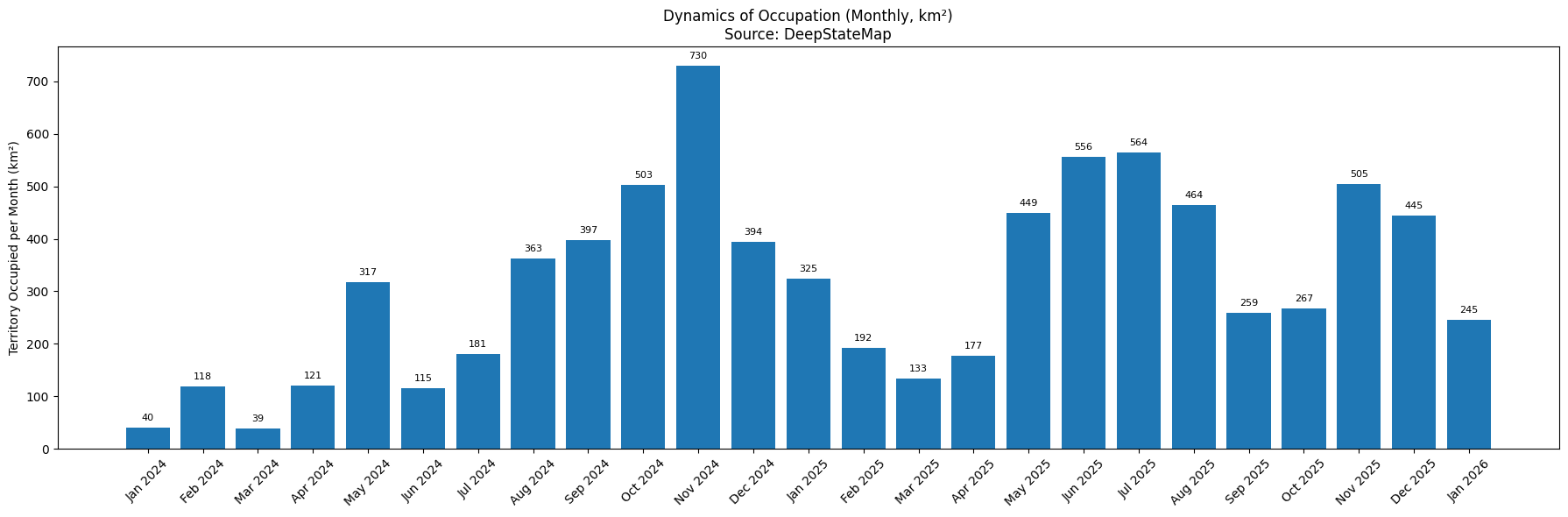
But despite the increase in the pace of the offensive of the Russian Federation, the front at the beginning of 2026 still retains signs of a protracted positional struggle. It is characterized by high dynamics, the absence of deep breakthroughs and the remaining defense potential of the Armed Forces of Ukraine.
Although Russia's creeping advance on the front line continues, its pace has slowed down somewhat. Over the past week, the Russian Federation has managed to occupy only about 10 square kilometers, while the average weekly advance was previously between 50 and 100 square kilometers.
Ukraine carried out several local counterattacks - in the area of Pokrovsk (Donetsk region), in the south in the direction of Gulyaipole (Zaporozhye direction), as well as in the Dnipropetrovsk region near the village of Ivanovka.
At the same time, the Russian army continues to put pressure in the Donetsk region. There is an advance in the area of Platonovka in the Sloviansk-Kramatorsk direction, as well as in the area of Myrnohrad and Pokrovsk.
Since the beginning of February 2026, Ukrainian troops have been able to regain more than 200 square kilometers, which was the fastest pace of advance in the last 2.5 years. The intensification of Ukrainian counterattacks is associated with the recent restriction of access of Russian forces to the Starlink system, which caused serious problems with communication and control on the battlefield. However, she said that this allegedly did not affect combat capabilities. But Ukraine claims that the shutdown has significantly complicated the work of Russian units. Russia's access to Starlink terminals has long been a serious problem for Ukraine. For a certain period, it was not fully resolved, including due to the use of unregistered terminals by some Ukrainian units. The new Minister of Defense, Mykhailo Fedorov, is credited with tightening control and restricting access for Russian forces, including thanks to the established interaction with Elon Musk. On February 2, Mykhailo Fedorov announced the launch of the verification procedure for Starlink terminals in the country. According to him, only verified and registered devices should operate on the territory of Ukraine, while all others are subject to disconnection in order to prevent the use of the system by Russian troops. Which created additional opportunities for Ukrainian counterattacks.
On the Ukrainian side, there are urgent problems that continue to determine its military posture. These are human resources – a shortage of mobilized and trained fighters; a high level of desertion and delays in training, according to some sources – up to 50% before the start of training. Ammunition and logistics - depletion of warehouses, vulnerability of supply routes, stretched rear line.
Air defense and missile defense are limited reserves of air defense systems against massive drone and missile strikes. Command and control - difficulties of coordination on a stretched front, vulnerability of communications (command - control).
Financing – high dependence on external aid; risk of lack of funds for a long-term mobilization economy.
Losses of the parties. About 1 million Russian soldiers were killed or injured (750 wounded and 250 killed).
The total loss of the Armed Forces of Ukraine as a result of deaths, injuries and retirement could reach up to 500 thousand people by the end of 2025, including about 54 thousand missing. According to foreign estimates, Ukraine's losses in killed and wounded are about 400 thousand people, of which 60-100 thousand were killed (official data are not disclosed).
At the same time, in 2025, the crisis of personnel retention sharply manifested itself. From January 2022 to October 2025, 311,327 criminal proceedings were registered in Ukraine, of which 255 thousand were for the SZP and 56.2 thousand for desertion; in January-October 2025 alone, 161,461 proceedings were registered. In fact, the waves of mobilization in 2025 did not cover the scale of personnel retirement, if we take into account that the total number of deserters is estimated at more than 300 thousand people. Mobilization has increasingly transformed into a systemic political and social problem. Demographic exhaustion, public fatigue from the war, distrust of TCC practices, corruption, lack of clear terms of service and rotation have turned mobilization into one of the main factors of internal vulnerability of the state. According to a study by the Sociological Group Rating (dated December 5-6, 2024), 67% of Ukrainian citizens do not trust TCC representatives, and 29% trust them. For comparison, 94% trust the servicemen on the front line.
Infrastructure war.
The energy front is increasingly turning into one of the key lines of confrontation, where strikes on generation and networks are becoming an instrument of strategic pressure on Ukraine. In 2025, there was a maximum intensification of Russian air attacks on Ukraine. Russia strikes railway infrastructure, gas production and gas transportation, as well as power generation facilities. The number of missiles used by Russia since the beginning of the full-scale invasion may exceed 12,000 units. The intensity of the blows usually increased on the eve of the heating season. The total direct physical damage to the energy sector is now estimated at $20.51 billion. These losses do not take into account the losses associated with the occupation of the Zaporizhzhia nuclear power plant and the destruction of the Kakhovka dam. Russia has carried out many massive attacks on Ukraine's energy infrastructure and occupied generation facilities with a total capacity of 18 GW. According to the latest government data, the total need for the restoration and modernization of the energy sector for the next 10 years is $90.6 billion (this was announced by Energy Minister Dmytro Shmyhal).
At the same time, Ukraine strikes at the Russian oil and gas infrastructure, which creates tangible damage to the Russian economy - about $100 billion. In particular, Ukrainian drones regularly carry out attacks on the territory of the Russian Federation. Since August 2025, Ukraine has affected about 20% of the capacities (equivalent to about 1.1-1.2 million barrels of oil per day) of the Russian energy complex - about 20 oil refineries (Lukoil in Volgograd, Rosneft in Ryazan, as well as refineries in the Rostov, Samara, Saratov and Krasnodar regions, etc.)Some refineries burned for several days (for example, the large Novoshakhtinsky refinery in the Rostov region), and strikes on the Druzhba oil trunk pipeline led to fires at the Unecha oil pumping station in the Bryansk region and a halt in oil supplies to Europe. . They affect the formation of a recession, the degradation of the Russian economy and complicate the supply of the front.
Internal situation in the country.
With the beginning of the war, a real explosion of social solidarity took place in Ukrainian society, which at that time united all segments of the population. A huge number of people signed up for the territorial defense, the armed forces of Ukraine, many became volunteers. The Armed Forces of Ukraine enjoy the greatest support (over 90%). The effect of "uniting around the flag" was also fully manifested: there was a rapid increase in support for the authorities in general and the President in particular, according to various estimates, from 88% to 91% of citizens approved of his activities. and his party "Servant of the People" - 40%-50%.
In 2022-23, Ukraine was characterized by a leadership model of governance, where power was nominally consolidated in the hands of the Supreme Commander-in-Chief, President V. Zelensky and his team.
But the Ukrainian counteroffensive in the South of the country in the summer of 2023 did not demonstrate the expected result, which is why there is a weakening of international support, the team of President V. Zelensky is beginning to lose its rating positions within the country.
At the same time, in Ukraine, the Ukrainian society itself began to reassess the situation in the country. At first, this manifested itself in the growth of demand for criticism of the authorities. Then in the growth of non-perception of corruption. The issue of corruption has become the key claim of society to the state. 52.5% expressed the opinion that it is possible to criticize the authorities for corruption during the war.
On December 14, 2023, the European Council makes an important decision for Ukraine to start negotiations on the country's accession to the EU. Rather, it was a symbolic step of political support from European partners, which does not yet guarantee the country a quick accession to the EU. But the start of the EU accession negotiations is extremely important for the government team in Ukraine in terms of demonstrating European prospects and "victories" to Ukrainian society.
The years 2024-2025 were a period when President Volodymyr Zelensky lost his monopoly on power, forced under pressure to dismiss his "almighty" head of the Office, Andriy Yermak, who could have been involved in the so-called "Mindich" case. This is an undeniable manifestation of the trend towards the weakening of the Presidential vertical in favor of the Anti-Corruption Vertical, the parliament and the power bloc; which may eventually lead to new elections as early as 2026.
The loss of V. Zelensky's status as an undisputed political leader against the backdrop of the growing popularity of other alternative figures, such as the former commander-in-chief of the Armed Forces of Ukraine Valery Zaluzhny (74% trust him) or the head of the Main Intelligence Directorate Kyrylo Budanov (59% trust him), the loss of realistic prospects for victory in the war, which accelerated the accumulation of Ukrainian society's fatigue from suffering and deprivation, multiplied by the severe corruption scandals of "Mindichgate" formed a persistent the demand within Ukrainian society for peace talks and the cessation of hostilities is 69% (Gallup poll) in 2025. And the resignation of the Head of the Office of the President, as well as the earlier change of the Head of Government and the composition of the Cabinet of Ministers of Ukraine, only partially reduced the negative pressure on the authorities.
The majority of citizens believe that events in Ukraine are developing in the wrong direction – 48% ( Razumkov Center survey). Only 32.5% hold the opposite opinion.
The level of trust in government institutions has decreased. Maintaining a high level of trust, first of all, concerns those institutions that are directly responsible for the country's defense. 28% trust the government headed by Yulia Svyrydenko, 30% do not trust it, while 42% of respondents said they do not know or cannot assess its activities. Only 20% trust the Verkhovna Rada of Ukraine, 76% do not trust it. Society is also critical of TCC: 24% trust them, 68% do not trust them (research by the Sociological Group "Rating").
The rating of trust in the President of Ukraine Volodymyr Zelensky in 2025 generally remained at a stable level - 61% of Ukrainians trust him, 32% do not trust him (according to KIIS) despite corruption scandals, and paradoxically, largely due to opposition to external pressure from Donald Trump.
The change in US strategy regarding the Ukrainian-Russian war in 2025 resulted in the refusal to provide financial and military assistance in conjunction with the suspension of USAID work. USAID has been one of the key channels of American support for Ukraine. Since the beginning of the full-scale war in 2022, the agency has allocated about $30 billion in direct budget support to Ukraine, $5 billion for development programs, and $2.6 billion for humanitarian assistance. In 2024 alone, Ukraine received more than $5 billion through USAID programs, of which $3.9 billion was direct non-refundable budget assistance to finance non-military spending. The current changes will also significantly affect the activities of anti-corruption organizations.
The activity of the opposition is growing and an active political struggle is unfolding. In addition to the ex-commander-in-chief of the Armed Forces of Ukraine Valeriy Zaluzhnyi, who will be a serious competitor to the team of V.Zelensky, ex-President Petro Poroshenko and the leader of the "Batkivshchyna" Yulia Tymoshenko remain potential strong political figures, but they, unlike V. Zaluzhny, have high anti-ratings - about 70%. Right-wing forces, led by ex-President P. Poroshenko, periodically during 2025 try to destroy the informal coalition of the Servant of the People and the remnants of the Opposition Platform for Life (primarily the Platform for Life and Peace and Restoration of Ukraine) in the Parliament. This coalition allows you to make most decisions, since the Servant of the People has recently been able to vote on its own only 14% of initiatives. A stable majority in the Verkhovna Rada is the key to controlling the government and law enforcement agencies. Without it, Volodymyr Zelensky risks losing the levers of control.
Linguistically and religiously, Ukraine has undergone significant changes, which is a consequence of both the war and socio-economic shifts, such as the outflow of the more affluent urban population. Formally, the number of Ukrainian-speaking citizens has increased, and the Ukrainian language has become even more dominant, but the number of Ukrainian speakers has actually decreased. In the religious sphere, the Orthodox Church of Ukraine has become the dominant confession, gradually supplanting the Ukrainian one Orthodox Church.
Over the period 2022–2026, significant personnel rotations took place in Ukraine, which significantly affected the internal political balance. In February 2024, the Commander-in-Chief of the Armed Forces of Ukraine, General Valerii Zaluzhnyi, was dismissed, and soon he was appointed Ambassador Extraordinary and Plenipotentiary of Ukraine to the United Kingdom. This decision was seen as an attempt by the President of Ukraine Volodymyr Zelensky to restore governability and political monocracy, since the rapid growth of V. Zaluzhny's popularity against the backdrop of the war objectively formed an alternative center of influence and a potential electoral threat.
In the fall of 2025, there was a change in the composition of the Cabinet of Ministers of Ukraine: Prime Minister Denys Shmyhal was dismissed (and first appointed Minister of Defense, and eventually Minister of Energy), Yulia Svyrydenko, who previously held the post of First Vice Prime Minister - Minister of Economy of Ukraine, was appointed as the new Prime Minister. restoration of public ratings against the backdrop of accumulated socio-economic negativity. The resignation of the government also made it possible to redistribute responsibility for wartime crisis decisions.
In November 2025, Head of the Office of the President of Ukraine Andriy Yermak was dismissed against the backdrop of the so-called "Mindichgate" and the aggravation of the conflict between the Office of the President and anti-corruption bodies, which entered an open phase in the summer of 2025. The confrontation between Bankova and the structures of the anti-corruption vertical (NABU, SAPO, HACC) became one of the most serious domestic political crises of the war period.
For the position of Head of the President's Office on January 2, 2026 the Chief of the Main Intelligence Directorate of the Ministry of Defense of Ukraine, Lieutenant General Kyrylo Budanov, was appointed. In general, it looked like an attempt to revive the presidential vertical and restore managerial discipline. The replacement of Andriy Yermak, whose reputation by that time had become politically toxic, with a power figure should strengthen the position of the President at least at the initial stage.
In 2026, Ukraine is highly likely to face the need to turn to a direct popular mandate through elections and/or a referendum, since it will be extremely difficult to get out of the current military-political and institutional impasse without renewing the legitimacy of the government. The issue of elections in the Ukrainian context goes far beyond the framework of the internal democratic procedure and becomes a key element of the negotiation architecture. President Volodymyr Zelensky publicly indicated that the elections are part of the "peace program" and can take place after a truce is reached (for at least 60 days). V. Zelensky has repeatedly stressed that any decisions on territorial issues within the framework of possible peace agreements can only be made with the participation of the people of Ukraine - through elections or a referendum.
International sanctions against the Russian Federation and economic losses.
After the start of a full-scale war in 2022, Western countries sharply increased sanctions pressure on the Russian Federation. The sanctions were aimed primarily at restricting the access of the Russian army and its suppliers to technology, equipment and financing. In terms of the number of restrictions imposed, Russia bypassed Iran, Syria and North Korea. Restrictive measures for aiding and abetting aggression were also imposed against Belarus. The sanctions covered key areas: the financial sector (disconnecting banks from SWIFT, restrictions on settlements and transactions with assets), freezing sovereign reserves and assets, the energy sector (oil embargo, price ceiling for oil and petroleum products, restrictions on production technologies), the export of high technology and dual-use goods, the military-industrial complex, transport and aviation, shipping and the "shadow fleet", personal sanctions against officials, businessmen and companies. The gold and foreign exchange reserves of the Russian Federation in the amount of about $ 300 billion were frozen. Since 2022, the EU has adopted 19 packages of sanctions (the 20th is under consideration).
Sanctions pressure is systematically undermining the Russian economy, limiting its technological and investment potential. Russia's GDP in 2022 decreased by (-2.1%), and in 2023 it grew by 3.6% in absolute terms, amounting to 172,148.3 billion rubles. The aggregate estimated range of economic losses and lost profits of the Russian Federation for the period 2022–2026, excluding frozen reserves, may range from $500 billion to $1 trillion. In addition to direct economic losses from sanctions, reduced export revenues and structural degradation of the economy, by the end of 2025, Russia will incur colossal direct military budget expenditures, which have increased manifold over the four years of the war and have become a systemic factor of pressure on the state's finances. By the end of 2025, Russia spends more than $140 billion a year (13.5 trillion rubles) on the war, which is almost three times the pre-war level of military spending in 2021 (3.58 trillion rubles ≈ $48 billion).
However, the effect of sanctions remains limited. Russia's share of energy supplies to Europe has fallen from about 40 percent to about 15 percent, but it has not completely disappeared. Some of the flows are redirected through bypass schemes, from petroleum products processed in third countries to LNG supplies to European ports. Exceptions and transitional regimes (including for oil via the southern branch of the Druzhba pipeline to Hungary, Slovakia and the Czech Republic) also reduce the overall effect of the restrictions, while the European economies themselves have incurred additional adjustment costs. Europe's indirect losses from the war in Ukraine could reach about $2 trillion due to a combination of factors: a sharp rise in energy prices after the abandonment of Russian gas and oil, large-scale budget compensations to households and businesses, rising prices for electricity and industrial production, loss of competitiveness of energy-intensive industries (metallurgy, chemicals, fertilizers), accelerated inflation and rising interest rates, additional spending on defense and support for Ukraine, and slowing economic growth and reallocation of investment. A significant role was also played by the costs of emergency diversification of supplies - LNG infrastructure, import subsidies and logistics restructuring.
At the same time, the war has caused damage to the global economy: the destruction of Ukraine (minus hundreds of billions of GDP), a decline in investor confidence, trade difficulties (global trade grew by only 2.2% in 2022 - €100 trillion against 14% in 2021-€97 trillion), a food crisis in poor countries and the cost of helping refugees (in Europe there are ~6 million Ukrainian refugees, their reception required from €30-40 billion). In particular, a significant blow fell on global supply chains - the supply of grain, metals, fertilizers and energy carriers was disrupted, insurance and transport costs increased, and price volatility increased. The blockade of Ukrainian ports and the reduction in grain exports provoked a food crisis in a number of countries in Africa and Asia, increasing inflation and social instability.
The Ukrainian economy has suffered colossal losses from direct destruction and pays off to a large extent due to external support. In 2022, Ukraine's GDP collapsed by 29.1% - industry, infrastructure and agriculture were badly affected by the fighting. Millions of citizens became refugees, unemployment soared. Tax revenues decreased, while military spending increased significantly. Ukraine's budget deficit immediately rose to $3-5 billion per month, against pre-war expectations of $600 million.
Inflation in 2022 reached 26.6% in annual terms due to the destruction of logistics and emission financing of the budget. But later, in the period from December 2022 to December 2025, Ukraine went through a phase of moderate reduction in inflationary pressure: annual inflation fell from double-digit values to about 9-10%.
At the end of 2023, GDP growth stabilized and amounted to 5.5. But by the end of 2024, Ukraine's GDP grew by only 2.9%. In nominal terms, the economy reached about UAH 7.6-7.8 trillion, or $195-200 billion.
The GDP growth range in 2025 is 1.7–2.0%. In nominal terms, this corresponds to an economy of about UAH 8.6-8.8 trillion, or about $215-225 billion, depending on the hryvnia exchange rate and inflationary dynamics.
Demographically, Ukraine has lost between 10 and 15 million of its population:
Since the beginning of the invasion, the Russian Federation has seized territories inhabited by at least 3-3.5 million people (in general, from 6 to 9 million people may live in the territories of Ukraine occupied by the Russian Federation, including Crimea);
According to official UN data alone, there are 6.8 million Ukrainian refugees in the world (of which about 6 million are in Europe) and, most likely, these figures are incomplete. A significant part of the refugees are also on the territory of the Russian Federation and Belarus. Another 3.6 million are registered as internally displaced persons. Another 4.3 million have already returned to their homes. That is, a total of about 15 million Ukrainians have left their homes since the beginning of the Russian invasion. And a third have already returned. Refugees and IDPs are gradually finding jobs. 45% of refugees abroad and 43% of IDPs have already found work.
According to the United Nations, at least 15 thousand dead and about 41 thousand wounded were recorded among the civilian population - and this does not take into account losses among military personnel.
The number of able-bodied Ukrainians has decreased by 5.5 million people or 30% since the beginning of the invasion. This is more than in Germany after World War II. Before the invasion, Ukraine had 17.4 million able-bodied residents.
By mid-2025, the Ukrainian economy was on the verge of stagflation, a combination of high inflation (in June 2025, annual inflation was about 14.3%) and a decline in business activity. The main reasons are the disappearance of the low base effect, losses at the front, strikes on energy and infrastructure, a weak harvest, a drop in construction and a crisis in the labor market due to mobilization.
An additional risk was a default on domestic debt obligations, which in May-June 2025 was technically recognized in connection with the revision of the terms of government bonds (domestic loan bonds). This weakened investor confidence and increased pressure on the budget.
The World Bank, the European Commission, and the United Nations have increased their estimates of the total cost of Ukraine's reconstruction and recovery to $524 billion over the next decade.
According to the Kiel Institute for the World Economy, by 2026, Ukraine will lose about $120 billion in economic output (GDP) and almost $1 trillion in fixed capital. The costs for third countries not directly involved in the war amount to $250 billion, of which about $70 billion will be spent on the war. falls on the European Union. And $15-20 billion. on Germany alone, which, apparently, will be entrusted with the main responsibility for financing Ukraine.
There is an increase in Ukraine's financial dependence.
Over the entire period of the war, Ukraine has received about €330 billion in aid from allies (according to the Kiel Institute for the World Economy, meaning allocated aid, not delivered) of which: 45% (about €146.6 billion) is financial aid; about 45% is military aid (€151.6 billion); and about 10% is humanitarian aid (€31.8 billion).
The United States allocated 114.6 billion euros, and Europe - 188.6 billion euros. Ukraine also received more than 26 billion euros in aid from Japan (13 billion euros) and Canada (13 billion euros).
USA: military aid – €64.6 billion; financial – €46.6 billion; humanitarian – €3.4 billion.
Europe + Japan and Canada: military aid – 87 billion euros; financial aid – 100 billion euros; humanitarian aid – 28.4 billion euros.
The EU allocated the most financial assistance to Ukraine - 73 billion euros. Most of the military assistance from European countries was allocated by: Germany - 19.7 billion euros, Great Britain - 13.7 billion euros; Denmark - 9.6 billion euros; the Netherlands - 8.2 billion euros; Sweden - 7.9 billion euros; France - 5.9 billion euros.
As for budget funding, according to the Ministry of Finance, for the period 2022-2025, Ukraine received about $164.59 billion, which allowed the state to function in wartime.
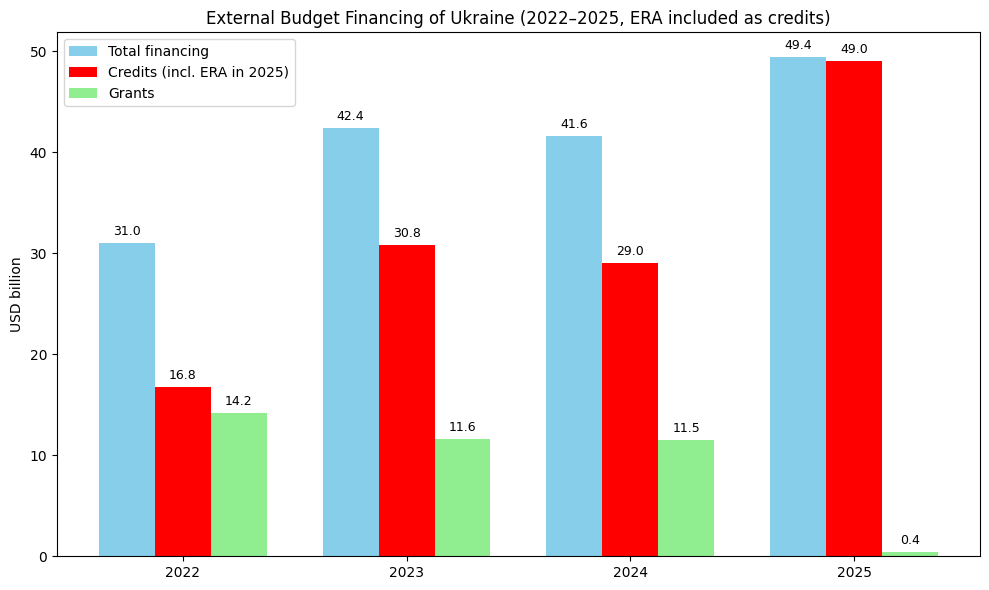
On average, about 59% of this amount was in loans and about 41% in grants, but the actual structure of aid changed significantly over the years, reflecting the transformation of the support model and the political cycles of donor countries. But since the second half of 2025, the model of support for the country has changed dramatically: the United States has withdrawn from direct budget financing programs; Europe has reduced the scale and changed the format of assistance; the format of support has almost completely become credit-centric. Grants, as a form of non-repayable assistance, have practically disappeared, giving way to loans, albeit more preferential, but still forming Ukraine's future debt obligations.
The year 2022 was characterized by an emergency model of support: Ukraine received about $31 billion, with a high share of grants, primarily from the United States, which made it possible to close the budget deficit without a rapid increase in the debt burden. 2023 was the peak year in terms of funding ($42.4 billion), but it was then that a turning point occurred - a sharp increase in the share of loans and the strengthening of the role of the EU as a key donor, while reducing the relative contribution of the United States. In 2024, the volume of support remained at a high level (about $41.6 billion), but the aid model became more institutionalized: loans from the EU and international financial organizations dominated, and grants stopped growing.
2025 has become a qualitatively new stage. Formally, the volume of external budget financing even increased ($49.36 billion), but in fact, Ukraine switched to an almost completely credit model of survival, the amount of grants became symbolic ($0.4 billion)
The role of the United States has undergone the most dramatic transformation. If in 2022-2023 Washington was one of the key sources of budget funds, especially grants, then by 2025 there is no direct participation of the United States in financing the Ukrainian budget. Support has shifted to the plane of political guarantees, defense solutions and indirect financial mechanisms.
The European Union, on the contrary, became a systemic donor in 2023-2024 and retained its participation in 2025, but in limited volumes. At the same time, the EU has also moved from the model of solidarity grants to credit logic, reducing the direct burden on the budgets of member states. The European Commission has become a key donor of financial assistance. The share of aid at the EU level increased from about 50% in 2022 to almost 90% in 2025, equivalent to €35.1 billion. At the end of 2025, a new loan package of €90 billion for 2026-2027 was agreed. At the same time, these funds are not enough to cover all the needs of Ukraine: according to the IMF, about $137 billion is needed for 2026-2027, This means that the funding gap persists.
Ruslan Bortnik and Oksana Krasovskaya
for the Ukrainian Institute of Politics