Авторы публикации
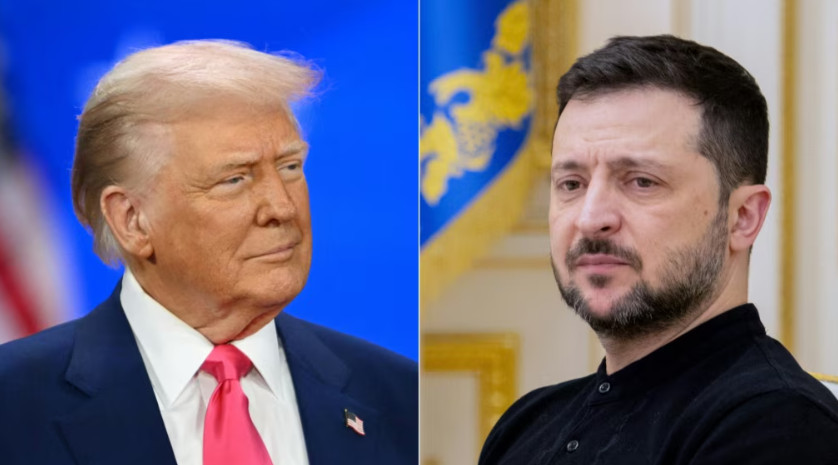
The confrontation between the Presidents of Ukraine and the United States is increasingly shifting into the information space, where each side seeks to place political and moral responsibility on the other.
Overall, the conflict between Donald Trump and Volodymyr Zelensky can serve as an example of a clash between two different approaches to governance — straightforward business pragmatism and classical international politics, in which public opinion is one of the key resources.
D. Trump's logic is that of a businessman focused on direct benefits, minimizing costs, and concluding deals quickly. If an agreement with Moscow or pressure on a weaker ally brings economic and domestic political dividends, for example, making it possible to contain rising fuel prices ahead of elections, this becomes a sufficient basis for him to make a decision.
The world's political elites are largely guided by the same principles of power and personal gain as big business, but they have one fundamental difference — politicians are forced to conceal their pragmatic, and sometimes openly predatory, interests behind the mask of “public morality.”
Unlike authoritarian systems, in democratic societies (even with all their shortcomings, manipulations, and political technologies) citizens remain the source of the legitimacy of power. And citizens, however cynical they may be in everyday life, have a vital need to believe that their leaders represent the “forces of good” and defend a “just world order.”
In other words, a political “predator” is forced to present his actions to society as a “noble mission.” Disregarding this mask risks the loss of public support and political nullification. Therefore, even the harshest geopolitical decisions require a visible “moral justification” for society, such as the defense of democracy, the restoration of justice, or the provision of security, etc.
And when D. Trump attempted to impose his geopolitical deal on Ukraine, V. Zelensky shifted the confrontation to a field where he has an advantage — the international media space.
Addressing the global media, the Ukrainian President appeals not so much to D. Trump himself as over his head — to American voters and Western society. Thus, V. Zelensky, consciously or intuitively, strikes at D. Trump's vulnerable point — he calls into question the image of the American President as a “leader who brings peace and justice.”
For his part, D. Trump is also trying to shape public opinion by portraying the Ukrainian leadership as corrupt, uninterested in achieving peace, and obstructing an end to the war.
However, reputational attacks on the Ukrainian leadership do not remove the main constraint facing D. Trump himself — the need to take into account the overall attitude of American and Western society toward the nature of the Ukrainian-Russian war. Open (or poorly concealed) coercion of Ukraine into making concessions, when most Western societies perceive it as a victim of Russian aggression, could result in far greater political costs for D. Trump ahead of the Congressional elections than rising fuel prices.
The Kremlin itself further complicates D. Trump's position. By continuing its heavy, massive strikes on Ukrainian cities, Russia creates horrifying images of destruction and civilian deaths for Western audiences, including Americans. These images strengthen public sympathy for Ukraine and, at the same time, make it more difficult for the White House to present economic agreements with Moscow as politically and “morally justified.”
It is precisely in this context that the statement by U.S. Secretary of State Marco Rubio, that D. Trump does not like seeing Russian ballistic missiles strike residential buildings in Kyiv, should be viewed. This is a form of “moral distancing” by Washington from Moscow's actions.
Oksana Krasovskaya, Political Analyst at the Ukrainian Institute of Politics
_________________________________________
General Context.
Tensions between Ukraine and the United States reached their peak after Trump concluded a deal with Putin under which Washington would refrain from further tightening sanctions against Russia in exchange for Moscow supplying limited volumes of diesel fuel to the global market to contain rising prices.
Bloomberg reports that Zelensky says Trump is putting pressure on Ukraine, rather than on Putin, to force it to make concessions.
In an interview with the publication, Ukrainian President V. Zelensky outlined what he described as a series of unfriendly steps taken by Washington toward Kyiv. These include the deliberate slowing of Starlink internet speeds and delays in the already limited supplies of Patriot ballistic missile interceptors.
“I believe that steps were taken to persuade Ukraine to capitulate,” Zelensky said. “I am not saying that this is the goal pursued by our partners. I do not want to think that our American partners believe that the war against Russia could have been ended earlier at Ukraine's expense. But that is how it looks.”
Earlier, V. Zelensky stated that U.S. warnings about Russian ballistic missile launches were absent on October 12, 13, and part of October 14. On October 18, V. Zelensky announced the resumption of the transmission of American intelligence data after its temporary suspension.
On the night of October 19, Russia launched a massive attack on Kyiv in two waves, using ballistic and cruise missiles as well as drones. According to the Ukrainian Air Force, before the first wave of the attack, at approximately 11:00 p.m., no warning was received from American partners, and Ukrainian radar systems independently detected the ballistic targets. Before the second wave, the United States had already provided the relevant information.
At the same time, U.S. Secretary of State Marco Rubio refuted the Ukrainian President's statements, emphasizing that Washington had not stopped sharing intelligence with Ukraine, and expressed surprise at where V. Zelensky was obtaining such information and why he was publicly sharing it with journalists. At the same time, M. Rubio noted that “D. Trump does not like seeing ballistic missiles strike residential buildings in Kyiv.”