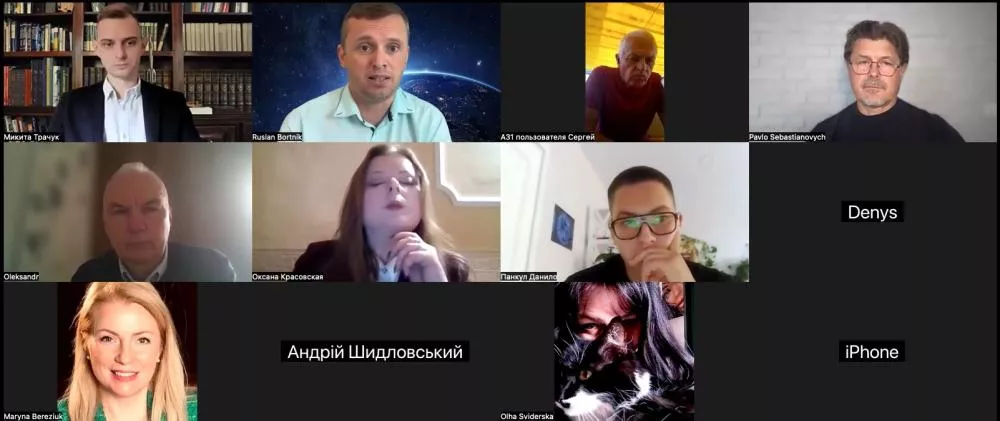
On 13 October 2026, the Ukrainian Institute of Politics held a roundtable entitled “Envisioning the Future in Wartime: Between the Front Line and the Home Front”. Participants discussed the conditions for postwar recovery, preserving human potential, relations between citizens and the state, the role of veterans, and Ukraine's international position.
The central theme of the discussion was the transition from wartime survival to sustainable development. The cessation of hostilities alone will not resolve accumulated social tensions, restore trust in institutions, or ensure the return of Ukrainians. Preparations for peaceful life must therefore begin now, with a discussion of specific decisions, the resources they require, and their consequences.
Ruslan Bortnik opened and moderated the discussion. The presentations and debate reflected different approaches to the timing and mechanisms of transformation, ranging from a phased postwar transition to economic reforms during the war itself.
Preserving the State and Its People
Ruslan Bortnik identified two starting points for assessing any model of the future: preserving Ukrainian statehood and preserving its people. In his view, decisions should be assessed in terms of their impact on the country's capacity for independent development and on citizens' willingness to build their lives there.
He identified the preservation of the full range of rights and freedoms enshrined in the Constitution as one of the main conditions for such a future. Temporary restrictions imposed under martial law must end when their legal grounds cease to exist. The restoration of rights in full must not be made conditional on the adoption of a new Constitution.
At the same time, Bortnik proposed taking approximately five years after the end of the war as a target for modernising the Constitution. This period is needed for people to return, competitive politics to be restored, and the performance of state institutions to be assessed. The constitutional process should involve veterans, local communities, the academic community, businesses, and Ukrainians abroad.
The substance of the new republic he proposed is a renewed social contract that preserves the state's legal continuity: citizens fulfil their obligations and participate in defending the country; the state guarantees rights and opportunities for development; public officials are accountable for their decisions; and the law applies equally to everyone.
The Front Line, the Home Front, and Preventing Social Conflicts
An important part of the roundtable was the presentation by Danylo Pankov, a representative of the Military Institute of Taras Shevchenko National University of Kyiv. He presented research on social conflicts prepared jointly with Nazar Krytskaliuk.
Pankov drew attention to the connection between distrust of state institutions, declining trust between social groups, and the risk of deepening societal tensions. The issues discussed included mobilisation, social inequality, the situation of internally displaced persons, and differing views on the country's direction of development.
As tools for preventing conflicts, he proposed direct dialogue between the authorities and citizens, legal education, the development of mediation, and accessible dispute resolution procedures. In his assessment, the postwar period could become a time of heightened social tension, making it necessary to prepare the relevant mechanisms in advance.
Ruslan Bortnik separately warned against a conflict over the right to determine who is a “real Ukrainian”. Veterans, residents of different regions, displaced persons, refugees, and those who remained at home have different experiences of the war but equal rights as citizens. Responsibility for specific violations must be individual and established by a court.
Democratic Transition and Trust in the State
Andriy Yermolayev identified the alienation of society from the state as one of the key challenges. In his assessment, replacing those in power without changing mechanisms of oversight and self-organisation could reproduce the previous model of governance and create further grounds for public disillusionment.
He proposed discussing an agreed two-year transition period during which the first postwar parliament and local authorities would focus on stabilisation, restoring everyday life, and launching a new constitutional process. Local self-government, civic participation, and dialogue with domestic capital, including small and medium-sized businesses, play an important role in this model.
Pavlo Sebastyanovych questioned whether such a transition could be secured in advance and emphasised the importance of the quality of the people who come to power through elections. His approach places decentralisation, effective procedures for direct citizen participation, and officials' responsibility for the conditions of economic activity at its centre.
The discussion thus addressed both institutional arrangements and the quality of political teams. Participants differed in their assessments of the sequence of change, but linked prospects for development to expanding society's ability to influence state decisions.
From Survival to Shaping the Future
Olena Sushyi, who holds a Doctor of Sciences degree in Public Administration, proposed examining several possible scenarios for postwar development. In her view, a scenario-based approach makes it possible to identify critical decisions and risks affecting the country's trajectory in advance.
She emphasised that society's ability to adapt to threats and organise itself during wartime must be transformed into the ability to build functioning institutions. A prolonged existence in survival mode exhausts people and entrenches practices of adapting to an ineffective system.
In this approach, a new social contract is a system of mutual expectations and responsibilities between the state and citizens, as well as between groups with different experiences of the war. A shared framework for the future must leave room for different life plans and understandings of justice.
Veterans and the Return of Ukrainians
During the discussion of veterans policy, Ruslan Bortnik proposed a personalised pathway back to civilian life encompassing medical treatment, rehabilitation, psychological support, housing, education, and employment. Such a pathway should have a designated coordinator and clear timelines for providing support.
Particular attention is needed for the families of those killed, missing, or held captive, as well as people with severe injuries. Social guarantees must be backed by funding and oversight of implementation. Military experience can also become a resource for public administration, local politics, and entrepreneurship.
The return of Ukrainians from abroad was discussed in terms of actual living conditions. Security, employment, housing, children's education, and access to healthcare determine a family's decision to return. Bortnik proposed recognising qualifications obtained abroad, supporting business relocation, and maintaining cooperation with Ukrainians who remain abroad for the time being. Support for returnees should be combined with assistance for internally displaced persons and those who continue to live in the country.
The Economic Foundations of Recovery and Ukraine's International Agency
Pavlo Sebastyanovych emphasised that changes to lending, the tax system, and the conditions for entrepreneurship are needed during the war itself. In his assessment, the possibility of economic development depends on government decisions, access to financial resources, and businesses' ability to operate without excessive administrative pressure.
Ruslan Bortnik proposed assessing recovery projects by the jobs they create, budget revenues, export potential, and reductions in critical dependence. He identified the defence industry, dual-use technologies, agricultural processing, energy, and logistics as priorities. Science and education should be integrated into these production links through specific tasks and government contracts.
Serhiy Znamenskyi drew attention to the starting parameters of any scenario: territory, population size, the structure of ownership, and available resources. He emphasised the need to consider the terms of participation for domestic and foreign capital, as well as external constraints on the country's development.
Oksana Krasovska examined Ukraine's international position through the concept of “global strategic loneliness”. In her assessment, partners increasingly revise their commitments according to their own interests, making Ukraine's resilience dependent on strengthening its domestic economic, defence, and intellectual resources. Stronger relations with other states can be built through joint production, technological cooperation, and a mutual interest in Ukraine's development.
Bortnik linked this model to Ukraine's place within the European political space and the development of its own trade and security mediation functions. These should be underpinned by a strong army, a functioning economy, infrastructure, and predictable rules of governance.
Continuing the Discussion
A peer-reviewed collection of presentations and abstracts is planned following the roundtable. Ruslan Bortnik also announced his intention to bring the ideas presented to members of parliament, government representatives, and foreign partners, and to make discussions of Ukraine's future a regular undertaking.
The issues raised form a practical agenda for further work: which institutions are responsible for the postwar transition, what resources they have, and which indicators society can use to assess the results. Preserving people, restoring trust, and enabling the country to finance its own development will be decisive conditions for Ukraine's sustainable future.