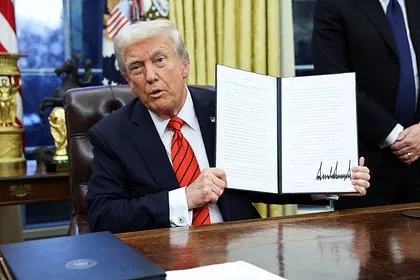
The Trump administration's new National Security Strategy 2025 is conceived as the official compass for US foreign, defense, and economic policy. The clear meaning of the document without diplomatic makeup: America no longer wants to be a "global nanny," wants to be the main beneficiary of order, and invites allies to grow up at their own expense and at their own expense.
Essence and purpose. The document tries to return to the strategy what was usually killed by bureaucracy: priorities and constraints. It explicitly states that it is pointless to list the whole world and all the problems, and that focus is more important than "universal tutelage." This is ideologically packaged in "America First," "peace through strength," sovereignty, and the rejection of extended interventionism.
A couple of key narratives of the text:
Sovereignty and the balance of power as a basic framework.
A tight link between the economy and security. Industrial survival, supply chain control, tariffs, and technological competition have been heralded as instruments of national power.
The end of the era of free Allied Defense. It almost marked the slogan: the United States will no longer keep the system "like the Atlas."
Ukraine-Russia: what exactly is new and where is the smell of realpolitik.
The most important wording for you is in the European section and sounds as utilitarian as possible. The United States considers it a "core interest" to achieve a quick cessation of hostilities in Ukraine for:
- stabilization of European economies,
-prevention of unintended escalation,
- restoration of strategic stability with Russia,
- the possibility of post-war reconstruction of Ukraine as a viable state.
If translated from the official language into the language of cold policy: Ukraine,
in the logic of this NSS, is not a goal in itself, but a node of European stabilization and risk management with the Russian Federation.
This is not a "crusade for democracy". This is the control of the fire, so that it does not burn the European rear and knock the United States out of the greater competition. of NATO as a perpetually expanding alliance." That is, the strategy directly allows working with Russian fears/narratives as an element of de-escalation, regardless of whether someone likes them or not.
Europe: an ally that must stop being a patient. The tone towards Europe is almost therapeutically cruel. It speaks not only of military spending or stagnation, but of a deeper diagnosis:
a decline in the share of global GDP (from about 25% in 1990 to 14% today),
- Regulatory pressure,
- identity crisis,
- migration policy,
- censorship and suppression of opposition,
- A drop in the birth rate.
The United States wants to see a "strong Europe", but with a very specific meaning:
- More independence in defense,
- less dependence,
- more market for American goods,
- political support for "patriotic European parties" as a sign of a possible reversal of the course.
And separately about money and security:
The text includes the "Hague Commitment" with a requirement of 5% of GDP for defense for NATO countries. In practical terms, this is a signal: your security is no longer a U.S. subsidy, but a commercially and politically conditional service.
Russia: not "persuade", but "stabilize". Russia appears in this document in conjunction with European stability. The logic is as follows: Europe has a significant conventional advantage over the Russian Federation (except for the nuclear dimension). After the war in Ukraine, Europe's relations with Russia are "deeply weakened", and the Russian Federation is perceived as an existential threat.
Therefore, the United States will have to work diplomatically to restore the conditions of strategic stability in Eurasia and reduce the risk of a direct conflict between the Russian Federation and European states.
This is not about friendship. And yes, it leaves room for a deal if it: reduces the likelihood of a big war; gives the U.S. a free hand in the larger game.
China: the main systemic competitor, but war is not needed.
China is described as a source of key economic and technological threats, including:
- state subsidies,
- unfair trade,
- industrial espionage and IP theft,
-threats to supply chains and critical minerals,
- export of fentanyl precursors,
- propaganda and influence operations.
The military-political center of gravity in Asia is especially tied to Taiwan and the "First Island Chain".
Allies are invited to:
- spend more,
give the U.S. access to ports and infrastructure,
invest in deterrence.
At the same time, the old declarative framework for Taiwan is fixed:
The United States "do not support any unilateral change to the status quo" in the Taiwan Strait.
That is, the strategy is trying to maintain a balance between a demonstration of force and limiting the risk of a direct war with China.
Key difference from the previous version (2022). In short and without sweet speeches: Biden's 2022 NSS was built around the leadership of democracies, global coalitions, the "decisive decade", the competition of systems and a wide range of "common challenges".
2025 Trump's NSS sharply narrows the focus to the national interest, transfers values to the mode of optional rhetoric and relies on economic nationalism, hard redistribution of burden to allies and bargain de-escalation of conflicts. In an applied sense, this means: less ideological "saving the world", more calculation of "how much it costs the United States and what do we get in return", a more comfortable willingness to talk about the conditions for ending the war in Ukraine as a tool for stabilizing Europe and restarting the strategic framework with the Russian Federation.
A brief overview of the U.S. National Security Strategy 2025.
Section I. Introduction. What is the American strategy?
The strategy emphasizes the need to focus on core U.S. national interests rather than globalist ambitions. The goal of foreign policy is "to protect core national interests; This is the only focus of this strategy." As noted in the document, after the Cold War, previous administrations (the main reference to the Biden Administration) got involved in many conflicts and unclear goals, which depleted the country's funds. The first Trump Administration, as stated in the document, "turned out to be right, avoiding and correcting the above and leading the country to a new golden age." "America First" as a principle of foreign policy motivation, appealing to a pragmatic national approach and the revival of the country's competitiveness.
Section II: What the U.S. Should Want.
The strategy articulates global goals and specific U.S. desires. The primary goal is the "continued existence and security" of the U.S. as an independent republic that protects the rights of its citizens. The U.S. wants to protect its nation, territory, economy, and way of life from military threats and hostile foreign influence (espionage, predatory trade practices, human trafficking, propaganda, etc.). The strategy also emphasizes full control of borders and immigration so that "a border controlled by the will of the American people, … was fundamental to the survival of the United States as a sovereign republic." The U.S. seeks to have the most powerful and modern nuclear deterrent (including the Golden Dome for defense), as well as the strongest, most dynamic and innovative economy. Describing the economy, the document says that "the U.S. economy is the foundation of a way of life that provides broad prosperity and opens up pathways for social mobility." The strategy also seeks the strongest industrial base and energy sector capable of not only fueling economic growth, but also to become an export leader. In addition, the United States wants to maintain global technological leadership and protect intellectual property, as well as soft power – influence through culture and ideals. Cultural and spiritual aspects are also noted: the document calls it important to "revive the spiritual and cultural health of America", love for its past and heroes.
Specific foreign policy objectives of the United States are listed : in the Western Hemisphere – stability and the fight against narcoterrorism, the implementation of the "Trump correction to the Monroe Doctrine"; in the Indo-Pacific region – the preservation of free and open seas, secure supplies and economic recovery; in Europe – "to support allies in preserving the freedom and security of Europe, restoring its civilizational confidence and Western identity"; in the Middle East – to prevent the domination of a hostile power over the region and to avoid "forever wars"; and to ensure global leadership in strategic technologies. These goals are called "essential U.S. national interests" that should be focused on first.
Section III: Available U.S. Funds.
The United States has truly outstanding resources. The document lists the country's economic, military, and geopolitical advantages: the world's largest and most innovative market and economy, a dominant financial system (with the dollar as its reserve currency), a high-tech sector that provides a qualitative advantage for the military, and the most powerful military force and a broad network of allies in key regions. The geographical location of the United States is combined with an abundance of resources and oceans that protect the country from military invasion. The soft power of the United States – the ideals of freedom, democratic values, and cultural influence – also underpin its international credibility. In addition, the strategy also names Trump's internal reforms as its "means": the deployment of energy potential and the reindustrialization of the economy, reduction of regulation, tax cuts, and investment in new technologies. In particular, the document emphasizes the "deployment of colossal energy potential" as a strategic priority and the restoration of its own industrial base. The goal of the strategy is to combine all these resources to strengthen American power and make the country greater than ever before.
Section IV. Principles of strategy.
The strategy builds the basis of foreign policy on several key principles. One of them is a focus on the core of interests: the United States must clearly define its priorities and not be dispersed. The declaration "America First" is consistent with this idea. Another principle is peace through strength: a strong military and economy serve as the best deterrent. At the same time, respect for national sovereignty is proclaimed: The United States will "ruthlessly defend its own sovereignty" and prevent external interference and ideological pressure (including monopolization of discourse or influence through migration). The strategy emphasizes a commitment to the balance of power: the United States will not allow any country to become so powerful as to threaten its interests, and will work with allies to balance regional and global forces. "The United States cannot allow any country to become so dominant as to threaten our interests. As the United States rejects the ill-fated concept of global domination for itself, we must prevent the global and in some cases even regional domination of others. This does not mean wasting blood and treasure to limit the influence of all the world's great and middle powers. rich and powerful countries is the eternal truth of international relations. This reality sometimes requires cooperation with partners to thwart ambitions that threaten our common interests," the document says.
An important component of the principles is fairness in relations with partners. The document sharply criticizes the practice of free patronage for allies (from military alliances to trade relations). The United States now "insists on fair treatment" from other countries: it "will no longer tolerate" and cannot afford "trade imbalances" and "predatory economic practices." expenditures (a new target of 5% of GDP for defense is given). In addition, one of the principles is the principle of impartiality/realism: the United States recognizes the need to soberly assess what is possible and strive for peace, without imposing democracy against the wishes of countries. A "predisposition to non-interventionism" is also mentioned: intervention is justified only at a very high threshold. Thus, the strategy combines "America First" with an emphasis on strong defense, national sovereignty, and the demand for justice from allies.
Section V. Policy Priorities.
The strategy identifies several key priorities that reflect its main objectives. Stop the era of mass migration. The document states that countries have the right to determine who to let in, and that "the era of mass migration must end." Border control is called a "primary element of national security." Protection of fundamental rights and freedoms. The United States emphasizes the need to protect freedom of speech, religion, and democratic choice at home, and opposes "anti-democratic restrictions on fundamental freedoms in Europe" and other allies. Burden-sharing. The strategy explicitly states the end of an era when the U.S., like the Atlas, "supported the entire world order." Now "rich, developed allies" must take over regional defense. The document mentions that Trump has set a new standard – 5% of NATO's GDP for defense – and the U.S. will promote the creation of a network of partnerships in which countries receive preferences for a larger share in the defense of their areas.
Other priorities include peace through diplomacy and economics: to promote peace agreements even outside of the immediate interests of the United States. Economic security priorities are also given: balanced trade, independence from hostile supply chains, reindustrialization, and the revival of the defense industry. A detailed list of measures is given (such as protection against unfair exports, investment in technology), but the key message is that the economy serves security, and the priority is to protect domestic workers and industries. Finally, energy dominance is a separate priority: the United States intends to once again become a leader in the production of oil, gas, coal and nuclear, which will create jobs and increase influence, in contrast to the "catastrophic" ideas of combating climate that "have hurt Europe so much."
Western Hemisphere (America).
The United States must be the leader in the Western Hemisphere as a condition of security and prosperity. Other countries should see the U.S. as a first-choice partner, and Washington will (in various ways) "discourage their cooperation with others." In the regional sections, the U.S. specifies its approach to each major region. In the Western Hemisphere, the document proclaims a return to the Monroe Doctrine. It is argued that after years of neglect, the United States will "restore the Monroe Doctrine" – exactly "Trump Monroe Adjustment" – in order to regain American dominance in the region and protect access to key territories. Specifically, it is planned to prevent external rivals from entering the region through military bases or control of strategically important facilities. In other words, the United States will actively counter any hostile influences in its own hemisphere using economic and diplomatic leverage, consistent with the stated "conventional and mighty restoration of American power and priorities."
Asia and the Indo-Pacific region.
For Asia, the strategy aims to "win an economic future and prevent military confrontation." The document notes that Trump has allegedly dispelled the errors of previous American assumptions about China, and states the reality: Asia already accounts for almost half of the world's GDP, and the United States competes there primarily with economic measures.
The strategy proclaims the need to "reconsider economic relations with China," prioritizing reciprocity and fairness. In particular, it says that trade with China should be "balanced and focused on insensitive factors," and the United States seeks mutually beneficial terms while protecting its own industries strengthen alliances in the region (for example, with Japan, South Korea, India, etc.). That is, the United States will use technological and military superiority together with partners to deter any potential military threats in the Indo-Pacific region.
Containing the conflict over Taiwan is a priority. The United States will maintain a long-standing declarative policy towards Taiwan, which means that Washington does not support any unilateral changes to the status quo in the Taiwan Strait. There is a call for allies to increase defense spending, which also applies to Taiwan and Australia. "America's diplomatic efforts should focus on ensuring that allies and partners in the First Island Chain give the U.S. military greater access to their ports and other facilities, so that they spend more on their own defense, and, most importantly, invest in capabilities designed to deter aggression." The United States should work with allies and treaty partners — who together add more $35 trillion of economic power to its own national economy of $30 trillion (together accounting for more than half of the world economy).
Europe and Ukraine.
In the section on Europe, the strategy focuses on it. The document sharply criticizes the current trajectory of the continent and describes Europe's deep-seated problems as signs of "civilizational erasure." In describing the situation, he talks about the EU's activities that impose unnecessary regulations and threaten freedoms and sovereignty, as well as migration policies, censorship, falling birth rates and the loss of national identities. "The continent will be unrecognizable in 20 years." In such conditions, the U.S. strategy sets the goal of "Europe has remained European, restored civilizational confidence." It is emphasized that Trump and the United States should help Europe overcome uncertainty by returning it to the spirit of patriotism and traditional values.
Separately, the strategy focuses on the war in Ukraine. It is noted that Russia started a conflict as a result of which many Europeans today view Russia as an "existential threat." Managing European relations with Russia will require significant U.S. diplomatic engagement both to restore conditions of strategic stability on the Eurasian continent and to reduce the risk of conflict between Russia and European states.
A key interest of the United States is to negotiate an early cessation of hostilities in Ukraine in order to stabilize European economies, prevent the inadvertent escalation or expansion of the war, restore strategic stability with Russia, and ensure the post-war reconstruction of Ukraine for its survival as a viable state. The document also indicates that the war in Ukraine has unexpectedly increased the external dependence of Europe (especially Germany), The United States seeks to help Europe be self-sufficient: one of the priorities of the strategy is called "to give Europe the ability to defend itself," including real responsibility for its own defense.
At the same time, the strategy recognizes the strategic importance of Europe. Europe remains "strategically and culturally vital" for the United States: European industry, science and culture are strong, and trade continues to be "the backbone of the world economy and American prosperity." Accordingly, the United States declares its readiness to support democracy and freedoms on the European continent: "U.S. diplomacy will continue to defend genuine democracy, freedom of expression and undisguised honoring the national character of European countries." The goal is to help Europe correct its current course, making it a strong partner. The point is that "we need a strong Europe to compete successfully and together not to allow any enemy to dominate the continent." The US strategy declares close cooperation with those European allies who want to "regain their former greatness." It is noted that in the long term, it is likely that within a few decades at the latest, some NATO members will become predominantly non-European.
A separate observation: European independence is based on conditions of weakness.
At the level of declarations, the United States speaks of the need for a "stronger Europe" that should "take primary responsibility for defense" and stop "being a patient." The strategy speaks of the need to "help Europe stand on its feet and act as a group of sovereign nations." However, this call comes at a time when Europe is structurally weakened.
Recall that before the full-scale war in Ukraine - in the period after Trump's first presidential term (2016-2020) This caused concern in Washington, since an economically strong and politically independent Europe could become an alternative pole of influence. At that time, American elites viewed such trends as a challenge. However, after the outbreak of the conflict, under the pressure of the threat from Russia and a wave of sanctions, Europe rallied around the United States, But at the cost of its economic stability.
The sanctions blow to the export of energy resources of the Russian Federation paralyzed stable fuel flows and caused an energy shock in Europe. The EU economy found itself in stagnation: GDP growth did not exceed 1% in 2024, Europe's total losses from the sanctions policy are estimated at hundreds of billions of euros, and with indirect effects reach trillions. The United States and China then became the main beneficiaries of the situation, against the backdrop of Europe's difficulties, they strengthened their positions: one took the place of the Russian Federation in the European market (supplies of LNG and defense goods), the other gained access to cheap Russian resources.
Under these conditions, the U.S. call for European independence can be interpreted as sending a weak partner into a "free float" — but under controlled accompaniment. A strong and independent Europe before the war in Ukraine could have become a challenge.
Middle East.
The strategy states that the traditional reasons for the American focus on the Middle East are largely a thing of the past. The United States has once again become the largest exporter of energy, and great power competition has been replaced by "great power jockeying". Therefore, the priorities of the United States are shifting: less military intervention and more economic cooperation. The document proclaims the idea of "shifting burdens and building peace" – that is, ending "endless wars" by seeking peace through diplomacy and agreements (already mentioned in the previous sections). The Middle East is proposed to be considered as a growing region of partnership and investment. On the one hand, it is announced that the United States will gradually lift restrictive energy policies and increase production, which "will make the Middle East a source and destination for international investment outside of oil" (e.g., in nuclear energy, AI, defense technology). On the other hand, key interests remain, such as preventing the enemy from controlling oil supplies, free passage through the Strait of Hormuz and the Red Sea, and Israel's security. The strategy proposes to accept the region as it is and cooperate in areas of common interest, while helping to ensure energy and anti-terrorism security.
Africa.
For Africa, the strategy offers a very different approach. The document criticizes the previous orientation towards the imposition of a "liberal ideology" in the region and calls for an emphasis on economic partnerships. Instead of foreign interventions, the United States will work with selected countries to resolve conflicts, stimulate mutually beneficial trade, and move from an aid scheme to investment and growth. resources and the energy sector of Africa, without the establishment of permanent military bases. The strategy is clear about transforming the relationship: "The United States must shift from aid to Africa to trade and investment cooperation, focusing on countries that open markets to our goods." The U.S. is also willing to engage in regional conflict resolution through peace agreements, but to avoid "empty" foreign commitments. This approach reflects a shared vision: America intends to work with African partners as equal economic players, expanding markets and protecting the interests of both sides, rather than dictating ideology to them.
What the United States wants from the world - and how it intends to achieve it.
In the new strategy, the United States formulates its vision of the desired world through the prism of pragmatic interests. America wants an international system where its economic, technological, and military superiority is preserved as the foundation of the global order. This means a world in which regions are adjusted in favor of American interests, allies take part of the burden, and rivals are contained—economically, technologically, strategically. globalization: "a world in which supply chains are resilient," "key technologies are developing according to American standards," and access to critical resources, logistics, and currency flows remains under Washington's control. To quote from the document, "We want U.S. technology and U.S. standards — especially in AI, biotechnology, and quantum computing — to drive the world forward."
The United States intends to achieve this through the comprehensive use of all levers of state power. First, through diplomacy and individual deals: "Trump conducted peace agreements between the conflicting countries in 8 months," the strategy states. Second, through the economy: tariffs, blockages, export controls, restarting domestic industry, ousting competitors from key markets. Fourth, through the reorientation of alliances: the United States no longer wants to be a "global nanny," it demands more autonomy from its allies, but within the framework of a favorable architecture. This is not a rejection of leadership, but its repackaging: "a leader, but not a sponsor." The mechanism of the deal is that the allies must pay economically and politically for access, technology and military guarantees.
***
In general, in the new US National Security Strategy (November 2025), the emphasis is clearly shifted towards the national interests of "America First". The document proclaims a return to firm borders, increased internal power and "fair burden-sharing" among allies.
Particular attention is paid to Europe: the strategy sharply criticizes its current ways and sets the task of strengthening it as an independent strategic partner, as well as accelerating the settlement of the war in Ukraine. But the end of the war in Ukraine is not an act of support, but an element of risk management on the European flank. It was important to close migration flows as a threat to internal sovereignty; to restore the monopoly in the Western Hemisphere under a new edition of the Monroe Doctrine. A special emphasis is on containing China as the main systemic competitor. But in general, they are trying to maintain a balance between a demonstration of force and limiting the risk of a direct confrontation with China.
In all sections, the same logic is preserved – to protect and increase American power (economic, military and cultural), demanding "equality and responsibility" from other states. A set of these measures, according to the plan, should provide the United States with a "new golden age" of power and security.
In the foreign policy sense, the document relies not on alliances, but on the moment of coincidence of interests. This is not a strategy of peace, but of pinpoint decompression – to localize, stabilize, benefit, and leave.
At the same time, this strategy is not a reversal of isolationism, but a reassessment of the contractual terms of US participation in the world system. Washington is not giving up influence, it is simply no longer willing to pay a fixed price for it. The US has not left, but it will no longer come at a first call.
All external lines – Europe, Asia, the Middle East – are now described not through democratic values, but through functions: what it gives the United States, who covers the costs, what risks can be removed. Even Trump's "peace initiatives" are described as budgetary and quick-payback tools, and not "moral missions" as it was, for example, under his rival, the Biden administration. Under Donald Trump, Washington is moving from a "global mission" to a strategically selective service: alliance and security are no longer subsidized, they are becoming commercially conditioned services, whose price, conditions and benefits must be clearly defined.
The New U.S. Security Strategy is, in its way, a test of the world's limits to the new strategic American selfishness. The United States is trying: is it possible to maintain global influence by delegating costs, but maintaining control? Will it be possible to simultaneously force allies to pay, restrain competitors, and re-establish itself?
NSS-2025 is not only a kind of message to the world, but also a briefing for the elites within the United States: what is more funded, what is cut, which institutions are given priority, where the state apparatus needs to be restructured. This is a foreign policy built into the restart of the governance model within the country. In this sense, the document is not so much an ideology, but an administrative vector for which everything will be sharpened: from the budget to diplomacy.
Ruslan Bortnik and Oksana Krasovskaya
for the Ukrainian Institute of Politics