Introduction.
The formation of the DoNRO doctrine began at the end of 2025, when the U.S. administration officially consolidated its course toward full dominance in the Western Hemisphere. On the bicentennial of the Monroe Doctrine, December 2, 2025, the White House issued an official presidential message [1], where this foreign policy vector was named the Trump Corollary. This document laid the foundation for the expulsion of any “non‑hemispheric competitors” from North and South America [2].
The very term “Donroe Doctrine” (DoNRO) originated as a media neologism. It first appeared on the cover of the tabloid New York Post in January 2025, formed as a fusion of the words Donald and Monroe. However, it acquired the status of a real political doctrine a year later, against the backdrop of a large‑scale U.S. military operation in Venezuela in January 2026 and the subsequent detention of Nicolás Maduro [3]. The final legitimization of the term occurred on January 5, 2026, when Donald Trump publicly adopted this media label at a press conference. According to WRAL News / CNN [4] and the recorded encyclopedic chronology [4], the president personally confirmed the concept, stating: “They now call it the ‘Donroe Doctrine’” [5]. From that moment, the DoNRO concept ceased to be a newspaper cliché and officially entered the public sphere as an updated version of the classical Monroe Doctrine, adapted to modern conditions.
The classical Monroe Doctrine, proclaimed in 1823 by President James Monroe, was based on the principle “America for Americans” and prohibited European powers from interfering in the affairs of the Western Hemisphere. It established the right of the United States to regard any external interference in the region as a threat to its national security and became the foundation of American foreign policy in the 19th–20th centuries.
Trump proposed his own addition to this concept. Unlike the historical version, which implied isolation and distancing from Europe, the new doctrine is built on active measures and rejection of isolationism. Its key principle is the defense of the hemisphere without closing it off from the outside world. The United States declared the Western Hemisphere a zone of priority interests and is prepared to use military, diplomatic, and economic instruments for its protection, while maintaining involvement in global processes.
The doctrine became not just a declaration but a new framework of American policy in the Western Hemisphere. Its emergence reflects a strategic shift from the classical Monroe Doctrine to active engagement without isolation, and this is precisely what makes it an important subject of analysis. Understanding the logic of DoNRO allows us to assess how the United States intends to consolidate its influence in the region, what instruments it employs, and what long‑term consequences such a policy may have for the international security system.
1. Historical Preconditions and Formation of the Doctrine.
The formation of the DoNRO doctrine was a consequence of the crisis of the American strategy of liberal hegemony, which after the Cold War relied on global intervention. Campaigns in Afghanistan and the Middle East led to overstretch: according to the Costs of War project at Brown University, U.S. expenditures after 2001 exceeded 8 trillion dollars [6]. This forced the political establishment to acknowledge that the role of “world policeman” undermined the economic and military core of American power. In this situation, the Trump administration began searching for new policy frameworks that would allow focusing on priority regions and reducing the burden of global involvement.
At the same time, threats near U.S. borders intensified. Uncontrolled migration and narco‑terrorism, exacerbated by the fentanyl crisis, ceased to be considered merely criminal problems. They are now treated as a direct asymmetric threat to national security [7]. Cartels have effectively transformed into militarized structures controlling territories south of the U.S., which required a shift from police measures to strategic deterrence.
However, the main geopolitical challenge was the penetration of competitors into Latin America. China uses economic instruments to control infrastructure (from ports in Peru to space facilities in Argentina). Russia and Iran are strengthening military and intelligence presence in Venezuela, Nicaragua, and Cuba [8]. In the logic of DoNRO, this is perceived as a violation of the principles of the Monroe Doctrine and the creation of bridgeheads for threats to the U.S.
In addition, under conditions of multipolarity, the U.S. decided to audit its commitments. Unlike the era of unipolarity, DoNRO is based on prioritization: the defense of the Western Hemisphere has become the key priority. Only by ensuring the security of its own borders and expelling competitors from the region can the U.S. safely respond to global crises remotely.
The doctrine also changed the classification of threats. Whereas liberal hegemony required intervention at any change in the democratic status quo, DoNRO relies on the concept of offshore balancing [9]—a strategy in which a major power does not intervene directly in regional conflicts but seeks to maintain the balance of power at a distance. Within this approach, the U.S. supports allies and partners so that they themselves deter regional competitors and confront threats. American resources remain in reserve for critical cases. Therefore, crises in Eurasia or the Middle East are no longer automatic grounds for intervention: a global threat is recognized as critical only when it directly endangers the security of the Western Hemisphere.
Historically, this sharply differs from previous strategies. Roosevelt’s “Good Neighbor Policy” and Kennedy’s “Alliance for Progress” relied on soft power and economic assistance. DoNRO discards this idealism: financial injections do not guarantee loyalty, so the new strategy emphasizes hard deterrence and transactional diplomacy [10]. The contrast is also evident with the course of the 1990s and 2000s, when the U.S. relied on multilateral institutions and trade projects. The reliance on consensus led to a loss of initiative and allowed external players to gain a foothold in the region [11]. Within DoNRO, Washington reserves the right to unilateral preventive actions, effectively reviving the logic of Theodore Roosevelt’s corollary.
Comparison of U.S. Regional Security Strategies and the DoNRO Doctrine
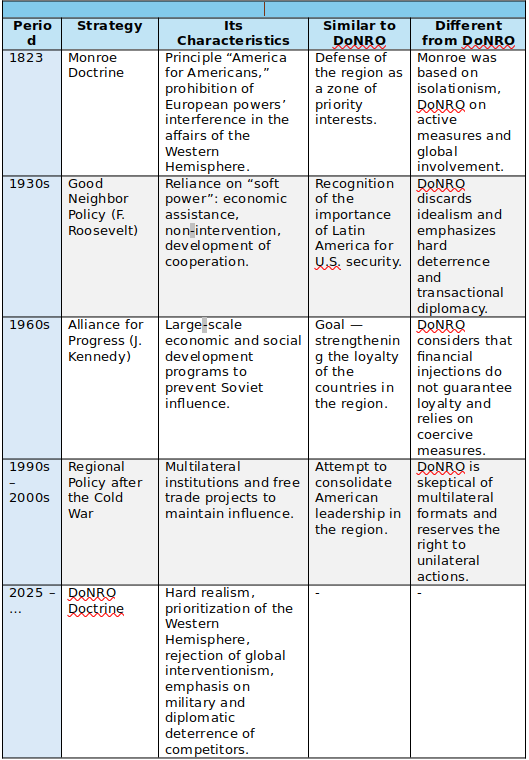
Thus, the DoNRO doctrine became a response to the failure of global interventionist policy and the inefficiency of soft institutional approaches in the region, implemented through international organizations. War fatigue, vulnerability of the southern borders, and the penetration of competitors created a demand for a new course—hard realism and an impenetrable security architecture of the Western Hemisphere.
2. Rejection of Isolationism as a Key Element of the Doctrine.
Mechanisms of Combining Defense and Openness. The DoNRO doctrine fundamentally rejects classical isolationism and the “fortress under siege” strategy, but does not return to universal hegemonism and interventionism. At its core lies the concept of “managed retreat” and selective engagement: the United States does not close itself off, but seeks to combine strict defense of its own borders with the preservation of global openness. In the 2025 National Security Strategy, the rejection of expansion leading to exhaustion and the transition to a more sustainable model of leadership is directly recorded, where intervention is justified only in the event of a threat to critical interests or the global balance of power [12].
The key instrument of this transformation became burden‑sharing. Unlike the previous logic of “division,” the new paradigm provides that allies will take on the main weight of deterrence. In Europe, this was manifested in unprecedented demands on NATO members to increase defense budgets to 5% of GDP [13]. In Asia, Japan, South Korea, and Australia are rapidly building up military capabilities to balance China and North Korea, while in the Middle East regional partners were forced to independently construct a security architecture against Iran amid the reduction of direct American presence [14]. Such a policy makes strategic rivalry financially sustainable for the United States and responds to the domestic demand of American society for prioritizing the national economy [15]. But at the same time, it stimulates allies toward greater autonomy, which in the long run may weaken the U.S.‑centered alliance system.
To minimize risks, the United States is implementing mechanisms of remote deterrence. The reduction of large contingents is compensated by the concept of “over‑the‑horizon”—projection of power from beyond the horizon. Washington relies on sanctions and financial pressure, as well as the use of advantages in cyberspace and outer space. Research shows that American cyber strategy has evolved from conditional optimism to recognition of a real threat and the need for active application of cyber power [16]. In space, the United States is developing a strategy of “deterrence by denial,” creating resilient satellite constellations and integrating commercial systems for protection against attacks [9]. These instruments allow the U.S. to maintain the role of arbiter of global security without being drawn into protracted ground campaigns.
The final element became the concept of a “Worthy Peace.” The United States abandons projects of liberal hegemony, which included the export of democracy and large‑scale state‑building, and concentrates on preserving a global balance of power favorable to itself [17]. This brings the strategy closer to the model of offshore balancing, where American presence is limited to pragmatic calculations of national security rather than universal ideological imperatives [18].
Thus, the rejection of isolationism within DoNRO forms a pragmatic system: the United States retains global leadership but intervenes only in the event of a threat to critical interests or the emergence of a dominant regional hegemon. Burden‑sharing with allies and remote methods of projecting power where direct military intervention is not considered mandatory create the core of the renewed doctrine. Washington no longer seeks to manage the entire world directly, but firmly reserves the right to use force if anyone attempts to change the favorable and familiar balance or undermine the foundations of American prosperity.
3. Potential Challenges and Consequences for the DoNRO Doctrine.
The practical implementation of the DoNRO doctrine faces a number of systemic challenges that call its sustainability into question. The main paradox lies in the contradiction between the protection of national territory and the need to preserve global economic openness. The United States remains deeply integrated into the world trading system, and any attempt by opponents to block maritime communications, disrupt technological transits, or break supply chains will force Washington to respond harshly, erasing the line between remote deterrence and direct intervention [19].
Domestic American constraints intensify this contradiction. American society requires greater attention to internal problems—economy, migration, infrastructure—which, as a result, creates a demand for abandoning foreign commitments that require large expenditures. However, political elites engaged in foreign policy fear the loss of global levers of influence and resist significant reductions in military presence. Taken together, this makes the course unstable and vulnerable to populist fluctuations [20].
The shift of emphasis to absolute security of its own borders creates risks in relations with Latin America. The United States seeks to expel Chinese corporations from the region’s infrastructure projects, but for the countries of South and Central America such a policy appears as an encroachment on sovereignty and freedom of trade [21]. As a result, there arises the threat of a revival of neo‑imperialism, since aggressive defense of the “near abroad” may provoke the growth of anti‑American sentiment and push the region toward closer cooperation with Beijing and Moscow [22]. Especially given that U.S. forceful actions in the region, often ignoring the principles of sovereignty of other, albeit weaker, states, provoke counter‑reaction—strong anti‑American sentiment, particularly in Latin America.
The transfer of responsibility for security to allies is fraught with the risk of insufficient global security. Modernization of armies and defense industries requires decades, and during the transition period there arises a “window of vulnerability,” when U.S. adversaries may use military force to change the existing balance in the region [23, 24]. Allies, fearing the loss of American protection, are forced to increase defense budgets, form autonomous coalitions, and sign separate bilateral security agreements, increasing their independence from the United States, which may have far‑reaching consequences for any alliances and agreements involving the U.S. In conditions of panic, radical steps are possible—from rapid arms buildup and militarization to forced appeasement of adversaries, which potentially threatens the collapse of the alliance system [15].
Additional contradiction arises from the inconsistency between the logic of offshore balancing and the political initiatives of the Trump administration. While the doctrine presupposes minimizing direct intervention and transferring responsibility to regional allies, Trump demanded active participation from European partners in the war against Iran. Such an approach may contradict the principle of remote deterrence and demonstrates the internal complexity of American strategy: simultaneously declaring a rejection of excessive involvement and pressuring allies to draw them into a large‑scale conflict. This reflects the gap between the theoretical doctrine and the practice of foreign policy.
The reaction of European allies to these demands was extremely cautious: pressure from Washington was perceived as the imposition of someone else’s war, which increased distrust toward American strategy and pushed the EU to seek greater autonomy in the field of security. In addition, attempts to draw Europe into conflict with Iran contradict the declared goal of strengthening the non‑proliferation regime. Such initiatives create the risk of undermining it, as they reinforce suspicions of U.S. double standards and provoke regional powers to reconsider their own commitments.
Domestic political dynamics in the United States become a key factor in the viability of the doctrine. Polarization between isolationists and globalists makes the strategy structurally unstable. Each electoral cycle threatens to revise basic imperatives, undermining the predictability of American policy [25, 26]. If commitments are reconsidered every four years, allies lose confidence in long‑term support, while opponents perceive inconsistency as weakness, thereby increasing the risk of escalation.
The contradiction is particularly acute in the sphere of economy and technology. The United States uses export control and a “de‑risking” strategy to protect technological sovereignty, but this fragments global supply chains and forces allies to choose between loyalty to Washington and access to Asian markets [27]. Turning interdependence into a weapon accelerates the creation of alternative financial and technological systems, reducing the effectiveness of sanctions and the dollar monopoly [28].
The main stress test for the doctrine is the Indo‑Pacific region. The United States seeks to shift deterrence onto Japan, South Korea, and the AUKUS alliance, maintaining the role of offshore balancer. But the scale of China’s potential makes the task extremely difficult. In the event of failure of the strategy in the Taiwan Strait, Washington will face a choice: either enter into direct conflict with a nuclear superpower, or refuse intervention, which would mean the collapse of the system of guarantees and the loss of status as global hegemon [29].
Thus, the transition to a strategy of managed retreat is not liberation from imperial overstretch but a risky recalibration. Success depends on the ability to simultaneously restrain domestic populism, support allies, control opponents, and maintain financial dominance. Failure in even one of these directions may trigger a domino effect and turn strategic withdrawal into the collapse of the U.S.‑centered order [30].
4. Prospects and Strategic Significance of the DoNRO Doctrine.
The value of the doctrine lies in its ability to ensure the long‑term sustainability of American leadership through the transition from ideologically motivated expansion to a pragmatic model of strategic management. Under conditions of domestic pressure and objective resource constraints, the United States needs a new “security theory” that allows concentration of efforts on technological and economic modernization, as well as on deterring key global rivals [31]. In the long term, the strategy transforms the U.S. from a global “policeman,” forced to react to every local crisis, into an arbiter of the international system. Such an architecture should create the resilience necessary for prolonged geopolitical competition without the risks of overstretch.
A key condition for the viability of the course is its adaptability to non‑traditional and asymmetric threats. The reduction of ground presence is compensated by the integration of new vectors of deterrence: cyber, space, and information‑psychological operations. Modern threats require a departure from purely traditional approaches to warfare in favor of technological flexibility [32]. By shifting the main burden of defense onto allies, Washington concentrates on dominance in the digital environment, deployment of autonomous systems, and control of information flows. This will allow scaling presence in crisis zones primarily through non‑military methods, reducing costs and domestic political risks.
However, reliance on remote deterrence creates new vulnerability. Delegating direct contact to allies and managing security “over the horizon” makes such an architecture dependent on satellite constellations, cable infrastructure, and the security of data transmission networks. The experience of modern conflicts shows that communication systems and command centers become priority targets [33]. In the event of a successful attack on command‑information infrastructure, the concept of remote balancing may collapse, leaving allies without intelligence and coordination.
At the global level, this strategy accelerates the transition to a more regionalized security system. Washington’s refusal to directly administer peripheral processes forces regional players to form their own self‑sufficiency blocs [34]. In this system, the U.S. shifts to the format of offshore balancing: setting standards of compatibility, controlling financial transactions, and preventing the emergence of a dominant hegemon in key zones of Eurasia. Thus, the doctrine does not mean complete isolationism but changes the form of American presence, shifting the emphasis from territorial management to system regulation.
An integral element of the process is the fragmentation of the world economic system—conditional deglobalization. The U.S. moves from the role of guarantor of free trade to architects of protected supply chains and the concept of “friend‑shoring.” This is a strategy of relocating supply chains to “friendly” allied countries to reduce dependence on potential adversaries and strengthen economic security. The strategy requires allies not only to achieve military autonomy but also economic solidarity. Barriers on high‑tech exports and tariff protection of domestic industry force partners to choose between access to American markets and cooperation with China [35]. Such synchronization of economy and security in theory will deprive adversary states of the ability to use globalization to build up military potential.
However, here arises the strategic trap of “double deterrence.” The attempt to simultaneously suppress threats from global competitors and shift costs onto regional players again leads to a paradox: harsh pressure without providing alternatives pushes countries of the Global South toward forming independent centers of power. This accelerates the formation of anti‑Western coalitions and the creation of alternative financial and institutional structures [36]. As a result, the strategy, conceived as resource saving, may generate a multipolar bloc requiring even greater strain from the United States.
A key condition for the success of the doctrine remains domestic political predictability. Such a transformation is impossible without bipartisan consensus in Congress. Despite polarization, foreign policy elites are forced to seek points of convergence, especially in matters of technological competition and revision of aid mechanisms [37]. If the concept of a “Worthy Peace” is not consolidated as bipartisan, it risks remaining a temporary maneuver of a particular administration. In conditions of political conflict, allies’ trust may be lost.
In historical perspective, the doctrine signifies a final farewell to the illusion of the “unipolar moment.” It reflects the recognition by elites of resource limitations and the rejection of direct administration of global processes. The strategic significance lies in managed preparation for a period of systemic transition [38]. The United States shifts from the role of global policeman to the role of “global soldier,” appearing in crisis points only at decisive moments and, by virtue of its interests, maintaining dominance in innovation, finance, and remote projection of power to secure its critical interests for decades ahead.
Conclusions.
American foreign policy is entering a phase of deep transformation: the DoNRO doctrine represents a rejection of the costly model of “liberal hegemony” and a transition to a pragmatic course of reducing permanent direct presence—while selectively participating and intervening in key processes. This is not isolationism, but an attempt to reduce costs and revise the rules of the global game, maintaining the role of supreme arbiter (global military power) while delegating to allies a significant part of defense and financial functions (policing functions).
The central mechanism of the process becomes remote deterrence, based on financial power, sanctions pressure, and technological superiority in cyberspace and outer space. However, this creates a contradiction: by shifting responsibility for traditional defense onto partners, Washington stimulates their strategic autonomy, which gradually weakens the unconditional leadership of the United States within alliances and raises the question of their viability.
The tight linkage of economy with security and the policy of creating protected supply chains in allied countries strengthen U.S. positions in critical spheres but create a boomerang effect. Using the financial system as an instrument of coercion does not isolate opponents but accelerates the fragmentation of the unified global market. Countries of the Global South, fearing vulnerability, begin to integrate into alternative institutional and settlement systems formed by U.S. rivals. As a result, the “risk‑reduction” strategy paradoxically accelerates the formation of a multipolar world and undermines the mechanisms of globalization that historically ensured American power.
Thus, the DoNRO doctrine acts as a tool of adaptation to multipolarity, allowing the United States to extend its strategic leadership with lower costs. Its viability will be determined by internal factors: deep political polarization and dependence of the course on electoral cycles deprive the strategy of predictability. At the same time, the very concept reflects the ability of American foreign policy to flexibly restructure and search for new formats of global presence. In this sense, the doctrine opens opportunities for more rational allocation of resources, strengthening technological and financial superiority, and maintaining key U.S. positions in the world system even under conditions of intensifying multipolarity.
Ruslan Bortnik, Yeva Antonenko, Ukrainian Institute of Politics
References:
1. The White House. America 250: Presidential Message on the Anniversary of the Monroe Doctrine. December 2, 2025.
2. Responsible Statecraft. Trump Corollary: A New Monroe Doctrine? December 2025.
https://responsiblestatecraft.org/trump-corollory/
3. Wikipedia. 2026 United States Intervention in Venezuela. January 2026.
https://en.wikipedia.org/wiki/2026_United_States_intervention_in_Venezuela
4. WRAL News. How Right-Wing Media Inspired Trump’s Donroe Doctrine. January 6, 2026.
https://www.wral.com/how-right-wing-media-inspired-trump-s-donroe-doctrine/22296100/
5. Wikipedia. Donroe Doctrine. January 2026.
https://en.wikipedia.org/wiki/Donroe_Doctrine
6. Watson Institute for International and Public Affairs, Brown University. Costs of War Project.
https://watson.brown.edu/costsofwar/
7. Council on Foreign Relations. Mexico’s Long War: Drugs, Crime, and the Cartels. February 23, 2026.
https://www.cfr.org/backgrounder/mexicos-long-war-drugs-crime-and-cartels
8. Council on Foreign Relations (CFR). China’s Growing Influence in Latin America. June 6, 2025.
9. Mearsheimer, J. J., & Walt, S. M. The Case for Offshore Balancing: A Superior U.S. Grand Strategy. Foreign Affairs. June 13, 2016.
https://www.foreignaffairs.com/articles/united-states/2016-06-13/case-offshore-balancing
10. Sullivan, M. P. Latin America and the Caribbean: U.S. Policy Overview. Congressional Research Service (CRS). November 23, 2022.
https://sgp.fas.org/crs/row/IF10460.pdf (https://www.google.com/search?q=https://sgp.fas.org/crs/row/IF10460.pdf)
11. RAND Corporation. Great-Power Competition and Conflict in Latin America. Jun 20, 2023.
https://www.rand.org/pubs/research_reports/RRA969-4.html
12. America’s Managed Retreat: How the 2025 U.S. National Security Strategy Shifts the Burden to Allies. Global Security Review.
13. Breaking down Trump’s 2025 National Security Strategy. Brookings Institution. December 8, 2025.
https://www.brookings.edu/articles/breaking-down-trumps-2025-national-security-strategy/
14. Ten Jolting Takeaways from Trump's New National Security Strategy. War on the Rocks. December 5, 2025.
https://warontherocks.com/ten-jolting-takeaways-from-trumps-new-national-security-strategy/
15. Balancing Act — How Allies Have Responded to Limited U.S. Retrenchment. RAND Corporation. Jul 8, 2025.
https://www.rand.org/pubs/research_briefs/RBA739-3.html
16. Shifting Dynamics in Transatlantic Relations: Implications for Mediterranean Security. Istituto Affari Internazionali. December 23, 2025.
17. The World Has Passed the Old Grand Strategies By. RAND Corporation. Oct 5, 2016.
https://www.rand.org/pubs/commentary/2016/10/the-world-has-passed-the-old-grand-strategies-by.html
18. How the United States Could Lose a Great-Power War. RAND Corporation. Oct 30, 2019.
https://www.rand.org/pubs/commentary/2019/10/how-the-united-states-could-lose-a-great-power-war.html
19. Backing into World War III. Brookings Institution. February 6, 2017.
https://www.brookings.edu/articles/backing-into-world-war-iii/
20. Democracies Divided: The Global Challenge of Political Polarization. Brookings Institution.
https://www.brookings.edu/wp-content/uploads/2019/04/democracies-divided_introduction-1.pdf
21. To counter extreme politics, revive global democracies' Rust Belts. Brookings Institution. April 8, 2021.
https://www.brookings.edu/articles/to-counter-extreme-politics-revive-global-democracies-rust-belts/
22. Normal is over. Brookings Institution. February 2018.
https://www.brookings.edu/articles/normal-is-over/
23. How Might NATO Allies Respond if the United States Retrenches from Europe? RAND Corporation. 2025.
(https://www.rand.org/content/dam/rand/pubs/research_reports/RRA2800/RRA2807-2/RAND_RRA2807-2.pdf
24. Anticipating Allies' Responses to U.S. Retrenchment: Lessons from Limited Military Withdrawals During the Cold War. RAND Corporation. 2025.
https://www.rand.org/content/dam/rand/pubs/research_reports/RRA700/RRA739-8/RAND_RRA739-8.pdf
25. Beyond left versus right, beyond elites versus populists. Brookings Institution. May 15, 2025.
https://www.brookings.edu/articles/beyond-left-versus-right-beyond-elites-versus-populists/
26. Is Trump reshaping the world order? Brookings Institution. February 2, 2026.
https://www.brookings.edu/articles/is-trump-reshaping-the-world-order/
27. Choking Off China’s Access to the Future of AI. CSIS. October 11, 2022.
https://www.csis.org/analysis/choking-chinas-access-future-ai
28. Beijing’s sanctions dilemma: Chinese narratives on economic coercion. Brookings Institution. October 21, 2024.
29. Fighting Abroad from an Ally's Land: Challenges and Opportunities for U.S. Forces in the Indo-Pacific. RAND Corporation. Sep 16, 2024.
https://www.rand.org/pubs/research_reports/RRA1985-1.html
30. The crisis of the liberal international order. Brookings Institution. February 4, 2020.
https://www.brookings.edu/books/the-crisis-of-liberal-internationalism/
31. Center for Analysis of U.S. Grand Strategy. RAND Corporation.
https://www.rand.org/global-and-emerging-risks/centers/grand-strategy.html
32. From the Pentagon's “4+1” threat matrix, to “4+1 times 2”. Brookings Institution. May 11, 2020.
https://www.brookings.edu/articles/from-the-pentagons-41-threat-matrix-to-41-times-2/
33. Lessons from the Ukraine Conflict: Modern Warfare in the Age of Autonomy, Information, and Resilience. CSIS. May 2, 2025.
34. US grand strategy under President Biden and beyond. Brookings Institution. May 5, 2022.
https://www.brookings.edu/events/us-grand-strategy-under-president-biden-and-beyond/
35. Tariffs in 2025: Short-Run Impacts on the U.S. Economy. Brookings Institution. March 26-27, 2026.
https://www.brookings.edu/wp-content/uploads/2026/03/1_Fajgelbaum-Khandelwal_unembargoed.pdf
36. Competing for the System: The Essence of Emerging Strategic Rivalries. RAND Corporation. November 2022.
https://www.rand.org/content/dam/rand/pubs/perspectives/PEA1400/PEA1404-2/RAND_PEA1404-2.pdf
37. What Lies Ahead: Foreign Policy and National Security in the 118th Congress. CSIS. January 10, 2023.
https://www.csis.org/analysis/what-lies-ahead-foreign-policy-and-national-security-118th-congress
38. From Containment to Global Leadership: America and the World After the Cold War. RAND Corporation.
https://www.rand.org/content/dam/rand/pubs/monograph_reports/2006/MR525.pdf