Friends, we would like to remind you that additional analytical products of the Ukrainian Institute of Politics are available for organizations, businesses, and private clients, including Weekly Intelligence Briefs, Geopolitical Risk Reports, Executive Briefings, as well as special analytical materials and forecasts prepared upon individual request. For additional information, please contact us at: uiamp2012@gmail.com or by phone: +38 (093) 757-75-65.
WEEKLY REVIEW:
THE UKRAINIAN DIMENSION.
(17–24 June 2026)
The past week was marked by a final further departure from the so-called "Anchorage Agreements" between the Russian Federation and the United States, which can be regarded as the most important tactical and diplomatic success of Ukraine and its European partners. On June 23, Russian Foreign Minister Sergey Lavrov, as part of Russia's campaign of pressure on the United States, stated that the United States was not going to compel Ukraine to implement them. Earlier, the Kremlin rejected the five peace conditions put forward by the "E3" countries and Ukraine, which envisaged ending the war along the current front line and deploying foreign troops on Ukrainian territory. S. Lavrov also suggested that last year's summit in Alaska could have been used by the White House to buy time. According to the Russian side, the United States is now effectively abandoning its claim to the role of an "objective mediator" in settling the war in Ukraine and is continuing its policy of increasing sanctions pressure on the Russian Federation.
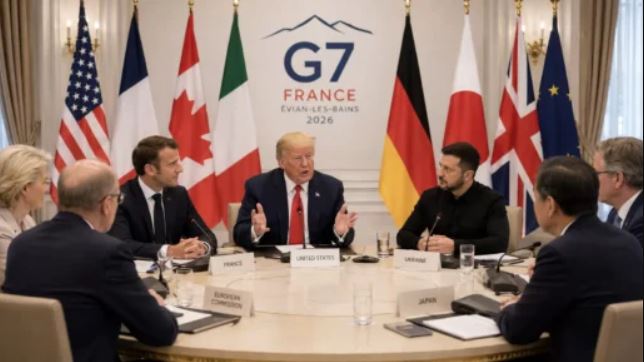
This diplomatic drift away from Anchorage resulted from the systematic efforts of Ukraine and its allies to reorient the Donald Trump Administration, particularly during the G7 Summit (held from June 15 to June 17), where a common position of the Western partners on Ukraine was successfully coordinated. Kyiv managed to somewhat change the perception of the situation in the White House and among its European allies by clearly demonstrating that Russia does not possess a decisive advantage in the war; alternatively, the White House may have decided to play the "change of position" card in order to increase pressure on Russia.
The intensification of Ukrainian strikes against Russia's rear infrastructure, particularly Moscow and Crimea, in June 2026 was driven not only by critically important military objectives but also by profound political and diplomatic motives. On the geopolitical stage, attacks on Russia's rear directly undermine attempts to impose on Kyiv an unfavorable peace based on the so-called "Anchorage" formula (which предусматривает the withdrawal of the Armed Forces of Ukraine from Donetsk Oblast).
While heavy defensive battles continue in Donbas (particularly for the city of Kostiantynivka), active strikes against Russia's rear have become Ukraine's main instrument of diplomatic pressure. At the same time, Moscow had earlier attempted to achieve the same objective through its attacks on Kyiv. Precise and demonstrative strikes showed Ukraine's allies that Kyiv is capable of waging war effectively through technology, restored Western confidence, and, in essence, have for now removed capitulation demands (such as the withdrawal of Ukrainian troops from Donbas) from the agenda.
The isolation of Crimea through the destruction of military facilities is also an instrument for demonstrating Russia's vulnerability to its partners, disproving the Kremlin's ability to dictate its own terms at the negotiating table.
Massive strikes against Crimea, as well as Moscow, are intended to demonstrate to the White House, President D. Trump, and Western partners in Europe that Russia is not winning the war, that its deep rear is vulnerable, and that its air defense system is ineffective. Consequently, political pressure aimed at ending the war should be exerted not on Ukraine, but on the Russian Federation. According to the Ukrainian leadership, this should be reflected in additional anti-Russian sanctions, increased military and financial assistance to Ukraine, and a change in political rhetoric.
In addition, the "demonstrative" attacks on Crimea and retaliatory strikes against Moscow (the so-called Ukrainian retaliatory strike for Russia's attack on Kyiv on June 15, during which the symbolic cultural site of the Kyiv-Pechersk Lavra was damaged) are intended to "raise the morale" of Ukrainian society, which has already become seriously exhausted by the war. Conversely, Ukraine seeks to undermine Russian society's confidence in its own security, thereby provoking political instability. The introduction of strict restrictions in Crimea in June 2026 as a result of the strikes (a ban on gasoline sales to civilians, suspension of children's camps, cancellation of mass events, and power outages) undermines Russia's internal stability. The creation of unbearable living conditions is forcing Russian citizens to leave the peninsula in large numbers.
However, for the Kremlin, active attacks on Russia's rear will not yet become a reason to stop the war or change its conditions. The Russian authorities have already set in motion a propaganda campaign of "tightening the belts," shifting the burden of the crisis onto their own society and calling on people to adapt to the new economic realities for the sake of military objectives. On the one hand, the Kremlin seeks to prevent growing panic among the population by demonstrating that everything is under control and that "we are moving toward victory." On the other hand, it does not want to promise a quick solution to existing problems, instead urging everyone to prepare for "difficult trials for the sake of victory."
The abandonment of the behind-the-scenes arrangements reached in Anchorage, although representing a victory for Ukraine, effectively marks a profound degradation of the peace process as a whole. It underscores the irreconcilable difference in the positions of the parties: Russia publicly states that it will resume negotiations with Ukraine only on the basis of the "Istanbul Agreements" draft, but now exclusively taking into account the "new realities on the ground," effectively demanding that Ukraine relinquish the territories of Donbas and the southern regions. Ukraine, in turn, categorically rejects the surrender of territory, demonstrates its ability to wage technology-based warfare in Crimea, and shifts to the language of tough ultimatums toward the Kremlin's allies.
The abandonment of diplomatic frameworks inevitably leads to another round of escalation, pushing the conflict into a phase of total and uncompromising war of attrition, in which both sides will even more actively destroy each other's rear and energy infrastructure. Belarus also risks being drawn into this spiral of escalation. On June 19, 2026, President of Ukraine Volodymyr Zelenskyy issued an ultimatum to Alexander Lukashenko, demanding that within one week he dismantle Russian military relay equipment installed on Belarusian towers, stating directly: "Let him remove this equipment... If he does not do it, we will." At the same time, Zelenskyy expanded the scope of his accusations by directly referring to the Belarusian military-industrial complex's contribution to Russia's war economy, noting a sharp increase in fuel supplies (in particular, a thirteenfold increase in gasoline exports from Belarus to Russia since the beginning of the year). This ultimatum, effectively supported by the European Commission as Ukraine's legitimate right to self-defense, placed Minsk in a deadlock: compliance with the demands would provoke a conflict between Lukashenko and Russian President Vladimir Putin (who has already initiated urgent talks on the matter), while ignoring them would result in actual Ukrainian UAV strikes against facilities on Belarusian territory.
The "E3" format on Ukraine is gradually evolving into the E5 format (the E5 summit took place on June 24): Italy and Poland are increasingly joining Germany, France, and the United Kingdom, seeking access to the future negotiation process with Moscow and participation in shaping Europe's strategy on Ukraine. Rome's participation became possible amid Italy's gradual convergence with the broader European line and its distancing from the U.S. course under Trump, while Warsaw's participation reflects its desire to secure the status of one of the key players in the Ukrainian direction. This is particularly important for Poland, as it seeks to preserve its role as the main logistical and distribution hub for post-war Ukraine.
A more active involvement of Poland in the E5 negotiation format may help reduce tensions in Ukrainian-Polish relations, which have noticeably deteriorated in recent months. The political conflict was triggered by the decision of the President of Ukraine to name one of the Ukrainian military units after the "UPA heroes," which provoked a strong reaction in Warsaw. The culmination of this diplomatic confrontation was the decision of Polish President Karol Nawrocki to strip Volodymyr Zelenskyy of Poland's highest state award, the Order of the White Eagle. However, the historical dispute surrounding the UPA serves rather as a convenient trigger for political tension, while the real causes of the deterioration in relations between Ukraine and Poland are more closely linked to the struggle for status and resources amid the peace negotiations and Ukraine's European integration process, as well as Poland's domestic politics, where right-wing forces use the Ukrainian issue to mobilize the electorate and promote the "Poland First" agenda ahead of future parliamentary elections.
______________________
Progress of the Peace Negotiations on Ending the War in Ukraine
Russia is increasingly openly demonstrating its dissatisfaction that, in Moscow's view, the United States has failed to fulfill its part of the informal agreements reached in Anchorage. Russian Presidential Aide Yuri Ushakov stated that "Russia is no longer waiting for the implementation of the Anchorage agreements, but for victory... One of the parties proved unable to fulfill the agreements reached in Anchorage," Ushakov said. He also added that "the West is mistaken if it believes it can defeat Russia, while Russian troops continue to advance."
Russian Foreign Minister Sergey Lavrov effectively acknowledged the failure of negotiations with Trump within the framework of the so-called Anchorage format and accused the White House of deception aimed at buying time. "I do not even want to suspect that Alaska, like the European actions, was designed to buy time for rearming the Kyiv regime; I do not even want to think about it. But in reality, things turned out the way they turned out... As for the United States, judging by its actions, it seems to be moving away from its claim to the role of an objective mediator and is continuing the same course of increasing sanctions pressure on Russia," Lavrov stated.
It should be recalled that, according to the Russian version of events, during the meeting in Anchorage in 2025, Donald Trump proposed a plan for ending the war that envisaged the withdrawal of Ukrainian troops from the territory of Donetsk Oblast. At the same time, Washington allegedly undertook to persuade Kyiv to accept such a decision. However, President of Ukraine Volodymyr Zelenskyy refused to consider such a scenario, while the U.S. administration did not take any serious measures to pressure Ukraine, including disconnecting the Starlink system or suspending intelligence sharing. Judging by the statements of Russian officials, this is precisely what the Kremlin considers to be the United States' failure to fulfill its commitments. For the time being, Moscow has been forced to acknowledge that it has failed to impose its Anchorage-based settlement terms on Ukraine through Washington.
At the same time, Russia also made it clear that it would not accept the five peace conditions put forward on June 7 by Ukraine and the "E3" countries and would not agree to stop the war along the current front line as a condition for launching negotiations (as stated by Russian Foreign Minister Sergey Lavrov).
Russian President Vladimir Putin declared his readiness to return to peace negotiations with Ukraine on the basis of the 2022 Istanbul Agreements, taking into account the "realities on the ground." This format envisaged Ukraine's renunciation of NATO membership, the deployment of foreign troops and certain categories of weapons on its territory, as well as the establishment of a system of international security guarantees provided by Russia, the United States, the United Kingdom, France, and China. Russia, in turn, was prepared to withdraw its troops from most occupied territories except Crimea, while the status of certain areas of Donetsk and Luhansk oblasts was to be settled through a separate negotiation process. At the same time, Moscow insisted on substantial limitations on Ukraine's military potential, including a significant reduction in the size of its armed forces. However, the Kremlin's reference to the need to take into account the "realities on the ground" means that Moscow is now proceeding from the current line of control and regards as the subject of negotiations the territories that came under its control after 2022, including parts of Donetsk, Luhansk, Zaporizhzhia, and Kherson oblasts. In effect, this is no longer a return to the Istanbul Agreements in their original form, but rather their adaptation to the new military and political realities.
However, such demands by Moscow remain unacceptable to Ukraine under the current circumstances.
Ukraine's strategy is aimed at encouraging Donald Trump to finally abandon the logic of the Anchorage agreements with Russia, including the withdrawal of the Armed Forces of Ukraine from Donbas. As an alternative, Kyiv is promoting the idea of ending the war along the current front line, calculating that Moscow will reject such an option and that Washington will consequently increase pressure on Russia. It is noteworthy that President Volodymyr Zelenskyy is increasingly appealing directly to Russian society, calling for an end to the war, including after the strikes on Moscow and Crimea.
The broader objective is to create, in the eyes of the international community and particularly within Russia, the perception that Ukraine is ready for peace and that Vladimir Putin is the principal obstacle to achieving it. This calculation is based on exploiting the growing fatigue of Russian society with the war and its associated hardships. Should Russia's internal stability weaken, Kyiv expects to gain stronger negotiating positions and subsequently propose much tougher settlement terms to Moscow.
Meanwhile, Moscow continues trying to pressure Washington in the expectation that the United States will, in turn, increase pressure on Kyiv and push the Ukrainian leadership toward accepting Russia's peace conditions. At the current stage, however, Washington has adopted a more detached position, observing the development of the situation. The United States sees that Russia is encountering serious difficulties on the battlefield, while Ukraine continues to inflict significant military and economic damage on Russia by conducting strikes deep inside the country.
For this reason, the U.S. administration is not demonstrating any particular urgency in promoting a compromise settlement and likely does not rule out a scenario of further depletion of Russia's resources. This concerns not only human and financial losses but also the gradual attrition of strategically important elements of Russia's military potential, including its aviation and other components of military infrastructure. From Washington's perspective, such a development objectively serves the long-term interests of the United States in maintaining the strategic balance with Russia.
It is precisely for this reason that the absence of the expected U.S. pressure on Ukraine is causing increasing irritation in Moscow, where a much more active role by Washington had been anticipated in implementing the approaches that the Russian leadership associates with the agreements reached in Anchorage.
Results of the G7 Summit in France
The G7 (Group of Seven) Summit was held on June 15–17, 2026, in the French city of Évian-les-Bains. The G7 leaders reaffirmed their continued political, economic, and military support for Ukraine. At the conclusion of the summit, a joint G7 statement was adopted and signed by the President of the United States. On the sidelines of the summit, the Presidents of Ukraine and the United States held a meeting. The leaders conducted a closed bilateral meeting, as well as trilateral talks with the participation of French President Emmanuel Macron. U.S. President Donald Trump described his meeting with President of Ukraine Volodymyr Zelenskyy and the other G7 leaders as "very good." Zelenskyy showed Trump photographs of the destruction caused by the Russian strike of June 15 (including images of the burning Kyiv-Pechersk Lavra). Following this, Trump and U.S. Secretary of State Marco Rubio, for the first time, positively assessed the possibility of granting Ukraine licenses for the domestic production of interceptor missiles for Patriot systems. The U.S. President publicly stated that Russia was losing the initiative and "must make a deal" to stop the war. Donald Trump joined the other G7 leaders in signing the joint declaration. The document reaffirmed the "unwavering support for Ukraine," committed the G7 to strengthening sanctions against Russia's oil and gas sector, increasing deliveries of air defense systems, and considering the transfer of licenses for weapons production to Ukraine.
The principal and fundamentally important difference between this year's G7 Summit in France (Évian-les-Bains) and last year's G7 Summit in Canada (which ended without a joint communiqué on Ukraine because of disagreements with the United States) is that the allies were largely able to develop a coordinated position on Ukraine. In particular, they adopted the key joint document directly concerning Ukraine — the "G7 Leaders' Statement on Geopolitical Issues." The United States, led by President Donald Trump, officially supported and signed this document. It commits the G7 to increasing deliveries of air defense systems, interceptor missiles, and long-range weapons to Ukraine. In addition, Trump and the other leaders agreed to consider granting Ukraine licenses to expand its own defense production. Moreover, on the sidelines of the summit, Trump hinted at his readiness to reinstate previously suspended sanctions against Russian oil.
Equally important is the fact that the statements effectively acknowledge the resilience of Ukraine's resistance on the battlefield and the absence of any major strategic successes by Russia. In effect, Europe and Ukraine succeeded in advancing their own negotiating framework, while Washington, at least at this stage, chose not to oppose it publicly.
This may indicate either a partial convergence of the American and the Ukrainian-European positions or a desire on the part of the United States to increase pressure on Moscow ahead of a new stage of negotiations.
Overall, there are growing indications that the United States may increasingly support the idea of ending hostilities along the current front line and gradually move away from several elements of the so-called "Anchorage logic," which envisages more substantial concessions from Ukraine, including territorial concessions in Donbas. At the same time, rapid changes should not yet be expected. For the Russian leadership, agreeing to end the war under pressure from the United States and the G7 countries would be perceived as a political concession. Therefore, the more likely scenario remains further diplomatic and military escalation. Nevertheless, the very fact that the current summit succeeded in consolidating joint support for Ukraine's key demands can already be regarded as an important political victory for Kyiv and Europe.
The "E3" on Ukraine Is Evolving into the E5: Italy and Poland Seek Access to Future Negotiations with Moscow
On June 24, the E5 leaders' summit took place in Berlin, bringing together Germany, the United Kingdom, France, Italy, and Poland. The summit was entirely devoted to coordinating further military support for Ukraine and strengthening European security. The meeting was attended by French President Emmanuel Macron, German Chancellor Friedrich Merz, Italian Prime Minister Giorgia Meloni, Polish Prime Minister Donald Tusk, and UK Prime Minister Keir Starmer, who attended the summit despite his previously announced resignation.
In essence, the former "E3" is evolving into the broader E5 format. Despite its previous reputation as one of Donald Trump's closest European partners, Italy is increasingly shifting toward the broader European line. To a large extent, it is precisely this political transformation in Rome that has made it possible to expand the former "E3" format into the E5 by including Italy and Poland among the countries seeking to participate in shaping Europe's strategy on Ukraine and the future negotiation process with Moscow. The transformation of the former "E3" into the broader E5 format is now underway.
Italy and Poland appear to have secured a place both at the table of future negotiations with Moscow and within the decision-making framework on the Ukrainian direction. This also partly explains some of the current tensions in Polish-Ukrainian relations. Germany, France, and the United Kingdom are being compelled to share responsibilities and allow other major European states to participate in the process. Italy is a member of the G7, while Poland is one of Europe's largest countries; therefore, their inclusion in the negotiating framework appears logical.
However, this process may also have a downside. If Italy and Poland have gained places in the new format, similar claims may eventually be advanced by the Netherlands, Spain, Belgium, Portugal, and other medium-sized European countries. As a result, this could further complicate the still not fully formed European system for managing issues related to war, peace, and support for Ukraine.
Of particular interest is the question of how deeply Italy and Poland will be involved in the future negotiation process. Participation in negotiations means not only taking part in political decision-making but also participating in the distribution of financial flows related to arms supplies to Ukraine, future reconstruction programs, infrastructure projects, and economic contracts. For many European countries, this is not only a matter of security but also one of significant economic interests.
Escalation of Ukrainian Strikes on Russia's Rear Infrastructure.
First of all, the new wave of intensive Ukrainian attacks on Russia's rear infrastructure was marked by a large-scale retaliatory strike against Moscow in response to the Russian attack of June 15, 2026. It should be recalled that during that raid, the Kyiv Pechersk Lavra was seriously damaged (the roof of the Dormition Cathedral caught fire), as well as the Dovzhenko Film Studio and a number of other cultural heritage sites. The primary target of the Ukrainian retaliatory strike was the Moscow Oil Refinery (MOR) in Kapotnya. During a series of consecutive attacks on June 16 and June 18, the facility sustained critical damage. Drones successively disabled both primary oil refining units (including the key ELOU-AVT-6 unit). The Moscow Oil Refinery suspended operations until 2027. It should be recalled that the Moscow Oil Refinery supplied about 40% of the gasoline market and up to 50% of the diesel fuel market in the Moscow region, being one of the key fuel suppliers for the capital's filling station networks. Due to the explosions and burning petroleum products, a so-called "oil rain" fell over Moscow. Nearby shopping centers and residential buildings were hit by fragments and blast waves. Footage of one of the strikes went viral on social media. A Ukrainian UAV (or, according to some reports, a Russian air defense missile that intercepted it) fell directly onto a huge fuel storage tank. The powerful explosion literally tore off and hurled the multi-ton metal hatch of the tank high into the air.
Against the backdrop of systematic Ukrainian strikes on Russia's oil refining infrastructure, Russia has been forced to consider the possibility of importing fuel from other countries. According to available data, gasoline production in Russia has declined by approximately 25% compared to the same period last year. At the same time, Russian petroleum product exports in early June decreased by 15%, indicating growing problems in the country's oil refining sector.
Ukrainian Armed Forces strikes on Crimea in June 2026 assumed a comprehensive and systematic nature. As a result, the peninsula's critical infrastructure supporting Russian military and logistics facilities sustained significant damage. In addition to airfields and air defense assets, the Balaklava Thermal Power Plant and an electrical substation in Sevastopol suffered substantial damage. Drone strikes caused widespread power outages and blackouts in several districts. Fuel infrastructure at the Kerch oil depot was damaged. Falling drone debris caused a fire on the territory of the Simferopol Thermal Power Plant. Logistics hubs were also affected: satellite imagery recorded damage to transport interchanges and bridges, including in the Chonhar area. Infrastructure at the Saky and Hvardiiske military airfields was damaged. Near Kerch, two pieces of equipment belonging to an S-400 surface-to-air missile system, as well as two Pantsir-S1 air defense missile and gun systems, were destroyed.
Fuel supply for the civilian population of the peninsula has entered a critical phase. Due to the destruction of oil depots and the shutdown of the Kerch ferry crossing, the peninsula has entered its most severe energy crisis since 2014. As of June 21, 2026, by decision of the local authorities in Crimea, the free sale of gasoline and diesel fuel at filling stations to individuals and legal entities (both for cash and via vouchers/QR codes) has been completely suspended. Fuel is supplied exclusively to emergency service vehicles (ambulances, EMERCOM, police) and special-purpose vehicles ensuring basic public services. "One official — one vehicle": each ministry on the peninsula has been left with only one official vehicle, while the remainder of the state-funded vehicle fleet has been completely mothballed in order to conserve fuel and lubricants.
Due to the fuel shortage on the peninsula, many residents are now traveling to Krasnodar Krai to purchase gasoline. According to the local "authorities," the amount of fuel allowed to be transported across the Crimean Bridge has been doubled to 200 liters per vehicle. Crimean residents will now be able to bring back even more fuel—provided that a large-scale fuel shortage does not begin in Krasnodar Krai, where shortages have already been observed in some areas.
The systemic fuel shortage caused by attacks on oil refineries has spread beyond Crimea and now affects more than 53 regions of the Russian Federation, where fuel sales have been limited to 50 liters per customer. On online marketplaces (Avito, Ozon), the Federal Antimonopoly Service has begun mass blocking of advertisements for the resale of scarce gasoline. Fuel sale restrictions have also been introduced in the Tyumen and Novosibirsk regions. At Gazprom Neft filling stations in the Tyumen region, gasoline sales are now limited to no more than 40 liters per vehicle, while diesel sales are limited to 80 liters in populated areas and 200 liters on highways. Filling portable fuel containers is prohibited.
In three energy districts of Crimea, rolling power outages have been introduced due to substation failures and insufficient power generation at thermal power plants. In practice, half of Crimea has been left without electricity because of the авария (as confirmed by Russian public channels), which note that the cause has not yet been established. Power outages began in Yevpatoria, the Krasnoperekopsk, Saky, Dzhankoi, and Krasnohvardiiske districts. In Sevastopol, street lighting is not functioning, and scheduled electricity outages have officially been introduced.
Transport and logistics collapse. The railway bridge over the North Crimean Canal also became one of the key targets of the June campaign. Strikes against it effectively severed the peninsula's internal logistics network. A strategic railway bridge near Kerch (close to the settlement of Oktyabrskoye), located directly above the North Crimean Canal, came under attack. As a result of the strikes, the railway track was damaged and the bridge's supporting structures were partially deformed. This completely blocked the movement of military trains carrying equipment, ammunition, and fuel tankers from the Kerch ferry crossing and the Crimean Bridge into the interior of the peninsula. The bridge connected the Kerch Peninsula with central Crimea. Combined with the destruction of ferries at the Port Kavkaz terminal and strikes on the Kerch oil depot, the disabling of this bridge effectively cut off Crimea's eastern gateway from the rest of the peninsula.
Following the destruction of the ferries, traffic along the key R-280 "Novorossiya" supply highway fell by 71%, as fuel tankers are being destroyed en masse by UAVs directly along their routes.
Ukraine's transition to more active attacks against Russia's rear infrastructure represents an attempt to achieve two primary objectives: the visible destruction of Russian logistics in Crimea and the creation of a powerful visual narrative for Western countries aimed at changing their political position on the war. Massive strikes against Crimea (as well as Moscow) are intended to demonstrate to the White House, President Donald Trump, and Ukraine's Western partners in Europe that Russia is not winning the war, that its deep rear remains vulnerable, and that its air defense system is ineffective. Consequently, political pressure to end the war should be directed not at Ukraine, but at Russia. According to this approach, such pressure should result in additional anti-Russian sanctions, increased military and financial assistance to Ukraine, and a shift in political rhetoric.
Political Conflict Between Ukraine and Poland.
Last week, the political crisis between Ukraine and Poland reached a new level. On June 19, Polish President Karol Nawrocki officially stripped Volodymyr Zelenskyy of Poland's highest state decoration — the Order of the White Eagle (awarded to him in 2023). "In light of President Volodymyr Zelenskyy's decision to name one of the units of the Armed Forces of Ukraine the 'Heroes of the UPA'," Nawrocki's statement reads, "I have decided to strip the President of Ukraine of the Order of the White Eagle." Former Polish President Andrzej Duda stated that the award had been presented to Volodymyr Zelenskyy "at a different time and under different circumstances," thereby effectively supporting Nawrocki's initiative.
Volodymyr Zelenskyy returned his Order of the White Eagle to Poland, noting that the decoration is still held by Benito Mussolini and Catherine II. In response, the Polish side stated that state decorations are not revoked posthumously.
In protest, Ukrainian Foreign Minister Andrii Sybiha, Head of the Office of the President Kyrylo Budanov, and Ukraine's Ambassador to Poland Vasyl Bodnar renounced their Polish state awards. Former Presidents of Ukraine Leonid Kuchma, Viktor Yushchenko, Petro Poroshenko, as well as former Prime Minister Volodymyr Groysman also renounced the Order.
President of Ukraine Volodymyr Zelenskyy will not participate in the Ukraine Recovery Conference, which will take place on June 25–26 in Gdańsk. The Ukrainian delegation will be headed by Prime Minister Yuliia Svyrydenko. Polish President Karol Nawrocki will also not attend the conference.
It is noteworthy that the scandal surrounding the renaming of a Ukrainian military unit in honor of the "Heroes of the UPA" has united the positions of President Karol Nawrocki and Prime Minister Donald Tusk, who had previously been political rivals, with both adopting the same firm position.
Polish Prime Minister Donald Tusk, representing the more liberal government, also described Kyiv's decision as "a serious problem." He called on the Ukrainian authorities to take the initiative in resolving the situation, warning of the risk of serious damage to bilateral relations. Donald Tusk, who is a political opponent of Karol Nawrocki, described the involvement of Polish and Ukrainian politicians in the conflict as a strategic mistake that would harm both countries economically, geopolitically, and reputationally.
The situation may indeed have a seriously negative impact on Ukrainian-Polish relations in the future. The historical dispute has already directly moved into the sphere of European integration, and Warsaw has begun openly using EU integration leverage as an instrument of political pressure. A direct link has been established with the EU: Karol Nawrocki explicitly stated that such actions demonstrate Ukraine's "unpreparedness to be part of the European family." Earlier, Polish ministers (including Defence Minister Władysław Kosiniak-Kamysz) repeatedly stressed: "Without resolving the Volhynia issue, there will be no Ukrainian accession to the EU."
Poland risks occupying the position of a hard-line Eurosceptic toward Ukraine, partially assuming the blocking role previously played by Hungary under former Prime Minister Viktor Orbán. Warsaw may begin systematically delaying the negotiation chapters on Ukraine's accession to the European Union.
Electoral Factor. No political force in Warsaw is currently prepared to compromise at the expense of its electoral ratings, making Poland's position on Ukraine's European integration increasingly uncompromising. Polish politicians remain directly dependent on right-wing and conservative voters, for whom the UPA issue constitutes a fundamental negative trigger. Ukraine's refusal to coordinate historical memory policies gives Warsaw legitimate grounds (in the eyes of the Polish public) to block or delay Ukraine's accession negotiations with the European Union for years, even after the active phase of the war ends.
The most dangerous long-term consequence could be the destruction of the unprecedented empathy that Polish society has demonstrated toward Ukraine since 2022. Poland has received the largest wave of Ukrainian refugees, with more than 14 million border crossings recorded over different periods. According to official reports by the Council for Cooperation with Ukraine under the Prime Minister of Poland and the Chancellery of the President, Poland's total assistance to Ukraine exceeded PLN 106 billion (approximately $30 billion / €28 billion) by the end of 2025.
Integration: Poland provided Ukrainians with free access to healthcare, education, and the labour market. By 2026, Poland had the highest employment rate among Ukrainian refugees of all OECD countries (65%).
Private Citizens' Support: During the first months of the war, 77% of Poles personally participated in assistance efforts, while around 7% opened their homes to Ukrainian families. Polish citizens spent approximately PLN 10 billion of their own money supporting Ukraine.
According to an SW Research poll conducted on June 9–10, 2026, 51.9% of Poles said their attitude toward Ukraine had worsened after the Separate Special Operations Center "North" of the Ukrainian Special Operations Forces was granted the honorary title "Named after the Heroes of the UPA." For 31.9% this decision had no impact; 11.7% were undecided; while 4.5% reported that their attitude toward Ukraine had improved.
Polish Perceptions of Volodymyr Zelenskyy
A poll conducted by United Surveys for Wirtualna Polska and Polsat News (mid-June 2026) showed that 58.3% of Poles believe Volodymyr Zelenskyy has a negative attitude toward Poland. Another 30.1% believe the Ukrainian President views Poland positively, while 11.6% were undecided. Among voters of the right-wing parties Law and Justice (PiS) and Confederation, the share believing that Zelenskyy holds a negative attitude toward Poland reaches 83%.
At the same time, Poland's more active involvement in the E5 negotiating format established in Berlin (where support for Ukraine became the central topic) may help reduce tensions in Ukrainian-Polish relations. In this context, the historical dispute is likely serving mainly as a convenient political trigger. It is worth recalling that Ukraine's Law on the Legal Status and Honouring of Fighters for Ukraine's Independence, which effectively legitimized state recognition of the OUN and UPA, was adopted as early as 2015 under a different Ukrainian President. In 2016, the Polish Sejm recognized the Volhynia tragedy as genocide against the Polish people, and in 2025 Poland went even further by legally establishing the "National Day of Remembrance of Poles — Victims of the Genocide Committed by the OUN and UPA in the Eastern Territories of the Second Polish Republic."
At that time, however, the dispute did not cross certain political red lines. Poland did not revoke state decorations from the President of Ukraine or other Ukrainian officials. On the contrary, Polish authorities continued awarding Polish state decorations to Ukrainian officials and publicly described Ukraine as a strategic partner.
The real drivers of the current conflict are more likely geopolitical bargaining over status, the distribution of future resources, and preparations for Poland's parliamentary elections. Warsaw seeks to secure its position as the principal logistical and reconstruction hub for post-war Ukraine.
Amid intense domestic political competition, Polish politicians are also using historical memory to mobilize conservative and right-wing voters. Growing pressure from the far-right Confederation party is forcing both Law and Justice (PiS) and Donald Tusk's governing coalition to adopt tougher rhetoric toward Ukraine in order to avoid losing electoral support. At the same time, growing fatigue within Polish society over the prolonged crisis and the costs of supporting Ukrainian refugees encourages politicians to emphasize the slogan "Poland First." The next parliamentary elections in Poland, which will determine the new government and Prime Minister, are scheduled for October 2027.
Frontline Situation. Course of Military Operations.
Russian forces are attempting to restore their previous pace of offensive operations. Over the past week, Russia occupied approximately 25 sq. km of Ukrainian territory and currently controls 116.915 thousand sq. km, or 19.37% of Ukraine's territory.
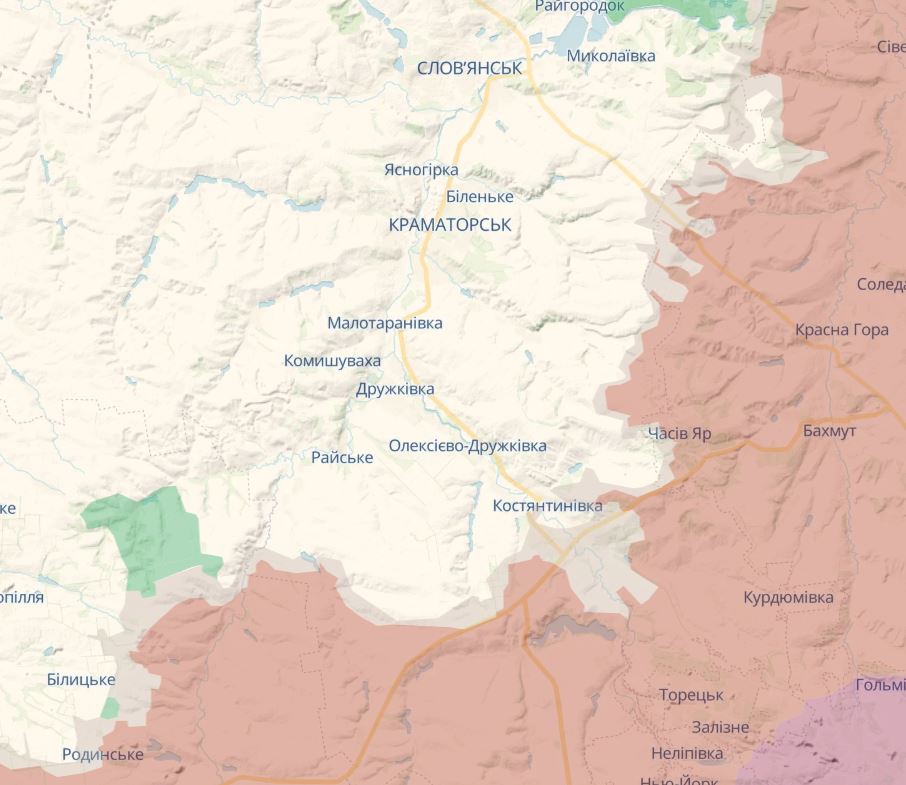
The most difficult situation for the Ukrainian Defense Forces remains in the Donetsk region, particularly around Kostiantynivka. Almost the entire city has already become part of the "grey zone." Small Russian assault groups are infiltrating different parts of the city and attempting to establish positions within residential areas. Ukrainian logistics have been seriously disrupted due to the overwhelming presence of Russian drones. Russian forces are attempting to establish fire control over key supply routes. The loss of Kostiantynivka would significantly worsen Ukraine's position in northern Donetsk region, creating a direct threat to the Kramatorsk-Sloviansk urban agglomeration.
In the Sloviansk and Kramatorsk directions, fighting continues to advance around Zakitne, Kryva Luka, and Piskunivka.
In the Lyman direction, Russian forces have intensified assaults near Yampil and Drobysheve, attempting to enter the "grey zone" on the outskirts of Lyman. In Chasiv Yar, prolonged urban fighting continues, with Ukrainian logistics severely hampered by remote mining and drone operations. The Pokrovsk direction remains the area of highest combat intensity, where Russian forces are attempting to cut Ukrainian supply routes while advancing near Rodynske.
Sumy Region. Northern Slobozhanshchyna direction: Russian offensive activity has sharply intensified in the northern part of the region. The situation has deteriorated due to Russian attempts to cross the border and establish positions on the outskirts of border villages, particularly Bezsalivka and Velyka Rybytsia, in an effort to create a so-called "buffer zone." The intensity of artillery strikes and drone attacks against civilian infrastructure and residential areas has increased substantially. Deliberate strikes against transport links between Sumy and Kharkiv have also been recorded.
Kharkiv Region. The situation has significantly worsened north of Kharkiv, particularly around Kozacha Lopan, Izbytske, Starytsia, Okhrimivka, and the Vovchansk area. Russian forces have intensified assaults using small infantry groups supported by guided aerial bombs (KABs). Ukrainian Defense Forces continue to hold their positions while conducting counterattacks against the logistics supporting Russian offensive operations.
Kupiansk Direction. Russian forces continue efforts to establish control over key transport hubs by infiltrating the outskirts of Kupiansk-Vuzlovyi and Kurylivka. Fighting has shifted closer to Radkivka and Pishchane, where Russian troops are attempting to break through the defensive line despite active Ukrainian fire resistance.
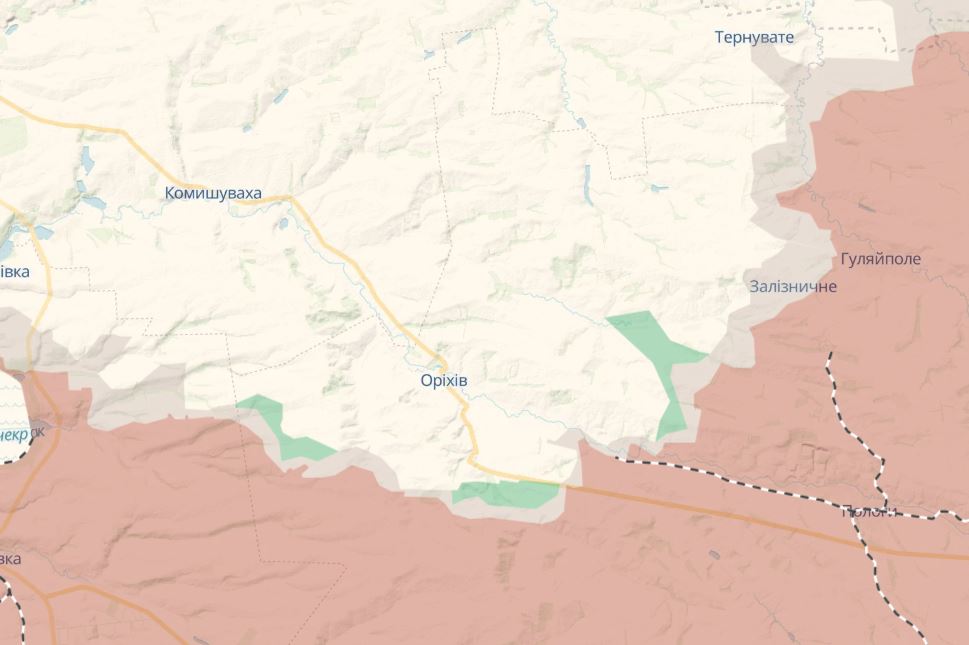
Zaporizhzhia Region. The Huliaipole direction remains one of the most dynamic sectors of the front. Russian forces continue large-scale assaults near Verkhnia Tersa, Rybne, and Zaliznychne in an attempt to reverse recent localized Ukrainian counteroffensives. In the Orikhiv direction, tensions remain high, although Russian assault activity has decreased, with combat increasingly taking the form of artillery duels and positional warfare.
Kherson Region. Along the Prydniprovske bridgehead sector, relative calm persists regarding ground assaults. However, both sides continue intensive counter-battery operations and actively employ FPV strike drones over the Dnipro River.
The transportation and fuel collapse in Crimea is having a direct, though uneven, impact on the combat effectiveness of Russian forces. By degrading Crimea as a military base, Ukraine seeks to weaken Russia's southern flank. This is expected to delay any renewed Russian offensive toward Zaporizhzhia and tie down significant Russian forces in the Zaporizhzhia and Kherson regions, limiting their ability to redeploy reserves and equipment to Donbas. However, the destruction of Crimea's logistical infrastructure affects the front asymmetrically: while Russia's southern grouping may lose mobility, operations on the eastern front (Donbas) are expected to be affected only minimally.
The probability of Ukrainian drone strikes against targets inside Belarus is currently assessed as very high. Ukraine's military leadership has reportedly identified 30 priority targets out of a broader list of approximately 500. Primary targets could include Belarusian-Russian radar stations, MESH communication relay systems, and Belarusian energy infrastructure, including oil refineries. The principal objective of such strikes would be to prevent Belarus from being used as a future negotiation platform between the United States and Russia, while also pressuring Minsk to remove Russian military assets from Belarusian territory and halt fuel exports to Russia.
Battle Maps
(Based on DeepState Map)
Donetsk Region
Zaporizhzhia Region
Ruslan Bortnik, Oksana Krasovskaya
for the Ukrainian Institute of Politics
Friends, we would like to remind you that additional analytical products of the Ukrainian Institute of Politics are available for organizations, businesses, and private clients, including Weekly Intelligence Briefs, Geopolitical Risk Reports, Executive Briefings, as well as special analytical materials and forecasts prepared upon individual request. For additional information, please contact us at: uiamp2012@gmail.com or by phone: +38 (093) 757-75-65.