Ukrainian Institute of Politics
HIGHLIGHTS OF 2025 FOR UKRAINE:
WAR, POLITICS, PUBLIC OPINION, ECONOMY, INTERNATIONAL SITUATION;
SOCIAL AND POLITICAL TRANSFORMATIONS
Introduction. Key trends for 2025.
-
Geopolitics and negotiations around Ukraine.
1. The final shift in the political balance in the United States in favor of the Republicans. The arrival of the new US President Donald Trump's team to power and its impact on the country's foreign policy strategy.
2. Western allies’ aid to Ukraine in the war. The balance is shifting: the US is transferring the main burden of financial responsibility to Europe.
3. The progress of peace negotiations in Ukraine. The role of the new US President in this process.
-
The course of the war in 2025: military operations.
1. (January 2025 – present) – a tactical military initiative on the side of the Russian army, which realizes its numerical and resource advantage. In 2025, the advance of Russian troops accelerated significantly.
2. Infrastructure war between Ukraine and Russia.
-
Domestic policy.
-
Personnel rotations and corruption scandals, the situation regarding the elections, disagreements among the military-political leadership, etc.
-
Transformation of Public Opinion. Sociology. Drastic Changes in Public Opinion in Ukraine.
-
Mobilization. Society's reaction to mobilization processes.
-
Socio-psychological consequences of war and internal lines of tension.
-
Macroeconomic situation and macroeconomics
-
Key economic indicators.
-
Financing the State Budget of Ukraine. The impact of aid from Western partners and international financial institutions, and the conditions for providing aid.
-
State budget of Ukraine for 2026
V. Conclusions and forecasts for 2026.
Introduction. Main trends.
Trends 2025: Thirty entries from the Ukrainian Institute of Politics
1. A strategic turn in the wrong direction. The outcome of 2025 for Ukraine is determined, first and foremost, by the radical shift in US strategy regarding the Ukrainian-Russian war that followed Donald Trump's victory in the presidential election. Washington's decision to cut off financial and military aid to Ukraine, coupled with the suspension of USAID operations, it became the key structural factor of the year, triggering a chain reaction of consequences: a reduction in Ukraine's military potential, a shift to a negotiating mindset, a change in the Ukrainian leadership's public rhetoric, a readjustment of the positions of European partners, a general rethinking of Ukraine's role and prospects, and an intensification of domestic political struggle and turbulence. The resulting shift in the US role—from Ukraine's ally to a negotiating moderator—became the main driver of the negotiating process, which escalated in 2025.
At the same time, the United States maintains a critical presence in the conflict in Ukraine through continued funding of intelligence and support activities in Ukraine, arms sales under the PURL program, as well as by concluding the Minerals Agreement, and demonstrating a willingness to provide Ukraine with broader security guarantees.
2. After the loss of the Zelenskyy’s status as the undisputed political leader against the backdrop of the other alternative figures’ growing popularity, such as former Commander-in-Chief of the Ukrainian Armed Forces Valeriy Zaluzhny and Chief of the Main Intelligence Directorate Kyrylo Budanov, as we noted last year, 2025 marked the year when President Volodymyr Zelenskyy lost his de facto power monopoly, forced under pressure from the Anti-Corruption Constellation of public bodies to dismiss his all-powerful head of office, Andriy Yermak. This is likely an undeniable sign of the trend toward weakening the presidential hierarchy in favor of the Anti-Corruption Constellation of public bodies (such as the National Anti-Corruption Bureau of Ukraine (NABU) that investigates high-profile corruption cases in Ukraine via a network of covert detectives, Specialized Anti-Corruption Prosecutor's Office (SAPO) that prepares evidence collected by NABU to present it in the High Anti-Corruption Court (HACC), – translator’s note) and, as well as parliament and the security services. This weakening, amid unresolved contradictions, could ultimately lead to new presidential and parliamentary elections as early as 2026.
3. The loss of realistic prospects for victory in the war, which accelerated the accumulation of Ukrainian society's war fatigue, suffering and deprivation, coupled with the serious corruption scandals of "Mindichgate," has generated a persistent demand within Ukrainian society for peace talks and a cessation of hostilities (69%, according to a Gallup poll). All of this could ultimately create a complex and unstable political environment within the country, in which traditional methods of governing may no longer work. The resignation of the Head of the Office of the President, as well as the earlier replacement of the Head of Government and the Cabinet of Ministers, only partially alleviated the negative pressure on the government.
After all, the majority of citizens believe that events in Ukraine are developing in the wrong direction. — 48% (Razumkov Center poll). Only 32.5% hold the opposite opinion.
Trust in government institutions has declined. This high level of trust primarily affects those institutions directly responsible for the country's defense. Twenty-eight percent of respondents trust the government led by Yulia Svyrydenko, while 30% distrust it, with 42% of respondents saying they don't know or can't evaluate its performance. Only 20% trust the Verkhovna Rada of Ukraine, while 76% distrust it. The public is also critical of the conscription centers, abbreviated as “TCK” in Ukrainian: 24% trust it, while 68% distrust it (research by the Rating Sociological Group).
The trust rating for Ukrainian President Volodymyr Zelenskyy remained generally stable in 2025 – 61% of Ukrainians trust him, 32% do not (according to KIIS) despite corruption scandals and, paradoxically, largely due to his resistance to external pressure from Donald Trump.
4. In 2025, the Armed Forces of Ukraine (AFU) finally transitioned to a strategic defensive, while the tactical offensive initiative was consolidated by the Russian Army. However, the Russian Army was unable to achieve a turning point in the war or the ability to make deep and rapid breakthroughs into Ukrainian territory due to the persistent strategic balance of resources and technologies between the parties to the conflict. At the same time, the speed of the Ukrainian territory’s seizure increased: between January 1 and December 26, 2025, the Russian Army captured approximately 4,300 square kilometers, excluding the Kursk salient (compared to 3,300 square kilometers in 2024; and over the entire course of 2023, the front shifted by only 200 square kilometers in favor of Ukrainian troops). The most significant advances by Russian troops occurred in the Gulyapoile, Pokrovsk, Siversk, and Sumy directions. The Russian Federation added a new war aim – "buffer zone" on the Ukrainian side of the border, control of which the Russian Federation may attempt to legitimize in addition to its occupation of five Ukrainian regions (the Autonomous Republic of Crimea, Donetsk, Luhansk, Zaporizhzhia, and Kherson Oblasts). However, these territorial changes do not create a strategic risk of defeat for either side or preconditions for military capitulation.
5. However, by the end of the year, it can be concluded that neither Russia nor Ukraine and its coalition of allies had achieved their key goals in this war. Russia was unable to overthrow the Ukrainian government and establish a loyal political regime in Ukraine through military or political means, to carry out a territorial redistribution of Ukraine's southern and eastern regions—annexing the so-called "Novorossiya" within its historical borders—or to oust the US and NATO from the post-Soviet space. The US and its partners were unable to sufficiently weaken Russia and achieve its destabilization and reorganization, forcing it to abandon its geopolitical goals. Ukraine, meanwhile, was unable to expel Russia from the occupied territories and restore its borders, which led to the de facto abandonment of the goal of the "1991 borders" and its replacement with the thesis of "peace along the front lines."
6. The war has finally entered the stage of a war of attrition, in which the main targets of destruction are the economic, energy, and logistical infrastructure, as well as the human potential of the enemy.
7. Both sides are suffering heavy losses in personnel, equipment, and other resources. The total loss of the Ukrainian army due to deaths and injuries since the beginning of the war could reach 500,000, including over 100,000 killed and 54,000 missing. Russia's losses in the war could be around 1 million, including 250,000 killed and 750,000 wounded. Ukraine and Russia are already facing ammunition shortages and exhausted troops, making the role of external assistance critical. For both countries, but more so for Ukraine, the issue of replenishing their armies with new recruits and mobilization is pressing.
8. The Russian offensive and the formation of a local, tactical advantage are determined primarily by the instability and inconsistency of Western aid to Ukraine, the cessation of American military aid, and the gradual depletion of human resources for mobilization; while Russia maintains a strategic resource advantage. At the same time, Ukraine remains a testing ground for the most advanced military technologies, and combat operations on its territory today are effectively a mix of technologies and tactics from the First, Second, and Third World Wars.
9. By the end of 2025, Russian President V. Putin ordered a large-scale expansion of the so-called “buffer zone” in Ukraine in 2026. The "buffer zone," as interpreted by Russia, effectively signifies a new form of territorial appropriation. While Moscow's previous territorial claims were recorded in Crimea, the Donetsk, Luhansk, Zaporizhia, and Kherson regions and formally appeared to be a "closed list," in 2025 a new, unformulated, but real territorial claim was introduced. The "buffer zone" concept allows the Kremlin to blur the boundaries of previously stated demands without naming specific regions, while legitimizing the further expansion of control. Essentially, this is the covert addition of yet another "subject of occupation."
10. Mobilization crisis in Ukraine and the desertion crisis. In the final measurement of 2025, mobilization has increasingly transformed into a systemic political and social problem. Demographic exhaustion, public war fatigue, distrust of the conscription center “TCK” practices [the nearest equivalent in English would be the term “press gangs”, – translator’s note], corruption, and the lack of clear terms of service and rotation have turned mobilization into one of the main factors of the state's internal vulnerability. At the same time, in 2025, a sharp personnel retention crisis emerged. The scale of Absence without Leave (AWOL) and desertion has become comparable to mobilization. From January 2022 to October 2025, 311,327 criminal cases were registered in Ukraine, 255,000 of which were related to UAU and 56,200 to desertion; in January–October 2025 alone, 161,461 cases were registered. In fact, the waves of mobilization in 2025 did not overlap the scale of personnel attrition.
11. Ukraine's financial dependence continues to grow. But since the second half of 2025, the country's support model has changed dramatically: the United States withdrew from direct budget financing programs; Europe has reduced the scale and changed the format of assistance; the support format has become almost entirely credit-centric. Grants, as a form of non-repayable assistance, have practically disappeared, giving way to loans, albeit largely concessional, but still forming Ukraine's future debt obligations. Over the period 2022–2025, Ukraine received an unprecedented volume of external budget financing – about $164.59 billion, which allowed the state to function in war conditions. In December 2025, the EU agreed to provide Ukraine with a loan of €90 billion for 2026–2027. However, these funds are not enough to cover all of Ukraine's needs: according to IMF estimates, about $137 billion is needed for 2026–2027, which means that the financing gap persistent.
12. In 2025, the purchasing power of most Ukrainians declined significantly. With annual inflation in the range of 9–12% , and 12–20% and higher for food and basic services, the growth in nominal incomes of the population (7–9% on average) did not compensate for the rising cost of living, resulting in real incomes declining by 5–10%, and for certain social groups, by up to 15–20%. The poverty rate in Ukraine remains at 37% of the population, according to the World Bank.
13. The Russian-Ukrainian war has become the most documented and automated war in human history (thanks to the proliferation of drones), and this progress continues rapidly.
2025 marked the year of the greatest intensification of negotiations between the US and Russia, with the participation of Ukraine and Europe. Based on the positions already voiced by Donald Trump's team, it is clear that potential peace agreements could include territorial concessions for Ukraine, partial lifting of sanctions off Russia, Ukraine's refusal to join NATO but commitment to join the EU, as well as security and deterrence guarantees and a reconstruction funding package. At the same time, Trump is attempting to protect Ukraine only in his western zone of influence, which is a real stumbling block in the US-Russia negotiations.
15. Trump has paradoxically established himself as the conflict's chief arbiter, despite the United States' involvement on Ukraine's side. However, the Ukrainian government and the E3 (France, Germany, and the United Kingdom), as well as hawks from the Republican and Democratic parties, hope to convince Trump to return to his "ally of Ukraine" policy, abandon pressure on Ukraine to make territorial concessions to Russia, and end the war along the current front lines by coercing Russia to do so; or to wait for a shift in the political balance within the United States following the Congressional by-elections in November 2026.
Both sides in the conflict, Russia and Ukraine, are hoping to convince Donald Trump of their rightness by attempting to pit him against an adversary that "does not want peace." Ukrainian President Volodymyr Zelenskyy is gradually being portrayed as "the main problem for a peaceful settlement," while Putin is being portrayed as "a new Hitler seeking to attack Europe."
16. Trump's new foreign policy strategy—"Donroe"—has led to the emergence of a new geopolitical reality of "strategic loneliness" for all participants in international relations, as well as the emergence of numerous fault lines within the "Western World." The new US National Security Strategy, which proclaims a new American-centric foreign policy that sharply criticizes allies and does not view Russia as an existential threat or enemy, became the manifesto of this process. Europe also remains internally divided between a so-called "pro-Trump conservative" camp and a "democratic-liberal" camp
17. Ukraine remains at the center of a global geopolitical standoff. Currently, the world is rapidly polarizing between the countries of the Global South and the Western world. This is particularly noticeable in the peace negotiations for Ukraine, which are currently splitting into two major camps: the West (Ukraine, the United States, and its allies) and the East (China and the countries of the Global South). The former advocates a military or diplomatic victory for Ukraine, followed by its integration into the Western world, while the latter advocates ending the war through mutual concessions and the formation of a new geopolitical balance of a multipolar (or non-polar) world.
Against the backdrop of Russia's isolation, economic, military, political, and technological ties between Russia and Iran, Belarus, China, North Korea, Venezuela, and others have deepened. These states have begun to identify common interests, align their rhetoric, and coordinate military and diplomatic activities. The "Syrian" defeat of Iran and Russia, and the subsequent Iran-Israel War, have not yet led to a strategic shift in the balance even in the Middle East, although they have strengthened the US and Israel.
18. Ukraine remains a fully functional state. With relative political stability, but with a negative trend and uncertain prospects, enormous military, political, and social tensions, an economic crisis, and a chronic crisis at the front. The current government and Ukraine's Western allies owe a great deal to the continued stability in Ukraine.
The main positive outcome of 2025 was the preservation of the state's fundamental stability. Despite tactical retreats by the Ukrainian army and local enemy breakthroughs in certain areas (Dobropillya, Hulyaipole, Siversk), the front did not collapse.
Similarly, despite mounting crises, relative socioeconomic and political stability was maintained in the rear. State institutions continued to function, and the country avoided a scenario of systemic collapse—amid the war and declining external support, this became a key factor in curbing negative dynamics.
19. Ukraine continues to change politically, economically, militarily, territorially, demographically, ethnically, and religiously. It is gradually ceasing to be a multicultural and agrarian-industrial country with intense political competition, becoming a more monocultural and agrarian country with a militarized, leader-driven style.
20. The resignation of Andriy Yermak from the post of Head of the Office of the President somewhat freed the political system from the pressure of the presidential chain of command and increased competition, which led to a partial restoration of the political role of the government and parliament, which are still not fully active in the political process.
21. Ukrainian President V. Zelenskyy and his team are making active efforts to accelerate Ukraine's approaching the EU accession. This step is driven not only by Ukraine's strategic goals of rapprochement with the European Union, but also by the need to demonstrate political achievements amid a difficult situation at the front and changing public opinion within the country. The prospect of further EU accession (which has already become a bargaining chip for peace agreements) will have a decisive impact on the stability of Ukraine's political system and the political prospects of Volodymyr Zelenskyy and his team. Ukraine's long-standing attempts to join NATO appear to have been removed from the agenda for now.
22. Amid a protracted war and growing social fatigue, so-called "Latin American" factors in Ukraine's domestic politics are intensifying in 2025. An increase in violent incidents, including murders and politically motivated killings, the expansion of the use of law enforcement for political ends, and the use of extrajudicial pressure, punishment, and reprisals are also taking place. A decline in public tolerance, a radicalization of discourse, and the justification of violence under various pretexts under the logic of "wartime" are bringing the country's internal dynamics closer to patterns characteristic of unstable Latin American states of the late 20th and early 21st centuries.
23. The internal division of Ukrainian society manifests itself not only along political and value lines —between a passionate minority and a passive majority, who have different perceptions of the war's goals, the means of ending it, and the future of the state. At the same time, a specific socioeconomic stratification is taking shape: society is divided into a privileged stratum of security forces, bureaucrats, and affiliated political and media actors, and the rest of the population. The privileged stratum becomes the beneficiary of the new governance model and demonstrates relative prosperity, while the passive majority is supported primarily through one-time social programs ("a thousand hryvnias [Ukrainian national currency; 1,000 UAH ~ $25; “helicopter money,” – translator’s note]," "winter thousand," etc.), without participating in either real political processes or in the distribution of the country's key economic flows.
24. The key negative domestic event of the year for Ukraine was the standoff between key security and anti-corruption institutions, ultimately resulting in the dismissal of the head of the Office of the President and the corruption scandal regarding the "Mindich case." It not only undermined trust within the country but also dealt a serious blow to Ukraine's international reputation, demonstrating the level of cynicism among some elites in the face of war. This scandal had direct foreign policy consequences, including a negative impact on Ukraine's ability to receive a reparations loan and a weakening of Kyiv's negotiating position. In fact, it accelerated a reassessment of Ukraine in the eyes of its external partners and deepened skepticism regarding the Ukrainian political system.
25. 2025 marks a turning point in the development and practical application of artificial intelligence, primarily in politics, media, and public communications. The widespread adoption of generative AI tools has led to the emergence of a fully-fledged alternative information reality, in which citizens and voters are increasingly finding it difficult to distinguish reliable information from fakes and manipulative content. The use of AI to generate text, images, videos, and voice simulations has created entirely new conditions for large-scale and difficult-to-verify influence on public opinion. This isn't just a matter of isolated fakes, but rather systemic, massive information and political attacks capable of distorting perceptions of events, undermining trust in institutions, and shaping controlled emotional reactions. As a result, information security and the cognitive resilience of society are becoming key vulnerabilities in modern politics.
26. Overall, 2025 did not represent a turning point, but it did mark an intensification of negative trends. It did not break the established dynamic, but neither did it reverse it: the status quo on key issues was maintained, while depressive and crisis trends deepened. The year became a transitional one, setting the stage for tougher decisions and possible future transformations. 2025 was a period of accumulation and manifestation of contradictions; next year could mark their resolution.
27. The year 2026 has the potential to be truly decisive. American negotiating policies, changes in the configuration of external support, and internal processes in Ukraine could lead not just to policy adjustments, but to a shift in the state's strategic course and recomposition of political elites.
I. Geopolitics and negotiations on Ukraine.
1. The final shift in the political balance inside the U.S. in favor of the Republicans.
The final shift in the political balance in the United States in favor of the Republicans. The arrival of the new US President Donald Trump's team to power and its impact on the country's foreign policy strategy.
In January 2025, Republicans occupy the White House and key positions in Congress. Donald Trump, the victorious US President, is inaugurated on January 20, 2025, after which he begins a major revision of the country's foreign policy. Within the first weeks, the new administration develops a more pragmatic, transactional foreign policy line, focused on reducing US commitments and revising the level of military and financial aid to allies, with an emphasis on bilateral "deals" rather than multilateral initiatives. It directly impacts the Ukrainian agenda, creating the conditions for a change in Washington's approach to the war and the format of a future peace settlement.
Donald Trump's policies in 2025 are shaped by the slogan "America First," which means strict prioritization of US national interests over obligations to allies and international organizations. Since returning to the White House, Trump has consistently demonstrated a course toward dismantling the established architecture of alliances and shifting relations with partners to a strictly pragmatic, transactional model— a "fee-for-service" model. This approach has become one of the key trends of 2025, dramatically altering the global economic and political balance.
The new strategy manifested itself most clearly in the trade sphere. In April 2025, Trump imposed a basic 10% tariff on all imports, citing the need to "restore fairness" and protect American manufacturing. Within days, the administration moved to more aggressive measures: differentiated retaliatory tariffs were announced, tied to the trade balance and policies of individual countries.
China became the primary target of pressure. By March 2025, tariffs on Chinese goods were increased to 20%, while 25% duties on steel and aluminum from all countries were simultaneously imposed. The overall burden on Chinese exports reached 45–80% for certain categories. However, on May 12, 2025, the parties implemented a temporary de-escalation: tariffs were reduced to 30% for 90 days, and China reduced its retaliatory tariffs to 10%.
Japan also found itself under attack. Initial tariffs of 24–25% on automobiles and industrial products threatened the country's entire exports model. Following intense negotiations, a compromise was reached on July 23, 2025: tariffs were reduced to 15%, and Tokyo opened access to American agricultural products and high-tech exports.
India suffered one of the harshest blows. The initial 26% tariff was increased by another 25% on August 6, 2025, bringing the total rate to approximately 50%. The formal pretext was India's purchases of Russian oil, which Washington perceived as "undermining American interests." India took a demonstrably independent stance: Prime Minister Narendra Modi ignored Trump's attempts to establish direct dialogue and confirmed his participation in the 25th SCO summit, strengthening cooperation with China and Russia. This became part of a broader trend: the emergence of solidarity in the Global South and the rise of alternative centers of power, which created strategic risks for the United States comparable to the "Kissinger nightmare," but in an even more complex configuration— Beijing, Moscow, and New Delhi.
Brazil also came under severe pressure. In April 2025, its goods were levied a 10% tariff, and on July 9, 2025, the tariff was raised to 50% on all Brazilian imports. This tightening was Washington's reaction to Brazil's political line and its growing rapprochement with China and Russia.
Canada and Mexico, despite the USMCA, also experienced pressure. Tariffs on goods outside the USMCA were increased from 25% to 35% in August 2025. The Canadian government was forced to lift most of the retaliatory tariffs, retaining only measures in sensitive sectors. Against this backdrop, Trump intensified rhetoric about "Canada becoming the 51st state," which was perceived in Ottawa as a symbolic infringement on sovereignty. The US has repeatedly imposed and suspended tariffs of 25-30% against Mexico, tying them to the fight against illegal immigration and fentanyl supply chains. At the same time, Trump has revived the idea of building a wall on the Mexican border as a key symbol of his immigration policy.
US strategy in 2025 is becoming increasingly pragmatic, conditional, and transactional, even with respect to long-standing allies. Washington is now openly demonstrating that no one is immune from economic pressure if previous agreements no longer serve US interests. Tariffs, investment commitments, and trade quotas are becoming elements of a broader political bargaining process—not only on trade issues, but also in security, energy, technology, and industrial policy, where the US seeks to consolidate its advantage and redistribute the burden to its allies.
By the summer of 2025, relations between the United States and the European Union were on the brink of a full-scale trade war. This was sparked by Trump's repeated statements about his intention to impose 30% import tariffs on a wide range of European goods, from automobiles and semiconductors to pharmaceuticals, starting August 1, 2025.
In response, the European Commission announced the preparation of mirror tariffs totaling €93 billion and a number of additional restrictions on American exports. This has become the most serious trade crisis in US-EU relations in decades.
The turning point came on July 27, 2025, when US President Donald Trump and European Commission President Ursula von der Leyen signed a framework trade agreement at a meeting in Turnberry, Scotland. The document stipulated:
-
15% import duty on most EU goods to the US;
-
Europe's reciprocal commitment to invest $600 billion in the American economy ;
-
and an additional $750 billion to the US energy sector and defense industry through 2028.
In fact, the tension was relieved not through a mutually beneficial compromise, but through a large-scale investment package and concessions from the EU. The US maintained its higher tariffs, albeit at a moderate level (15%), while the EU agreed to offset US demands with large investment commitments. Thus, the EU avoided an immediate trade escalation, but entered a new era of relations, where economic coercion has become the norm, and the alliance with the US is increasingly conditional and pre-paid.
Overall, the deal marked a shift in transatlantic relations to a new, much more pragmatic format. Mechanisms that previously assumed almost automatic, liberal market openness between allies are now being replaced by a flexible and conditional trade policy, in which every economic concession is tied to Washington's current political and strategic interests.
The increasingly unpredictable and self-centered course of the United States under Donald Trump is undermining the previous collective security architecture and forcing allies to rethink their own strategic resilience. Trump questioned NATO's fundamental principle— the collective defense pledge —saying that its commitment to Article 5 "depends on how you define it." He demanded that allies increase defense spending to 4-5% of GDP, effectively doubling previous targets.
These statements signaled that the United States is prepared to honor its commitments only to the extent that it serves its interests, and that the security of its allies is no longer automatically guaranteed. The erosion of trust has intensified amid Trump's closed negotiations with Moscow and Washington's attempts to formulate its own initiatives on Ukraine, bypassing its European partners. In Europe, such actions are perceived as elements of a unilateral pressure policy, which some leaders directly describe as a form of "appeasement" of Russia and the exclusion of the EU from key decisions.
As a result, European states have begun to prepare for a less predictable US role in ensuring the continent's security. There are open statements that America "no longer intends to guarantee Europe's security," and key partners are promoting ideas of strategic autonomy. The EU has launched large-scale defense initiatives, including the Readiness 2030 program, aimed at increasing its own military capabilities and reducing dependence on American defense.
Growing uncertainty in the sphere of collective security is leading to a sharp increase in demand for domestic armed forces, national defense technologies, and autonomous military capabilities. Countries around the world are increasing their military budgets, assuming that in a critical situation they will have to rely primarily on themselves.
In 2024, global military spending reached $2.7 trillion, a record high and reflecting accelerated national investment in defense. Many European countries have embarked on large-scale rearmament since the outbreak of the war in Ukraine: Germany created a €100 billion fund to modernize the Bundeswehr, Poland is increasing defense spending to 4-5% of GDP, and Japan plans to double its military budget by 2027. Even countries that have long relied on allies—for example, South Korea, under the US nuclear umbrella—are now considering strengthening their own offensive capabilities and, in some cases, debating the possibility of creating national deterrents. Thus, a new reality is emerging: states are seeking to ensure their own security independently, which simultaneously strengthens their position but also increases the risk of international instability.
The number of bilateral defense agreements within NATO is growing, reflecting both the adaptation to the war in Ukraine and states' doubts about the Alliance's ability to quickly respond to threats. Such formats make it possible to bypass complex multilateral procedures and make decisions much more quickly.
On July 17, 2025, Germany and the United Kingdom signed a Treaty of Friendship and Bilateral Cooperation, covering defense cooperation, technological and industrial projects, and strategic deterrence coordination. Earlier, on October 23, 2024, London and Berlin concluded a separate defense agreement expanding joint military planning. Germany thus received de facto security guarantees from both European nuclear powers simultaneously.
The UK is simultaneously strengthening ties with Paris: building on previous defense agreements, 2025 has become a year of expanded cooperation, including joint nuclear force planning and the establishment of a coalition headquarters in Paris to support Ukraine. France and Germany, in turn, had previously cemented their cooperation with the bilateral Treaty of Aachen, and since 2025 have expanded coordination in defense and the military industry. The troika—Germany, France, and the UK—is becoming the center of a new European security architecture, around which broad coalitions and "alliances within the Alliance" are forming.
These processes intensified following the September 10, 2025, incident, when Russian drones violated Polish airspace. This event sent a serious signal to countries on NATO's eastern flank. Poland accelerated its national defense strengthening; Lithuania, Latvia, and Estonia are strengthening their air defense measures in the wake of the "drones over Poland" and the Zapad-2025 exercises involving Russian troops, which took place in Belarus from September 12 to 16, 2025.
At the same time, there is a growing movement toward technological autonomy. Recognizing that access to foreign technology may be limited in times of crisis, countries are investing in their own industrial and innovative sovereignty. The European Union is actively promoting the concept of "technological sovereignty," developing critical sectors such as microelectronics, artificial intelligence, and cybersecurity. This is partly a response to the growing unpredictability of the United States and the uncertainty of transatlantic guarantees. In Europe, there is growing demand for the development of high-tech defense, satellite systems, and dual-use technologies.
Similar processes are also occurring outside of Europe. China, India, and other major powers are accelerating the development of their own semiconductors, weapons platforms, communications systems, and space technologies. The global system is increasingly fragmenting into several technological and defense blocs, each seeking to minimize dependence on external supplies.
Taken together, these processes are shaping a new international environment in which countries increasingly rely less on the stability of collective security mechanisms and increasingly focus on building their own military, technological, and political resources. These trends had existed before, but they accelerated sharply after the Republicans, led by Donald Trump, came to power: the new US line has called into question the automaticity of alliance guarantees and given further impetus to the global pivot toward strategic autonomy. As a result, the global system is entering a phase in which national capacity to act independently is becoming crucial, and alliances are increasingly viewed as auxiliary tools rather than as unconditional guarantors of protection.
The weakening of Western coordination has created a vacuum that other actors are filling, advancing their own interests. While the Trump administration is shaping its foreign policy around national egoism and short-term gain, China is seeking to occupy the vacated space by proposing its own model of global order, built on the rhetoric of "justice and equality."
These trends became particularly evident at the SCO summit in Tianjin (August 31 – September 1, 2025), which confirmed the accelerated rapprochement between Moscow, Beijing, and New Delhi amid growing confrontation with Washington. Beijing used the SCO platform to demonstrate its ability to claim the role of architect of a new global system. For outside observers, including Washington, the summit signaled the emergence of closer coordination among the largest countries of Eurasia, which the West increasingly views as an emerging anti-Western bloc. The ideological dimension was strengthened by the head of the People's Republic of China, Xi Jinping, who, during the SCO summit in Tianjin on August 31, 2025 presented his "Global Governance Initiative." China emphasizes the need to renew the international system, preserving the UN as its core, but moving toward greater multipolarity and a weakening of Western dominance. Beijing is thus seeking to establish itself as the center of an alternative global project that contrasts favorably with the American "America First" approach.
China is actively filling the emerging influence gap, expanding its economic and political presence in Eastern and Southeastern Europe. This dynamic is particularly noticeable in the Western Balkans, which are effectively becoming a key corridor for Chinese access to EU markets as part of the Belt and Road Initiative. Through loans from state-owned banks, Beijing is financing infrastructure—transport hubs, energy facilities, and mining projects—gaining long-term leverage over local political elites. A prime example is the construction of the Belgrade-Budapest high-speed railway, which will be integrated with the Greek port of Piraeus, managed by the Chinese corporation COSCO. This route transforms Hungary into a strategic "bridge" for Chinese goods to Europe, increasing the region's dependence on Chinese investment and logistics.
Overall, a clear trend is emerging: while the US deepens its transactional foreign policy model and Europe fails to offer its own strategic alternative, China is transforming the emerging vacuum into an opportunity to expand its influence —economic, political, and ideological. This is precisely what defines the nature of the emerging multipolarity in 2025.
Against this backdrop, Turkey is consistently expanding its influence in the Balkans, the Caucasus, and Central Asia, using a combination of soft power, infrastructure projects, and strategic alliances. In the Western Balkans, Ankara is emphasizing its cultural and humanitarian presence: state foundations and agencies are developing educational, cultural, and religious programs in Muslim-majority regions, strengthening historical ties and establishing strong channels of trust with local political elites.
The strengthening of Turkey's position in the South Caucasus became particularly noticeable after the end of the Azerbaijani-Armenian conflict in 2025, when Baku effectively consolidated its gains and secured a favorable post-war settlement format. In August 2025, a US-brokered peace treaty was signed between Azerbaijan and Armenia, resolving some contentious issues but not leading to a final resolution of the conflict. Nagorno-Karabakh is now fully under Azerbaijan's control. Negotiations between Azerbaijan and Armenia continue, but trust is fragile. The mandate of Russian peacekeepers in the region ended in 2025, and they left. Ankara became Azerbaijan's main foreign policy and military-technical partner, allowing it to strengthen the Turkey-Azerbaijan-Georgia strategic "triangle." This format is based on a network of shared energy routes, transport corridors, and defense cooperation, becoming a pillar of Turkish influence in Eurasia.
Other regional players are acting in a similar manner. In 2025, Saudi Arabia expanded its investment presence in Africa and the Middle East, strengthening its position through infrastructure projects and financial instruments. Iran continues to use a combination of political influence, military presence, and a network of proxy groups to strengthen its position in adjacent regions, seeking to maintain its dominance in the Persian Gulf and the Levant.
For Ukraine, the new geopolitical reality necessitates building a multi-layered security architecture in which NATO and the EU remain important, but not the only pillars. A key condition is the state's ability to independently ensure resilience by combining military, economic, and technological resources. As competing centers of power emerge, Ukraine will need a model that allows for flexible interaction with various blocs without losing its sovereignty or becoming an instrument of foreign strategies.
With the advent of the Donald Trump administration, Washington's policy toward Ukraine underwent a dramatic shift: from its previous leadership in military support, the United States moved to a significantly more restrained stance. Already in the first months of the new administration, the United States virtually ceased free arms deliveries to Ukraine. For the first time since the start of the full-scale war, the American government limited itself to authorizing only commercial arms sales, which Ukraine must purchase with its own or European funds, instead of providing direct military aid. Essentially, the previous model of allied support was replaced by a market-based contractual arrangement, reflecting the priorities of the "America First" policy. As a result, Europe was forced to sharply increase its own contribution to Ukraine's defense needs to compensate for the decline in American support and prevent a strategic imbalance on the front.
The Trump administration is showing reluctance to expend resources on a protracted standoff with Moscow and pursuing a course to end the war as quickly as possible, putting pressure on both sides. From their perspective, a protracted war in Ukraine distracts the United States from containing China and gives Beijing time to further strengthen its position.
It should be emphasized that, given the war in Ukraine, the priorities of the United States under Donald Trump and Europe have diverged significantly. For Washington, the key long-term threat is not Russia, but China, which is actively increasing its influence among the countries of the Global South, demonstrating its military might, and openly claiming the role of one of the centers of global governance. It is the China factor that is of greatest concern to Donald Trump and the Republican elite: in their perception, a real strategic rival to the United States is a state capable of surpassing America in economics, technology, and global norm-setting. Russia, meanwhile, is viewed as a problematic but weakened actor, long preoccupied with the aftermath of the war and limited in its expansionist potential.
However, such distancing by the United States creates a vulnerability for Europe, where there are serious concerns about its own security and the prospect of a possible future confrontation with Russia.
New US National Security Strategy.
By the end of the year, US President Donald Trump's policies were logically codified in the new US National Security Strategy, published on December 5, 2025. The document proclaims a return to strong borders, strengthened domestic strength, and "equitable burden-sharing" among allies. Overall, the new US National Security Strategy (November 2025) clearly shifts the emphasis toward "America First" national interests. The clear message of the document, stripped of diplomatic overtones, is that America no longer wants to be the "global nanny" but rather the primary beneficiary of order, while encouraging allies to grow up at their own expense.
Particular attention is paid to Europe: the strategy sharply criticizes its current situation. It addresses not only military spending or stagnation, but a deeper diagnosis: a decline in the share of global GDP (from about 25% in 1990 to 14% today), regulatory pressure, identity crisis, migration policy, censorship and suppression of opposition, and falling birth rates.
At the same time, the strategy acknowledges the strategic importance of Europe. Europe remains "strategically and culturally vital" to the United States: European industry, science, and culture are strong, and trade remains "the backbone of the global economy and American prosperity."
The United States wants a "strong Europe," but with a very specific meaning: more independence in defense, less dependence, a larger market for American goods, and regime change to right-wing conservatives. The United States declares its readiness to support democracy and freedom on the European continent: "U.S. diplomacy will continue to champion genuine democracy, freedom of speech, and an unabashed celebration of the national character of European countries." The goal is to help Europe correct its current course, making it a strong partner. The point is that the United States needs a "strong Europe" "to compete successfully and, together, prevent any enemy from dominating the continent." The US strategy declares close cooperation with those European allies who want to "regain their former greatness." It is noted that in the long term, it is quite possible that some NATO members will become predominantly non-European.
The United States aims to strengthen Europe as an independent strategic partner and to expedite the resolution of the war in Ukraine. Ukraine, in the logic of this NSS, is not an end in itself, but a hub for European stabilization and risk management with Russia. Russia must not be "persuaded" or defeated, but rather "stabilized." Managing European relations with Russia will require significant US diplomatic engagement both to restore conditions of strategic stability on the Eurasian continent and to reduce the risk of conflict between Russia and European states.
A unifying logic emerges across all sections: to protect and enhance American power (economic, military, and cultural) by demanding "equality and responsibility" from other states. This combination of measures, as envisioned, is intended to ensure a "New Golden Age " of US power and security. In foreign policy terms, the document emphasizes not alliances but convergence of interests. This is not a strategy of peace, but of targeted decompression— localize, stabilize, extract benefits, and withdraw.
At the same time, this strategy is not a turn toward isolationism, but a reassessment of the contractual terms of US participation in the global system. Washington is not giving up its influence; it is simply no longer willing to pay a fixed price for it. The US hasn't left, but it will no longer come when called upon. Its new language is one of conditions, stakes, and limits, in which sentimentality no longer holds sway.
All external relations— Europe, Asia, the Middle East —are now described not in terms of democratic values, but in terms of functions: what does this give the US, who covers the costs, what risks can be mitigated. Even Trump's "peace initiatives" are described as budget-friendly, quick-return instruments, rather than "moral missions," as they were, for example, under his rival, the Biden administration. Under Trump, Washington is shifting from a "global mission" to a strategically selective service: Alliances and security are no longer subsidized – they become commercially conditioned services whose price, conditions and benefits must be clearly defined.
The new US National Security Strategy is a precise embodiment of the policy of American self-interest under the Trump administration. It simultaneously serves as a message to the world and a set of instructions for the US elite: what should be financed more, what should be cut, which institutions should be prioritized, where the government apparatus needs to be restructured, and so on. It is a foreign policy integrated into a reboot of the domestic governance model. In this sense, the document is not so much an ideology as an administrative vector, which will guide everything from the budget to diplomacy.
Eastern Guardian.
Europe is entering a period of heightened military turbulence, where high technology coexists with high uncertainty. In 2025, the apparent cohesion of the NATO Alliance has been shaken. The new US Trump administration has questioned NATO's principle of collective defense (commitment to Article 5), tying it to additional financial burdens. Specifically, Trump has demanded that European allies increase military spending to 4–5% of GDP.
A new challenge has emerged from the periodic border incidents (including those involving drones) carried out by the Russian Federation, likely testing the readiness of NATO countries for a coordinated response.
As a result, Europe as a whole is forced to rethink the foundations of its defense strategy and support the practical side of Alliance unity – from building up its own defense capabilities to operational coordination on the eastern flank.
On September 12, 2025, NATO announced the launch of Operation Eastern Guard, a large-scale mission to strengthen the defense of the alliance's eastern flank from the Baltic to the Black Sea. The trigger was an incident in Poland: on the night of September 10, approximately 19–20 Russian unmanned aerial vehicles (UAVs) violated Polish airspace, flying from Belarus and Ukraine. Polish air defense forces and NATO allies responded immediately: fighter jets from the Polish and Netherlands Air Forces, an AWACS airborne early warning aircraft from Italy, and a NATO multirole tanker were scrambled. As a result, some of the drones were shot down—the first time in the history of the war in Ukraine that Russian UAVs had been destroyed over the territory of a NATO member state. Warsaw called the incident an "act of aggression" and convened an emergency government meeting, after which it formally appealed to its allies, invoking Article 4 of the North Atlantic Treaty. This is the eighth time in NATO's history that Article 4, which provides for urgent consultations among allies when one side's security is threatened, has been invoked. The allies unanimously expressed solidarity with Poland and condemned Moscow's "reckless" behavior, although the situation did not escalate to the invocation of Article 5 (collective defense).
Overall, we can speak of an emerging trend: the war in Ukraine is increasingly "spilling out" beyond its borders, affecting neighboring countries. Russian drones, missiles, and aircraft have already violated the airspace of Moldova, Romania, Poland, as well as the Baltic and Scandinavian countries. In particular, Tallinn convened an emergency meeting of the UN Security Council for the first time in 34 years in connection with Russia's violation of Estonian airspace. Three Russian MiG-31 fighter jets entered Estonian airspace without permission over the Gulf of Finland near the island of Vaindloo on September 19. In this context, we can also mention how, during the landing of the plane of the President of the European Commission, Ursula von der Leyen, in Plovdiv, Bulgaria (August 31, 2025), GPS navigation disruptions were recorded, which gave rise to suspicions of possible external interference by Russia (which has not been precisely confirmed). But all these episodes have increased the perception of a threat in European countries and create a dangerous precedent of a "shadow war" on NATO's doorstep, requiring the development of a new comprehensive response from the Alliance.
The possibility of deliberate action on the part of the Russian Federation also cannot be completely ruled out. This escalation could apparently have been the Kremlin's response to the developing debate in the West about post-war security guarantees for Ukraine, and at the same time, it is determining how prepared the West is to respond to such provocations. Russia could demonstrate that Ready to "probe" NATO with drones: Drones over Poland are supposedly NATO's response: " You give weapons to Ukraine, and we will show you that we can fly to you too."
For Ukraine, the events surrounding the Eastern Guardian also have a dual significance. On the one hand, NATO has made it clear that it continues to avoid direct intervention in the war. On the other hand, the allies have nevertheless attempted to rally behind Ukraine: the NATO Council statement emphasized that no Russian provocations will force the West to abandon its assistance to Ukraine, as "Ukraine's security is an investment in our own security." The incident in Poland highlights Ukraine's urgent and growing need for air defense, which the Ukrainian leadership has been able to reinforce by highlighting the Russian threat.
Incidents like those in Poland indicate that the NATO Alliance is already directly feeling the effects of the war in Ukraine. While this strengthens NATO's resolve to strengthen its defenses, it is not yet considering direct counterattacks against Russia. European capitals and Washington are demonstrating that they will not succumb to provocations designed to draw NATO into war.
Drone attacks, if repeated, will mobilize European society to increase pressure on Trump to impose new sanctions on Russia and reject any compromises that would, in any way, reward Russia for starting the war. Such consequences are quite possible today.
For now, it can be concluded that a tense but stable balance has been established on the eastern flank – the sides are sending each other signals of resolve, trying not to cross "red lines." Maintaining this fragile balance will be the focus of the international community in the coming months. European stability and transatlantic unity are being tested, the outcome of which will determine whether the lessons of the Ukrainian conflict have been learned and whether NATO is prepared for new challenges.
2. Assistance to Ukraine in the war from Western allies.
Overall, the dynamics of the Russian-Ukrainian war continue to be decisively determined by the volume and nature of military aid from Western partners.
The final trend in 2025: aid to Ukraine is being "Europeanized," with the US role becoming more controlling and conditional. Until 2025, the United States remained Ukraine's key donor and strategic partner, with its decisions largely determining the scale of support and the balance of power on the front. However, in 2025, actual responsibility for military and financial support for Ukraine was largely delegated to the European Union and individual European states, leading to a change in the aid structure, a slowdown in deliveries, and an increased burden on European budgets and defense systems.
Following the shift in the political balance in the United States and the accession of Donald Trump and his Republican team to power in January 2025, Washington embarked on a course of action to end hostilities and gradually withdraw military support for Ukraine. This dramatically increased uncertainty for Ukraine's defense and called into question the sustainability of the entire system of external support.
The practical implementation of this policy became evident in the first days after the inauguration of the new US President, Donald Trump (January 20, 2025). It became clear that the new US Administration was seeking to curtail the Ukrainian program and did not view it as a medium-term priority, either financially or militarily. This was evident not so much in public statements as in personnel and institutional decisions affecting key structures responsible for supporting Ukraine.
At the Pentagon, employees coordinating arms deliveries and interactions with the Ukrainian side were suspended or fired, effectively dismantling the previous system of operational support for aid. At the same time, US National Security Advisor Mike Waltz initiated a large-scale purge of the National Security Council: dozens of employees working on Ukraine, Iran, and North Korea were placed on administrative leave and removed from decision-making. Taken together, these steps were a clear signal of a reassessment of Washington's priorities and a reduction in US institutional engagement in the Ukrainian case.
The latest decisions on military aid to Ukraine were made by the Joe Biden Administration and implemented in early January 2025—in the form of limited packages through the Presidential Drawdown Authority totaling approximately $0.5 billion.
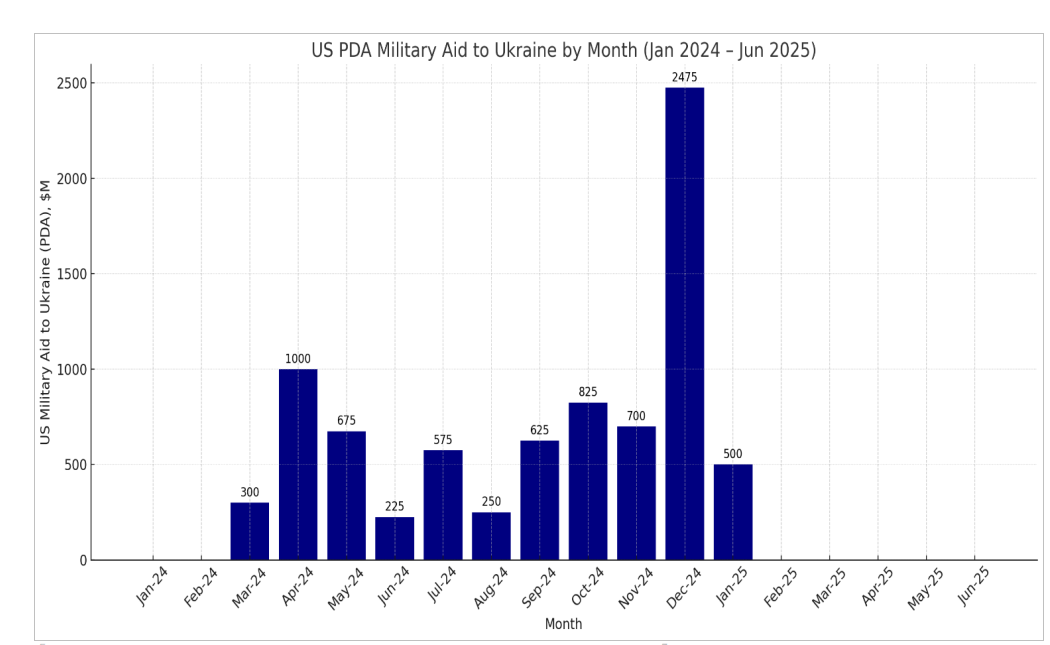
Dynamics of the transfer of military aid to Ukraine within the framework of the US presidential powers (Presidential Drawdown Authority, PDA).
Since the start of the full-scale war (February 2022 – January 2025), aid to Ukraine through the Presidential Drawdown Authority (PDA) under the Biden administration has amounted to more than 50 packages. Eighteen packages were allocated in 2024, with the final one on January 9, 2025, for $500 million (a total of $6.5–7 billion). In other words, no American aid has been delivered to Ukraine since January 2025.
These deliveries became the final inertial continuation of the policy of the previous Administration. After this, Ukraine received virtually no new systemic military aid from the United States until 2025: Congress did not approve new packages, and the Trump administration did not initiate additional appropriations. Support was limited to individual permits for commercial arms sales, which Kyiv was required to pay for itself (or with assistance from its European partners), marking a shift from an allied aid model to a market-based one.
As a result, by 2025, Ukraine had received the lowest amount of foreign aid since the start of the full-scale invasion, while its European partners were unable to fully compensate for the decline in US support. After relatively high levels of aid in the first half of 2025, military and financial support began to decline sharply in the summer months, a trend that continues through the end of the year. At the current pace of allocations, military aid remains insufficient to replace the loss of US support.
As the Kiel Institute for the World Economy notes, while annual allocations in 2022–2024 averaged around €41.6 billion and included Europe, the US, and other donors, in 2025 only €32.5 billion were allocated.
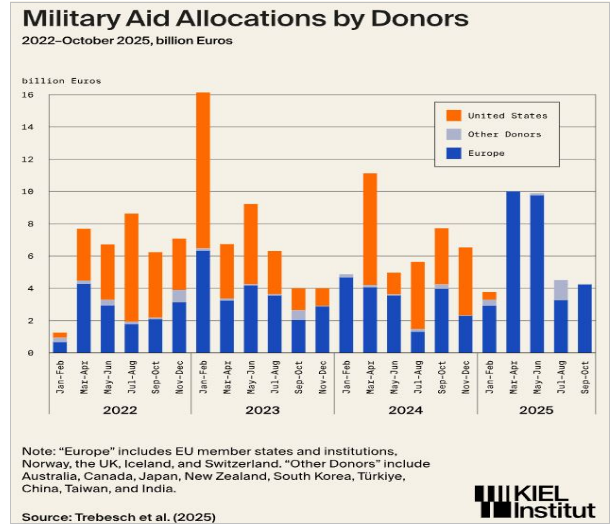
General dynamics of the transfer of international aid to Ukraine. Kiel Institute for the World Economy 2022-2025.
The largest proportion of aid to GDP came from the Nordic countries – Denmark, Finland, Norway and Sweden.
France, Germany, and the United Kingdom sharply increased their military spending compared to previous years, but relative to their GDP, all three countries remained significantly below their Nordic donors. Italy reduced its already low spending by 15 percent compared to 2022–2024, and Spain provided no new military aid in 2025.
Western aid to Ukraine currently consists primarily of budgetary macro-financial assistance (EU, IMF) and in-kind arms supplies (USA, UK, Germany, etc.), but not direct funding of the Ukrainian Ministry of Defense through the treasury.
Over the entire period of the war, Ukraine received approximately 330 billion euros in aid. (data from the Kiel Institute for the World Economy, meaning allocated aid, not delivered aid) of which: 45% (about 146.6 billion euros) is financial aid; about 45% is military aid (151.6 billion euros); and about 10% is humanitarian aid (31.8 billion euros).
The United States allocated €114.6 billion, while Europe allocated €188.6 billion. Ukraine also received over €26 billion in aid from Japan (€13 billion) and Canada (€13 billion).
US: Military Aid – 64.6 billion euros; financial – 46.6 billion euros; humanitarian – 3.4 billion euros.
Europe + Japan and Canada: Military aid – 87 billion euros; financial – 100 billion euros; humanitarian – 28.4 billion euros.
The EU allocated the most financial aid to Ukraine – €73 billion. The largest military aid from European countries was provided by Germany – €19.7 billion, and the UK – €13.7 billion. billion euros; Denmark – 9.6 billion euros; the Netherlands – 8.2 billion euros; Sweden – 7.9 billion euros; France – 5.9 billion euros.
In January-February 2025, the new US leadership initiated a large-scale audit of the use of international aid funds, including programs implemented in Ukraine. US President Donald Trump signed an executive order temporarily suspending all foreign aid programs for 90 days pending a review of their effectiveness and alignment with US foreign policy priorities. Formally, the order applied to programs of the US Agency for International Development (USAID) and did not directly affect macro-financial or military assistance to Ukraine. However, in practice, all support was paused until further decisions by the administration were clarified. USAID was one of the key channels of US support for Ukraine. Since the start of full-scale war in 2022, the agency has allocated approximately $30 billion in direct budget support to Ukraine, $5 billion in development programs, and $2.6 billion in humanitarian aid.
In parallel, in January 2025, the United States withdrew all requests for the transportation of military cargo for Ukraine, which had previously been routed through key logistics hubs in Rzeszów, Constanta, and Varna. This decision led to the suspension of deliveries of weapons and military equipment that remained at NATO bases in Europe, further signaling the scaling back of operational support.
Against this backdrop, the problem of further funding and military aid to Ukraine was effectively shifted to Europe, which by the beginning of 2025 found itself politically divided.
The first bloc—the United Kingdom and France —insists on continued support for Ukraine, maintaining sanctions pressure on Russia, and advancing the issue of security guarantees, including discussions of a possible peacekeeping contingent. This bloc is attempting to demonstrate its ability to support Ukraine even without the United States and allows for the purchase of American weapons with European funds in order to maintain Washington's interest. It is this group that the Office of the President of Ukraine is most focused on, despite the strained relations between London and Paris and the Trump administration and the lack of trust.
A second group of European countries—Hungary, Slovakia, and likely Italy —have adopted a wait-and-see approach, awaiting the development of an official US plan to end the Russian-Ukrainian war. These countries advocate a rapid end to hostilities, seek compromises with Russia, and are prepared to support settlement scenarios that primarily involve concessions at Ukraine's expense.
March – April 2025
Following a public spat between Ukrainian President Volodymyr Zelenskyy and US President Donald Trump on February 28, 2025, at the White House, relations between Kyiv and Washington entered a sharp cooling phase. As a result, starting March 1, 2025, the US suspended intelligence sharing and military aid to Ukraine for approximately one week. This significantly complicated Ukrainian forces' ability to conduct combat operations, especially on Russian territory. Not only were new arms deliveries frozen, but the exchange of intelligence between the US and Ukraine was completely suspended, including access to key satellite imagery, electronic intelligence, and signals intelligence. This component of American support proved fundamentally indispensable for Ukraine: despite their significant contributions, European allies were unable to fully compensate for the loss of American intelligence, operational information, and satellite tracking. This directly impacted the operational capabilities of the Ukrainian Armed Forces and led to a deterioration of the situation on the front in the Kursk region. From that point on, the Kursk bridgehead began to rapidly shrink and was virtually completely lost by June 2025. Simultaneously, in April 2025, Russian troops launched an offensive in the Sumy region in northern Ukraine.
Also in March 2025, discussions began on a joint U.S.-Ukrainian "reconstruction fund" for Ukraine, which became a key element of the Donald Trump administration's new economic policy. The draft agreement provides for full U.S. control over major investments in Ukrainian infrastructure and the mineral resources sector. The American side is demanding "right of first offer" for projects related to roads, railways, ports, mines, oil and gas, and the extraction of critical minerals, significantly expanding U.S. economic influence in Ukraine.
The draft creates a special reconstruction fund under US control, into which the Ukrainian government is obligated to transfer 50% of the revenues from all new projects. The US is entitled to 100% of the profits plus 4% per annum until its investment is fully recouped, although the total amount is not specified in the document. Kyiv is prohibited from offering projects rejected by the fund to other investors on more favorable terms for at least one year, effectively limiting Ukraine's economic sovereignty.
It is specifically stipulated that all US aid provided to Ukraine after the outbreak of full-scale war is considered a contribution to this fund. This means that Ukraine must repay all US military and economic support from 2022 onward before receiving any proceeds from the fund. According to the Kiel Institute, as of December 31, 2024, US aid to Ukraine amounted to €114.6 billion (approximately $120 billion). However, Donald Trump himself publicly uses significantly higher figures, citing amounts in the range of $300–500 billion.
Overall, the initial version of the agreement grants the United States broad rights to manage Ukrainian subsoil resources and infrastructure revenues, with the ability to transfer profits abroad, with minimal Ukrainian participation in decision-making. However, the document does not contain guarantees of arms supplies or investment commitments from the United States, making it primarily an instrument of economic and political pressure rather than a mechanism for restoration. On April 17, 2025, Ukraine and the United States signed a memorandum confirming the parties' intention to finalize and conclude the subsoil agreement.
By April 2025, it became clear that the US and Europe lacked a coherent understanding of who should bear responsibility for Ukraine's continued support, and to what extent. European elites were demonstrating a willingness to increase their involvement, but were not prepared to fully replace the United States in funding and military assistance.
European governments spend an average of just 0.1 percent of their gross domestic product (GDP) annually on bilateral aid to Ukraine. To offset US support, the contribution of all EU states and institutions would have to rise to 0.21 percent of GDP—a level that the Baltic and Scandinavian countries have already significantly exceeded.
In absolute terms, this means an increase in European aid from the current €44 billion per year to €82 billion. Particularly in demand will be EU institutions (an increase from €16 to €36 billion), Germany (from €6 to €9 billion), the United Kingdom (from €5 to €6.5 billion), France (from €1.5 to €6 billion), Italy (from €0.8 to €4.5 billion), and Spain (from €0.5 to €3 billion).
One way Europe could maintain support for the Ukrainian Armed Forces is by confiscating approximately €250 billion worth of Russian assets frozen in the EU. However, the EU is concerned about the financial consequences of such a move. This would undermine trust in the European financial system among third countries, potentially triggering capital outflows from the EU. It would also significantly complicate the subsequent restoration of relations with Russia.
It is becoming clear that replacing American weapons and ammunition will be much more difficult. To fully replace American weapons, European industry must quickly and significantly increase production volumes. Europe has long since stopped simply supplying from existing stockpiles; it now orders most of Ukraine's weapons directly from the weapon manufacturers. This process must be significantly accelerated through firm purchase commitments.
The greatest dependence on American weapons currently lies in rocket artillery (e.g., HIMARS, 86% of which is US-made), howitzer artillery ammunition (over 80% US-made), and long-range air defense systems (e.g., Patriot, 70% US-made). In other areas, including howitzers and main battle tanks, the majority of supplied weapons systems are already European-made. There is also no substitute for US military intelligence.
May 2025
From May 20–22, 2025, a meeting of G7 finance ministers took place in Banff, Canada. During the discussions, the United States opposed the inclusion of language on "further support for Ukraine" in the G7 final statement and took a cautious stance in assessing Russian aggression, reluctantly calling Russia's full-scale invasion of Ukraine "illegal."
This reflects a profound shift in Washington's position: Ukraine is no longer perceived as a strategic priority, and rhetorical restraint indicates the US desire to preserve space for possible agreements with Moscow without legal or moral constraints. This weakens Kyiv's diplomatic position and undermines Western unity.
The G7's language has practical implications: it is used as a basis for preparing new aid packages, sanctions, and negotiating initiatives. Weakening it demotivates allies and creates conditions for fragmentation of the Western coalition, since without a firm US stance, European partners are unlikely to insist on a tougher line.
In 2025, the administration of US President Donald Trump repeatedly blocked or significantly softened language condemning Russia's actions within international organizations, reflecting a general shift in the American position toward the Kremlin from harsh political pressure to a more neutral and pragmatic line.
1. UN General Assembly (February 24, 2025): On the third anniversary of Russia's full-scale invasion of Ukraine, the UN General Assembly adopted a resolution condemning Russia's aggression and calling for the complete and unconditional withdrawal of Russian troops from Ukrainian territory. The United States voted against the resolution, joining Russia and 16 other countries, including North Korea and Belarus. This marked the first time since the war began that the United States had not supported such a resolution, raising concerns among allies and increasing tensions in transatlantic relations.
2. UN Security Council: The United States proposed its own resolution calling for an end to the conflict, but without mentioning Russia's aggression or supporting Ukraine's territorial integrity. Attempts by European countries to introduce amendments condemning Russia's actions were blocked by Russia with a veto. As a result, the Security Council adopted the American resolution in its original, neutral wording, drawing criticism from the United States' European allies.
3. Withdrawal from co-sponsorship of the General Assembly resolution: In February 2025, the United States withdrew from co-sponsorship of a UN General Assembly resolution supporting Ukraine's territorial integrity and demanding the withdrawal of Russian troops. This was a significant departure from previous US policy, which had actively supported such initiatives.
At the end of February, the US opposed calling Russia an "aggressor" in the G7 statement on the third anniversary of the war in Ukraine.
In mid-April, the United States refused to sign a joint statement with the G7 countries condemning the Russian missile strike on Sumy, which killed more than 30 people. According to Bloomberg, the Trump administration explained this by saying it was "working to preserve space for peace talks" and maintaining contacts with Russian authorities. Ultimately, the statement was not signed.
July – August 2025
In the first week of July 2025 (effective July 1), the United States temporarily suspended critical weapons supplies to Ukraine for the second time.
The official reason for the suspension was a logistical review: at the direction of President Donald Trump, the Pentagon was required to "review its weapons stockpiles" following the recent airstrikes on Iranian targets in June. The White House presented this as a "standard review" of all international military aid, not just for Ukraine.
It's important to emphasize that this isn't a complete halt to aid: according to current estimates, funding and deliveries have been halted for approximately 7-12 of the 80 weapons, ammunition, and spare parts previously supplied to Ukraine. These include critical items such as Patriot, Hellfire, and GMLRS missiles.
However, the halt in deliveries of, for example, Stinger missiles, grenade launchers, or 155mm artillery shells has no significant impact on the overall situation. As a result, approximately 10-15% of all weapons have been suspended.
The following key categories were included in the ban:
-
Patriot missiles are surface-to-air missile systems and Patriot interceptor missiles.
-
HIMARS GMLRS missiles are guided missiles for HIMARS launchers.
-
Stinger man-portable air defense missiles (MANPADS) are anti-aircraft and anti-drone systems.
-
Anti-tank missile systems are portable systems such as Javelin and similar systems.
-
Precision-guided munitions – various precision artillery and guided projectiles.
In essence, only those supplies that are critically needed by the United States itself to maintain its own security have been suspended.
At the same time, the United States continued to fulfill its previously assumed obligations, maintaining intelligence and analytical capabilities, target designation, and early missile warning systems.
The pause in arms supplies to Ukraine was used by the Donald Trump administration not only as a tool to pressure Kyiv and signal to its allies, but also as a test of Moscow's reaction. Trump apparently hoped that a temporary suspension of military aid and a demonstration of US flexibility could push the Kremlin toward certain peace concessions or at least a softening of its negotiating position. However, telephone conversations on July 3, 2025, between US President Donald Trump and Russian President Vladimir Putin failed to soften Moscow's position. Following the conversation, the Russian side clearly demonstrated its unwillingness to compromise. The Kremlin adopted a tough and extremely demanding stance and continued to insist on its maximalist demands regarding Ukraine. This disappointed the US administration and was one of the reasons the White House decided to resume defensive arms supplies to Ukraine after a brief pause.
The Ukrainian authorities have been placed in a difficult position: President Volodymyr Zelenskyy acknowledged that Ukraine would be "very difficult" without US support and immediately began consultations with Washington to resolve the issue. In particular, the most pressing issue for Ukraine is the supply of air defense systems. Russia took advantage of the suspension of arms supplies to Ukraine and increased the frequency of shelling. On July 4 alone, Russian Army launched 550 drones and missiles at Ukrainian territory. In June, Russia again set a record for the number of long-range drones launched. According to the Kyiv Independent, this number was 5,337. The previous record was set in March – 4,198 units. In May, the Russians launched 4,003 drones. Other Ukrainian sources report that there were even more Shaheds and their modifications in June – 5,438 (according to the Novinarnya website). This is almost 1,500 more than the previous month. In other words, Russia increased the intensity of attacks by 35% over the month.
On July 4, after several tense days, a telephone conversation between US President Donald Trump and Ukrainian President Volodymyr Zelenskyy helped move the situation forward. During this conversation, Trump emphasized that the pause was not his personal decision, but merely the result of a review of the Pentagon's stockpiles. He "assured" Zelenskyy that the US would provide Ukraine with as many weapons as it could afford —that is, as many as American resources and interests allowed under the current circumstances. Zelenskyy, for his part, called this conversation "very important and useful," one of the "best to date" with Trump. Specific steps to expand the supply of air defense systems to protect Ukrainian skies were discussed.
On July 7, US President D. Trump announced that he would send additional weapons to Ukraine for defense. During a meeting with Israeli Prime Minister Benjamin Netanyahu, Trump noted:
"We're going to send some more weapons (though he didn't specify what kind) —we have to. They (the Ukrainians) have to be able to defend themselves. They're being hit very hard right now. They're going to be hit even harder. We have to send more weapons—especially defensive weapons—because they're being hit very hard. A lot of people are dying."
Trump also emphasized: "I'm disappointed that Putin hasn't stopped. I'm not happy with Putin at all!" Meanwhile, Pentagon spokesman Sean Parnell announced that, at the direction of US President Donald Trump, additional American defense weapons (the items were not specified) would be sent to Ukraine.
It is important to note that this is not a strategic turn by US President D. Trump "toward Biden's course" (as some media outlets are reporting), but rather his flexible tactical maneuvering between external and internal pressures, while maintaining control over the situation. It is important to note that we are talking about resuming arms supplies from the packages that were adopted under D. Biden (and which are already ending). It is worth paying attention to the rhetoric of D. Trump himself: he emphasizes that “we will still transfer some weapons,” but does not specify which deliveries he is talking about; it is possible that not all deliveries from the stopped arms packages can be resumed.
Various media outlets have cited Donald Trump's phrase "a little more weapons," indicating a lack of fundamental decisions regarding new large-scale packages. The key reason for the suspension, however, was less a political game with Moscow than a technical one. Primarily, it was the need to review stockpiles following significant deliveries of Patriot missiles to protect Israel from Iranian attacks. It is reported that the United States has only about 25% of the required Patriot missiles remaining. The decision to continue arms deliveries after Biden's packages are exhausted will be of paramount importance. The key question is whether new supply packages to Ukraine will be approved, as well as the framework under which they will be implemented—free of charge, as under Biden, for a fee, or through contributions to the Fund created under the resource deal (which, in fact, will also be free of charge). In other words, maneuvering around military aid is inextricably linked to the new model of US-Ukrainian relations: an agreement on joint development of mineral resources and a restoration fund.
The resumption of supplies was presented as a tactical move to ensure peace and continue negotiations —that is, the transfer of weapons was not intended to fundamentally alter the balance of power, but to prevent Ukraine from collapsing on the front lines and maintain the possibility of negotiating. However, the Kremlin noted that it considers Trump's "actions" to be "not consistent with efforts to promote a peaceful settlement," adding that the Europeans had also chosen a course aimed at "continuing hostilities."
One could speak of manual control of supplies: some are temporarily suspended, others are reopened, but all of this is done in a very limited and ad hoc manner, taking into account both internal criticism and the general need to prevent Ukraine's rapid military degradation. This is a tactical game, and any actions involving weapons are presented as a tool to influence the negotiation process and put pressure on participants on both sides.
Thus, after failing to coax Moscow into making concessions in peace talks, the White House has essentially returned to sending weapons to Ukraine, balancing "America First" rhetoric with the need to prevent Russia from quickly gaining a unilateral advantage on the front lines.
In any case, the United States now always reserves the right to adjust the volume and terms of support based on the situation and diplomatic negotiations. The Trump administration, in essence, continues to monitor and control the conflict, trying not to expend significant resources and waiting for a shift in the balance of power before returning to the role of arbitrator or mediator between the parties.
On July 18, 2025, the European Union approved the next, 18th, package of sanctions against the Russian Federation (economic and individual restrictive measures), targeting the energy sector, oil export logistics, and financial infrastructure. The EU Council expanded the sanctions list by adding 14 individuals and 41 legal entities, bringing the total number of individual targets to over 2,500. A complete ban on transactions was imposed on 22 more Russian banks and on any transactions with the Russian Direct Investment Fund and its entities. Export restrictions against suppliers to the Russian military-industrial complex were strengthened, with sanctions imposed on three Chinese, eight Belarusian companies, and 26 new entities (including seven in China/Hong Kong and four in Turkey).
One of the central elements of the new EU package was a reduction in the price cap for Russian oil from $60 to $47.6 per barrel (-15%), as well as measures against 105 new "shadow fleet" ships, bringing the total number of vessels included in the list to 444. In the long term, the new price cap of $47.6 per barrel could reduce Russia's revenues to approximately €2.5-2.7 billion per month. However, this calculation assumes strict and complete adherence to the price cap policy, which is not always followed even now. Losses to the Russian budget from reduced oil and gas revenues and additional costs for logistics and external debt servicing are estimated at approximately $100 billion annually.
But the new EU and UK packages, however harsh, rarely clearly conflict with Washington's current tactics. US President Donald Trump, having taken a 50-day pause on imposing his own secondary sanctions, could, in the absence of concessions from Russia on peace talks, give the green light and effectively delegate the function of increasing pressure on Moscow to European partners, so as not to be drawn into direct escalation before the Kremlin's "trial period" expires. Thus, both the sanctions and any actual deliveries of long-range weapons by Germany and other European countries should be viewed as elements of a complex diplomatic game and coordinated Western pressure on Russia. Trump himself is maintaining his distance and not directly engaging in escalation, leaving Moscow under the "soft pressure" of sanctions and diplomacy. In other words, Washington has, for now, handed over the leverage to its allies during the Kremlin's 50-day "trial period."
In July 2025, Donald Trump and the new NATO Secretary General, Mark Rutte, agreed on a new strategy (deal), under which a significant portion of Western aid to Ukraine would formally flow through NATO and EU institutions. The US would supply limited quantities of critical weapons (Patriot, ammunition, GMLRS) "against future compensation" from European allies, while Europe would coordinate and finance new large defense packages. This means Europe would have to pay for all arms deliveries. At the current time (July 2025), this deal is more of a political and logistical compromise than an immediate phase shift on the front. It opens the prospect of long-term Western support for Ukraine, but does not yet address the critical shortage of shells, missiles, and real-time intelligence. The impact on the front will not be felt until autumn 2025, when Europe will be able to increase supplies and establish sustainable supply under the "new rules."
Essentially, Washington is shifting its relations with Europe and Ukraine to a commercial basis: new arms and technology supplies are being made primarily "against future compensation" from European allies. The US continues its policy of distancing itself and is gradually shifting responsibility for military and financial support for Ukraine to Europe and NATO structures.
Throughout the war, the dynamics of American aid clearly influenced the situation on the front. If the US were to cease financial and military support for Ukraine, European states could still partially fill the gap in many areas or even compensate. However, the reduction in arms and resource supplies would seriously limit the time frame within which Ukraine could effectively resist.
Currently, European governments spend an average of just 0.1 percent of their gross domestic product (GDP) annually on bilateral aid to Ukraine. To offset US support, the contribution of all EU states and institutions would have to increase to 0.21 percent of GDP—a level that the Baltic and Scandinavian countries have already significantly exceeded.
In absolute terms, this means an increase in European aid from the current €44 billion per year to €82 billion.
If Europe fails to effectively double its military spending, the phase of managed attrition could give way to a phase of strategic breakdown for Ukraine. If aid is resumed, Ukraine can maintain its defensive potential and deter further Russian advances over the next year. If aid is discontinued, the risk of deep breakthroughs and a significant shift in the frontline to Ukraine's detriment within a few months could arise.
September – October 2025
Game of sanctions. US President Donald Trump called on the European Union to impose 100% tariffs on China and India to halt their purchases of Russian oil and increase pressure on Moscow to end the war in Ukraine. He promised that if the US does so, it will follow Brussels' lead.
US Energy Secretary Chris Wright stated that the EU should replace purchases of Russian oil and gas with supplies from the US. According to him, this step would not only reduce funding for the Russian military but also allow Brussels to fulfill the terms of the trade agreement, which stipulates the purchase of $750 billion in US energy resources by 2028. Wright emphasized that ending Russian energy imports would be a signal paving the way for tougher US sanctions against Moscow.
While the EU is trying to get Washington to increase sanctions pressure on Russia, Donald Trump is taking a tougher stance: Europe must be consistent and, first and foremost, abandon its remaining channels of cooperation with Moscow. The logic is simple: Brussels wants the US to bear the brunt of the escalation, while continuing to rely on Russian resources.
There are two possible scenarios. If Europe refuses to comply with Trump's terms, Washington will be able to blame Brussels for the failure of sanctions pressure and use this as an argument for its own terms for ending the war. If the EU agrees, the US will also benefit: Europe will become more dependent on American energy resources, and Trump will gain the opportunity to engage in tough bargaining with Moscow and Beijing.
However, the most likely scenario remains an intermediate one: Brussels will avoid sharp confrontation and continue to issue new sanctions packages (19th, 20th, and beyond), trying to balance between US demands and the interests of its own trading partners. However, the practical effect remains limited: Russia's share of energy supplies to Europe has fallen from 40% to 15% after the 18th sanctions package, but has not completely disappeared. Moreover, a significant portion of the flows is being rerouted through bypass schemes—from Indian oil products to liquefied natural gas, which continues to flow into European ports.
Amid all these disagreements, tensions are rising between the allies. In an interview with Sky News President of Ukraine V. Zelensky He contrasted with Donald Trump's approach. He called on the US to impose unilateral sanctions against Russia, despite Trump's insistence on coordinating with Europe. He criticized the Alaska summit for conceding too much to Putin. He also called on Trump to take a "clear position" on security guarantees, warning that without US support, Europe would not budge. "Before we end the war, I really want all agreements to be concluded. I want... to have a document supported by the US and all European partners. This is very important. For this to happen, we need a clear position from President Trump," Zelenskyy stated.
These remarks exposed a growing line of contradiction: Kyiv and its European partners on one side, Washington on the other. Ukraine understands that Donald Trump is seeking to end the war and that his views are increasingly aligned with those of Russia following the talks in Alaska. Then, Vladimir Putin allegedly offered Donald Trump a "compromise" plan: adjusted territorial demands and a ceasefire in exchange for the withdrawal of Ukrainian troops from Donbas (without mentioning the Zaporizhia and Kherson regions), as well as agreement to certain security guarantees for Ukraine—but without the presence of NATO troops. Most sources claim that Trump has generally accepted this plan, but it does not fully satisfy Ukraine and Europe. Now Moscow expects Trump to pressure Kyiv and Brussels to agree to the negotiated terms. For Ukraine and the EU, the minimum task now is to prevent such pressure; the maximum is to convince Trump to adopt a hard line toward the Kremlin. At the same time, Ukraine understands that the mood in Washington is unstable. Therefore, the key strategy is strengthening support from European leaders and direct contacts with Trump. At the Yalta European Strategy (YES) conference, President Volodymyr Zelenskyy directly acknowledged the existence of competing voices around the American President and emphasized Kyiv's efforts to ensure that "good voices" have decisive influence.
On October 23, 2025, the 19th EU sanctions package was adopted in connection with Russia's ongoing invasion of Ukraine. It aimed to further tighten economic, financial, and technological pressure on Russia and close previously identified loopholes. It included expanding personal sanctions against representatives of the military-industrial complex and occupation authorities, strengthening export controls on dual-use goods, microelectronics, and defense equipment, additional measures in the shipping and logistics sectors (including controls on "shadow fleets" and insurance), and tightening financial restrictions on banks and entities involved in evading sanctions through third countries. Special emphasis was placed on monitoring mechanisms and secondary measures aimed at reducing re-exports and parallel imports, allowing the EU to review the year's results with a focus on improving the effectiveness and enforceability of the sanctions regime.
November-December 2025
The US defense budget for 2026 allocates $400 million for military support to Ukraine; a similar amount is also allocated for 2027. However, the content of these funds no longer constitutes aid in the classic sense. They are funding infrastructure that is critically important, first and foremost, to US interests: reconnaissance, targeting, and missile early warning systems in Ukraine. Essentially, the US President Donald Trump is gradually scaling back military and financial support for Ukraine. The announced $400 million is no longer aid in the classic sense, but funding for essential US infrastructure in Ukraine: reconnaissance, targeting, and early warning systems. This infrastructure is critically important for deterring Russia—aid that ensures the American presence of reconnaissance, targeting, and early missile warning assets. Without this infrastructure, our cities could simply become uninhabitable. In other words, the US is maintaining control over the critical deterrents of this war, ensuring that it goes on under control. At the same time, aid to eastern NATO countries, the Baltic states, Romania, and Poland is being cut. And this is also, in a way, an ultimatum to Europe. All of this suggests that the US has withdrawn from its role as the main participant in this war, this confrontation.
Europe is left alone with the problem of financing the war against Russia, while Ukraine receives only a minimal package that ensures an American presence.
At the 32nd meeting of the Contact Group on Defence of Ukraine (Rammstein), partners confirmed record-breaking and long-term commitments to military support for Ukraine, with a focus on 2026 and beyond.
In 2025, Ukraine's international partners made record defense commitments. According to Ukrainian Defense Minister Denys Shmyhal, approximately $5 billion was allocated to developing Ukrainian defense production, and another $5 billion was allocated to purchasing American weapons for Ukraine. Both figures were the highest since the war began, and the partners declare their intention to maintain this momentum in 2026.
Ukraine received confirmation of long-term military support from key allies:
Germany.
€11.5 billion in 2026 for Ukraine's defense (air defense, unmanned aerial vehicles, artillery ammunition);
two Patriot systems and the ninth IRIS-T system have been transferred; a significant number of AIM-9 Sidewinder missiles from the Bundeswehr's inventory are expected to be transferred in 2026.
United Kingdom.
£600 million in 2025 to strengthen Ukraine's air defense using frozen Russian assets, partner funds, and the national budget.
Canada.
30 million Canadian dollars for Ukrainian drones;
supplies of AIM-9 missiles, electro-optical sensors and other military aid.
The Netherlands.
€700 million for UAVs, including €400 million for Ukrainian-made products.
Denmark:
New contribution to PURL with a focus on aviation capabilities;
29th aid package for €250 million (drones, air defense, aviation support).
Norway.
About $7 billion in military aid in 2026;
contributions to American air defense systems and the "Czech initiative."
Poland.
Supplies of 155-mm artillery shells;
joint projects with Ukraine within the framework of SAFE.
Baltic countries.
Estonia: at least 0.25% of GDP (€142 million) + €9 million to the IT coalition;
Latvia: at least 0.25% of GDP (€110 million) — UAVs, electronic warfare, PURL;
Lithuania: over €220 million in 2026 (PURL, Patriot, the Czech initiative, demining).
Other partners.
Luxembourg: €100 million in 2026 + €15 million in PURL;
New Zealand: $15 million in PURL;
Portugal: contribution to the "Czech initiative" + €10 million for UAVs;
Montenegro: preparation of contributions to PURL and the NSATU fund;
Czech Republic: the supply of 760,000 artillery shells has already been financed under the "Czech initiative" for 2026.
December 18, 2025 The European Council approved a €90 billion loan to Ukraine for 2026–2027. The financing will be provided through EU borrowing on capital markets, guaranteed by the EU's budget reserve. The decision was supported by 25 heads of state and government.
The loan is intended to cover Ukraine's financial and military needs, beginning in the second quarter of 2026. Repayment of the loan is envisaged only after Ukraine receives reparations, primarily from frozen Russian assets. Until then, Russia's assets will remain immobilized, while the EU reserves the right to use them to service the debt in full compliance with EU and international law. The European Council instructed the Council of the EU and the European Parliament to continue working on the technical and legal mechanisms of the "reparations loan"; the issue will be reconsidered at the next meeting.
A political compromise was reached with the participation of Hungary, the Czech Republic, and Slovakia: Hungarian Prime Minister Viktor Orbán, coordinating with Andrej Babiš and Robert Fico, agreed to support the package on the condition that these countries would not participate in its financing. The final decision excluded all three countries from repayments on this loan.
At the same time, €90 billion is not enough to cover all of Ukraine’s needs: according to the IMF, approximately $137 billion is required for 2026–2027, which means a persistent financing gap.
The context of the decision is also important for the EU. As of 18 November 2025, the total EU debt outstanding was approximately €732.9 billion, of which:
€35.29 billion – short-term EU-Bills;
≈€697.61 billion – long-term EU Bonds.
This is not "Europe's debt as a whole," but rather the debt of EU supranational instruments, secured by the Union budget. For perspective, the EU budget for 2025 is €155.2 billion in payments, meaning the current debt is equivalent to approximately 4.7 annual budgets. For comparison, at the end of 2024, the EU debt was just over €600 billion, indicating accelerated growth, including due to NextGenerationEU programs and support for Ukraine (+€90 billion, an increase of approximately +12.3%).
Politically, this decision strengthens the position of Ukraine and Europe ahead of possible negotiations (including the format being discussed in Miami). As Ukrainian President Volodymyr Zelenskyy previously stated, the US is directly asking the question during consultations: "How can you survive another year without funding?" This is precisely why Kyiv insists on the confiscation of Russian assets—to remove the funding issue from the agenda. At the same time, the US continues to urge the EU not to seize the assets permanently, but to retain them as a bargaining tool with Russia.
3. The progress of peace negotiations on Ukraine.
The United States set a course for ending the war in Ukraine as a way to reduce European risks and free up resources to contain China. However, the Ukrainian track stalled in 2025, and the promise of peace in Ukraine within 24 hours failed to materialize by the end of 2025: neither side was prepared to make concessions on fundamental issues, so Washington relied on pressure and "parallel tracks" (shuttle contacts, packaged terms, and attempts to test the limits of compromise).
During 2025, several rounds of direct negotiations (at least 20 at various levels) took place between the United States and Russia, ranging from expert and diplomatic consultations to political contacts, including six meetings between US Special Representative S. Witkoff and Russian President V. Putin and one personal meeting between Trump and Putin in Anchorage, Alaska, on August 15, 2025.
Ukraine and the EU often found themselves outside the framework of key consultations, which increased the mistrust of Washington in European capitals.
January 2025. Immediately after his inauguration, D. Trump gave strict instructions to the Special Representative for Ukraine and the Russian Federation, K. Kellogg, to find a solution to the protracted Russian-Ukrainian conflict within 100 days. But K. Kellogg, while formally appointed as a negotiator, was eventually effectively removed from the actual negotiations due to a lack of autonomy and a lack of trust in him in Russia (the formal decision was made at the end of 2025). In practice, all key decisions and negotiations will be personally overseen by Donald Trump. This was largely the Kremlin's expectation, as they did not verbally reject negotiations but, as in Ukraine, were unwilling to make any concessions.
D. Trump also gave orders to prepare telephone negotiations with Russian President V. Putin.
At the same time, the US President is also trying to pressure the Russian side to achieve a compromise, and makes it clear that Vladimir Putin's refusal to stop the war will be "devastating" for the Russian economy.
On January 22, Donald Trump appealed to Russian President Vladimir Putin to immediately end the war against Ukraine. If the agreement is not reached, D. Trump threatened to impose high taxes, duties, and sanctions on all Russian goods supplied to the United States and other countries that support such measures.
For its part, Russia is adopting a largely wait-and-see approach, while simultaneously demonstrating openness to the start of negotiations with the new US President. Given its advantage on the front lines, Moscow is making it clear that it does not intend to make major concessions in the negotiations. As a reminder, Russia may consider the Istanbul Peace Plan (neutral status for Ukraine, refusal to join NATO, etc.) as a basis for negotiations, but believes that Ukraine and its allies should already proceed from the real situation "on the ground," that is, take into account the occupied territories.
In fact, the official position of the Ukrainian authorities, in key moments does not coincide with the vision of the new Trump administration. Despite harsh rhetoric directed at Western allies, Zelenskyy continues to insist on Ukraine's accession to NATO and demands reliable security guarantees and the presence of a peacekeeping contingent in Ukraine (up to 200,000 troops). Ukraine has also insisted on strict conditions for any potential dialogue with Russia. But Trump seems to believe that Ukraine's position can be somewhat ignored.
Ukraine's lower bound of interests in peace negotiations includes maintaining the country within the Western spectrum of influence, EU membership, maintaining the size of its army, and access to Western arms procurement. The upper bound encompasses a security agreement with the United States or other reliable guarantees, such as the deployment of peacekeeping forces, as well as the transfer of frozen Russian assets to Ukraine for restoration. Anything else, according to the authorities, is questionable.
February 2025
The Ukrainian leadership's initial attempts to establish relations with the new Trump administration are failing. On February 28, 2025, Ukrainian President Volodymyr Zelenskyy's visit ended in a scandal in the Oval Office of the White House.
The meeting actually addressed two key issues:
Ukrainian President V. Zelenskyy wanted to maintain Western support, while US President D. Trump wanted to maintain American influence in Ukraine. Trump attempted to break Zelenskyy's grip, swaying him to his side and distancing him from the influence of the liberal elites of Europe and the US.
D. Trump also sought to force V. Zelensky to sign an agreement on a ceasefire and cessation of hostilities, demanding that he issue an order to the Ukrainian armed forces to cease fire.
The main reason for the conflict is the ceasefire, the first element of D. Trump’s strategic plan to end the war and form a new geopolitical model with the participation of China and Russia.
V. Zelensky refused to sign a ceasefire without security guarantees, insisting on coordinating this issue with Ukraine's European allies, primarily Britain and France.
And after the talks with D., Trump became convinced that Zelenskyy remained under the influence of European leaders. This caused disappointment in the Trump administration. Following the talks, the Ukrainian president traveled to Europe, where he received the support of French President Emmanuel Macron and British Prime Minister Caroline Starmer, which only deepened the rift between the Trump administration and Zelenskyy's team. Following the conflict, V. Zelensky was offered the opportunity to smooth things over by appearing on Fox News, but he refused to apologize.
Following the scandal that erupted in the White House, Ukraine, with the support and encouragement of its European allies, primarily Great Britain and France, is attempting to restore relations with the United States. Ukrainian President Zelenskyy's statement of readiness to work under the leadership of US President Donald Trump is an attempt to re-establish dialogue with the American side. The subsequent reaction to this statement from the White House and Trump's acceptance of Zelenskyy's apology became an important diplomatic moment for Ukraine, allowing it to reduce the level of tension in bilateral relations with the United States.
At the end of February The main difference between D. Trump's vision of a peaceful settlement and the Europeans' was in the key conditions:
US President D. Trump demanded a complete cessation of hostilities before the start of negotiations.
French President Emmanuel Macron proposed a limited ceasefire, but did not include elections in Ukraine, as Trump had insisted. Macron presented the idea of a "phased" ceasefire. Instead of a complete halt to hostilities (as Trump insisted), Macron proposed a temporary halt to missile strikes, attacks on infrastructure, and naval operations for a month. After this, according to the plan, negotiations on a peace agreement would begin, followed by the deployment of peacekeepers.
E. Macron justified his position by saying that his option would allow Europe to actively participate in the peace negotiations and prevent the entire discussion from taking place between D. Trump and V. Putin without the participation of Europeans and Ukraine.
The key point of disagreement was the issue of military guarantees. Europe wanted the United States to continue its military support for Ukraine and to ensure the protection of European peacekeeping contingents that could be deployed to Ukraine after the signing of a peace agreement. However, Donald Trump has repeatedly stated that he has no intention of providing Europe with any military guarantees. Military guarantees for Europe contradict his strategy of rapprochement with Russia.
Ukraine ultimately faced a choice: either agree to Donald Trump's plan and conditions for a complete ceasefire (without any security guarantees from the US), or enter a new round of confrontation with Washington.
March 2025
It is possible to note the division of the negotiation process into two key areas:
Negotiations to end the war in Ukraine include discussions of the terms of the end of hostilities, the status of the occupied territories, and possible security guarantees.
Negotiations on strategic stability between the United States and Russia – including issues of security in the Middle East, the situation in the Red Sea, relations with Iran and Israel, as well as possible strategic economic deals.
This division partially makes cooperation between the US and Russia less dependent on the war in Ukraine and the actions of European allies.
On March 18, 2025, a telephone conversation took place between US President Donald Trump and Russian President Vladimir Putin, which lasted 2.5 hours. This demonstrated the high level of motivation on both sides to reset relations. The presidents discussed at least fifteen issues. Despite sharing common goals—a desire for peace, a ceasefire, and stabilization of the international situation—the official statements from Washington and Moscow differed significantly in emphasis. Russia focused more on demands for Ukraine, such as an end to mobilization and Western arms supplies, as well as on humanitarian aspects (security guarantees for prisoners of war and prisoner exchanges). The White House, for its part, limited itself to more streamlined language, emphasizing positive cooperation.
On March 24, 2025, in Riyadh (Saudi Arabia), for the first time in a long time, a meeting of Russian and American delegations on Ukraine took place. Following this meeting, the parties did not reach any specific agreements, but expressed their readiness to continue the negotiation process and maintain channels of dialogue for further discussion of possible parameters for a settlement.
April 2025
Despite US diplomatic activity, the process of ending the war in Ukraine is showing signs of a strategic impasse. Neither Ukraine nor Russia has demonstrated a genuine willingness to compromise. Washington's public optimism, expressed in statements by US President Donald Trump and his Special Representative, Stephen Witkoff, has not been backed by concrete agreements or results. While the negotiation process is formally ongoing, its substantive content remains extremely limited. In fact, US President Donald Trump's initiative to launch negotiations is encountering increasing resistance from both sides, which has irritated him personally. Consequently, the new US Administration has been harsher in its rhetoric toward both the Ukrainian and Russian leaderships. During a White House briefing, US President Donald Trump openly blamed all key participants, including former US President Donald Biden and the presidents of Ukraine and Russia, for starting the war: "This war shouldn't have started. And Biden could have stopped it. And Zelenskyy could have stopped it. And Putin shouldn't have started it. Everyone is to blame."
The Russian position boiled down to the following: any concessions are possible only in exchange for strategic concessions from the United States. The US is irritated by this tactic. It's also worth noting that Ukrainians are showing increasing signs and expressions of public dissatisfaction with US President Donald Trump and his negotiating model with Russia.
On April 25, 2025, the fourth meeting since the beginning of the year between Russian President Vladimir Putin and US Special Representative for the United States Steven Witkoff took place in Moscow.
Russian Foreign Minister S. Lavrov announced Russia's previous ultimatum conditions for ending the war with Ukraine.
In particular, on April 28, Russian Foreign Minister Lavrov voiced the following demands in an interview with the Brazilian publication O Globo:
-
Ukraine is not becoming a member of NATO, its status is neutral and non-aligned;
-
international recognition of “the Russian affiliation of Crimea, Sevastopol, the ‘DPR’, the ‘LPR’, the Kherson region and Zaporizhzhia”, that is, recognition of all Ukrainian regions occupied by Russia;
-
"demilitarization" and "denazification" of Ukraine;
-
lifting of sanctions and return of frozen Russian assets;
-
"overcoming the consequences of the neo-Nazi regime in Kyiv, formed as a result of the coup in February 2014," which allegedly "destroyed everything Russian" in Ukraine—language, media, culture, traditions, and "canonical Orthodoxy."
-
The day before, Sergey Lavrov also rejected the proposal to transfer control of the Zaporizhzhia Nuclear Power Plant to the United States and Ukraine, which contradicts the previously announced plan of the Donald Trump administration.
These Russian demands essentially repeat the ultimatum issued at the start of the war and indicate Russia's intention to raise the stakes. This creates significant difficulties for US President Donald Trump, as accepting Russia's conditions would undermine Trump's reputation and appear to be a concession. A new round of pressure on Russia—increased sanctions and continued aid to Ukraine—could be seen as an acknowledgment of the correctness of the Democrats' and former President Donald Biden's course, which is hostile to the new White House administration.
Probably in order to soften his ultimatum statements, the Russian President Putin declared a three-day ceasefire in honor of the 80th anniversary of victory in World War II—from midnight on May 7 to midnight on May 10. This could, in principle, be seen as a PR stunt.
Continuing the information game of "who will be the first to 'fail' the negotiation process in the eyes of the US President," the Ukrainian Foreign Ministry called on Russia to declare a truce for 30 days, not three. "If Russia truly wants peace, it must cease fire immediately. Why wait until May 8? If the fire can cease now and from any date for 30 days, then it's real, not just for show. Ukraine is ready to support a long-term, lasting, and complete ceasefire. And this is what we constantly propose, for at least 30 days," Ukrainian Foreign Minister O. Sybiha posted on X. Overall, Russia's ultimatum rhetoric gives Ukraine and the so-called European "hawks" (France, Great Britain) another reason to talk to their American allies about the Kremlin's inability to negotiate.
The White House, for its part, responded to Putin's "three-day ceasefire" by announcing that President Trump wants a permanent ceasefire. They also stated that Trump is increasingly frustrated with "both Putin and Zelensky."
May 2025
On May 1, 2025, the United States signed a natural resources agreement with Ukraine, thereby confirming its strategic presence in the region. This is also interpreted as opening a diplomatic window for negotiations.
At the political level, this deal is perceived in Ukraine and among some in the expert community not as a standard economic agreement, but as a form of covert external pressure and a condition for continued US support. Formally, the deal is not tied to the peace process, but with Ukraine refusing to discuss territorial concessions and the US seeking stabilization, the agreement is seen as a compromise element in negotiations with Russia.
Overall, Russia and Ukraine continue to engage in political gamesmanship and a sham negotiation process. Both sides seek to portray their opponents in a negative and blocking light—as the one hindering peace initiatives in the eyes of the international community, and especially US President Donald Trump.
The latest round of talks held in Istanbul on May 15, 2025, once again confirmed that the diplomatic track is being used as a continuation of the war—only through different diplomatic means. Despite the resumption of direct contact between Ukraine and Russia, the positions of the two sides remain rigid, mutually exclusive, and extremely far from convergence.
The very holding of a meeting between the Russian and Ukrainian delegations was something of an achievement, as negotiations in this format had not been held since April 2022.
However, the results of the negotiations merely confirmed a state of mutual mistrust and the parties' willingness to continue a policy of ultimatums rather than a search for mutually acceptable solutions. Conceptual agreements between Ukraine and the Russian Federation appear unattainable at this stage.
Overall, the Russian delegation to Turkey was structured to emphasize continuity with the Istanbul talks of March–April 2022, thereby avoiding a "fresh start." Moscow seeks to return to previously discussed topics, including Ukraine's neutral and non-aligned status, the withdrawal of foreign military contingents, the reduction of the Ukrainian Armed Forces, recognition of Crimea's status, and other issues previously discussed during the Istanbul peace talks.
As a result, the negotiations concluded with limited results —an agreement on a record-breaking PoW exchange of 1,000 for 1,000, as well as a decision to prepare proposals for a possible ceasefire. However, these proposals were already known and had been repeatedly put forward by both sides.
The Ukrainian delegation once again stated the need for an unconditional ceasefire for 30 days and the organization of a direct meeting between Volodymyr Zelenskyy and Vladimir Putin.
The Russian delegation, for its part, insists on:
-
Withdrawal of Ukrainian troops from the territories included in the Constitution of the Russian Federation (Donetsk, Luhansk, Zaporizhzhia and Kherson regions); According to media reports, Russian representatives also threatened to attack additional regions (in particular, the Kharkiv and Sumy regions) if these demands were not met.
-
The cessation of mobilization in Ukraine and the curtailment of military aid from the West as conditions for a ceasefire;
-
Ukraine's refusal to join the North Atlantic Treaty Organization (NATO) and to station foreign troops or weapons of mass destruction on its territory;
-
Renunciation of claims for reparations and compensation for damage caused as a result of the war;
-
Ensuring the rights of the Russian-speaking population and resolving related humanitarian issues;
-
Legal and actual recognition of territorial changes, including Ukraine’s renunciation of constitutional claims to Crimea and four regions (Donetsk, Luhansk, Zaporizhzhia, Kherson), as well as non-opposition to their possible international recognition;
-
A possible meeting between Vladimir Putin and Volodymyr Zelenskyy will only be held if preliminary agreements are reached and the draft agreement is initialed by the delegations.
Russian representatives made it clear they were prepared to wage war for a long time if their conditions were not met. As the head of the Russian delegation, Vladimir Medinsky, noted, Russia " is prepared to fight for a year, two, three—as long as it takes," although it "does not want war." Medinsky characterized the meeting positively and reported that the parties had agreed to present each other with detailed written visions for a possible ceasefire, after which negotiations would continue.
The May 19 phone call between Donald Trump and Vladimir Putin left more questions than answers. Ukraine and its European allies' hopes for US pressure on Moscow were dashed.
According to official reports, Donald Trump again pressed for an immediate ceasefire during the conversation. After the conversation, he announced on social media that "Russia and Ukraine will immediately begin negotiations for a ceasefire and, more importantly, an end to the war," adding that he felt "some progress has been made."
But in fact, instead of achieving agreement on an unconditional ceasefire, D. Trump actually supported the negotiating model proposed by Putin: first, political discussions, then a possible truce.
Moscow proposed combining the discussion of a ceasefire and a peace agreement into a single process, with the preparation of a “memorandum on a possible future settlement.” This gives V. Putin room to maneuver: to continue the offensive while simultaneously conducting negotiations that are beneficial in terms of reputation.
Overall, two fundamental narratives are emerging amidst the clash of diplomatic interests. The first is the Ukrainian-European model: it advocates an unconditional ceasefire, which includes a ceasefire prior to any negotiations. This approach entails rejecting Russian preconditions: unblocking agricultural exports, lifting sanctions on Rosselkhozbank, access to logistics, allowing Russian fertilizers to enter the international market, etc. The second is the Russian model: it advocates unconditional negotiations, meaning a willingness to engage in dialogue without a cessation of hostilities. In Moscow's logic, negotiations can proceed in parallel with military pressure, as part of an overall package of influence. Thus, the ceasefire becomes a bargaining chip rather than a starting point.
The Donald Trump administration, in this configuration, occupies a position between these two vectors. On the one hand, it publicly supports the idea of a ceasefire, including through statements by European leaders. On the other, it actively promotes the idea of initiating negotiations even amidst the fighting, emphasizing political expediency over legal or humanitarian prerequisites. This leads to a flexible but internally contradictory US line, where the degree of pressure varies depending on the current diplomatic situation.
May 24-26, 2025: Following three days of massive Russian missile and drone attacks on Ukrainian territory, US President Donald Trump lashed out at Russian President Vladimir Putin. In a statement published on his Truth Social page, Trump called Putin "absolutely CRAZY." According to him, the attacks on Ukrainian cities, accompanied by numerous civilian casualties, constitute "senseless murder." Later, Donald Trump wrote a new post: "Vladimir Putin doesn't understand that if it weren't for me, many really bad things would have happened to Russia by now—and I mean very bad. He's playing with fire!" These statements became some of Trump's harshest public statements against the Russian president in their entire political relationship. Russian President Vladimir Putin's actions, especially the attacks that have resulted in civilian casualties, undermine Trump's image as a "peacemaker" in the eyes of his allies and the American electorate. This is forcing Donald Trump to publicly condemn Moscow, lest he appear to be an "ally of the aggressor." However, the US has yet to make any concrete promises of sanctions or increased pressure on Russia.
However, Trump has not taken any concrete steps toward sanctions pressure on Russia. A number of factors underlie his restraint. First and foremost, the imposition of secondary sanctions against Russia would harm US economic interests—especially trade relations with China and India, the largest economies that continue to purchase Russian goods. Furthermore, a severe escalation would risk escalating tensions with Moscow, even leading to the risk of a nuclear confrontation—something the Trump team is eager to avoid. They view the war in Ukraine as a secondary conflict that does not require direct US military intervention, while the strategic focus should shift to Asia and focus on strengthening the American armed forces. There are currently no signs of a reconsideration of this approach.
It is important to note that US President Donald Trump's irritation with Russian President Vladimir Putin arose, in part, against the backdrop of Moscow's growing ambitions.
June 2025
The diplomatic and military-political situation on the war in Ukraine has entered a particularly tense phase of escalation and pressure.
Amid the lack of significant progress in peace talks between Ukraine and the Russian Federation, the United States is taking a pause on the peace track, allowing the conflict to unfold without active intervention. This is reflected both in the freezing of initiatives for new sanctions against Moscow and the gradual scaling back of military aid to Ukraine. Despite the presence of a sanctions bill in the Senate and the support of the Speaker of the House of Representatives, the White House has signaled that it does not intend to force its passage, leaving the instrument of sanctions pressure under the personal control of the President.
Overall, the situation surrounding the war in Ukraine is moving toward escalation. Following the June 2 talks between Russia and Ukraine in Istanbul, it can be concluded that the negotiation process is progressing very smoothly. However, after months of peace efforts, the Trump administration has achieved significant progress: the parties have initiated a systematic dialogue and presented official memoranda with clearly defined terms. However, despite all this, neither the political elites nor the most vocal segments of society in Ukraine and Russia have yet demonstrated a willingness to make the mutual concessions necessary for achieving sustainable peace.
On June 2, 2025, at negotiations in Istanbul, Ukraine and Russia presented memoranda that essentially repeated previous ultimatum positions and almost completely contradicted each other.
In Ukraine, the emphasis is on an unconditional ceasefire, the release of prisoners, the return of deported children, international security guarantees, maintaining a course towards NATO and the EU, and does not recognize any territorial losses.
In Russia, there is a demand for recognition of annexed territories, Ukraine's neutrality, abandonment of NATO, restrictions on the size of the Ukrainian Armed Forces, recognition of the Russian language, the lifting of sanctions, etc. These proposals remain incompatible.
These documents demonstrate that there are no points of contact between the parties to the conflict, and rapprochement is only possible at the level of leaders under external pressure.
In other words, the June 2 talks failed to bring the positions of Russia and Ukraine any closer together. However, the parties reached a number of humanitarian agreements: the exchange of the bodies of 6,000 fallen servicemen, the exchange of prisoners of war on an "all for all" basis for the seriously wounded and prisoners under 25, and the creation of a permanent commission to organize exchanges without the need for further negotiations.
The 3rd round of negotiations between the delegations of Ukraine and Russia took place in Istanbul on June 23, 2025.
The Ukrainian delegation to the new negotiations was once again headed by R. Umerov (this time in the capacity of Secretary of the National Security and Defense Council, not Minister of Defense), and the Russian delegation was led by Assistant to the President of the Russian Federation V. Medinsky.
The negotiations between the Ukrainian and Russian delegations were immediately preceded by a personal meeting between their heads, R. Umerov and V. Medinsky, which was also attended by Turkish Foreign Minister H. Fidan. Details of this meeting were not publicly disclosed. The Turkish representative merely stated that Turkey could contribute to prisoner exchanges and undertake ceasefire monitoring if such agreements were reached between Ukraine and Russia.
Following the negotiations between the delegations, progress was made only on the humanitarian front: the exchange of prisoners and bodies. Both sides agreed to exchange approximately 1 200 prisoners of war. Russia agreed to hand over up to 3,000 extra bodies of deceased Ukrainian military personnel. The return of detained civilians, including children, is being discussed.
The Russian side also proposed short-term ceasefires (24-48 hours) along the front lines to allow for the evacuation of the wounded and the dead bodies. Furthermore, the Russian delegation proposed the formation of three working groups on political, humanitarian, and military issues, which would work online.
Ukraine, for its part, proposed a complete and unconditional ceasefire along the entire front line, as well as a meeting between the presidents of Ukraine and Russia before the end of summer. However, the Russian side essentially rejected this proposal, believing that a full agreement on the peace agreement is necessary before the leaders can meet.
On June 24-25, the NATO summit was held in The Hague, attended by Ukrainian President Volodymyr Zelenskyy. NATO countries continue to formally declare their support for Ukraine, but the political level of this support was significantly downgraded at the summit. Ukraine was not invited to the official portion of the summit, including meetings of heads of state and government. According to Western media reports, this decision was initiated by the Donald Trump administration, which seeks to prevent even symbolic steps that could be perceived as bringing Ukraine closer to NATO membership. Nevertheless, V. Zelensky's unofficial participation in other formats was possible—in particular, at the leaders' dinner, where invited guests are allowed.
The new summit declaration omits the formula for Ukraine's NATO membership —the same one that in previous years sounded like "Ukraine's future is in NATO." Russia is also no longer mentioned among the "immediate threats" to the Alliance. Trump will likely present these changes in his dialogue with Vladimir Putin as tangible steps toward meeting Russian demands. A scenario in which Trump could address Putin with the words, "Look, I've eliminated the goal of Ukraine's NATO membership, removed you from the list of threats—I've begun to fulfill my part of the bargain. Now your step is a ceasefire," seems a logical continuation of the current rhetoric.
Trump's position thus creates a new window for US-Russia negotiations. The NATO summit declaration effectively created preconditions, which Moscow has repeatedly cited as its basic demands. This may explain the reserved but satisfied tone of Ukrainian President Volodymyr Zelenskyy, who in public statements described his meeting with Trump as "lengthy and meaningful," without going into detail. He could be pleased that at least partial support remains and that dialogue remains open, albeit under new conditions.
Following the NATO summit in The Hague, US President Donald Trump failed to achieve a formal financial breakthrough or an "explosive" increase in European investment in the military-industrial complex. However, he did achieve two strategically important results: a softened stance on his initiatives by European countries and Ukraine, as well as a political basis for initiating negotiations with Russian President Vladimir Putin.
In late June 2025, amid the ongoing war in Ukraine and a persistent diplomatic impasse between Russia and its Western allies, Minsk suddenly found itself in the global spotlight, witnessing an event that had recently seemed unlikely. Keith Kellogg, the US Special Representative for Russia and Ukraine, arrived in Belarus on an official visit on June 21. It's possible that the US and Russia, amid European sanctions, are seeking new avenues for trade cooperation: Belarus could become an "offshore" or neutral venue for a number of deals and negotiations.
July 2025
US President Donald Trump, having taken a 50-day pause on imposing secondary sanctions, given the lack of concessions from Russia on peace talks, is giving the green light and effectively delegating the function of increasing pressure on Moscow to European partners, so as not to be drawn into direct escalation before the Kremlin's "probationary" period expires.
Amidst the failure of attempts to secure real concessions for peace, the US is making harsh statements against the Kremlin. Republican Senator Lindsey Graham declared that US President Donald Trump is "going to kick Putin's ass" by imposing 100% tariffs on Russia's main oil buyers—China, India, and Brazil. He claimed that these countries account for approximately 80% of Russia's oil export revenues, which fuels its war machine. Graham believes they will be offered a choice between the American economy and supporting Putin, and they will inevitably choose the US.
In practice, however, Washington's policy toward Russia appears much more restrained. By taking a 50-day pause on imposing secondary sanctions, given Russia's lack of concessions in peace talks, US President Donald Trump is effectively delegating the task of increasing pressure on Moscow to his European partners—through the EU's 18th sanctions package and the UK's parallel sanctions measures.
August 2025
The Kremlin is demonstrating in every way that it has no intention of giving in to pressure or making any concessions in the negotiations.
On August 4, Russia announced the lifting of unilateral restrictions previously in place within the framework of Intermediate-Range Nuclear Forces (INF) Treaty. This decision effectively frees the Russian military leadership to deploy new types of hypersonic intermediate-range ballistic missiles. Moscow's demonstrative stance may be motivated by a desire to increase pressure on Europe and the United States amid escalating military threats and strategic exercises, including Zapad 2025.
That is, now the Russian Federation does not consider itself bound by self-restrictions on the deployment of ground-based medium- and shorter-range missiles.
Of particular significance is the announcement of the completion of the first production batch of the latest Oreshnik system, which has already been delivered to the Russian Army. Following a meeting between Russian President Vladimir Putin and Belarusian President Alexander Lukashenko, it was emphasized that joint Russian-Belarusian military working groups have identified permanent deployment locations for these systems, and their operational preparations are currently underway. The operational deployment of the Oreshnik system on Belarusian territory significantly enhances Russia's ability to project force and maintain nuclear deterrence in Eastern Europe, particularly in the context of exercises simulating the use of tactical nuclear weapons.
In parallel, Russia and Belarus plan to begin strategic nuclear exercises "Zapad ‑2025 " next month.
Approximately 13,000 troops will participate in the military exercises, with OSCE observers invited. Experts and intelligence estimates indicate that the actual number of participants, including reserves and support, could reach 100,000. The Belarusian side has decided to conduct the exercises inland, rather than on the NATO border.
On August 15, US President Donald Trump and Russian President Vladimir Putin held talks in Alaska. On August 18, a meeting between US President Donald Trump and Ukrainian President Volodymyr Zelenskyy took place at the White House. European leaders also participated: Finnish President Alexander Stubb, Italian Prime Minister Giorgia Meloni, French President Emmanuel Macron, German Chancellor Friedrich Merz, British Prime Minister Keir Starmer, European Commission President Ursula von der Leyen, and NATO Secretary General Mark Rutte.
Formally, US President Donald Trump, acting as the main moderator of the peace process, has secured a number of concessions from both sides of the conflict.
In particular, the Russian leadership agreed to provide Ukraine with Western security guarantees. (which means that Ukraine will be under Western influence, among other things) and a reduction in territorial demands on the Donetsk Oblast, rather than the previously demanded Donetsk, Kherson, and Zaporizhzhia Oblasts. The issue of a possible territorial exchange is currently being actively discussed in the media: it is believed that part of the not-yet-captured territory of the Donetsk Oblast may have to be ceded in exchange for Russian-controlled regions of Sumy, Kharkiv, Dnipropetrovsk, and Mykolaiv Oblasts (Kinburn Spit). Overall, the US President believes that territorial issues should be resolved through discussions between Ukraine and Russia. D. Trump also managed to obtain preliminary consent from the Russian Federation to meet with Ukrainian President Volodymyr Zelensky.
Ukraine and its European allies' agreement to negotiate a comprehensive peace agreement and effectively abandon the unconditional ceasefire model (which they had previously insisted on) as a mandatory precondition for a settlement. This also means that the negotiations will proceed in parallel with ongoing hostilities. Donald Trump also managed to secure Ukraine's agreement in principle to discuss the territorial issue. (Although Ukraine has not yet specified the context.) Previously, Ukraine categorically rejected any possibility of discussing territorial issues. This was an absolutely taboo topic in Ukraine.
September 2025
The negotiation process surrounding the war in Ukraine has entered a tough bargaining phase. US President Donald Trump is seeking to end the war by simultaneously pressuring Russia, Ukraine, and Europe. US Vice President J.D. Vance stated this: "Essentially, we're trying to, so to speak, put pressure on both the Russians and the Ukrainians to try to bring them to the negotiating table and strike a deal," he said.
According to US Vice President J.D. Vance, peace talks have narrowed to two key issues: territory and security guarantees. He stated that Russia is demanding that Ukraine cede approximately 6,000 square kilometers of territory to end the war. This most likely refers to the northwestern part of the Donetsk region, which remains under the control of the Ukrainian Armed Forces. According to rough estimates, the Ukrainian Armed Forces retain less than 7,000 square kilometers of the region's total area of 26,500 square kilometers.
The main problem with the negotiations is that Washington, Kyiv, and European capitals have not yet been able to agree on a security guarantee regime for Ukraine. And since this mechanism has not been developed, there is nothing to put on the table with Russian President Vladimir Putin to demand his consent or negotiate the specific parameters of the agreement. Europe's position creates additional tension: it demands that sanctions pressure on Moscow be maintained as part of future security guarantees. This is precisely what reportedly greatly irritates Donald Trump.
UN General Assembly: Donald Trump's Shifting Rhetoric Toward Moscow. The 80th session of the UN General Assembly, which concluded on September 29, 2025, in New York, was notable for Ukraine in that US President Donald Trump publicly toughened his rhetoric toward Russia. It came as a major surprise to many when Donald Trump stated for the first time that he believes Ukraine will win and regain all its territories, including the 1991 borders. However, strategically, the situation remains uncertain; the harsh rhetoric has not been followed by concrete steps, and virtually nothing has changed in the White House's policy toward Russia: the US maintains a stance of limited engagement, shifting the main burden of support to Europe and preserving the economic benefits of arms supplies for itself.
In his speech at the UN General Assembly, the US President made several key points: regarding US domestic policy, Trump declared that the country is experiencing a "golden age", emphasizing, in his words, the record strength of the American economy and military, as well as the "best ever" state of border security; regarding the United Nations, he harshly criticized it, accusing it of "inefficiency and empty words instead of real actions"; regarding international initiatives, he spoke harshly about the states that recognized Palestine last week (Great Britain, Canada, Australia, Portugal, France, Belgium, Luxembourg, Monaco and Malta), calling this decision a mistake; he spoke out against the climate agenda, once again stating that climate change is "the biggest scam"; regarding Europe, he condemned the EU migration policy, stating that "Europe is going to hell" because of "experiments with open borders". He separately accused UN agencies of allegedly helping illegal migrants reach the United States by providing "food, housing, transportation and debit cards."
Trump's new stance on Russia has taken on particular significance. The US President emphasized that, even at the beginning of his term, he had hoped to end the war in Ukraine "very quickly," as he "had a good relationship with Vladimir Putin." However, he added, "the war is already in its fourth year, and this paints Russia in a bad light."
Trump also used harsh language against China and India, calling them "the main sponsors of war" through their purchases of Russian oil. However, he again directed his main criticism at Europe, declaring that the US would not increase economic pressure on Russia until the EU completely stopped importing Russian energy resources. Trump called purchases of oil and gas from Russia "shameful" for Europe and demanded the EU's participation in imposing tariff pressure on Russia.
Donald Trump raised the possibility of imposing harsh tariffs on Moscow, promised to reach an agreement with Hungary to reduce purchases of Russian gas, and stated that NATO allies could open fire on Russian aircraft if they violated the Alliance's airspace.
Trump's post on Truth Social following his speech at the General Assembly deserves special attention. In his message, Trump said: "I think Ukraine, with the support of the European Union, has the ability to fight and return all of Ukraine to its original form." Calling Russia a "paper tiger" in economic danger, Trump added that Ukraine could "return my country to its original form and, who knows, maybe even go further!" "With time, patience, and financial support from Europe, and in particular NATO, a return to the original borders where this war began is entirely possible. Why not?" "Putin and Russia are in big economic trouble, and now is the time for Ukraine to act. In any case, I wish both countries the best. We will continue to supply weapons to NATO so that NATO can do with them whatever it wants."
Trump's change in approach was likely influenced by a combination of factors:
- incidents involving Russian drones and military aircraft in the airspace of NATO and EU countries;
- information flow about the expansion of the capabilities of the Ukrainian Armed Forces and the parallel weakening of Russia;
- the understanding that Moscow does not have sufficient resources to present serious conditions to Kyiv, for example, regarding the Donetsk region.
Also, Russian President Vladimir Putin's appeal to the "nuclear factor" in the format of the need to re-sign the New START agreement was likely perceived in Washington as an attempt to speak "from a position of strength" and caused a negative political reaction and "backlash" - an attack on the reputation of "this force."
But it is possible that Moscow may have already known about Donald Trump's planned "verbal pivot" during his speech at the UN General Assembly.
And, of course, Donald Trump is very dissatisfied with Russia's attempts to demonstrate strength and the failure of American hopes that personal relations with Putin and "red carpet" events would lead to Russia's conciliatory policies. Therefore, Trump is now attacking Moscow's political position and reputation, just as he previously attacked Kyiv or Brussels.
For its part, Ukraine tried to make the most of the UN platforms in New York to mobilize international support in several key areas: military (new arms and aid supplies), political (promoting a model of security guarantees, keeping Crimea and Moldova on the agenda, etc.), sanctions (pressuring Russia through expanding restrictive measures), and humanitarian (the issue of returning back home of deported Ukrainian children).
But despite the rhetorical support for Ukraine and the informational attack on Russia, the bottom line of President Donald Trump's actual actions has been to essentially confirm the US withdrawal from the conflict —whether as Ukraine's ally or as a mediator between the parties—and to shift all responsibility for its progress and outcome to Europe (which is supposed to "support" and "finance" Ukraine) and the Ukrainian leadership itself. There are also no sanctions or return of aid to Ukraine, and the prospects for such remain extremely uncertain.
October 2025
On October 14, 2025, during a bilateral lunch with Argentine President Javier Miley, US President Donald Trump made a statement regarding his upcoming meeting with Ukrainian President Volodymyr Zelenskyy and the possible transfer of new weapons to Ukraine. According to Trump, Russian authorities show no desire to end the war, and the United States is considering various options for supporting Ukraine, including Tomahawk missiles.
The overall assessment of the meeting between the President of Ukraine and the President of the United States Donald Trump is cautiously moderately bivalent.
Given the current situation surrounding the Budapest summit between US President Donald Trump and Russian President Vladimir Putin, Washington is maintaining its tactics of controlled pressure until the meeting itself. In practice, this means partially imposing US sanctions —damaging to the Russian economy but not total—while maintaining channels for future dialogue.
The Ukrainian leadership generally does not believe in the prospect of any peace agreements with Moscow.
The purpose of V. Zelensky's persistent desire to participate in the summit in Budapest and meet with Putin is tactical and technological.
The Ukrainian President understands that Vladimir Putin categorically refuses to meet with him in person, and intends to use this fact to discredit the Russian position —to show that Moscow is avoiding direct dialogue and is unwilling to reach a peaceful resolution. This could therefore portray the Kremlin as the main culprit in the breakdown of the negotiation process in the eyes of US President Donald Trump.
At the same time, V. Zelenskyy is confident of his political and rhetorical superiority: he is confident that, as he did during his visit to the Oval Office in the United States in February 2025, he will not lose to Putin in a public debate, just as he did not lose to Trump then. On the contrary, in a personal meeting with Putin (if it takes place), he will be able to win public and media support, strongly defending Ukraine's position on the war, taking a tough, escalatory, and morally sound stance.
Ukraine has no hope that V. Zelensky will somehow succeed in influencing V. Putin and changing the Russian side's position, or that all of this will ultimately lead to a peaceful settlement.
Thus, Ukraine's participation in the Budapest summit is purely technical. It is an attempt to use the diplomatic platform not to advance a peaceful settlement, but to boost Volodymyr Zelenskyy's approval ratings, demonstrate his authority, and increase international pressure on Russia.
Negotiations are henceforth viewed merely as a tool for maintaining partnership with the United States. Ukraine's primary objective in the negotiations is to maintain relations with US President Donald Trump and avoid a repeat of the scenario of the suspension of military aid and intelligence sharing. The Office of the President of Ukraine hopes to sway Donald Trump to its side, convincing him to resume aid to Ukraine or provide the necessary weapons through sales to Europe, as well as impose new sanctions against Russia and its trading partners.
The Ukrainian side hopes that by demonstrating a pro-American and even pro-Trump stance, as well as relying on the support of the American military-industrial complex and liberal elites in the West, it will be able to "rewire" the new Trump administration and engage it in a process that will become irreversible. For example, Trump's provision of Tomahawk missiles or other weapons systems to Ukraine would make subsequent reconciliation with Moscow almost impossible.
November 2025
Against the backdrop of the domestic political crisis in Ukraine and the high-profile "Mindichgate" corruption scandal, the global press has once again intensified its coverage of a so-called US-Russian peace plan. According to several Western publications, US Secretary of State Marco Rubio, US Presidential Special Envoy Steve Witkoff, and Donald Trump's son-in-law, businessman Jared Kushner, were allegedly working on this concept. The reports claim that back in October, Witkoff held closed-door consultations on the settlement formula with Russian Presidential Special Envoy Kirill Dmitriev, who traveled to the US specifically to discuss approaches to a future agreement.
Soon after, Donald Trump's so-called peace plan was published. Essentially, the 28-point plan envisions an end to hostilities by establishing a new geopolitical status for Ukraine as a non-aligned state (without the right to station Western allied troops on its territory) within the Western political and economic zone of influence. (the key investment manager is the United States, with the possibility of integration into the EU) with the loss of some economic (and transit) and military-political sovereignty, without strict security guarantees (no collective defense); and with the loss of some territories (Crimea, the Donetsk and Luhansk regions, as well as large parts of the Kherson and Zaporizhzhia regions) and humanitarian sovereignty in favor of the Russian Federation (the rights of Russian-speakers and the Ukrainian Orthodox Church were restored). This is a kind of "Finlandization" of the 1940-1945 period, only in a much milder form.
Ukraine will have to reform its government through elections (a partial or complete loss of power for President V. Zelenskyy's team is possible). Ukraine will also be unable to join NATO and must abandon this goal. However, it receives assurances of military-technical and economic assistance for reconstruction in the event of renewed Russian aggression. It will maintain a large army (up to 600,000 troops), and Western forces (fighter jets) will be increased in Poland as part of the "Coalition of the Willing" or, following the model of NATO's Operation Eastern Guard, as a safety net for Ukraine. There are no restrictions on the deployment of weapons systems, or they will be stipulated in subsequent US-Russian agreements (for example, as part of the START dialogue).
In addition to territorial gains and Ukraine's new status, Russia will receive a gradual lifting of sanctions in exchange for a formal renunciation of its aggressive policies and frozen assets, the majority of which ($100 billion) will go toward Ukraine's post-war reconstruction, while the rest will go toward joint US-Russian economic projects. At the same time, the Kremlin will be deprived of the ability to influence political and economic processes in Ukraine, or rather, in most of it. (which, in fact, will not be under Russian control). This is precisely why, even after Donald Trump's peace plan is possibly agreed upon with Ukraine and Europe, objections and discussions are possible from the Russian side.
The plan itself is not an agreement, but a Declaration of Intent. Implementation of this document entails the signing of several dozen more agreements, amendments to the Constitution of Ukraine, the NATO Charter, hundreds of Ukrainian laws or bylaws (such work is not currently underway), and could continue for years, even with goodwill.
Ukraine, with the help of its European partners (primarily Germany, France, and Britain), hoped to significantly amend some provisions of Trump's peace plan. Its European allies prepared a 24-point counterproposal rejecting some of the terms of Trump's plan. Later, on November 25, British Prime Minister Keir Starmer stated that Europe was abandoning its own plan for resolving the conflict in Ukraine and was ready to cooperate on the US proposal. "There was a strong consensus that we should work with the existing text, although some parts of it are unacceptable, but other parts are essential, rather than with a different text," Starmer emphasized.
Following negotiations between the United States and Ukraine in Geneva, Ukraine succeeded in securing an extension of the November 27, 2025, deadline previously set by US President Donald Trump for Ukraine's support of the proposed peace plan. US Secretary of State Marco Rubio clarified that this deadline is not a fixed or irreversible date.
At this stage, the main problematic issues for agreement between the parties can be identified: territory (Ukraine is required to withdraw its troops from the entire Donbas) and security guarantees (Ukrainian authorities are demanding "reliable security guarantees" from the US). It was also reported that the ownership of the Zaporizhzhia Nuclear Power Plant remains a contentious issue; Ukraine insists on returning it to its control (but this issue is less important than the first two). For Ukraine, implementing Trump's plan without significant and fundamental changes is highly toxic.
It should be noted that the main provisions of Donald Trump's plan do not entirely satisfy either Ukraine or Russia. Specifically, the Kremlin is unhappy with the fact that it will not be able to influence the remaining 80% of Ukraine; according to the plan, this part of the country will remain in the Western zone of influence. However, to avoid conflict with the United States, both sides are demonstrating openness to negotiations. In reality, however, both Russia and Ukraine are hoping to pit their opponent against Trump, forcing him to be the first to abandon the terms of the American peace plan.
December 2025
Resistance from Ukraine and its European allies to key provisions of the original draft led to the launch of revisions. According to government sources, an alternative version, including 20 key points, was prepared with the mediation of the UK, Germany, and France, modifying and replacing several provisions of Trump's baseline text.
On December 23, 2025, the Ukrainian delegation, led by National Security and Defense Council Secretary Rustem Umerov and Chief of the General Staff Andriy Hnatov, reported the results of their talks with the American side to Ukrainian President Volodymyr Zelenskyy. Following these talks, the United States agreed to submit the revised proposals, formulated jointly with Ukraine and key European partners, to Russia for informal consideration (presumably through Kirill Dmitriev). Direct contact between the American side and Vladimir Putin in the coming weeks to "test" Russia's response to the basic parameters of a compromise is also possible.
These proposals do not constitute an agreed-upon peace plan, but are considered a tentative package for preliminary discussion. Serious differences remain between the United States and Ukraine on key issues—in particular, the status of territories, control over the Zaporizhzhia Nuclear Power Plant, and the nature of security guarantees. The Russian side, for its part, opposes:
-
the presence of Western military forces on Ukrainian territory;
-
maintaining the course towards NATO membership;
-
the absence of a neutral status for Ukraine;
-
the number of the Ukrainian Armed Forces in the amount of up to 800 thousand people;
-
absence of restrictions on the post-war armed forces of Ukraine;
-
lack of guarantees regarding the status of the Russian language;
-
the absence of a solid mechanism for the gradual lifting of sanctions and the return of frozen assets.
The following draft documents are attached to the proposal:
-
trilateral draft agreement on security guarantees (Ukraine – USA – EU);
-
bilateral agreement on security guarantees from the United States for Ukraine;
-
The "Ukraine Prosperity Roadmap" is a strategic document developed jointly with the United States for Ukraine's recovery and economic development through 2040.
On December 28, 2025, talks between US President Donald Trump and Ukrainian President Volodymyr Zelenskyy, which took place in Florida and lasted more than two hours, failed to produce a breakthrough in resolving the war. However, they did record significant progress in detailing the parties' positions. The key result was that all the key parameters of a possible peace settlement were effectively "put on the table": a multi-option peace framework was formed, within which several scenarios were considered for each sensitive issue—from territories to security guarantees. Crucially, however, key issues remain unresolved: security guarantees for Ukraine and the region, Ukraine's territorial integrity, and issues of the country's internal political architecture. These problems have been lingering since at least 2014, and over the past decade, the parties have failed to cross the threshold of fundamental compromise, limiting themselves to tactical rapprochement and subsequent backtracking.
In terms of bilateral US-Ukrainian relations, the meeting was largely simulative and political in nature, but it was precisely here that important shifts were made. This included the US's willingness to discuss security guarantees for Ukraine, following a logic similar to NATO's Article 5, as well as its willingness to consider a US-Ukraine free trade area —topics that Washington had not previously publicly raised. These elements could be considered a potential breakthrough in US-Ukrainian relations, but they are deferred and can only be realized if a resolution with Russia is reached. Thus, progress is not reflected in a peaceful settlement, but in the parameters of future relations between Kyiv and Washington.
The most important thing for Ukraine now in the peace process and relations with the United States is that the negotiation process has been able to continue (buying time), while not a single document has been fully initialed or signed. Ukraine's negotiating position has not been narrowed. Moreover, as negotiations progress, the Trump Peace Plan is becoming an increasingly complex document, broken into separate parts with attached draft agreements, further complicating and delaying its potential signing. Meanwhile, key decisions and strategic concessions have not been made; everything remains at the discretion of President Volodymyr Zelenskyy. Relations with Trump's team have also been maintained. The White House has not yet imposed any sanctions against Ukraine, despite the obvious delays in the process and US President Donald Trump's public criticism of Ukrainian President Volodymyr Zelenskyy, who stated the need for elections.
By the end of 2025, the United States had effectively failed to push through and secure a single strategic concession from Ukraine on the most pressing issues. Key issues remain unresolved: territory (Ukraine is being asked to withdraw its troops from the entire Donbas) and security guarantees (Ukrainian authorities are demanding "reliable security guarantees" from the United States); NATO membership; and the size of the Ukrainian Armed Forces. Meanwhile, the Ukrainian side has now learned more details of the negotiations, with the United States providing more frameworks for resolving pressing issues. These frameworks could potentially be used by Ukraine to further undermine the peace dialogue.
But Donald Trump's pressure will intensify, primarily on Ukraine. This is not due to antipathy toward Kyiv, but to Trump's logic: he views Ukraine as the weakest link and, in his view, as politically hostile, under the influence of liberal democratic circles in the United States—his domestic opponents. In this sense, Trump sees pressure on Kyiv as a tool in both his foreign and domestic political struggle, aimed at maintaining Ukraine within the Western sphere of influence, but on terms that best suit his own strategy.
In this situation, Ukraine's main strategy is to stall for time, and ideally, to distort the peace plan so that the Trump administration considers it realistic while simultaneously making it unacceptable to Moscow. This would shift the focus of the negotiations to US-Russian relations, escalating the standoff between them. This should ultimately lead to an escalation of the conflict between the US and Russia. Therefore, Ukraine is not currently seeking a model for ending the war in these negotiations, nor is it planning to make strategic concessions. They are either trying to distort the peace agreements so that they are not accepted by the Kremlin, or to stall for time. Currently, Ukraine is seeking to delay the peace plan approval process until the US Congressional by-elections (fall 2026). At the same time, the Ukrainian government will declare its readiness to accept the Trump Peace Plan and make tactical concessions on secondary issues.
Appendix: Text and analysis of the draft peace plan.
(as of December 24, 2025)
The text of the peace plan as of December 24, 2025
Ukraine's proposal
US proposal
Russia's likely position
1) Ukraine's sovereignty will be reaffirmed. We confirm that Ukraine is a sovereign state, and all signatories to the agreement confirm this with their signatures.
Supports (basic “red line”).
Supports (as a frame of legitimacy).
Formally, they may agree to the wording, but they will try to “impose” reservations (a practical limitation of sovereignty).
2 This document constitutes a complete and unconditional non-aggression pact between Russia and Ukraine. To maintain lasting peace, a mechanism will be established to monitor the line of contact using unmanned aerial surveillance, ensuring prompt reporting of violations and dispute resolution. Technical groups will finalize all the details.
Supports monitoring and recording of violations.
Supports, emphasis on verification/monitoring.
They are more likely to agree if monitoring does not create military/political risks for the Russian Federation and identify a line that is advantageous to the Russian Federation.
3) Ukraine will receive strong security guarantees.
Supports (the key meaning of the package).
It supports, but the “guarantees” are tied to conditions (see point 5).
They are ready for dialogue on this issue.
4) The number of the Armed Forces of Ukraine will remain at 800 thousand in peacetime.
Supports.
May be accepted as a compromise, but with controls/conditions.
Against (traditional line: “reduce/limit”).
5) The United States, NATO, and the European states that have signed the agreement will provide Ukraine with security guarantees, modeled on Article 5:
a) If Russia invades Ukraine, in addition to a coordinated military response, all global sanctions against Russia will be reinstated.
(b) If Ukraine invades Russia or opens fire on Russian territory without provocation, the security guarantees will be considered null and void. If Russia opens fire on Ukraine, the security guarantees will come into effect.
c) Bilateral security guarantees are not excluded by this agreement.
Supports, but seeks the presence of Western troops on Ukrainian territory and legally binding guarantees.
The United States is prepared to provide such guarantees in the event of Ukraine's concessions on the territorial issue, and also to waive "compensation" for providing such guarantees.
Strongly against the models of Western troop presence on Ukrainian territory.
6) Russia will formalize its non-aggression policy towards Europe and Ukraine in all laws and documents required for ratification.
Supports
Supports (legal “attachment” of obligations).
Supports and will try to make it as declarative/vague as possible.
7) Ukraine will become a member of the European Union (EU) within a specified timeframe, and in the short term, Ukraine will receive preferential access to the EU single market.
Supports, but wants a fixed entry date.
The US may support it politically, but the decision is up to the EU (there is no US position in the text).
They don’t mind if other points of the plan are implemented.
8) A large-scale global development program for Ukraine, the content of which will be defined in a separate agreement on investment and future prosperity. It will cover a wide range of economic areas, including, but not limited to:
▪️Creation of a Ukrainian development fund for investments in high-growth sectors, including technology, data centers, and artificial intelligence.
The United States and American companies will cooperate with Ukraine and jointly invest in the reconstruction, development, modernization, and operation of Ukraine's gas infrastructure, including gas pipelines and storage facilities.
▪️Joint efforts will be made to restore war-torn areas with the aim of rebuilding, reconstructing and modernizing cities and residential areas.
▪️Infrastructure development.
▪️Extraction of minerals and natural resources.
▪️The World Bank will provide a special financing facility to guarantee funds to accelerate these efforts.
▪️A high-level working group will be established, including the head of the global financial sector, who will be tasked with organizing the implementation of the strategic reconstruction plan and maximizing the prospects for future development.
Supports (recovery and growth).
Supports under control/investment conditions.
Supports, but the issue of using frozen Russian assets remains unresolved.
9) Several funds will be created to restore the Ukrainian economy, reconstruct affected areas and regions, and address humanitarian issues.
The United States and European countries will create a capital investment and grants fund with a target volume of $200 billion to provide transparent and effective financing to Ukraine.
A wide range of capital investments and other financial instruments will be mobilized to support Ukraine's recovery. Global recovery institutions will use mechanisms designed to strengthen and facilitate these efforts.
▪️Ukraine will apply the highest global standards to attract foreign direct investment.
▪️Ukraine reserves the right to demand compensation for damages caused.
Supports, but wants to receive all frozen Russian assets and additional guarantees.
Supports the idea, but will put pressure on the distribution of the workload.
Probably perceives it as a “plan to consolidate Ukraine’s position in the West”; may demand that the money “not go to war.”
10) After the conclusion of this agreement, Ukraine will accelerate the process of concluding a free trade agreement with the United States.
Supports
They are considering FTA with both Ukraine and Russia.
Rather, it will support an FTA with the US and sell it as “normalization” and a reason to ease sanctions.
11) Ukraine confirms that it will remain a non-nuclear state in accordance with the Treaty on the Non-Proliferation of Nuclear Weapons.
They rather agree (de facto they already are), but without additional restrictions.
Supports (non-proliferation).
Supports, may require additional control mechanisms.
12) The Zaporizhzhia Nuclear Power Plant will be operated jointly by three countries: Ukraine, the United States, and Russia. (There is no agreement on this point between Ukraine and the United States.)
Ukraine proposes 50/50 US-Ukraine ownership of the Zaporizhzhya NPP and demands demilitarization (withdrawal of Russian troops) from the Zaporizhzhya NPP, the city of Energodar, and the Kakhovka Dam area.
USA proposes a 33/33/33 US-Ukrainian-Russian ratio of ownership and the USA as the main manager.
Likely wants to retain de facto control/share and political leverage; may agree only with equal rights and the preservation of dominant influence. Will not agree to demilitarization of the region.
13) Both countries commit to implementing educational programs in schools and society that promote mutual understanding and tolerance of different cultures, as well as combating racism and prejudice. Ukraine will apply EU rules on religious tolerance and the protection of minority languages.
This is a Ukrainian-European formulation.
Rather, it will support the “rights & governance” block.
Russia is against it. It demands formal status for the Russian language and decisions regarding the Ukrainian Orthodox Church.
14) In the Donetsk, Luhansk, Zaporizhzhia and Kherson regions, the line of deployment of troops on the date of this agreement is de facto recognized as the line of contact.
▪️We, as parties, essentially confirm that this is the line of contact where we currently stand.
▪️A working group will be convened to determine the redeployment of forces necessary to end the conflict, as well as to define the parameters of potential future special economic zones in the Donetsk region.
▪️After a similar base for troop movement is established along the line of contact, international forces will be deployed to ensure compliance with this agreement. If a decision is made to establish such a zone, special approval from the Ukrainian parliament or a referendum will be required.
▪️For this agreement to enter into force, the Russian Federation must withdraw its troops from the Dnipropetrovsk, Mykolaiv, Sumy, and Kharkiv regions.
▪️The Parties agree to respect the rules, guarantees, and obligations of the Geneva Conventions of 1949 and their Additional Protocols, which are fully applicable in the territory, including universally recognized human rights. (There is no agreement on this point between the United States and Ukraine)
Ukraine also demands the withdrawal of Russian troops from the Donetsk region in response to the withdrawal of Ukrainian troops.
Insists on the immediate withdrawal of Ukrainian troops from the Donetsk region and proposes the SEZ as a compromise; does not mind the referendum.
Demands that Ukraine withdraw from the Donetsk region as a precondition for a ceasefire.
15) Having agreed on future territorial arrangements, the Russian Federation and Ukraine undertake not to change these arrangements by force.
Supports with guarantees and compliance monitoring.
Supports as a mechanism for “freezing” the conflict.
It supports it because it reinforces the status quo.
16) Russia will not interfere with Ukraine’s use of the Dnipro and the Black Sea for commercial purposes.
Supports (removal of blockade/risks to trading).
Supports (maritime security and trade).
It may partially agree, bargaining for a control regime and “security”; it will try to redefine demilitarization.
17) A humanitarian committee will be created to resolve outstanding issues.
▪️All remaining prisoners of war, including those convicted in Russia from 2014 to the present, will be exchanged on an "all for all" basis.
▪️All detained civilians and hostages, including children and political prisoners, will be released.
▪️Measures will be taken to address the problems and suffering of the victims of the conflict.
Supports as much as possible (especially children/civilians).
Supports both the "easy" and publicly winning block.
Supports, but will negotiate.
18) Ukraine should hold elections as soon as possible after the agreement is signed.
It will likely insist on security/regime until the elections (the text does not provide details). Ukraine may submit the agreement to parliament for ratification and/or hold a nationwide referendum for approval at the same time.
Will likely support acceleration as a “legitimization” of the package.
He will probably support it, counting on political turbulence and a change in the configuration of power in Kyiv.
19) This agreement is legally binding. Its implementation will be monitored and guaranteed by peace councils chaired by President Donald Trump. This mechanism will include Ukraine, Europe, NATO, Russia, and the United States. Sanctions will be imposed in the event of violations.
It will support the real feasibility and automaticity of punishments.
Support: The US gets a central role as arbitrator/guarantor.
Rather, it will try to weaken the sanctions mechanism or achieve “symmetry” in the interpretation of violations.
20) Once all parties have accepted this agreement, a complete ceasefire will come into effect immediately.
It supports it because the principle of a ceasefire until the withdrawal of troops is once again established.
Supports, but doubts its feasibility.
He will probably be against it, first demanding the withdrawal of Ukrainian troops from the Donetsk region.
II. The course of the war in 2025: military operations.
1. (January 2025 – present) – tactical military initiative on the side of the Russian army.
Since the beginning of 2025, the advance of Russian troops in Ukraine has accelerated significantly, as Russia is exploiting its numerical and resource advantages. Currently, Russia has captured approximately 116,000 square kilometers (19.2%) of the Ukrainian territory. If for the whole of 2024 the Russian Federation captured about 3,300 km2, then as of the second half of December 2025 it was already about 4,300 km2 (0.72%).
The situation with the occupation by region looks like this.
In Dnipropetrovsk Oblast, 0.6% of the territory is under occupation. In Sumy Oblast, 1.0% of the territory is occupied. In Kharkiv Oblast, the occupation level is 4.7%, which is 1.3% more than a year ago. Kherson Oblast remains 72% occupied, with no changes over the year. In Zaporizhia Oblast, 74.8% of the territory is under occupation, with an increase of 2.1% over the year. In Donetsk Oblast, 78.1% of the territory is occupied, with an increase of 10.6% over the past year. Luhansk Oblast is almost completely occupied – 99.6%, with an increase of 0.6% over the year.
But despite the increasing pace of the Russian offensive in 2025, the front still retains signs of protracted trench warfare. It is characterized by high dynamics, the absence of deep breakthroughs, and the continued defensive potential of the Ukrainian Armed Forces.
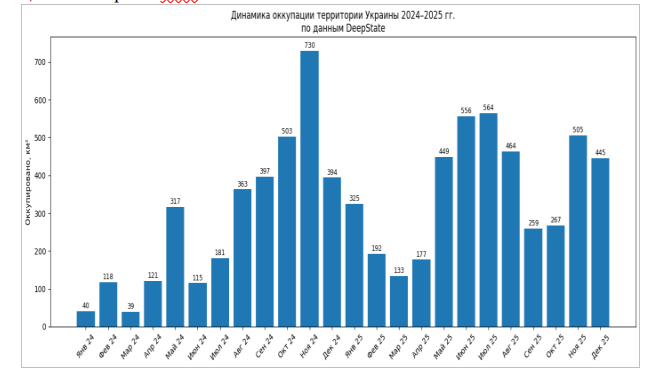
The concentration of significant Ukrainian Armed Forces forces in the Kursk region in early 2025, a continuation of the operation launched in August 2024, had a significant impact on the dynamics of the front. This weakened Ukrainian positions in other areas and created conditions for intensified Russian offensive actions in the Donetsk, Kharkiv, Sumy, Dnipropetrovsk, and Zaporizhzhia regions. Russian troops approached Kostiantynivka, increasing pressure on the Ukrainian defense. The most difficult situation for the Ukrainian Armed Forces developed in the area of the Pokrovsk-Myrnohrad agglomeration, which became the key focal point of the fighting in the Donetsk direction. However, Ukraine failed to hold the Kursk bridgehead: by July 2025, it was almost completely abandoned.
Map of military operations in Ukraine.
(December 31, 2024, according to DeepState)
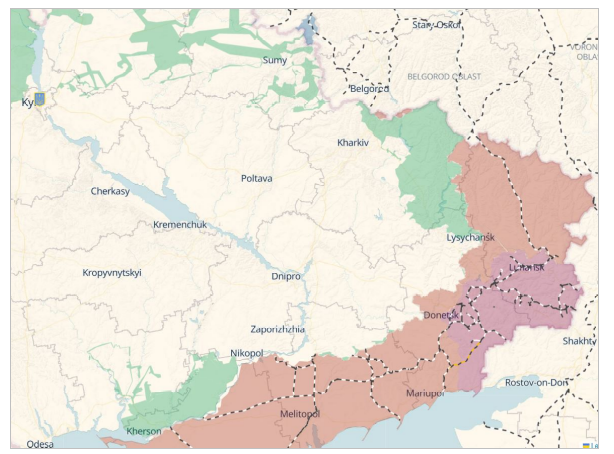
Map of military operations in Ukraine.
(December 31, 2025, according to DeepState)
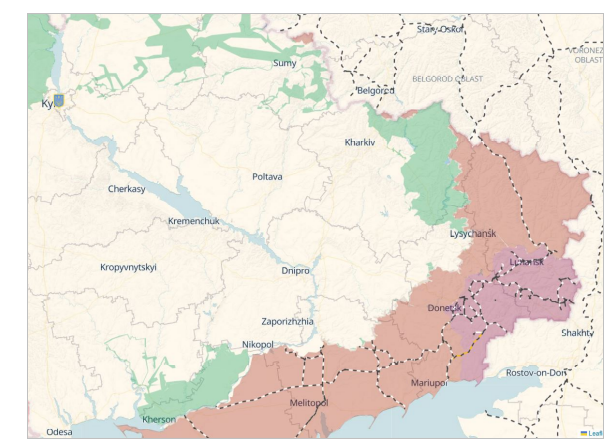
The most intense fighting in 2025 took place in:
– Pokrovsk-Mirnograd, Konstantinovka and Liman directions (Donetsk region),
– in the area of Kupyansk and Volchansk (Kharkiv region),
- in the south-east of the Dnipropetrovsk region,
– as well as in the Zaporizhzhia direction.
During 2025, Russian troops were able to finally establish control over 4 cities in the Donetsk region:
- Kurakhove (battles from September 13, 2024 to January 6, 2025);
- Velyka Novosilka (battles from November 4, 2024 to January 26, 2025);
- Toretsk (from June 19, 2024 to August 1, 2025), the defense of which lasted more than a year;
– Siversk (battles from July 3, 2025 to December 21, 2025)
At the same time, a number of key cities have not been fully captured by the end of 2025. Chasiv Yar (Donetsk Oblast) has been held by the Ukrainian Armed Forces since April 2024; in September–October 2025, the front line near the city remained virtually unchanged, with fighting concentrated on the outer neighborhoods. Pokrovsk and Myrnohrad are also not fully under Russian control as of the end of 2025. As of early December 2025, Pokrovsk is in a zone of extremely intense fighting: Russian forces control over 95% of the city's territory, while the Ukrainian Armed Forces hold certain areas, conduct rearguard actions, and conduct an organized withdrawal, while simultaneously attempting to evacuate civilians. Myrnohrad is encircled, and a significant portion of it is also under Russian control. In the short term, there is a high probability of the Ukrainian Armed Forces losing both Myrnohrad and Pokrovsk, which is associated with the loss of control over key heights and supply routes to the agglomeration.
Overall, 2025 has shown that Russia has increased the pace of its territorial advance, but the war remains a grueling conflict without decisive strategic turning points.
Ukraine faces pressing challenges that continue to shape its military posture. These include human resources— a shortage of mobilizable and trained fighters; high desertion rates and poor training, according to some sources. Ammunition and logistics —depleted stockpiles, vulnerable supply routes, and a stretched rear area. Financing —heavy dependence on external aid; risk of insufficient funds for a long-term mobilization economy. Air defense and missile defense —limited air defense reserves against massive drone and missile strikes. Command and control —difficulties in coordination across a stretched frontline, vulnerable command-and-control communications.
Casualties on both sides. Ukraine's losses in killed and wounded soldiers amounted to approximately 400,000. Around 1 million Russian troops were killed or wounded. Between 60,000 and 100,000 Ukrainian troops were killed. The number of Russian soldiers killed is estimated at 250,000.
In Ukraine, from January 2022 to October 2025, a total of 311,327 criminal cases were opened (255,000 cases of Absence without Leave (AWOL) + 56,200 cases of desertion). From January to October 2025, there were 161,461 criminal proceedings.
Chronology of military operations.
January 2025
In January 2025, Ukraine lost two towns in the Donetsk Oblast: Kurakhove (January 6) and Velyka Novosilka (January 26). The loss of Velyka Novosilka had significant operational significance: the town was a key logistics hub for the southern sector of the Donetsk Front and covered the route to Hulyaipole and Orikhove, the last major strongholds on the route to Zaporizhzhia. After its fall, the Ukrainian Armed Forces' supply and maneuvers in this direction were significantly complicated. According to military estimates, there were virtually no significant fortifications in the steppe zone from the western border of the Donetsk Oblast to the Dnieper River. But despite Russia's offensive actions in several directions, no deep operational breakthroughs were recorded in January.
February 2025
In February 2025, the pace of Russian troop advance slowed down, but Russia still captured 192 square kilometers of territory, less than the 325 square kilometers in January but above the 2024 average (118 square kilometers). The slowdown was due to Ukraine activating reserves for counterattacks in the Kursk region, as well as in the Toretsk and Pokrovsk sectors. In most sectors of the front, Russian troops operated primarily defensively, with the exception of the Velyka Novosyolka area. The Ukrainian Armed Forces achieved tactical success in some areas: in Toretsk, control was restored over approximately half of the city, and in the Pokrovsk area, Ukrainian forces continued to contain Russian pressure.
The most complex situation developed in the Kursk bridgehead, where the Russian Federation had concentrated its most combat-ready units. Despite Ukrainian counterattacks in the Sudzha area, Russian troops advanced in the Pogrebki and Sverdlikovo areas; Orlovka returned to Russian control, and Novaya Sorochina moved into the "gray zone." As a result, Ukrainian-controlled territory in the Kursk region was reduced from 428 to 396 km². An additional escalation factor was the expansion of hostilities into Ukrainian territory. On February 19, 2025, following the partial withdrawal of the Ukrainian Armed Forces from the border areas of the Kursk region, Russian troops began an offensive in the Sumy region. At the peak of their advance, they will be able to approach to within approximately 20 km of the city of Sumy, creating a direct threat to the regional center and the civilian population.
March 2025
March 2025 was one of the most severe periods for Ukraine to date in terms of the rate of territorial losses. Russia's total advance amounted to approximately 460 square kilometers, of which 133 square kilometers were within Ukrainian territory, and over 327 square kilometers were in areas of the Kursk Oblast recaptured by Russia.
The sharp deterioration of the situation coincided with the suspension of intelligence sharing between the US and Ukraine in early March, which significantly weakened the Ukrainian Armed Forces' ability to hold positions on Russian territory.
Against this backdrop, Russian forces launched a large-scale offensive in the Kursk region, advancing westward from Kurilovka and establishing fire control over the Sudzha-Yunakovka highway, a key logistical artery for the Ukrainian Armed Forces. As a result, Ukraine began rapidly losing previously captured territory: while at the beginning of 2025, the Ukrainian Armed Forces controlled approximately 400 square kilometers, by March 30, 2025, it had only lost approximately 80 square kilometers, or 6% of the previously captured territory. For comparison, at the peak of the operation in August 2024, the Ukrainian Armed Forces controlled 823 square kilometers, with another 416 square kilometers in the “gray zone”. By the end of March, the Ukrainian presence in the Kursk region had been reduced to two small border bridgeheads totaling approximately 80 square kilometers, with further declines expected.
On other sectors of the front, the Russian Federation continued its offensive north of Velyka Novosilka. The Pokrovsk direction was largely stabilized, with no significant advances by the Russian Armed Forces recorded there. In Toretsk, the front line remained dynamic; Russian forces captured the Tsentralna mine, the last major Ukrainian fortified area in the city. On the Zaporizhzhia direction, the Russian offensive intensified southwest of Orikhove.
In March, the Ukrainian Armed Forces carried out limited counterattacks in the Kharkiv region, in an area where Russian troops attempted to cross the Oskil River and gained a foothold near Novomlynsk.
A separate episode was An attempt by the Ukrainian Armed Forces to launch an offensive in the Belgorod region in the areas of Prilesye, Grafovka, and Demidovka, which, according to estimates, was not only tactical but also political and informational in nature—including against the backdrop of preparations for telephone conversations between US President Donald Trump and Russian President Vladimir Putin.
April 2025
In April 2025, the intensity of hostilities and the pace of Russian troops advances increased compared to March. During the month, Russia captured 177 square kilometers of Ukrainian territory (compared to 133 square kilometers in March). Ukraine also lost approximately 50 square kilometers in the Kursk region, bringing Russia's total advance in April to approximately 225 square kilometers. This was almost double the April 2024 figures, although it remained below the January 2025 (325 square kilometers) and November 2024 peak (730 square kilometers).
In the second half of April, Ukraine was driven out of almost the entire Kursk bridgehead. After it split into two isolated areas, the northern part, including Sudzha, was cut off from the main forces of the Ukrainian Armed Forces. The remaining Ukrainian units in the Oleshnya and Gornal areas operated under isolation and constant pressure. By the end of the month, approximately 17–30 square kilometers remained under Ukrainian control in the Kursk region, with a trend toward further reduction. Russia's Kursk operation effectively transformed into a pursuit of retreating Ukrainian forces and the transfer of hostilities into Ukrainian territory .
In northern Ukraine, along the border of Sumy Oblast, Russian troops expanded their offensive zone, advancing toward Loknya and the Yunakovka region, a key junction on the highway to Sudzha. The occupation of Zhuravka and several border settlements was announced. In fact, Russia established a presence in approximately 50 square kilometers of Sumy Oblast, primarily in the area of border villages. Meanwhile, the city of Sumy remained more than 30 kilometers away, and there were no signs of preparations for a rapid offensive on Sumy or Kharkiv in April.
On the Donetsk front, Russian forces made significant advances near the Kurakhove-Zaporizhzhia highway, and on the Pokrovsk front, near Nadezhdinka near the Dnipropetrovsk Oblast border. On the Toretsk front, Russian forces advanced near Sukha Balka, south of Toretsk. Near Chasiv Yar, assaults continued on the city's northern neighborhoods, where a Ukrainian presence remained.
In the Lyman-Oskil sector (Kharkiv and Luhansk regions), the Russian Federation advanced in the Yekaterynivka area and developed an offensive towards Borova.
Overall, April 2025 marked the transition of the Kursk campaign to a border escalation phase. The most likely logic behind Russia's actions was the formation of a so-called "sanitary zone" 20-30 km deep along the border—from the Kharkiv to Chernihiv regions—in order to push back the front line and reduce the Ukrainian Armed Forces' ability to strike Russian territory. While the discussion was not about a large-scale strategic offensive, it was about continuing the momentum of the Kursk operation. However, the Sumy and Kharkiv directions were becoming key risk zones for 2025.
Russia and North Korea officially confirmed the participation of North Korean troops in combat operations on the Russian side in the Kursk region.
On April 26, 2025, the Russian Foreign Ministry officially acknowledged the participation of North Korean troops in fighting in the Kursk region. Ministry spokesperson Maria Zakharova stated that North Korean troops fought against Ukrainian forces within the framework of the strategic partnership agreement between Russia and North Korea. The Kremlin confirmed that Russia may also provide military assistance to North Korea in accordance with the bilateral military agreement, as stated by Russian presidential press secretary Dmitry Peskov. On April 28, North Korea also officially acknowledged for the first time the participation of its troops in fighting in the Kursk region. The United States criticized North Korea's involvement in the war against Ukraine in the Kursk region. A US State Department spokesperson stated that North Korea and other third countries "facilitated the continuation" of the war and "bear responsibility for it." The United States claims that Russia's training of North Korean soldiers violates numerous UN Security Council resolutions, which collectively impose broad prohibitions on the provision or receipt of military training or assistance to or from North Korea.
Overall, official recognition of this fact serves several purposes: demonstrating the Russian-North Korean alliance, publicly expressing gratitude to the DPRK, and creating conditions for expanding the North Korean contingent's participation. A possible increase in the number of North Korean troops is seen as a way to relieve Russian forces, including by securing the border. Furthermore, this step may be linked to an intention to deepen military cooperation, including the possible presence of Russian military instructors on North Korean territory. This also strengthens strategic cooperation between Russia and China, given the existing defense alliance between the DPRK and China.
North Korea's involvement on Russia's side and Moscow's willingness to expand military cooperation with Pyongyang provide Ukraine with grounds to further promote the idea of a Moscow-Pyongyang-Beijing "axis," even if China is not formally involved in the fighting. Ukraine regularly accuses China of military cooperation with Russia, including the supply of dual-use goods, drone components, and the participation of Chinese citizens in the Russian army. Ukraine's information campaigns are aimed at renewing support and loyalty to the United States. Therefore, Kyiv will likely strive to emphasize that Russia's support for North Korea is impossible without, at a minimum, indirect approval and strategic coordination with China, given the allied relationship between Beijing and Pyongyang.
May 2025
May 2025 became one of the most tense periods of the war, demonstrating a sharp acceleration of territorial losses for Ukraine, the expansion of hostilities in the Sumy region, further pressure on the Konstantynivka-Pokrovsk agglomeration and the almost final “collapse” of the Kursk bridgehead. There is a transition from local offensive actions to large-scale pressure in several directions at once, primarily in the Donetsk and Sumy regions.
In one month, Russia seized approximately 449 square kilometers of Ukrainian territory, which was one of the highest figures for the entire year of 2025 and approached the peak values of autumn 2024.
The most difficult situation for the Ukrainian Armed Forces developed in the Konstantynivka and Pokrovsk-Mirnograd directions. Russian troops made significant advances south of Konstantynivka, in the areas of Alexandropol, Romanovka, Nova Poltavka, and Vodyane Druhe, as well as in the strip between Toretsk and Pokrovsk (the Sukha Balka and Kalynove areas). Fighting was conducted along sections of the Pokrovsk-Konstantynivka highway, threatening to envelop the Ukrainian group and create operational pockets. Further west, in the Bogatyr area on the Donetsk-Zaporizhzhia highway, Russia increased pressure with the goal of reaching the Vovchya River and advancing further toward the Dnipropetrovsk region.
The situation also worsened in the Liman sector, where Russian forces sought to establish control over commanding heights near the village of Nove, threatening to breach the Oskil River defenses and complicating the holding of Borova and Kupyansk. In the northern Kharkiv region, Russian units advanced near Kamenka on the right bank of the Oskil.
In the northern direction, Russian forces developed an offensive in the Sumy region, where by the end of the month they had captured approximately 67.5 square kilometers of Ukrainian territory, with another 61.6 square kilometers in the "gray zone." Russia attempted to reach the Yunakovka-Sumy highway, creating conditions for an advance from Belovody to Yablunovka and from Loknya to Yunakovka. Simultaneously, in the Kursk region, the Ukrainian presence was reduced to approximately 12 square kilometers, with another 5 square kilometers remaining in the Tyotkino area, effectively marking the end of the active phase of the Ukrainian operation in this direction.
June 2025
June 2025 saw Russia's sustained offensive superiority and the expansion of the combat zone in the Donetsk, Kharkiv, and Sumy directions, with Ukraine's territorial losses amounting to 556 km² per month.
The main pressure remained on the Donetsk front: fighting took place in the area of the Pokrovsk-Mirnograd agglomeration, Chasiv Yar, Toretsk and south of Konstantinovka.
In the Kharkov region, Russian forces launched an offensive in the area of Kupyansk, the Dvurichne bridgehead and along the Oskol River (Sinkovka, Novomikhaylovka, Grekovka), creating a threat to Kupyansk and Borova.
In the northern direction, the situation in Sumy Oblast remained most dynamic. Russia controlled approximately 208 square kilometers of Ukrainian territory and was advancing in the directions of Yunakovka, Oleksiivka, Myropillia, and Prokhody. The distance to the city of Sumy had shrunk to approximately 20 kilometers.
In the Zaporizhzhia region, the front line remained generally stable, with positional battles continuing in the areas of Lobkove, Kamenske, Rabotino and Verbove, while the Russian Federation's defensive lines were simultaneously strengthened.
In June, the Ukrainian Armed Forces launched counterattacks in the Kursk region (Tetkino, Popovo-Lezhachi, Novy Put, Vesyoloye, Gornal, Guevo; from Ryzhevka and Bezsalovka), but they did not bring any significant territorial results.
July 2025
July 2025 marked the peak month of the Russian offensive in 2025, recording the highest rate of territorial losses for Ukraine. Russian troops advanced 564 square kilometers, the highest figure for the entire year of 2025 and the second largest advance in the 2024–2025 period, after November 2024 (730 square kilometers). The pace of advance exceeded the June figures by 12 square kilometers, confirming Russia's sustained offensive superiority. Russia achieved its most significant results in the Donetsk region, particularly in the Novopavlovske sector, where it captured 34% of the total territory captured in a month, with a relatively low proportion of assault attacks (12%). In the Pokrovsk and Sumy sectors, the advance was less effective in terms of the ratio of attacks to captured territory, but the pressure remained high.
The main fighting in the Donetsk region centered around the Pokrovsk-Myrnohrad agglomeration, which Russian forces attempted to outflank from the northeast. The advance was from Mayak toward Myrnohrad, while in Pokrovsk, Russian sabotage and reconnaissance groups were observed infiltrating from the south. Near Konstantinovka, Russian forces took up new positions near Popov Yar and also advanced near Toretsk, in the areas of Leonidovka and Dyleevka.
At the same time, the Russian Federation increased pressure on the borders of the Dnipropetrovsk region, advancing in the areas of Orekhovo and Voskresenka, and also capturing Grushevskoye, which indicated an attempt to expand the front beyond the Donetsk region.
In the northern direction, advancement has been recorded in the Sumy region: the village of Yablunovka has been captured.
In the Kharkiv region, intensified fighting was observed in the area of Vovchansk, which could indicate an attempt by the Russian Federation to open an auxiliary direction to divert Ukrainian reserves.
The key factors accelerating Russia's advance in July were the Ukrainian Armed Forces' shortage of personnel, primarily trained infantry, as well as the increased effectiveness of Russian attack drones, which significantly complicated Ukrainian defense and reserve maneuvers.
August 2025.
In August 2025, Russian offensive activity remained high. Over the course of the month, Russia captured approximately 464 square kilometers of Ukrainian territory, confirming the continued steady pace of advance following the July peak.
Key events centered in the Donetsk region. By August 1, 2025, the city of Toretsk was completely captured by Russian forces. Following the Russian breakthrough in the Dobropillia sector, the Ukrainian Armed Forces redeployed reserves, including units of the Azov Brigade, which allowed them to stabilize the front and conduct limited counterattacks. The situation near Pokrovsk remained tense, but there were no significant changes to the front line. Further Russian advances were recorded in the western part of the Donetsk region.
In the Luhansk region, Russian forces have consolidated their positions in the Serebryansk forestry area, effectively eliminating the last remaining Ukrainian-controlled area in the region. In the south, Russia has advanced into the eastern part of the Zaporizhia region and is fighting near the border with the Dnipropetrovsk region.
In the second half of the month, Russia began transferring units from the Sumy direction to the Donetsk region, which reduced the offensive potential in the north, but increased pressure on the central section of the front.
At the same time, signs of preparations for a possible new offensive in the Zaporizhzhia direction were recorded – an increase in logistical activity, airstrikes, and a concentration of forces.
The progress of negotiations with the US has increasingly directly influenced Moscow's military strategy. Russia operates on the premise that while control over the Donetsk region can theoretically be secured politically and diplomatically, control over the Zaporizhzhia region can only be recognized if it is secured through actual military advancement.
September 2025
In September 2025, the pace of Russian troops advancement slowed down significantly. According to monitoring data, Russia captured 259 square kilometers of Ukrainian territory during the month, almost half the 464 square kilometers it captured in August and marking the lowest level since May 2025.
The main clashes were concentrated in the Donetsk and Kharkiv regions. In the Pokrovsk sector, Russian troops advanced toward the southwestern outskirts of the city, near Zverevo, and attempted to reach the industrial zone north of Udachne, threatening the facilities of the Pokrovsk mine administration. At the same time, the situation in the Konstantinovka sector worsened: Russian troops consolidated their positions in the Aleksandro-Shultino area, captured Poltavka, and Konstantinovka found itself effectively surrounded on three sides, with the distance to the front line reduced to 6–9 km. Heavy fighting continued in the Dobropillya sector, but Ukrainian counterattacks failed to achieve significant success.
In the Liman-Yampol sector (northern Donetsk Oblast), the situation also worsened: Russian units penetrated Yampil, engaged in street fighting, and entrenched themselves in residential areas. Russia claimed to have captured Shandrigolovo, Derilovo, and Zarichne, threatening to break through the defenses in front of Liman and reach the Liman-Seversk line. In the Luhansk Oblast, Russian troops almost completely took control of the Serebryansk forestry, eliminating one of the last stable Ukrainian strongholds in the region.
Kharkiv direction. In Kupyansk, the situation for the Ukrainian Armed Forces was critical. Russian troops consolidated their positions in the northern and then central districts of Kupyansk, took up new positions near Kondrashivka, and began expanding the "gray zone." The entrance to the city was forbidden for civilians and volunteers, and the evacuation of the population effectively halted. The potential loss of Kupyansk threatened to push the front line back to the Oskil River, significantly complicating the defense of the entire northeastern direction.
In the Dnipropetrovsk region, two pressure zones have formed: the main one along the Novoselivka-Sosnivka-Berezove-Novomykolayivka line (over 16 km long, with a penetration depth of up to 10 km), and a secondary one further north, near Novopavlivka. The village of Stepove has been captured.
In the Zaporizhzhia region, Russian forces have developed an offensive along the southern vector – Novoivanivka-Olgovske, entrenched themselves in the western part of Verbove, and also advanced in the areas of Berezove and Kalynovske, threatening to break into the rear of the Ukrainian group and advance toward Zaporizhzhia and the Dnipro along the Donetsk-Zaporizhzhia highway.
Against the backdrop of general pressure, the Sumy direction became an exception: here the Ukrainian Armed Forces managed to push back Russian units in the areas of Konstantynivka and Novokonstantynivka, and in some areas, to once again reach the state border.
October 2025
In October 2025, the pace of Russian troops advancement remained moderate, but Russia continued to hold the initiative in key sectors of the front. According to monitoring data, Russia captured approximately 267 square kilometers of Ukrainian territory during the month. Despite a slight slowdown compared to the summer peaks, the front maintained high momentum without any deep operational breakthroughs.
The most intense fighting took place in the Donetsk region —in the Pokrovsk-Myrnograd, Konstantynivka, and Lyman directions. Russian troops continued their advance toward the southern outskirts of Konstantynivka, expanding their control in the Bila Gora and Plishchiivka areas, and also advanced in the Novopavlivka area.
In the Pokrovsk direction, Russia attempted to consolidate its position in the western part of Pokrovsk, advancing deeper into the private sector and toward the railway line west of the city, likely with the goal of reaching the E50 highway, one of the key logistics routes in Donbas. Simultaneously, Russian units began an assault on Myrnohrad from the east.
In the Lyman sector, advancement was recorded in the Shandrigolovo area, which increased pressure on the Ukrainian defense north of Liman.
Fierce fighting for Kupyansk continued in the Kharkiv region. Russian troops exerted comprehensive pressure on the city, while the Ukrainian Armed Forces launched local counterattacks, including near Radkovka. The deteriorating situation forced local authorities to call for the evacuation of residents from adjacent villages.
The combat zone in the Dnipropetrovsk region also expanded: Russian troops occupied Ternove and announced the capture of Oleksiivka, which confirmed Russia's further advance beyond the traditional front lines of Donbas.
November 2025
In November 2025, the pace of the Russian offensive sharply increased: in one month, Russia captured approximately 505 km², almost double the October figure (267 km²) and one of the highest figures for 2025. After a slowdown in the autumn, the Russian army again shifted to accelerated territorial advancement.
Ukraine suffered its heaviest losses in the Novopavlivka-Huliaipole area, at the junction of the Dnipropetrovsk and Zaporizhia regions. This sector accounted for approximately 69% of all captured territory during the month, despite the fact that assault operations accounted for only 16% of the total, indicating the weakness of Ukrainian defenses in this area.
The main fighting took place in the Donetsk region —in the Pokrovsk-Myrnohrad, Konstantinovsk, and Limansk directions — as well as in the Kupyansk region (Kharkiv region) and in the southeast of the Dnipropetrovsk region. In the Pokrovsk-Myrnohrad agglomeration, the "gray zone" expanded: Russian forces advanced east of Myrnohrad and north of Pokrovsk, approaching the highway through Hryshino, one of the key supply lines for the Ukrainian Armed Forces. The highway to Pavlohrad had previously been cut, seriously complicating the logistics of Ukrainian forces.
In the Liman direction, the threat of a breakthrough to the city remained: constant pressure and attempts to reach the Liman-Seversk road were recorded. East of Yampil, Russian units were digging into the forested areas, taking advantage of the deteriorating weather conditions to advance. The key episode was the Russian advance in Novopavlivka (Dnipropetrovsk Oblast). The entry of Russian troops into the town posed the threat of an offensive on Mezheva and created the risk of an attack on the rear of the Ukrainian group holding the Pokrovsk-Dobropillya line. South of Novopavlivka, Russia continued its advance toward Hulyaipole (Rivnepillya and Sladke areas).
Russia also announced the capture of Nechayivka, on the border between the Dnipropetrovsk and Zaporizhzhia regions. The Ukrainian side has not officially confirmed this loss, but the very fact of the fighting indicates a further expansion of the zone of instability along the interregional border.
At the end of November 2025, Ukrainian troops continued to control only a small area (up to 12 km²) of Russian territory in the area of the village of Tetkino.
December 2025
In December 2025, Russian troops occupied approximately 445 square kilometers of Ukrainian territory. Despite a slight slowdown compared to November, Russia maintained the offensive initiative and continued to methodically expand its zone of control.
The main fighting concentrated in several key areas. In the Donetsk region, Russian forces increased pressure in the areas of Siversk, Pokrovsk, and Myrnohrad, seeking to disrupt Ukrainian logistics and create conditions for further encirclement of the Pokrovsk agglomeration. On December 21, Ukrainian forces were forced to abandon the town of Siversk. In the Zaporizhzhia sector, active fighting continued near Hulyaipolye, where Russia attempted to advance and force the Ukrainian Armed Forces to redistribute reserves. In the Kharkiv region, near Kupyansk, Russian troops maintained their offensive activity and attempted to consolidate previously captured positions.
The main factors behind Russia's continued slow progress are:
This is primarily due to the increase in the size of the Russian army in accordance with the development program for the Russian Armed Forces for the coming years, with the recruitment of contract soldiers amid the ongoing conscription of young soldiers. At the same time, the effective size of the Ukrainian armed forces is declining due to the large number of deserters, and therefore significant losses.
- reducing the technological gap between the armed forces of Russia and Ukraine (formed after massive deliveries of Western weapons to Ukraine), especially in terms of the use of drones for reconnaissance and modern communications equipment;
- maintaining a significant resource advantage and Russia's dominance in conventional weapons (long-range artillery and missile systems, aviation, armored vehicles, etc.).
In terms of combat tactics, while the First and Second World Wars were dominated by a continuous trench line, the war in Ukraine (2022–2023) presents a different picture. The development of weapons (primarily drones and electronic warfare/crew defense systems) is changing the very meaning of fortifications: a continuous front line is a thing of the past.
The widespread use of attack and reconnaissance drones, electronic warfare systems, and guided aerial bombs (GABs) hthe forward edge of the battle area (FEBA) forward edge. Today, the forward line is a network of concealed, carefully camouflaged positions. Large concentrations of personnel in open terrain become instantly vulnerable.
The tactical structure of the front now looks different: now the front is not a single continuous trench line, or even a chain of strongpoints with gaps between them, but a scattered necklace of small, hidden observation posts with a few soldiers inside them. At a distance of 3-5 km from the observation posts is the first line of drones (the crews of the attack drones and their guards). Also located there are compact infantry reserves divided into small assault groups. And at a distance of 10-12 km is the second line, that is, the bases of UAV units, artillery positions (at a position there is usually one gun and one reserve), headquarters and rear infrastructure. Attack and reconnaissance drones are almost constantly in the air, conducting continuous surveillance of the battlefield and reacting to the slightest enemy movement.
Observation posts (OPs), manned by several fighters, perform reconnaissance, target designation, and localized clearing operations, but they are relatively rare along the line of contact: their role is to provide operational information and precise fire control, not to serve as a means of holding broad positions for long periods. These OPs direct attack and reconnaissance UAVs, direct artillery fire, and initiate localized clearing operations—for example, to eliminate multiple enemy infiltrations to the rear. The mass concentration of personnel in exposed positions immediately makes the unit vulnerable: it will be detected and destroyed primarily by drones, artillery, or air defense. This model of small, tightly controlled observation posts, followed by the deployment of networked firepower, is replicated by both Ukraine and Russia and has become a characteristic feature of modern tactics in the Ukrainian theater of operations.
The current offensive on the Ukrainian front also differs radically from the classic operations of past wars. While a breakthrough previously required the concentration of large armored columns supported by aircraft, artillery, and infantry, today such tactics have become virtually impossible due to the prevalence of drones and precision-guided systems. Any mass movement of equipment or personnel is immediately detected by reconnaissance assets and destroyed by precision weapons.
Russia spends approximately $150 billion annually to finance its military objectives. Therefore, Ukraine must maintain this balance in the economics of war. According to [former] Defense Minister Dmytro Shmyhal, at least $120 billion must be spent on defense by 2026. Next year, this is the minimum requirement to maintain parity of forces on the front. The country plans to attract half of this amount from Western partners and use it for weapons production. This year, approximately $58 billion has been allocated in the Ukrainian defense budget.
The drone production race is of paramount importance, as their use on the front lines is now effectively decisive for the parties to the conflict. Ukraine and Russia are actively increasing drone production, but with different focuses: Russia is increasing production of Shahed kamikaze drones and other UAVs, including using Chinese technology, while Ukraine is developing its own technologies, increasing the production of attack and long-range drones, and developing interceptor drones in cooperation with Western partners. Ukraine claims to be capable of producing up to 10 million drones per year, significantly exceeding Russian production volumes. Drone production in Ukraine has increased by 900% in a year (from 20,000 to over 200,000 per month by July 2025).
Public estimates of drone production in Russia also indicate a large-scale expansion (thousands or tens of thousands per month for some types—estimates vary; there are reports of thousands of Shahed drones per month, according to Ukrainian intelligence). However, Russia has significantly increased drone production, including FPV drones, which it produces at a rate of 4,000 units per day. Russia relies on Chinese companies for technology and components, allowing it to rapidly scale up production.
2. Infrastructure war between Ukraine and Russia.
The energy front is increasingly becoming one of the key lines of confrontation, where attacks on generation and networks are becoming an instrument of strategic pressure on Ukraine. In 2025, Russian air attacks on Ukraine peaked. Russia is targeting railway infrastructure, gas production and transportation facilities, and power generation facilities.
As of October 2025, the total number of missiles used by Russia since the beginning of the full-scale invasion exceeded 10,000 units (including cruise, ballistic, and air-launched missiles, including launches and interceptions). By the end of 2025, this figure could approach 12,000. This estimate is based on aggregated open-source data and official statements from the Ukrainian side.
A distinctive feature of 2025 was a sharp intensification of ballistic strikes. According to the Ukrainian president, Russia used approximately 770 ballistic missiles and more than 50 Kinzhal hypersonic missiles during the year, making 2025 one of the most intense years for the use of hard-to-intercept weapons. This indicates a shift in emphasis from the mass of threats to the quality and complexity of them.
The following picture can be observed in the dynamics over the years:
2022 – about 3000 launches, peak intensity in the initial phase of the invasion.
2023 – approximately 5,000 launches, with a focus on winter massive strikes against the energy sector.
2024 – 2000–2500 launches, targeted pressure on critical infrastructure.
2025 (until October) – about 1,500 launches, but with a maximum share of ballistic missiles.
Despite the reduction in the overall number of missile strikes in 2025, their destructive potential has increased due to ballistics and hypersonic weapons, which significantly complicate the work of air defenses.
60-70% of targets were intercepted in 2022, this figure reached 80-90% in 2025. However, the high effectiveness of the air defense does not reduce the attritional nature of the campaign, as even a limited number of successful hits on energy sources has a disproportionately high impact.
Drone attacks deserve paying special attention. By 2025, Russia will deploy up to 5,000–5,500 kamikaze drones per month, using them to overload air defenses and accompany missile strikes. Drones are becoming a tool of tactical attrition, increasing the cost of defense and reducing its long-term resilience.
Overall, since early 2025, 237 large-scale attacks on power‑sector facilities have occurred. In August-September alone, there were 140 attacks. The intensity of attacks increased in anticipation of the heating season. The main targets are: energy Distribution System Operators (DSO) (26%), energy Transmission System Operator (TSO) Ukrenergo (33%), Ukraine’s state-owned national railway operator, overseeing rail transportation services and administering the country’s railway infrastructure Ukrzaliznytsia (Ukrainian Railways) (20%), and electricity and heat generation facilities (20%). The most actively attacked targets are Ukrenergo's 330-750 kV substations in the Sumy and Chernihiv regions, which account for almost half of all attacks. On September 8, the Trypilska TPP of one of Ukraine’s major state-owned power generation companies, responsible for operating thermal power plants and supplying electricity to the national grid Centrenergo sustained significant damage (the facility was hit by 19 drones). On October 3, The Kramatorsk Thermal Power Plant (TPP) was attacked, sustaining significant damage. In October 2025, following another shelling of Ukraine, two Kyiv thermal power plants were completely shut down. One of the damaged plants had a capacity of ~800 MW, and the other ~540 MW, depriving the system of a total of ~1,300 MW of generation.
Total direct physical damage to the energy sector is currently estimated at $20.51 billion. These losses do not include those associated with the occupation of the Zaporizhzhia Nuclear Power Plant and the destruction of the Kakhovka Dam. Russia carried out multiple massive attacks on Ukraine's energy infrastructure and occupied generation facilities with a total capacity of 18 GW. As a result of the attacks in 2024, 10 GW of power generation was lost or damaged, of which approximately 5 GW (50%) was restored primarily through the Energy Support Fund and assistance from other partners.
The Ukrainian Ministry of Energy confirmed that, as of November 18, outages have increased significantly. Ukraine is experiencing outages that on some days last 15-17 hours per day. Twelve regions of Ukraine currently experience serious power shortages. Most of Ukraine's thermal power plants (TPPs) sustained significant damage as a result of attacks by Russian forces, although it is impossible to completely disable them due to the large scale of the facilities. Energy industry analysts estimate that damage at some plants ranges from 30% to 70%, while units that were in operation continue to function. As a result, electricity generation at these TPPs has significantly decreased, and since the beginning of last week, their output has remained at a minimum. Otherwise, only nine operational nuclear power plant units remain as the basis for the energy sector to navigate the winter season.
Since the beginning of 2025, there has been a clear Russian focus on trying to destroy Ukraine’s natural gas infrastructure. The year began with large-scale attacks on natural gas production facilities. Massive shelling of the Kharkiv and Poltava regions disabled approximately 60% of Ukraine's natural gas production. Attacks on western Ukraine (Lviv and Ternopil regions) have increased.
Ukraine's logistics —railways, key highways, supply hubs—have also become another target for Russia.
These strikes exacerbate existing problems with the supply of energy, water, and fuel, and create a chain reaction: disrupted supply – increased outages – reduced economic activity.
Russia appears to be implementing a combined strategy of three blackouts—natural gas, logistics, and electricity —aiming not just to damage infrastructure, but to trigger a systemic crisis and undermine Ukraine's internal stability.
The first element is a natural gas blackout. Ukraine has already lost approximately 60% of its own natural gas production. This will force the government to spend an additional €2 billion to import approximately 4.5 billion cubic meters of gas by the end of March, which represents approximately 20% of winter consumption. Currently, Ukraine is effectively dependent on two reverse supply routes: the Slovak-Hungarian route, which accounts for 60-80% of all imported gas, and the Polish route. Most of the gas comes from Europe, but this is Russian gas, delivered via TurkStream and South Stream, and then returned to Ukraine with a "European premium." At each of these stages, Russia has indirect interests. Therefore, if Moscow so chooses, it can easily reduce reverse flow volumes—not necessarily through strikes, but simply by declaring "maintenance" or reducing pipeline pressure. This could become especially critical in January-March, when gas reserves in storage facilities are depleted.
The second element is a logistical blackout. Rail service in the Chernihiv and Sumy regions is already effectively paralyzed due to massive Russian attacks on rolling stock, primarily locomotives. The loss of locomotives is particularly painful, as they are extremely expensive and difficult to replace. Ukraine already suffered a locomotive shortage before the war, and now it has become critical. Russian strikes against diesel and electric locomotives are undermining Ukrzaliznytsia's ability to maintain transport corridors, potentially leading to the collapse of rail service in frontline and border areas. This also further isolates regions adjacent to the Russian border, where natural gas and electricity supplies are already disrupted. Moscow's goal, it seems, is to create a buffer "gray zone," not directly controlled but decimated socioeconomically, with displaced populations and destroyed infrastructure.
The third element is the power blackout. Although the electricity situation in October appeared relatively stable, the Ukrainian power grid relies primarily on nuclear generation, with the virtual loss of flexible capacity—thermal and natural gas-fired power plants. Many of these plants are seriously damaged. Ukraine also relies on imported electricity from Slovakia and Hungary, which provide more than 50–60% of the grid's external power supply. Although Ukraine has even exported electricity at certain points, the current balance is extremely vulnerable to any further disruptions to the grid or nuclear power plants.
Ukraine is entering the 2025-2026 winter with a tense, but still manageable, energy balance. Overall, the likelihood of a nationwide blackout is assessed as low, but not excluded. Nuclear power plants remain the backbone of the system, but if grid connections and imports are lost, the balance could become unstable. The key factors preventing a collapse will be the speed of infrastructure restoration, the stability of import channels, and the readiness to transition to a "strict energy conservation" regime.
For the Ukrainian Armed Forces, a stable power supply is no less critical than for the country's population and industry. Communication systems, command coordination, air defense operations, transport logistics, and the charging of drones and equipment directly depend on it. Power outages force military command to redistribute resources, prioritizing power to defense facilities at the expense of civilian needs. This reduces operational flexibility, increases infrastructure vulnerability, and complicates preparations for winter operations.
Ukrainian strikes on Russian territory.
At the same time, Ukraine is striking at Russian oil and gas infrastructure, which is causing significant damage to the Russian economy – approximately $100 billion. In particular, Ukrainian drones regularly carry out attacks on Russian territory. Since August 2025, Ukraine has struck at least 17% of the country's capabilities. (equivalent to approximately 1.1–1.2 million barrels of oil per day) of the Russian energy complex – approximately 18 oil refineries (Lukoil in Volgograd, Rosneft in Ryazan, as well as plants in the Rostov, Samara, Saratov, and Krasnodar regions, etc.), oil pumping stations and gas pipelines, and large fuel storage facilities. Some refineries burned for several days (for example, the large Novoshakhtinsk Oil Refinery in the Rostov region), and strikes on the Druzhba main oil pipeline led to fires at the Unecha pumping station in the Bryansk region and the interruption of oil supplies to Europe. The continuation of these attacks, extremely painful for Moscow, is contributing to a recession, the degradation of the Russian economy, and complicating the supply of the front.
As a result of such strikes, Russian regions are facing fuel shortages and rising prices in early autumn 2025. These attacks "undermine Putin's war machine" by making the war palpable for ordinary Russians. According to some estimates, due to consequences attacks stopped about 38% of Russian Oil refinery.
Operation Spiderweb.
On the eve of the Istanbul talks, Ukraine launched Operation Spider's Web on June 1 —a surprise and massive drone strike against Russian strategic aviation on its territory. During the operation, the SBU used over 100 FPV drones, secretly delivered to targets in trucks and then remotely launched, allowing strategic targets to be struck without the direct involvement of manned aircraft.
As a result of the attack, according to various estimates, between 13 and 41 strategic aircraft (up to 34% of the entire Russian strategic aviation fleet) were destroyed or damaged, with the estimated cost of losses exceeding $7 billion. Russia's total fleet of strategic aircraft is approximately 120, of which 80-90 are operational. This strike affected one component of Russia's nuclear triad. Given the limited production of such aircraft and logistical constraints, this represents a serious blow to Russia's nuclear triad, demonstrating its vulnerability.
Drone strikes targeted bases housing strategic bombers —specifically, nuclear-capable Tu-95 and Tu-160 aircraft. Four (or, according to some sources, five) strategic airfields were hit: Belaya (Irkutsk Oblast), Olenya (Murmansk Oblast), Dyagilevo (Ryazan Oblast), Ivanovo (Ivanovo Oblast), and (according to some sources, Ukrainka in Amur Oblast).
Operation "Spiderweb" changed the perception of the capabilities of Ukrainian special services and new technologies in warfare in general. Drones can be covertly delivered in trucks (or other vehicles) and launched from unexpected locations. This opens the potential for similar drone delivery and launch methods from other vehicles, including trains and shipping containers, theoretically making it possible to strike targets anywhere in the world with appropriate preparation and stealth.
The operation had, above all, a political significance: to strengthen Kyiv's position in the eyes of its Western partners and generate a new surge of support within Ukrainian society— similar to the effect of the counteroffensives in the summer of 2023, the attack on the Crimean Bridge, and, most importantly, the entry of Ukrainian troops into the Kursk region, into Russian territory.
Overall, Ukraine has demonstrated that it is capable of striking deeply-echeloned and well-defended Russian targets using inexpensive and mass-produced weapons.
In effect, the Ukrainian attack weakened Russia's starting position in the negotiations, demonstrating Ukraine's initiative and ability to deliver sensitive blows. At the same time, perhaps as a consequence of this attack, a lengthy informal meeting between the heads of the Ukrainian and Russian delegations prior to the talks (most likely to convey new Russian threats) followed, after which the head of the Presidential Administration, Andrei Yermak, flew to Washington to secure support from the White House and Congress (his trip was hardly a success).
The attack was seen as a means of influencing the US position—in particular, President Donald Trump. He, who had previously stated that "Ukrainian President V. Zelenskyy no longer holds the cards."
But ultimately, the US reacted to Operation Spiderweb with detachment. The White House pointedly emphasized that President Trump had not been informed of Ukraine's actions. Although Washington did not directly condemn Ukraine, it clearly demonstrated its displeasure with the attack on Russia.
Ukraine failed to take into account the nuclear impact this strike would have on the balance between Russia and the United States. Therefore, the West, including the United States, was forced to distance itself from this Ukrainian operation to avoid creating a situation in which its actions could be interpreted as an attack on the Russian nuclear triad, which could lead to an escalation of the nuclear conflict.
Against this backdrop, the US Administration has redirected key components of counter-drone systems, originally intended for Ukraine, to the needs of American troops in the Middle East.
At the same time, Ukraine continues to use drone attacks and active cyber operations against Russia, seeking to damage the Russian economy, defense industry, and logistics, as well as demoralize the enemy. The goal is to increase the cost of war for Russia and limit its ability to continue aggression. For example, there have been reports of server hacking and the leak of significant data from Russian defense enterprises, including Tupolev JSC. Such leaks could provide Ukraine with critical information about weapons designs, production capacities, supply chains, and vulnerabilities.
The West's continued distancing, particularly from the United States, allows Russia to launch retaliatory strikes against Ukraine without serious consequences or pressure. The primary goal of Russia's strikes against Ukraine is not only symbolic revenge for drone attacks (including Operation Spiderweb), but also the strategic destruction of key infrastructure. This primarily targets military-industrial production facilities—those involved in the production of drones, missiles, and ammunition—as well as energy and logistics. The strikes are aimed at undermining Ukraine's defense potential, destabilizing the economy, and triggering a mass exodus of the population. In this way, Russia seeks to undermine Ukraine's resilience.
Washington is attempting to blackmail Moscow with Tomahawk missiles.
In September 2025, in an interview with Fox News, Keith Kellogg, the Special Presidential Envoy for Ukraine, stated that Washington was not opposed to Ukraine launching long-range strikes against targets deep within Russia, and that the possibility of transferring Tomahawk cruise missiles was allegedly currently under consideration. "Is it the President's position to allow Ukraine to launch long-range strikes against Russia?" "I think if you read what he said, and read what Vice President Vance said, as well as Secretary of State Michael Rubio, the answer is yes." "Are we transferring Tomahawks to them?" "That decision has not yet been made. I know that President Zelenskyy has indeed requested them, which was confirmed by Vice President Vance's social media post. The decision will be up to the President," Kellogg said. The range of Tomahawk cruise missiles, depending on the modification, can reach up to 5,500 kilometers, which classifies them as strategic weapons. By comparison, the American ATACMS missiles provided to Ukraine in 2024 have a range of approximately 300 kilometers and are intended for tactical use.
This signal from Washington should be viewed not so much in its military but in its diplomatic dimension. The US was demonstrating a tough bargaining style with Moscow: publicly discussing the possibility of deep strikes and even the hypothetical transfer of Tomahawk missiles was a form of pressure on the Kremlin, designed to push it into negotiations on terms similar to those proposed by Donald Trump. Subsequently, as the negotiations progressed, the Tomahawk topic gradually disappeared from the agenda.
The reaction of Western partners to the latest massive shelling of Ukraine remains limited and largely declarative. The US's restrained response to the massive shelling of Ukraine is largely due to a reluctance to exacerbate relations with Russia, especially amid the escalating conflict in the Middle East. Washington seeks to avoid simultaneous escalation on two geopolitical fronts—in Eastern Europe and in the region, where the US is already embroiled in a standoff with Iran and its allies. In this context, increased pressure on Moscow, including additional sanctions or drastic steps to increase aid to Ukraine, could be perceived as a step toward direct confrontation, threatening to escalate beyond a manageable crisis. US strategic restraint, in turn, reduces the motivation of European countries to take more active actions in support of Ukraine. In the absence of a decisive position from Washington, several NATO countries are demonstrating caution in their rhetoric and the scope of their support for Ukraine.
III. Domestic policy.
1. Personnel rotations and corruption scandals, the situation surrounding the elections, disagreements among the military-political leadership, etc.
The domestic political outcome of 2025 for Ukraine can generally be characterized as maintaining the state's basic stability in the face of mounting pressure. Despite tactical retreats by the Ukrainian Armed Forces and localized enemy breakthroughs in certain areas (Dobropillya, Huliaipole, Seversk), the frontline has not collapsed. Similarly, in the rear, relative socio-economic and political stability was maintained: state institutions continued to function, and a scenario of systemic collapse was averted—which, in the context of war and the reduction of external support, became a key factor in containing negative dynamics.
The key domestic negative event of the year was the corruption scandal surrounding the so-called "Mindich case," which culminated in the resignation of Andriy Yermak, head of the Presidential Office. The scandal seriously undermined trust within the country and dealt a blow to Ukraine's international reputation, demonstrating the high level of cynicism among some elites in the face of war. Its consequences extended beyond domestic politics, impacting Kyiv's negotiating position and leading to the loss of the reparations loan, which accelerated a reassessment of Ukraine by its foreign partners.
A separate, alarming trend has been the escalation of confrontation between key security and anti-corruption institutions following the government's attempt to establish control over the anti-corruption system. The intensification of institutional conflicts in a war-time environment increases the risk of internal destabilization and could further weaken the state's governance if this trend continues into 2026.
January-March 2025
Against the backdrop of peace negotiations initiated by the new US President, Donald Trump, Ukraine is entering a new phase of political and societal transformation. This process is driven by the deteriorating situation on the frontline and declining support for the Ukrainian government, both from Western allies seeking to coordinate their actions with the new US administration and from Ukrainian society, weary of the protracted conflict.
At the same time, personal relations between Ukrainian President Volodymyr Zelensky and D. Trump were difficult, which increased nervousness within the Ukrainian elite, especially after the conflict between the two leaders in the White House (February 28, 2025).
The domestic political backdrop was complicated by the risks associated with the cessation of new US military aid. Although arms deliveries through the Joe Biden administration and European partners continued, Kyiv understood that a long-term pause on the US side posed a strategic threat, even if it did not appear critical in the short term (2-9 months). The Ukrainian political elite remained confident that the situation was manageable, but was clearly concerned about its future.
The opposition is growing in activity, and a vigorous political struggle is unfolding. Besides former Commander-in-Chief of the Ukrainian Armed Forces Valeriy Zaluzhny, who poses serious competition to Zelenskyy's team, former President Petro Poroshenko and Batkivshchyna leader Yulia Tymoshenko remain potential strong political figures. However, unlike Zaluzhny, they have high negative ratings—around 70%, [i.e., 70 percent of people distrust them, – translator’s note].
Attempts at alternative diplomacy.
Since January 2025, attempts by some in the Ukrainian opposition to establish their own channels of communication with the United States, bypassing the Office of the President, have become noticeable. These figures included the former Speaker of Parliament Dmytro Razumkov, Batkivshchyna leader Yulia Tymoshenko, former President Petro Poroshenko, and individual parliamentary leaders. However, they avoided open confrontation with Zelenskyy, recognizing his control over the security forces and key levers of power.
Escalation of the conflict with former President P. Poroshenko.
Since the beginning of 2025, the confrontation between V. Zelenskyy and P. Poroshenko has intensified. Rumors of possible National Security and Defense Council sanctions against the former president circulated in the media. On January 30, 2025, the Verkhovna Rada Committee on Rules of Procedure recommended Poroshenko's suspension from plenary sessions of parliament, a significant signal of escalating conflict. Despite a decline in his personal fortune and the weakening of his media assets (the status of the “Pyatyi” (The “Fifth” TV Channel) and “Pryamyi” (The “Straight” TV Channel) television channels was changed), Poroshenko retained his status as a key representative of the right-wing opposition. His political infrastructure, the European Solidarity faction, and his ability to regularly provoke parliamentary crises continued to cause serious concern for the authorities.
Right-wing forces, led by former President Poroshenko, have periodically attempted to disrupt the informal coalition of Servant of the People and the remnants of the Opposition Platform – For Life (primarily the Platform for Life and Peace and Restoration of Ukraine) in Parliament throughout 2025. This coalition allows for the majority of decisions to be made, as Servant of the People has recently been able to independently vote on only 14% of initiatives. A stable majority in the Verkhovna Rada is key to control over the government and security forces. Without it, Volodymyr Zelenskyy risks losing control. Then, to pass the laws the government needs, Servant of the People will be forced to negotiate not with Yury Boyko (which was much easier), but with Poroshenko. The most important areas for Zelenskyy's team are under attack – the parliamentary coalition, social stability, and the support and funding of Western allies.
On February 12, the National Security and Defense Council of Ukraine published a decision to impose sanctions against former President P. Poroshenko, I. Kolomoisky, G. Bogolyubov, K. Zhevago, and V. Medvedchuk.
I. Kolomoisky and G. Bogolyubov own the world's largest manganese ore deposits in the Nikopol manganese ore basin (Dnipropetrovsk region). Zhevago owns one of Ukraine's largest iron ore deposits, the Poltava Mining and Processing Plant. In this case, the sanctions are related to efforts to seize mining licenses in preparation for a minerals deal with the United States.
As for Poroshenko, sanctions were imposed to minimize his political, media, and economic influence on processes in the country, given the likelihood of the war ending and subsequent elections. The main consequences for Poroshenko are that he will be isolated within Ukraine, unable to travel internationally, and unable to communicate with foreign partners. Poroshenko accused Zelenskyy's team of leading Ukraine toward dictatorship, calling the president a "failed leader" whose actions undermine democratic institutions.
Overall, within the country, the authorities continue the process of neutralizing and pressuring potential rivals in the upcoming elections, as well as alternative negotiators from Ukraine in the peace process currently being initiated by US President Donald Trump.
In particular, Ukrainian President V. Zelenskyy criticized the mass trip of MPs to a prayer breakfast in the United States. He rebuked the MPs, saying that "half of the parliament is at a prayer breakfast, not in Kherson, not in the Kharkiv region, not in Zaporizhzhia, not in Sumy." Speaker of the Parliament R. Stefanchuk stated that 37 MPs went to "reset relations with our strategic partner, the United States." Former Ukrainian President Petro Poroshenko, who was there with his wife Maryna, also posted a video of the prayer breakfast on Facebook. Clearly, Poroshenko's attempts to establish contacts with the new US Presidential Administration, and possibly even to integrate into the negotiation process, are causing great irritation in the Presidential Office.
The USAID shutdown leaves a third of Ukraine's digitalization projects without funding.
USAID has been one of the key channels of American support for Ukraine. Since the start of full-scale war in 2022, the agency has allocated approximately $30 billion in direct budget support to Ukraine, $5 billion for development programs, and $2.6 billion for humanitarian assistance. In 2024 alone, Ukraine received over $5 billion through USAID programs, of which $3.9 billion was direct non-repayable budget assistance to finance non-military expenses. The largest amounts of funding went to economic development ($1.05 billion), humanitarian assistance ($580 million), and democracy and human rights programs ($340 million). As of December 31, 2024, 39 USAID programs were active in Ukraine with a total budget of $4.28 billion, distributed across five areas:
– democracy, human rights and governance – $1.09 billion;
– economic development – $1.15 billion;
– critical infrastructure – $1.4 billion;
– healthcare – $381.8 million;
– transition period and humanitarian aid – $252 million.
Within the framework of the projects “Cybersecurity of Critical Infrastructure” and “Support for Digital Transformation”, a number of ministries, government agencies, universities, and others received funding. Among them are the Ministry of Digital Transformation, SE National Information Systems, JSC Prozorro.Sale, SE Prozorro, SE Diia, and others.
USAID support has been an important source of funding for Ukraine's judicial system. The current changes will also significantly impact the activities of anti-corruption organizations in Ukraine, especially those that previously received USAID support. The Renaissance Foundation, part of George Soros's Open Society Foundations network, has also strengthened its activities in Ukraine. The Soros Foundation has historically supported projects aimed at developing democracy, human rights, and the rule of law, making it a natural partner for many Ukrainian NGOs during this period of financial instability. Organizations previously funded by USAID, such as the Anti-Corruption Action Center (ACAC), began receiving support from IRF.
It is obvious that the situation with USAID is being used in the Office of the President to reassign or eliminate some of those structures that have lost Western patronage and now find themselves in a vulnerable position. President Volodymyr Zelenskyy has ordered a review of programs previously funded by USAID and ensure their continuation at the expense of the state budget. This decision is aimed at preventing the disruption of key projects in the areas of digitalization, infrastructure, and social support.
April 2025
The resignation of US Ambassador to Ukraine Bridget Brink is part of Ukraine's broader reorientation toward the new Donald Trump administration.
Resignation ambassador USA V Ukraine Bridget Brink V April 2025 was the result of growing disagreements with the administration of President Donald Trump and deteriorating relations with the Office of Ukrainian President Volodymyr Zelensky.
Brink, appointed to the post in May 2022, was appointed under Joe Biden and actively represented the Democratic Party's line—a focus on firm containment of Russia, large-scale military aid to Ukraine, an emphasis on human rights, and institutional reform. The current Republican administration, by contrast, focuses on negotiations, spending controls, and a realistic approach to ending the war.
Bridget Brink's resignation reflects a broader reorientation of American policy toward Ukraine and marks the beginning of a new phase in bilateral relations, where priority is shifting from military support to diplomatic initiatives and economic agreements. In diplomacy, replacing a key representative in a country is a clear signal of a shift in emphasis. The new ambassador will likely be much closer to the thinking of Trump and his team, which will help expedite the approval of such projects and the signing of agreements on the use of natural resources, among other things.
This is also a signal to Ukraine's political and business elites that the rules of the game have changed. Success in relations with the US now requires new approaches and new connections, this time within the Republican mainstream.
May 2025
On May 1, 2025, Ukraine and the United States signed the Agreement on Strategic Cooperation in Critical Minerals and Energy Resources between the Cabinet of Ministers of Ukraine and the Government of the United States of America. The document was signed on behalf of Ukraine by Yulia Svyrydenko, First Deputy Prime Minister and Minister of Economy of Ukraine, and on behalf of the United States by Scott Bessent, US Secretary of the Treasury. The agreement is general and declarative in nature: its wording is intentionally broad, allowing each side to interpret its provisions to suit its own domestic interests. The Ukrainian side emphasizes investment and technological cooperation without debt obligations, while the Donald Trump administration presents the deal as a means of repaying previously provided aid and legally enshrining US economic influence.
The agreement is indefinite, but after 10 years the parties will be able to revise the distribution of income and raise the issue of its termination.
In addition to the framework document, two more interdepartmental agreements have been agreed upon: on the creation of an investment fund and project management mechanisms. These agreements define the actual balance of interests, including control over resources, budgetary flows, and operational management. However, they have not yet been made public due to political risks and the need for parliamentary ratification.
The agreement was ratified by the Verkhovna Rada of Ukraine on May 8, 2025, and on May 12, 2025, Ukrainian President Volodymyr Zelenskyy signed the corresponding law, officially entering into force. On May 13, the Public-Private Partnership Agency under the Ministry of Economy and the U.S. International Development Finance Corporation (DFC) signed agreements to establish a joint investment fund.
This agreement concerns the joint development of Ukraine's mineral resources (the agreement covers 57 types of minerals (lithium, titanium, rare earth elements) and hydrocarbons (oil, gas) and the creation of a joint investment fund for the country's reconstruction, where shares are divided 50/50, with profits in the first 10 years going toward Ukraine's reconstruction. Control over the resources remains with Kyiv, state-owned companies are not privatized, and the United States receives access to resources in exchange for aid and security.
In other words, the US military and financial support will be considered an investment contribution. US President Donald Trump stated that the US could receive "much more than $350 billion" from the deal, which corresponds to the amount of aid provided to Ukraine.
In fact, the amount could range from $8 to $20 billion over the next few years, depending on the technical implementation of the projects.
However, the implementation of such investments is associated with a number of serious problems:
• It mainly concerns old Soviet-era deposits, which require complete modernization or development from scratch.
• Infrastructure in potential mining areas is destroyed or absent, including supply chains, roads, power grids and security systems.
• The acute shortage of electricity, especially in the south and east of Ukraine, makes it impossible to implement large projects without prior energy reconstruction.
• The legal and tax regime, as well as the judicial system of Ukraine, remain a risk factor for investors.
Political context and potential consequences. The reality is that a significant portion of deposits (up to 40% of rare earth and other valuable minerals) are currently located in the Russian-occupied zone in eastern and southern Ukraine. Without the full restoration of territorial integrity, realizing the resource potential will be difficult. Therefore, there is a risk that the economic impact will be lower than stated, and the parties may renegotiate the terms in 5-10 years.
Profits for the first 10 years are not shared but used for restoration. In exchange, the United States receives privileged access to development and security assistance for these territories.
From a geopolitical perspective, the signing of the subsoil agreement was a turning point. For the first time, the United States received formal legal confirmation of its economic influence in Ukraine. While the European Union has an Association Agreement, the United States has so far operated through temporary humanitarian and military aid. Now, Washington is legally gaining a foothold in strategically important sectors of the Ukrainian economy—critical resources, the budget, and infrastructure. Having gained an economic foothold in Ukraine, the United States can already use it in upcoming negotiations with the Kremlin to build a new balance of influence between the West and Russia. Russia criticizes the signing of the subsoil agreement solely for its potential to create an internal crisis in Ukraine and somehow divide society. But it seems that Russia has already agreed to allow the United States, led by Donald Trump, to strengthen its influence in Ukraine and ensure the manageability of the situation. The only hope is that Ukraine is not under the influence of left-liberal European allies, who, for Russia, are more unpredictable in terms of future wars.
Ukrainian society, fatigued by war and economic challenges, views the deal as the lesser evil. However, critics say the very fact of signing the agreement could create legal risks for the Ukrainian elite in the future, similar to how the 2010 Kharkiv Accords became the subject of criminal investigations and political accusations. The deal does not appear equitable, and its approval is taking place under foreign policy and financial pressure.
June – July 2025
Rumors of major personnel changes in the Government of Ukraine have intensified within the Ukrainian political and information space.
The main focus of the discussion is the possible resignation of Ukrainian Prime Minister Denys Shmyhal and a partial reshuffle of the Cabinet of Ministers. According to available information, the issue could be considered by the Verkhovna Rada as early as the second ten-day period of July (approximately July 15, 2025). The main motivation for the changes is to strengthen governance, consolidate the executive branch under the control of the Office of the President, and prepare for negotiations with Western allies.
The political reason for the possible resignation is the sharp decline in the Cabinet's ratings. Trust in the government (according to KIIS data as of early 2025) has fallen to 20% (from 26% in December 2023), and 53% of respondents do not trust the government (down from 44% in December 2023). The trust balance has fallen over the past year from -18% to -33%. This makes the government politically toxic and threatens to redistribute negative ratings to the president himself.
Personnel changes in the government could be perceived as a way to ease public tensions and demonstrate a sign of renewal in the absence of elections and limited political competition. The resignation of the Cabinet of Ministers could also become a platform for renewed negotiations with both Western partners and domestic elites. Experts estimate that the reshuffles will primarily be within the elite: key positions could go to deputies or the inner circles of current ministers and deputy prime ministers.
First Deputy Prime Minister and Minister of Economy Yulia Svyrydenko is considered the number one candidate for the post of Prime Minister of Ukraine if Denys Shmyhal resigns. She is considered a protégé of the Head of the Office of the President of Ukraine, Andriy Yermak, which increases the likelihood of her appointment. Furthermore, Svyrydenko was involved in signing the subsoil deal with the United States on Ukraine's part. Therefore, such a replacement in the Office of the President may be seen as an attempt by the Office of the President to improve relations with the new US Administration.
The promotion of Yury Sviridenko to the post of Prime Minister automatically initiates a chain of further reshuffles in the Cabinet of Ministers, primarily within the government's economic bloc.
The issue of replacing Ukraine's Ambassador Extraordinary and Plenipotentiary to the United States, Oksana Markarova, is also being discussed. Possible candidates for this position include: Deputy Prime Minister for European and Euro-Atlantic Integration of Ukraine Olga Stefanishyna, Minister of Defense of Ukraine Rustem Umerov, and Minister of Energy of Ukraine Herman Galushchenko.
O. Chernyshov, Ukraine's Deputy Prime Minister and Minister for National Unity, is also being prepared. He is at the center of a major corruption investigation related to his tenure as Minister of Community and Territorial Development. According to the National Anti-Corruption Bureau of Ukraine (NABU) and the Specialized Anti-Corruption Prosecutor's Office (SAP), in 2021–2022, he allegedly facilitated the sale of Kyiv land plots at five times lower prices, which caused approximately UAH 1 billion in budget losses, and also received undeclared housing discounts totaling over UAH 14 million. On June 23, 2025, Chernyshov was served with a notice of suspicion. He returned from a business trip abroad and declared his willingness to cooperate with the investigation. The pretrial detention hearing was postponed until late June, and the case became part of a broader discussion about a possible government reshuffle.
At the same time, criticism of the head of the Presidential Office, Andriy Yermak, has intensified in the Western press.
In particular, Politico published an article highlighting his unpopularity in the United States. This may indicate a targeted campaign aimed at preparing the ground for his possible removal in the future. It cannot be completely ruled out that Zelenskyy could sacrifice Yermak to maintain the support of his Western allies.
Several publications (The Economist, meta.ua) indicate that personnel changes in the Cabinet of Ministers are being initiated and overseen directly by the Head of the Presidential Office, Andriy Yermak. His influence on the placement of key figures and the promotion of loyal candidates to leading executive positions is emphasized.
It is noteworthy that the situation around the political triumvirate of David Arakhamia (head of the Servant of the People faction in the Verkhovna Rada), Denys Shmyhal (Prime Minister of Ukraine), and Danylo Hetmantsev (head of the parliamentary committee on finance, tax, and customs policy) changed significantly in 2025. While this group de facto concentrated influence on budget, tax, and financial-economic policy in 2022–2024, in 2025 its role in managing the fiscal system significantly weakened, and key decision-making became more fragmented and dependent on the Office of the President.
Appointment of a new Prosecutor General of Ukraine.
On June 17, 2025, the Verkhovna Rada of Ukraine overwhelmingly supported Ruslan Kravchenko's candidacy for the post of Prosecutor General of Ukraine. 273 members of parliament voted for his appointment, five voted against, 23 abstained, and another 20 members were absent from the meeting. Notably, the majority was unable to appoint the Prosecutor General independently: the Servant of the People faction cast only 190 votes (out of the required 226). The remaining votes were provided by representatives of Batkivshchyna – 17, the groups For the Future – 12, Dovira – 18, as well as individual MPs who were previously part of the Opposition Platform – For Life (OPZZh) – 14, Restoration of Ukraine – 12, and non-factional MPs – 10. European Solidarity and Holos factions did not cast a single vote in favor.
The situation once again confirms that the mono-majority can no longer make all decisions independently without the support of other factions. Servant of the People regularly enlists the support of other political forces to make key decisions, indicating a decline in its independent power in Parliament.
This is the fourth Prosecutor General under President V. Zelenskyy. The previous one (A. Kostin) was dismissed in October 2024, and the country lived for more than six months without a full-fledged head of the Prosecutor General's Office. Ruslan Kravchenko is the first person in a long time to come from the prosecutorial system to become Prosecutor General. Since Viktor Shokin's tenure and Poroshenko's tenures, this position has been occupied by representatives of a wide range of fields, but not traditional prosecutors.
Kravchenko's appointment is politically motivated. Criminal cases against Petro Poroshenko, a sitting MP, have recently intensified. Suspicions and sanctions against MPs are signed exclusively by the Prosecutor General. There are reports that not all prosecutors on Zelenskyy's team were willing to sign such documents. In particular, former Prosecutor General Ruslan Ryaboshapka reportedly refused to sign Poroshenko's suspicions. It is believed that Kravchenko, having worked through the Yanukovych case, "has a sure hand" and could, if necessary, imprison Ukraine's second former president. Furthermore, the Prosecutor General's Office is actively managing cases, distributing jurisdiction among various investigative bodies and drafting charges in the courts. Therefore, the appointment of a new prosecutor may be linked to the intensification of domestic political processes, including the fight against Petro Poroshenko.
Change in the composition of the Cabinet of Ministers of Ukraine.
On July 17, 2025, a major government reshuffle took place in the Verkhovna Rada of Ukraine. The key goal of the changes was the Office of the President's attempt to strengthen its influence, improve the manageability of the executive branch, and prepare for new stages of dialogue with Western partners, primarily the US White House. Additional motivations included a desire to "let off steam" in society amid extremely low levels of trust in the previous Cabinet of Ministers (according to various sources, more than 50% of citizens distrusted it).
According to government officials, the change in government should facilitate improved relations with the new Trump administration. The focus in this regard is on the new Prime Minister, Yulia Svyrydenko, who previously served as First Deputy Prime Minister and Minister of Economy of Ukraine. She is considered a protégé of the Presidential Office; she participated in the signing of Ukraine's subsoil use agreement with the United States.
Former Prime Minister Denys Shmyhal has taken charge of the Ministry of Defense of Ukraine, reflecting a personnel rotation that maintains the Office of the President's influence in the key defense sector.
Mikhail Fedorov was appointed First Deputy Prime Minister and retained his post as Minister of Digital Transformation.
Oleksiy Kuleba became Deputy Prime Minister and Minister of Infrastructure and Territorial Development.
Taras Kachka, formerly Ukraine's trade representative, is now Deputy Prime Minister for European and Euro-Atlantic integration.
German Galushchenko took the post of Minister of Justice, and Svetlana Grinchuk, who previously headed the Ministry of Environmental Protection and Natural Resources, headed the Ministry of Energy.
In a number of ministries, personnel decisions have not changed:
Matvey Bidny – Minister of Youth and Sports,
Natalia Kalmykova – Minister of Veterans Affairs,
Igor Klimenko – head of the Ministry of Internal Affairs,
Oksen Lisovyi – Minister of Education and Science,
Viktor Lyashko – Minister of Health,
Sergii Marchenko – Minister of Finance,
Andriy Sybiga is the Minister of Foreign Affairs.
The position of the Minister of Culture remains vacant.
Structural changes also affected ministries:
— The Ministry of Strategic Industries was merged with the Ministry of Defense.
— The Ministry of Social Policy and the Ministry of National Unity have been merged; Denis Ulyutin (previously deputy to former Minister of Social Policy Oksana Zholnovych) has been appointed its new head.
— The Ministry of Economy, Environment, and Agriculture was created; it was headed by Alexey Sobolev (previously Yury Sviridenko's deputy).
It's worth noting that the vote to appoint Yury Svyrydenko as the new prime minister was far from smooth. Specifically, this appointment marks a decline in the influence of David Arakhamia, the head of the Servant of the People faction, in Parliament. He essentially won the "battle for the prime minister's post" in the fall, retaining Dmytro Shmygal in the post. It's possible that Arakhamia's influence contributed to the Servant of the People party's failure to secure the required number of votes to appoint Yulia Svyrydenko—201 out of 232 MPs. Of the five votes to dismiss and appoint the government, the Servant of the People never secured the required 226 votes to make a decision independently (the voting range is 190-201 votes). The appointment of Y. Svyrydenko also met with open rejection from opposition forces: the European Solidarity faction, Batkivshchyna, and several other groups (including Holos) did not support her candidacy.
The Office of the President and the President still retain dominant control over Parliament. However, this power rests on two main pillars: internal approval ratings, which are declining (Vladimir Zelenskyy's approval rating is already behind Vladimer Zaluzhnyy's), and external support, which has been unstable since Donald Trump's Republican team came to power in the United States. If either of these pillars disappears, the President's influence over Parliament will also diminish. Opposition to Zelenskyy has long existed within the Verkhovna Rada of Ukraine, and its ranks are now growing stronger.
An attempt to centralize control over the anti-corruption system.
On July 22, 2025, the Verkhovna Rada of Ukraine adopted in its second reading Bill No. 12414 "On Amendments to the Criminal Procedure Code of Ukraine Regarding the Specifics of Pre-Trial Investigations of Criminal Offenses Related to the Disappearance of Persons under Special Circumstances during Martial Law." The amendments to the law resulted in the National Anti-Corruption Bureau of Ukraine (NABU) and the Specialized Anti-Corruption Prosecutor's Office (SAPO) losing their institutional independence and effectively coming under the direct control of the Prosecutor General. Ukrainian President Volodymyr Zelenskyy immediately signed the law.
The innovations included:
• The Prosecutor General can now withdraw criminal cases from the National Anti-Corruption Bureau of Ukraine and transfer them to other bodies.
• The Prosecutor General becomes the de facto head of the Specialized Anti-Corruption Prosecutor’s Office and has the right to delegate the powers of the SAPO prosecutor to other prosecutors.
• The Prosecutor General receives the right to give mandatory written instructions to detectives of the National Anti-Corruption Bureau of Ukraine.
• The Prosecutor General can independently close cases against top officials.
The procedural autonomy of the SAPO is significantly limited:
The head of the Specialized Anti-Corruption Prosecutor's Office will no longer be able to serve on the prosecutorial team for specific cases—this right is now vested exclusively in the Prosecutor General. SAPO prosecutors can no longer determine NABU's jurisdiction in exceptional cases; the SAPO head no longer has the authority to resolve disputes over jurisdiction or amend appeals or cassation complaints filed by SAPO prosecutors.
These legislative changes were adopted amid a series of mass searches of NABU detectives, resulting in the arrest of several individuals. The heads of NABU and the SAPO publicly called the new legislation a de facto liquidation of their agencies' independence and called on the president not to sign the law. Ambassadors of the G7 countries and the European Union also expressed concern about the further weakening of anti-corruption institutions. According to sources in Brussels, they noted that the decisions taken would negatively impact the European Commission's annual assessment of Ukraine's EU membership criteria.
The legislative amendments adopted by the Verkhovna Rada were viewed as a political move, prompted by the fact that anti-corruption agencies had begun to create certain inconveniences for the authorities. Following the rise of Republicans led by Donald Trump to power in the United States and the weakening of liberal circles in Washington, the position and activities of anti-corruption agencies in Ukraine, especially those that had previously relied on USAID support, have become significantly less stable.
The formal existence of NABU and SAPO nevertheless forced political and business elites to be more cautious. However, despite significant external investments in the creation and support of these bodies, recent years have seen neither a fundamental breakthrough in the fight against corruption nor a systemic change to the status quo at the highest levels of power. Since 2015, international partners have invested approximately $200–300 million, and the EU has invested over €20 million, in support of NABU, SAPO, and HACC (their equipment, training, digitalization, and independence). State funding for Ukraine's anti-corruption agencies during this same period has amounted to approximately $300 million.
According to some in Ukraine's political establishment, the anti-corruption constellation of public bodies (NABU, SAPO, HACC) has become a tool of domestic political struggle and a channel for Western partners to influence the Ukrainian elite. While there have been many high-profile accusations, there have been virtually no actual convictions for top officials.
Corruption remains a major public concern: nearly 80% of the population and 76% of businesses cite corruption as the country's second-most pressing problem after the war with Russia. According to March 2025 polls, the level of distrust in the NABU, SAPO, and the HACC among Ukrainians reaches 70%.
The removal of the so-called external "yoke" and the legislative restriction of the independence of NABU and SAPO reflect the course towards centralized management of the anti-corruption system in the current government.
However, Brussels made it clear that support for Ukraine is tied to progress in transparency, judicial reform, and democratic governance. European Commissioner for Economic and Financial Affairs Valdis Dombrovskis emphasized that further financial assistance to Ukraine will be contingent on restoring the independence of anti-corruption institutions. He stated, "NABU and SAPO are crucial to Ukraine's reform agenda and must act independently to combat corruption and maintain public trust."
After the signing of Law No. 12414 by the President, which restricts the independence of anti-corruption bodies, protests took place in several cities across the country. The largest demonstrations were recorded in Kyiv, Lviv, Dnipro, Kharkiv, Odesa, Rivne, and Poltava. In the capital, between 500 and 1,000 people gathered at the Ivan Franko Theater, according to various estimates. Participants demanded from President Vladimir Zelensky impose veto on law and restore real independence anti-corruption organs.
The protests took on a clear political tint: they were publicly supported by Kyiv Mayor Vitali Klitschko, representatives of the European Solidarity party led by Petro Poroshenko, and members of the Holos faction, including Yaroslav Zheleznyak. This effectively became the first large-scale anti-government mobilization since the beginning of the war, demonstrating the transition of protest activity from virtual to offline and strengthening the opposition's position in public discourse.
Key Western partners — representatives of the G7 countries, the European Union, and the United States — also publicly expressed their concern over the adoption of Law No. 12414 and the restrictions it imposes on the independence of Ukraine’s anti‑corruption bodies. Almost immediately after the vote in the Verkhovna Rada on July 22, 2025, the ambassadors of the G7 countries issued an official statement emphasizing that any steps undermining the independence of NABU and SAPO pose a threat to Ukraine's reform agenda and European integration. On July 23, in Brussels, European Commissioner for Economic Affairs Valdis Dombrovskis directly linked the continuation of financial support and Ukraine's EU membership prospects to the genuine independence of the anti-corruption system, noting that NABU and SAP must operate without political interference. On the same day, the Head of the EU Delegation to Ukraine, Katarina Mathernová, emphasized that trust between the EU and Ukraine is built on an effective and independent anti-corruption bottom-up architecture (NABU, SAPO, HACC). In turn, the US Embassy in Kyiv published statements on social media on July 22–23 calling for the preservation of the independence of NABU and SAPO as the basis for Washington's sustained support for Ukraine.
In response to mounting discontent and pressure—both from international partners (the EU, G7) and the domestic opposition —the Office of the President was forced to react quickly. Volodymyr Zelenskyy announced that, following consultations with the heads of all key law enforcement agencies—the Security Service of Ukraine (SBU), the National Anti-Corruption Bureau (NABU), the Specialized Anti-Corruption Prosecutor's Office (SAPO), the Ministry of Internal Affairs (MIA), the National Anti-Corruption Corruption Prevention Agency (NACP), the State Bureau of Investigation (SBI), and the Prosecutor General's Office—a decision had been made to draft a new bill that would formally strengthen the independence of anti-corruption institutions. The creation of a joint working group was announced, tasked with developing a plan for concrete steps to strengthen the rule of law in the country.
On July 24, after two days of protests, the President of Ukraine registered new bill No. 13533 “On amendments to the Criminal Procedure Code of Ukraine and legislative acts of Ukraine, which is a feasible action by the National Anti-Corruption Bureau of Ukraine and the Specialized Anti-Corruption Prosecutor's Office,” intended to replace Law No. 12414, which limited the powers of the Specialized Anti-Corruption Prosecutor's Office and the National Anti-Corruption Bureau. Members of Parliament have already registered four bills on the independence of the NABU and SAPO after President Volodymyr Zelenskyy submitted his own.
The EU warned Ukraine that it would stop funding if Parliament failed to pass a new law on the NABU and SAPO.
Under the threat of political destabilization and external (Western partners) and internal (opposition) pressure, the Verkhovna Rada of Ukraine on July 31, 2025, as a whole adopted presidential bill No. 13533 "On restoration of powers of the National anti-corruption bureau Ukraine (NABU) and Specialized Anti-Corruption Prosecutor's Office (SAPO), having canceled a significant part of the provisions of the crisis law No. 12414 (4555‑IX), which significantly limited their independence. The bill received support of 331 MPs; the faction "The Servant of the People" gave 214 votes.
The bill repeals most of the changes to the Criminal Procedure Code that were introduced as a result of the adoption of Law 12414 regarding NABU and SAPO.
The procedural powers and guarantees of independence of NABU and SAPO are fully restored, including independent management of investigations and the ability to handle complaints and appeals from the SAPO leadership.
The head of the SAPO returns to the status of “head of the prosecutor’s office,” as provided for in the Criminal Procedure Code and the Law on the Prosecutor’s Office.
The Prosecutor General cannot issue mandatory written instructions to NABU detectives and the internal control of NABU and SAPO.
Some provisions of Law No. 12414, concerning the conditions for dismissal and automatic termination of powers of prosecutors during the reorganization of prosecutorial bodies, are retained.
The provision allowing the Prosecutor General to issue written instructions to the head of the pre-trial investigation body remains in place, although it is clarified that this does not apply to NABU detectives and the Internal Control Department.
The law retains changes regarding the simplified procedure for appointment to the prosecutor's office without a competition —in particular, from among former law enforcement officers—and changes regarding the dismissal of prosecutors—including from leadership positions.
The President's bill instructs the Cabinet of Ministers and the National Anti-Corruption Bureau of Ukraine (NABU) to amend the ban on NABU employees traveling abroad, except for official business trips. However, according to the National Security and Defense Council (NSDC) decision, officials are already banned from traveling abroad in 2023, except for official business trips and medical treatment. The corresponding ban is reflected in the Border Crossing Rules.
The law also requires polygraph testing for NABU employees with access to state secrets. However, as NABU noted, they already undergo polygraph testing.
The transitional provisions stipulate that the internal control unit of the NABU, SAPO, BES (Bureau of Economic Security), the Office of the Prosecutor General, the State Bureau of Investigation, and the National Police, using the methodology agreed upon with the SBU, at least once every two years, conducts polygraph examinations of employees of the NABU, SAPO, BES, the Office of the Prosecutor General, the State Bureau of Investigation, and the National Police who have access to state secrets, to check if they cooperate with the Russian Federation.
Within six months from the date of entry into force of this law, the SBU will conduct an investigation of employees of the NABU, SAPO, BES, the Prosecutor General's Office, the State Bureau of Investigation, and the National Police who have access to state secrets, for actions in favor of the Russian Federation.
The powers of anti-corruption bodies have been formally restored, but this has not eliminated all the accumulated discontent and is triggering a war between the anti-corruption bottom-up architecture and the Office of the President.
Essentially, the decision to restore the powers of NABU and SAPO is not the result of a negotiated agreement with Western partners, but rather the result of direct pressure and street mobilization, reinforced by the threat of a funding freeze. According to this logic, the Ukrainian government seeks to at least maintain control over other important bodies—the State Bureau of Investigation, the Armed Forces of Ukraine, and the Bureau of Economic Security—which have also become political targets for the West.
At the same time, the political system itself has weakened. The security forces and parliament feel exposed in this situation: in an attempt to absolve himself of some responsibility, the President has effectively shifted it to the security forces and parliamentary factions. However, this creates a new cycle of internal mistrust and tension within the government: the security forces and a significant portion of parliament feel victimized by this political maneuver, which undermines governance and internal loyalty within the system.
Mistrust and negative relationships between key parties —anti-corruption agencies, security forces, parliament, and the presidential administration—remain and will continue to have a destabilizing effect on the Ukrainian political system in the near future.
Europe is effectively getting the opportunity to impose tougher conditions on Ukraine in terms of personnel policy, reforms and oversight of the use of international aid. For the EU, this incident could now become a convenient tool for pressuring European integration: Brussels and individual member states could use this story as an argument that Ukraine is not yet ready for full membership in the European Union. All this only increases the risk of destabilization of the Ukrainian political system amid the ongoing war and dependence on external support.
For their part, anti-corruption agencies are increasing their pressure on the government and continue to strongly hint at the existence of serious compromising material within the highest echelons of President Zelenskyy's inner circle. The public revelation of such evidence is a strong irritant to society and increases the personal vulnerability of the authorities: compromising material on the inner circle acts as a powerful anti-corruption lever against Zelenskyy himself, increasing pressure both from outside—from the West—and from within the system.
September 2025
The standoff between law enforcement and anti-corruption agencies continues. The standoff between Ukraine's key anti-corruption and law enforcement agencies (NABU and SAPO on one side, and the SBU on the other) is taking on new forms and remains a factor destabilizing the Ukrainian political system.
The SBU released new details in the case of a NABU Central Office employee detained in June on charges of working for Russia. Investigators identify him as Viktor Gusarov, an officer of NABU's elite "D-2" unit. According to the SBU, he was recruited back in 2012, while serving in the Ministry of Internal Affairs, and was part of a group of Russian agents in Ukrainian law enforcement agencies under the supervision of FSB officer Igor Yegorov. This group, according to the intelligence agency, also included SBU Major General Valeriy Shaitanov (detained in 2020), former deputy head of Viktor Yanukovych's security, Dmytro Ivantsov (currently in Crimea), and a National Guard serviceman. The SBU claims that Gusarov, through Ivantsov, transmitted data on Ukrainian security officials and other citizens to Russia.
As this story unfolds, the media is recalling the case of MP Khristenko, who was extradited from the United Arab Emirates back to Ukraine and arrested by the SBU. According to sources, Khristenko may testify against NABU detective Ruslan Magamedrasulov, who is already in an SBU pretrial detention facility.
Meanwhile, the Security Service of Ukraine (SBU), the Office of the Prosecutor General, and the State Bureau of Investigation reported the discovery of another corruption case involving a senior NABU official. According to investigators, the deputy head of one of the Bureau's detective units failed to declare an apartment in Uzhhorod purchased by his family in December 2023 for approximately $100,000. The property was registered to a fictitious person, but correspondence with his wife, testimony from the seller, and a notary confirmed the authenticity of the transaction.
Furthermore, it was established that the suspect's parents hold Russian passports and reside in the temporarily occupied territory. This information was not included in the documents for obtaining security clearance, which constituted a violation of the law and grounds for revoking their security clearance.
October 2025
Ukrainian President V. Zelenskyy has stripped Odessa Mayor G. Trukhanov of his citizenship and position.
Ukrainian President Volodymyr Zelenskyy has stripped Gennady Trukhanov of his Ukrainian citizenship and his position as mayor of Odesa.
According to the Security Service of Ukraine, evidence of his Russian citizenship has been obtained —specifically, a foreign passport issued in 2015. Following the publication of the corresponding decree on the website of the Office of the President, the duties of the head of the Dnipropetrovsk Regional Military Administration (RMA) have been temporarily assigned to Deputy Vladyslav Gaivanenko, and the current head of the RMA, Serhiy Lysak, has been appointed head of the newly created Odesa Military Administration. Among the candidates being considered for the position of head of the Odesa city military administration are Deputy Head of the RMA Oleksiy Khimchenko and Lysak himself, who attended a meeting with Zelenskyy and received a personal commendation from the president for his work in the Dnipropetrovsk region.
Gennady Trukhanov, who served as mayor of Odesa for 12 years, denied the decision to resign and stated that he continues to consider himself the acting mayor. He intends to petition the US authorities to submit an official inquiry to the Russian Federation regarding his Russian citizenship, noting that Ukraine does not have direct diplomatic relations with the Russian Federation.
Trukhanov's resignation was part of the Presidential Office's policy of centralizing power and subordinating local governments to presidential power hierarchy. In recent years, mayors of large cities, wielding considerable authority and controlling significant financial resources, remained potential political rivals for the central government.
Trukhanov's position weakened following the appointment in 2023 of former Kyiv prosecutor Oleh Kiper as head of the Odesa Oblast (Regional) Military Administartion —a politician close to the head of the Presidential Office, Andriy Yermak. Trukhanov's departure also coincided with the weakening influence of the head of the Main Intelligence Directorate, Kyrylo Budanov, who had previously served as his informal patron. An additional factor was the spread of rumors about Trukhanov's contacts with Valeriy Zaluzhny, which were perceived within the Presidential Office as a sign of disloyalty.
November 2025
On November 10, 2025, one of the largest corruption scandals of the war, known as "Mindichgate," unfolded in Ukraine. The National Anti-Corruption Bureau of Ukraine (NABU), together with the Specialized Anti-Corruption Prosecutor's Office (SAPO), conducted a large-scale special operation in the energy sector, dubbed "Midas," which targeted members of President Volodymyr Zelenskyy's inner circle.
The National Anti-Corruption Bureau of Ukraine (NABU) officially announced the uncovering of a "high-level corruption network" in the energy sector. According to investigators, it operated for at least 15 months and had access to strategic enterprises, including NNEGC Energoatom and NEC Ukrenergo. Investigators claim the primary mechanism of this organization's operation was the systematic extortion of “kickbacks” from Energoatom's contractors and counterparties—amounting to 10-15% of the value of concluded contracts.
Investigators are looking into the case of possible fraudulent tenders, inflated equipment prices, and the distribution of contracts through affiliated companies linked to individual officials and business groups previously close to the president. As part of Operation Midas, NABU conducted over 70 searches, seizing significant amounts of cash and a large amount of documentation. The total amount of possible kickbacks is preliminarily estimated at approximately $100 million.
The investigation centers on Timur Mindich, a businessman, co-owner of the Kvartal 95 studio, and former business partner of President V. Zelenskyy. The National Anti-Corruption Bureau of Ukraine (NABU) believes he was one of the masterminds behind the scheme, coordinating interactions between officials and commercial entities that received lucrative contracts in the energy sector, as well as through his influence on former Energy Minister G. Galushchenko (now the Minister of Justice), and in the defense sector, through his influence on former Defense Minister R. Umerov (now the Secretary of the National Security and Defense Council). Mindich left Ukraine several hours before the searches began, giving rise to speculation about a possible information leak. Several reports claimed he had been warned of the upcoming actions and left early. The pre-trial investigation established that, throughout 2025, Mindich, using his influence and friendly ties with the President of Ukraine, organized illegal activities in various sectors of the economy.
According to the National Anti-Corruption Bureau of Ukraine (NABU), Mindich was served with a notice of suspicion in a case opened on August 21, 2025. The charges include the creation of a criminal organization (Part 1, Article 255 of the Criminal Code) and its leadership. Laundering of proceeds from crime by an organized group (Part 3, Article 27, Part 4, Article 28, Part 3, Article 209 of the Criminal Code). Unlawful influence on a member of the government (Part 1, Article 344 of the Criminal Code) specifically mentions that Mindich allegedly influenced former Defense Minister Rustem Umerov. Investigators also believe that Mindich, with the assistance of German Galushchenko's team, controlled financial flows in the energy sector, specifically through the NNEGC Energoatom company.
The so-called "Mindich tapes," which may contain a voice resembling President V. Zelensky, are also being discussed. According to the NABU, the investigation has hours of audio recordings— "wiretaps"—allegedly captured negotiations regarding contract awards and possible orders from higher-ups. NABU released the official portion of the recordings. In the conversations recorded by detectives, T. Mindich ("Karlson") manages financial flows, discusses securing trusted individuals through fictitious employment, gives "security" instructions, and expresses awareness of potential NABU attention.
NABU and SAPO, as well as the media associated with them, indicate that four ministers of the Government of Ukraine are involved in Mindich’s scheme: two former ones – Oleksandr Chernyshov (former Vice Prime Minister for the Restoration of Ukraine, former head of the Ministry for the Development of Communities, Territories and Infrastructure) and former Minister of Defense Rustem Umerov (now Secretary of the National Security and Defense Council, on a business trip to Turkey), and two current ones. Energy Minister Svitlana Grinchuk and former Energy Minister, now Justice Minister, Herman Galushchenko. On November 19, the Verkhovna Rada, despite the opposition blocking the podium, dismissed first Herman Galushchenko and then Svitlana Grinchuk.
In addition to T. Mindich ("Karlson"), according to investigators, the following participated in the criminal organization he created:
Igor Mironyuk ("Rocket") is a former advisor to the Ukrainian Minister of Energy. According to investigators, Mironyuk acted as an intermediary between Mindich and the management of energy companies, helping managing kickbacks and facilitate communications with contractors.
Dmitry Basov (“Tenor”) is the executive director of security at NNEGC Energoatom. Investigators believe he was responsible for the internal coordination of the scheme within the company, including overseeing contractor access to tenders and the security of fund transfer channels.
Alexander Zuckerman ("Sugarman") is a participant in the so-called "money laundering back office," who, according to investigators, was involved in converting funds into cash and then distributing them among the scheme's participants.
Igor Fursenko ("Reshik") was also a member of the back office, responsible for financial and operational support of transactions and the organization of the transit of funds through shell companies.
Lesya Ustimenko was an employee of commercial entities involved in the scheme. NABU reports that she facilitated document flow, fictitious contracts, and reporting for the laundering of funds.
Lyudmila Zorina was an accountant and assistant to the back office participants, responsible for accounting for financial flows, cashing out, and creating fictitious financial reports.
Yaroslav Zheleznyak, a member of parliament from the Holos faction (a straight-up Western-liberal politician), noted that the NABU has yet to identify approximately 40 nicknames of those involved in the Mindich case. One of the defendants, A. Zuckerman, invented pseudonyms for politicians who "used money laundering services." For example, Herman Galushchenko was given the nickname "Sigismund" or "Professor," and Oleksiy Chernyshov was given the nickname "Che Guevara."
Oleksiy Chernyshov, former Deputy Prime Minister for Reconstruction of Ukraine and former head of the Ministry of Development of Communities, Territories, and Infrastructure, was accused of corruption and the construction of the "Dynasty" cottage community, allegedly built for the President. According to investigators, he is considered one of the key links between the financial and construction lobby and the presidential inner circle.
On November 19, Chernyshov's bail was set at 51 million hryvnias, and he is expected to be released from pretrial detention soon. It should be noted that in 2024–2025, Chernyshov was embroiled in a scandal related to the construction of the "Dynasty" cottage community near Kyiv, which may have involved companies affiliated with the President's inner circle. Chernyshov was also mentioned in NABU and SAPO materials as a participant in a network for distributing state contracts in the energy and infrastructure sectors. He is often linked to Timur Mindich, as both were part of the so-called "inner circle" of the President's trusted confidants, through whom informal agreements on economic matters were brokered. Former Defense Minister Oleksiy Reznikov (2021–2024), who is close to the Presidential Office, has also been implicated in several corruption scandals related to the procurement of food and ammunition for the Ukrainian Armed Forces at inflated prices.
Overall, the Mindich case should be viewed in the context of the broader power struggle in Ukraine. The very choice of the day for disseminating the information suggests that the primary goal was to undermine the government's reputation and its political authority. NABU and SAPO began publishing all these materials openly and giving them maximum coverage in the media on Monday, when there is a certain vacuum in the information space. The investigation casts a shadow directly on President Volodymyr Zelenskyy and the head of the Presidential Administration, A. Yermak, whose personal relationships Timur Mindich effectively used as a tool to build his corruption ring. It also casts a shadow on the presidential security agencies —the SBU, the Prosecutor General's Office, and the State Bureau of Investigation—which, according to wiretaps, allegedly received a share of the corruption money.
The standoff has several levels. First, it's an attempt to deprive the Ukrainian government and President Volodymyr Zelenskyy of control over key financial sources, making him more dependent on the anti-corruption hierarchy and Western partners. It's also a struggle for Ukraine's energy sector, which still involves vast sums of money. $30-40 billion flows through state-owned energy companies annually.
This entire story is a continuation of the struggle between the "presidential" and anti-corruption hierarchies, which began even before the "cardboard Maidan" [protests that took place in July 2025 immediately after the Ukrainian government stripped the anti-corruption hierarchy of its independence, – translator’s note], Since then, the process has entered an open phase. Since then, there has been a constant war between the State Bureau of Investigation and the Security Service of Ukraine (SBU) on one side (internal security agencies aligned with the Office of the President of Ukraine) and the anti-corruption hierarchy (representing the liberal, pro-Western camp, acting with the support of Western partners and oriented toward the anti-corruption agenda of the EU and the US) on the other. We are now witnessing the final, or near-final, stage of this struggle. The trigger for the intensification of the Mindich case was, among other things, the fact that the SBU and the Prosecutor General's Office intensified their own investigations in the energy sector, including investigations into Oleksandr Kudrytskyi, Chairman of the Board of NEC Ukrenergo, and Mustafa Naem, former head of the State Agency for Reconstruction of Ukraine (figures close to the anti-corruption hierarchy). There is also a case on the fact of aiding and abetting the aggressor state by NABU detective Ruslan Magamedrasulov and abuse of office. Against this backdrop, rumors have also intensified about the possible imminent arrest of former President Petro Poroshenko in Ukraine. It should be understood that, alongside the anti‑corruption bodies (NABU and SAPO), the main driving forces behind the ‘Mindich process’ also included Ukrainian oligarchs and political forces opposed to the President’s Office. Specifically, these included Ihor Kolomoisky, Tomas Fiala, Viktor Pinchuk, politicians like former President Petro Poroshenko and Kyiv Mayor Vitali Klitschko, structures aligned with former liberal democratic centers of influence in the US and EU, various grant-funded NGOs, and the like.
It's less likely that global powers like Washington or Brussels were behind the Mindich case, although they could have been aware of the investigation, as it objectively weakens the Ukrainian leadership and could be used by Moscow to achieve new successes on the front lines. Therefore, Western partners have no interest in destabilization.
At the end of November 2025, NABU indicated that the investigation was ongoing and that new suspects might emerge. According to media reports, the indirect involvement of individual participants has so far been documented only in publications and sources, without official "tapes." Specifically, the "tapes" mention certain "overseers" allegedly from the Presidential Office (without names).
There are rumors that the head of the Presidential Office, Andriy Yermak, is likely involved in the "Mindich case" under the nickname "Ali Baba" (the main organizer), as reported extensively by media outlets affiliated with anti-corruption agencies and also by MP Yaroslav Zheleznyak (Holos faction). According to the NABU and a statement by MP Yaroslav Zheleznyak, Yermak appears on the "Mindich tapes" under this pseudonym—"Ali Baba."
Amid the media scandal, the opposition is demanding the dismissal of the head of the Presidential Office, A. Yermak, the resignation of the government, and the formation of a broad coalition with their participation. This was announced by the European Solidarity and Holos factions, and was later joined by Batkivshchyna. Part of Zelenskyy's inner circle is also demanding the resignation of the head of the Presidential Office (specifically, the group led by the Servant of the People faction leader D. Arakhamia, the Chairman of the Verkhovna Rada Committee on Finance, Tax, and Customs Policy Danylo Hetmantsev, First Deputy Prime Minister and Minister of Digital Transformation M. Fedorov, the head of the Main Intelligence Directorate K. Budanov, and individual The Servant of the People MPs).
December 2025
The revelation of new facts in the large-scale corruption scandal surrounding Timur Mindich (businessman, co-owner of the Kvartal 95 studio, and former business partner of President V. Zelenskyy), which later became known as "Mindichgate," led to the President being forced to dismiss the head of the Presidential Office, A. Yermak. Yermak, likely implicated in the "Mindich case" under the nickname "Ali Baba" (as the main organizer), according to NABU and SAPO, appeared on the "Mindich tapes," which was also actively reported by media outlets affiliated with anti-corruption agencies, as well as by MP Ya. Zheleznyak (Holos faction).
Yermak's resignation is a serious blow to the previous governance model, which was built around a single central "filter" of decisions. This is a challenge for Zelenskyy: he must now find a worthy successor and reorganize the power structure, otherwise he risks losing control of the chain of command. And with increasing pressure from the opposition and public discontent, he faces a parliamentary crisis and a loss of influence both domestically and internationally.
A. Yermak’s departure would be most advantageous, above all, to the anti‑corruption bodies themselves (NABU and SAPO). NABU and SAPO are effectively winning the standoff with the presidential chain of command and law enforcement agencies [SBU, SBI, the Prosecutor General’s Office, – translator’s note]; they can now operate with less risk of political backlash from the Office of the President. There are theories that if Yermak had remained as head of the Office of the President, he could have initiated charges against the leadership of SAPO and NABU —including for "disseminating leaks," "politically motivated investigations," "pressure on the government," "cooperation/citizenship with the Russian Federation," and so on. Now, however, the government's pressure on the anti-corruption agencies has clearly diminished. In particular, on December 3, the Kyiv Court of Appeal released NABU detective Ruslan Mahamedrasulov from custody and placed him under house arrest, after he had spent five months in the pre‑trial detention center. He was detained in July 2025 at the height of the standoff between the OP and anti-corruption agencies. The SBU published materials allegedly confirming that the NABU detective, along with his father, was involved in organizing illegal trade with Russia. On December 2, Kyiv's Pechersky District Court placed Sentyabr, the father of NABU detective Ruslan Magamedrasulov, from a pretrial detention facility to house arrest.
Furthermore, recent events have raised questions about the loyalty of pro-government security agencies to the Presidential Office —specifically, the Security Service of Ukraine (SBU), the State Bureau of Investigation (SBI), and the Office of the Prosecutor General. The current distancing stems from the fact that earlier, during the "cardboard Maidan " (summer 2025), the Office of the Prosecutor General effectively betrayed and jeopardized these agencies, making them a scapegoat. Initially, the SBU and SBI were pressed to increase pressure on anti-corruption agencies, but just 24 hours later, the Presidential Office publicly backed down: it abandoned the anti-corruption law, while accusing the Verkhovna Rada and security forces of attempting to strip NABU and SAPO of their powers. For the SBU and SBI, this signaled that they were ready to be sacrificed at a critical moment. They would not allow such a game to be played against them a second time.
Along with anti-corruption agencies, the main beneficiaries of Yermak's departure are oligarchs and opposition forces to the Presidential Office. These include Ihor Kolomoisky, Tomas Fiala, Viktor Pinchuk, politicians like former President Petro Poroshenko and Kyiv Mayor Vitali Klitschko, organizations aligned with former liberal democratic centers of influence in the US and EU, various grant-funded NGOs, and the like. For the opposition, this is an excellent opportunity to weaken Zelenskyy and create a political crisis that could force Zelenskyy to "share power."
Representatives of the so-called "anti-Zelensky coalition" (European Solidarity and Holos, later joined by Batkivshchyna) have already begun implementing their plan to divide V. Zelensky's monopoly on power and periodically create crises in Parliament.
Selection of a new successor to the head of the Office of the President will determine the new configuration of influence within the government and V. Zelensky's future strategy.
Firstly, who will become the coordinator of power, political and economic flows.
Secondly, the stability of the power hierarchy structure: the previous model under Yermak has already proven its vulnerability; a new leader could either tighten control or provoke a new wave of elite infighting.
Thirdly, it influences domestic strategy (war, mobilization, economics, reforms) and foreign strategy (diplomacy, interaction with partners, negotiations).
Regarding the vacuum created by the resignation of the head of the Presidential Office, A. Yermak, other groups within the government are actively trying to fill it. Overall, it's impossible to say that a complete vacuum has emerged. However, the President's micromanagement burden has certainly increased.
The roles of individual ministers and deputies of A. Yermak (especially Pavlo Palisa and Oleg Tatarov), who continue to work in their posts, as well as his first assistant Maria Levchenko and the parliamentary majority, have also been strengthened.
Inside the President V. Zelenskyy's inner circle there were also some "difficult relations" (if not hostile) with A. Yermak (in particular, the head of the Servant of the People faction, D. Arakhamia; Servant of the People deputy and Chairman of the Verkhovna Rada Committee on Finance, Tax, and Customs Policy, Daniil Hetmantsev; First Deputy Prime Minister and Minister of Digital Transformation, M. Fedorov; Head of the Main Intelligence Directorate, K. Budanov; and others). All of these figures, with his departure, gained new room to maneuver and increased their capabilities and influence.
On December 3, 2025, the Verkhovna Rada adopted the State Budget for 2026 (257 votes in favor), despite expectations of its possible failure. Servant of the People faction gave 193 votes in favor of the bill; Platform for Life and Peace – 16; “Vidriodzhennia” (Renaissance) – 11; “Za Maybutne” (For the Future) – 11; Dovira (Trust) – 16; Holos (Voice) – 1; Independent – 9. European Solidarity and Batkivshchyna deputies did not support the 2026 Budget bill.
President Volodymyr Zelenskyy tried to present the result as an indicator of domestic stability, especially against the backdrop of the large-scale corruption scandal surrounding the "Mindich case" and the resignation of the head of the Presidential Office Andriy Yermak. However, a successful vote does not mean the restoration of the president's previous control over the power hierarchy structure. The system is increasingly shifting toward a "soft scenario" of weakening the Office of the President, whereby powers gradually shift from the President to Parliament and its leaders. In particular, the key role in the final adoption of the 2026 budget was played by David Arakhamia, head of the Servant of the People faction, who managed to maintain the majority and acted as the de facto "operator" of the new balance of power. After Yermak's removal the President lost the ability to firmly control parliament and the government, especially amid pressure from the National Anti-Corruption Bureau of Ukraine (NABU) and the Specialized Anti-Corruption Prosecutor's Office (SAPO), which control the political agenda through anti-corruption investigations. Against this backdrop, D. Arakhamia situationally became the center of parliamentary coordination: he garnered votes for the budget, maintained control of his faction, and strengthened his own position in Parliament, while the President's role in decision-making is nevertheless declining.
The heads of security agencies – the Prosecutor General's Office, the Security Service of Ukraine, and the State Bureau of Investigation – have become freer in their actions.
Rustem Umerov will not only remain in his position as Secretary of the National Security and Defense Council by the end of 2025, but will also replace A. Yermak as the head of the Ukrainian negotiating team. Rumors suggest this decision may have been influenced by the United States, for whom Umerov is a convenient negotiator. The role of Foreign Minister Andriy Sybiha and, especially, his deputy, Serhiy Kyslytsya, has also increased.
Following the departure of the Head of the Presidential Office, Andriy Yermak, the President's influence on Parliament and the Government has become less direct and less manageable than in previous years: the single, manual coordination center that ensured the synchronicity of decisions, discipline among factions, and control over government processes has disappeared. However, this weakening of presidential control has not led to increased institutional agency for either the Verkhovna Rada or the Cabinet of Ministers. They continue to operate under conditions of structural dependence, fragmented influence, and constant pressure from law enforcement and anti-corruption institutions, which hinders the development of full autonomy and accountability.
In 2025, Ukrainian society saw a noticeably increased demand for greater agency in the Government and Parliament as independent decision-making centers capable of balancing the presidential chain of command in times of war and crisis management. However, the Verkhovna Rada's attempts to regain political agency ran into the institutional consequences of its own populist decision—the abolition of parliamentary immunity (constitutional amendments were adopted on September 3, 2019, and entered into force on January 1, 2020). Formally, this move was presented as an anti-corruption measure and a response to public demand for "equality before the law," but in practice, it significantly weakened parliament as an institution. Amid war and the strengthening of the state's security component, MPs found themselves doubly dependent: on the presidential chain of command, which controls key personnel, security, and resource decisions, and on the anti-corruption hierarchy, which has the power to exert criminal and procedural pressure, on the other hand. As a result, parliament has lost its ability to act as a collective entity: fear of individual liability, criminal risks, and reputational attacks encourages conformism and political caution rather than institutional autonomy. Thus, the abolition of parliamentary immunity without simultaneously strengthening the institutional guarantees of parliamentarism has led not to the purification of politics, but to the decline of the Verkhovna Rada's agency.
The process of appointing a successor to the head of the Office of the President was somewhat drawn out. This partly reflected the intensity of negotiations with the US at the time, but also indicated that the President needed space to restructure his inner circle following the departure of his closest and most trusted aide.
The most likely candidates for the position of Head of the Office of the President of Ukraine were considered to be: Denys Shmyhal (Minister of Defense and former Prime Minister of Ukraine), Mykhailo Fedorov (Deputy Prime Minister of Ukraine), Pavlo Palisa (Deputy Head of the Office of the President), and Kyrylo Budanov (Head of the Main Intelligence Directorate and the third most popular politician in Ukraine), who, however, has already declined the position. The President also mentioned Serhiy Kyslytsya, First Deputy Minister of Foreign Affairs, who is currently assisting him with negotiations—this is very important.
Following lengthy discussions surrounding the candidacy of a successor to the Head of the Presidential Office, on January 2, 2026, Volodymyr Zelenskyy appointed Kyrylo Budanov to the position. Budanov was initially considered the front-runner to head the Presidential Office. However, according to several sources, he initially declined the President's offer. It is unclear exactly what changed Budanov's position; it is likely important to consider US influence, his own high level of ambition, and pressure from the President, who may have left him no other choice.
Later, the President will also appoint Serhiy Kyslytsya as First Deputy Head of the Office of the President of Ukraine. Oleh Ivashchenko will be appointed Chief of Military Intelligence (GUR) to replace K. Budanov, and Mykhailo Fedorov will be appointed Minister of Defense, replacing Denys Shmyhal, who will become First Deputy Prime Minister and Minister of Energy of the country.
The appointment of a new head of the Presidential Office simultaneously drew a line under the domestic political processes of 2025 and opened a new stage in 2026, which could completely recreate the overall configuration of the presidential power hierarchy.
Appointment of K. Budanov as head of the Presidential Office:
1. This is not a "personnel reshuffle," but an attempt to revive the presidential chain of command. Zelenskyy needs a strongman capable of restoring the administration's managerial discipline, rigor, and political weight, which have been shaken since Yermak's resignation. This appointment strengthens the President's position, at least initially; time will tell what the ultimate impact will be.
2. The Zelenskyy-Budanov political duumvirate is a serious contender for victory in the presidential and parliamentary elections (even if they are not currently formally planned). It effectively unites two of the three key players in the country's political standing, which automatically reduces Zaluzhny's chances. Moreover, Budanov's agreement to take the position does not necessarily mean his "merging" with the presidential domain: rather, it signifies the adoption of an independent political role, an increase in his political clout, and a move into the political final stretch, which could ultimately lead him to the presidency.
3. Signaling to the rest of the world: focusing on Washington, primarily the "hardline" Republican wing. Budanov is perceived as a figure with strong ties to the US and an affinity with the conservative segment of the American elite, making him a convenient channel for normalizing relations with the White House through his personal authority.
4. A signal from internal coalitions: the "anti-corruption party" is being kept at a distance. Budanov has tense relations with liberal circles and those conventionally referred to as the anti-corruption constellation of the public bodies. As a result, Bankova Street [it’s like UK’s Downing Street but in Ukraine – the address of the Office of the President of Ukraine, – translator’s note] gains an even more autonomous player than Yermak was initially.
5. The office is becoming more military-like and less public. Personnel purges, a reduction in the level of public policy, and a transition to a more closed, "power-based" model of governance are likely.
6. The military track is being strengthened institutionally. This means a strengthening of the influence of the security bloc and a government focus on military priorities; governance is even more subordinated to the logic of war.
7. The negotiating track isn't closing—it's changing the architecture. The Budanov-Arakhamia partnership is potentially capable of conducting dialogue with both Washington and Moscow, creating the conditions for a peace/reconciliation agreement with Russia during Trump's presidency.
8. Internal conflict is not going away. The confrontation between the presidential and the anti-corruption domains remains, but will likely take a more intense and less public form.
9. Budanov's appointment is viewed overwhelmingly positively in society. He is seen as a well-balanced figure with connections to various political and institutional sectors, which increases trust in the new power structure.
The situation with the elections in Ukraine.
By the beginning of 2025 the issue of holding elections in Ukraine remained legally ruled out, but increasingly politically pressing. The presidential election, constitutionally scheduled for March 31, 2024, was not scheduled due to martial law. Parliamentary election, constitutionally scheduled for October 2023, also failed to take place. Similarly, local election scheduled for October 2025 also failed to take place.
Since the start of the full-scale war, the martial law and general mobilization regime has been extended regularly. By the end of 2025, Ukrainian President Volodymyr Zelenskyy signed the 16th extension of martial law and general mobilization, which is in effect until February 3, 2026.
Thus, by the beginning of 2025, a stable institutional pause in electoral processes had already developed in Ukraine, which will persist at least until martial law is lifted. This has created a unique political and legal context: formally, the legitimacy of power is guaranteed by the provisions of the Constitution and the martial law, but the election issue is gradually becoming a factor of internal and external political pressure.
Amid ongoing talk of a possible end to the war through agreements between the US and Russia, the topic of upcoming elections is increasingly being raised in Ukraine. In this context, the Office of the President of Ukraine is taking active steps to build political space, given declining public support.
The Central Election Commission (CEC) confirmed that elections (including local and parliamentary elections) cannot be held under martial law. Preparation timeline: The CEC will require approximately 90 days for technical preparations for the parliamentary election after the decision to hold them is made.
In December 2025 a working group has been established in the Rada to study the possibility of holding elections during wartime. Parliament Speaker Ruslan Stefanchuk stated that a bill on elections under martial law, which would be "one-time," is being developed.
The external pressure track.
Amid intensifying talk of possible negotiations and scenarios for ending the war, the topic of elections is increasingly being raised by Ukraine's Western partners, primarily in the context of the position of the US President Donald Trump administration. Washington views elections not so much as a legal necessity, but as an element of the peace process and subsequent political stabilization.
The Russian Federation, for its part, systematically exploits the topic of Ukraine having no elections, promoting the thesis of the "illegitimacy" of President Volodymyr Zelenskyy and the Ukrainian government as a whole. This narrative is used both in external communications and in negotiating rhetoric, despite the obvious legal inconsistency of such claims.
Internal political dynamics.
Within the country, the topic of elections is also gradually emerging from its "frozen" state. Setbacks at the front, corruption scandals, and the deteriorating socioeconomic situation are increasing internal tensions and heightening public sensitivity to the issue of political responsibility and a change in power.
The government's actions in 2025 indicate a desire to structure the political landscape in advance of potential elections and minimize the risks posed by competitors. Particular attention is being paid to figures capable of consolidating protest or alternative voters. In this context, tensions are growing noticeably around Valeriy Zaluzhny, the former Commander-in-Chief of the Ukrainian Armed Forces and Ukrainian Ambassador to the United Kingdom, whose public trust ratings consistently exceed those of the current President. At the same time, the standoff with former President Petro Poroshenko, a key figure in the right-wing opposition, is intensifying. Despite his high negative ratings, his political infrastructure, party network, and media resources remain a significant factor in exerting pressure on the government.
At the same time, pressure is increasing on representatives of the so-called "pro-Russian" political spectrum, which allows the authorities to demonstrate the uniform application of restrictive measures to all segments of the opposition and to mitigate accusations of selective political persecution.
Territorial issue, elections and security.
President Volodymyr Zelenskyy has publicly stated that elections are part of a "peace program" and can take place "as soon as possible" after the signing of a peace agreement or the achievement of sustainable security guarantees. Zelenskyy has repeatedly emphasized that any decisions on territorial issues within the framework of potential peace agreements can only be made with the participation of the Ukrainian people—through elections or a referendum. Formally, a referendum is only necessary in the event of an official renunciation of territories, but even orders from the military command to withdraw troops carry extremely high political risk. Under these circumstances, the authorities are avoiding any steps that could be interpreted as "prejudicing" political decisions without a public mandate.
Elections in Ukraine in the logic of Russian strategy.
The issue of elections in the Ukrainian context goes far beyond the domestic democratic process. It is becoming a key element of the negotiation architecture, a point of intersection between external pressure, internal resilience, and the strategic goals of the parties to the conflict. This is why the authorities in Kyiv are exercising extreme caution: any elections during a war or partial ceasefire carry the risk of undermining, rather than strengthening, the sovereignty and governance of the state.
Moscow's rhetoric is revealing in this context. Russian President Vladimir Putin's December 2025 statements about his willingness to consider a ceasefire for the duration of the presidential elections in Ukraine—provided that 5-10 million Ukrainians living in Russia could participate— demonstrate the true goal of Russia's strategy. It is not about temporary de-escalation or territorial gains as an end in themselves, but about restoring Russia's political and electoral influence within Ukraine.
2. Transformation of public opinion. Sociology. Radical changes in public opinion in Ukraine.
Overall, sociology in 2025 records not a breakdown, but a transformation of public consciousness. The demand for an end to the war has become the dominant public sentiment, transcending the confines of "quiet" closed sociological surveys and finally manifesting itself in public research.
Already at the end of 2024, a qualitative shift in public opinion was recorded: For the first time since the start of Russia's full-scale invasion, support for peace negotiations in Ukraine reached a majority. According to a Gallup poll, 52% of Ukrainians favored ending the war through negotiations, while only 38% believed it was necessary to continue fighting until victory. This marked a historic moment—the culmination of the mobilization consensus that dominated in 2022–2023.
By comparison, public sentiment was fundamentally different at the beginning of the war. In 2022, a Gallup poll found that 73% of Ukrainians supported continuing the war until victory, while only 22% considered negotiations. In 2023, this balance began to shift: the share of those in favor of fighting dropped to 63%, while support for negotiations rose to 27%. Throughout 2024, amid protracted fighting, mounting casualties, and uncertainty about external support, public fatigue intensified, leading to a final shift in public opinion in the fall toward negotiations.
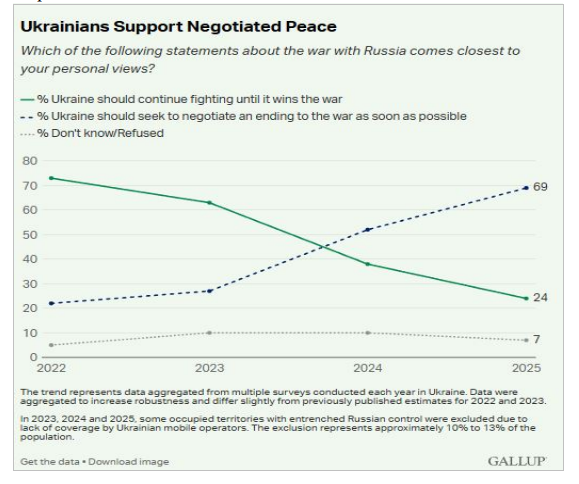
The year 2025 only solidified and intensified this trend. According to a Gallup poll conducted in early July 2025, 69% of Ukrainians favored a swift end to the war through negotiations, while only 24% supported continuing the fighting until victory.
It is important to note that increased support for negotiations does not mean a willingness to compromise or accept Russia’s conditions.
According to KIIS data (November-December 2025), 75% of Ukrainians categorically reject Russia's "peace" plan (compared to 82% in May 2025), and only 17% would agree to Russia's demands (up from 10% in May 2025). Meanwhile, 72% of Ukrainians would consider stopping the war along the front lines as a temporary option, which reflects not a shift in values but rather a rise in pragmatism.
Most citizens believe that the country is moving in the wrong direction.
According to a Razumkov Center poll conducted in November 2025, 32.5% of respondents believed that events in Ukraine were developing in the right direction, while 48% believed they were developing in the wrong direction. This is statistically insignificant compared to September 2024 and better than before the outbreak of full-scale war (20% and 65.5%, respectively, in December 2021). It should be noted that after the start of Russia's full-scale aggression against Ukraine, the share of citizens who believed that events in Ukraine were developing in the right direction increased significantly (from 20% in December 2021 to 51% in September-October 2022, reaching its highest levels in February-March 2023).
Expectations for a quick end to the war are extremely low.
Only 9% of Ukrainians expect the war to end by early 2026 (November – December 2025 KIIS), with another 14% expecting it to end in the first half of 2026. Eleven percent believe the war will end in the second half of 2026, and 32% believe it will end in 2027 or later. The share of those undecided has risen to 33% (from 23% in September 2025).
At the same time, 63% of Ukrainians say they are ready to endure the war as long as necessary (62% in September 2025) (KIIS study).
Willingness to defend the country. Among Ukrainian citizens (men and women 18+ who are not serving in the military), 54% say they would join the defense forces and take up arms. 38% say they are somewhat unwilling. By comparison, 45% of Polish citizens are willing to fight for their country, 41% in the US, 33% in the UK, 23% in Germany, and 32% in the EU as a whole (Gallup data, 2023).
Belief in Victory. 76% of Ukrainians believe victory is possible, provided sanctions pressure on Russia is lifted and sufficient military and financial aid is provided. Fifteen percent believe victory is impossible even under these conditions. Nine percent were undecided. In September 2024, 81% of respondents believed victory was possible, while 14% denied its possibility.
Social sentiment and perception of the future.
According to a study conducted by the Rating Sociological Group, commissioned by the International Republican Institute (July 22–27, 2025), Ukrainian society remains relatively optimistic about the country's future, although it is significantly lower than at the beginning of the war. 73% of citizens assess Ukraine's future as promising, while 22% view it negatively. By comparison, in April 2022, the ratio was 95% to 2%.
Corruption remains a key domestic problem.
According to the National Agency for Prevention of Corruption (NAPC) (January 2025), 79.4% of Ukrainians consider corruption to be one of the country's most serious problems (second only to war).
In November-December 2025 (KIIS), 59% of respondents believed that real attempts were being made to combat corruption in Ukraine (56% in September), while 33% still considered the country hopelessly corrupt (40% in September).
Regarding corruption in the circle of power.
Socis poll (conducted December 12-18, 2025) found that 54.8% of citizens consider the level of corruption in the country to be very high, while another 36.4% considered it to be high. The largest number of respondents (53.2%) blamed the Verkhovna Rada for the persistent high level of corruption in the country. 51.4% named the President, and another 50.2% named the Government. Additionally, 46.6% of respondents believe that anti-corruption agencies such as NABU, SAPO, and NACP are responsible.
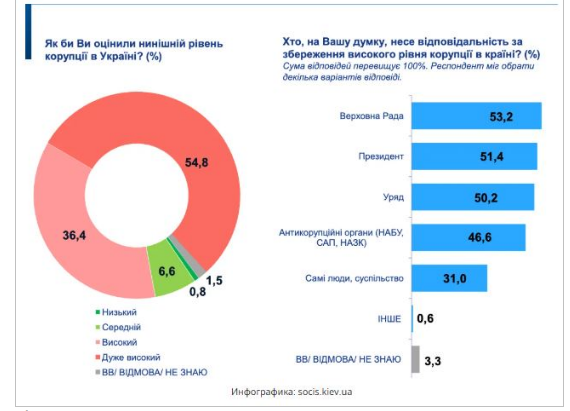
Who is to blame for the country's persistently high level of corruption? Socis (December 2025)
38.9% of respondents believe that the President is part of a corruption scheme exposed by NABU, 29% believe that the President knew about corruption in his circle but was not directly involved, and 18.8% believe that the President has nothing to do with corrupt deals and knew nothing about it.
30.1% of respondents believe the head of state should be held fully accountable in court for corruption within his circle, while another 28.4% believe the responsibility should be purely political and that he should not run for another term. And 30% are convinced that no evidence of his involvement has been established and that he is free to run again.
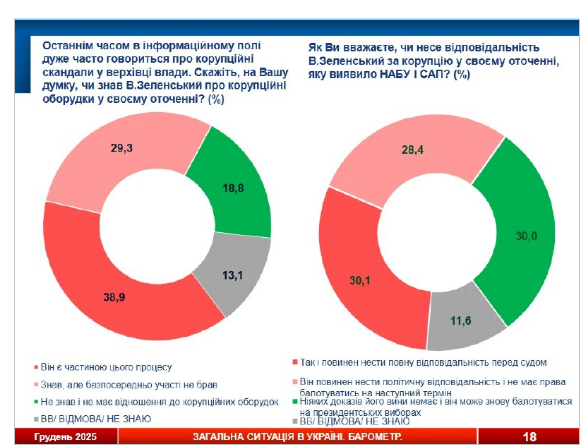
Main sources of information: Telegram is the most popular source of information for 47% (Sociological Group Rating, survey conducted in October 2024). It is followed by YouTube (26%), the "Unified News Marathon" (21%), eyewitness accounts/acquaintances, and official government sources (both 19% each).
The attitude towards elections in times of war remains reserved.
According to a study by the Sociological Group “Rating” commissioned by the International Republican Institute (July 22–27, 2025), fifty-one percent of citizens support holding a referendum on ending the war, while 40% oppose it. Local government elections are supported by 49%, while 48% oppose them; parliamentary elections are supported by 47%, while 49% oppose them; presidential elections are supported by only 35%, while 63% oppose them. Meanwhile, 74% of Ukrainians say they want new political parties, while 17% oppose them.
According to KIIS data (November-December 2025), only 9% of Ukrainians support holding elections before the cessation of hostilities (compared to 11% in September). Even with a ceasefire and security guarantees, only 25% would support elections. Fifty-seven percent believe elections are only possible after the war is completely over.
Trust in government bodies continues to decline.
It should be noted that in the first months after the outbreak of full-scale war, citizens' trust in most government institutions increased, driven by a recognition of the need for national consolidation in the face of external threats. However, over time, the level of trust in government institutions declined somewhat compared to the first year of the war. Maintaining a high level of trust primarily affects those institutions directly responsible for the country's defense.
According to a study by the Sociological Group “Rating” commissioned by the International Republican Institute (July 22–27, 2025), the Armed Forces of Ukraine maintain the highest level of trust: 94% of citizens trust the Armed Forces of Ukraine, while 3% do not (in April 2022, this figure was 98% versus 1%). 65% of Ukrainian President Volodymyr Zelenskyy is trusted, while 32% do not trust him (in April 2022, this figure was 94% versus 5%). 55% of Ukrainians trust the Commander-in-Chief of the Armed Forces of Ukraine, Oleksandr Syrskyi, while 32% do not trust him. 53% of Ukrainians trust Foreign Minister Andriy Sybiha, while 20% do not trust him.
At the same time, trust in government institutions is noticeably lower.
48% trust local government bodies, 48% do not trust them (in April 2022 – 84% versus 13%).
43% trust the police, 52% do not trust them (in April 2022 – 87% versus 7%).
Defense Minister Denys Shmyhal is trusted by 39%, while 36% do not trust him (in April 2022, it was 79% versus 6%).
35% trust the Secretary of the National Security and Defense Council of Ukraine Rustem Umerov, while 35% do not trust him.
28% trust the government headed by Yulia Sviridenko, 30% do not trust it, while 42% of respondents said they do not know or cannot evaluate its activities.
The public is most critical of the TCK: 24% trust them, 68% do not trust them (in February 2024, 32% versus 52%).
Only 20% trust the Verkhovna Rada of Ukraine, 76% do not trust it (in April 2022 – 64% versus 22%).
According to other data from the Razumkov Center (November 2025), among state and public institutions, trust is most often expressed in the Armed Forces of Ukraine (92% of respondents trust them), the State Emergency Service (86%), volunteer organizations (81%), volunteer units (78%), the National Guard of Ukraine (72%), the Main Intelligence Directorate (71%), the Security Service of Ukraine (65%), the Church (65%), public organizations (64%), the Ministry of Defense of Ukraine (63%), and the National Bank of Ukraine (54%).
Also, the share of those who trust exceeds the share of those who do not trust the head of the city (town, village) (50% and 42%, respectively), the local council of the city (town, village) (49.5% and 41%, respectively). 34%).
The share of those who trust the President of Ukraine does not differ statistically significantly from the share of those who do not trust him (48% and 45%, respectively); the same applies to the Ukrainian media (48% and 45%, respectively) and the State Bureau of Investigation (40% and 42%, respectively).
The majority of respondents express a lack of confidence in the Verkhovna Rada of Ukraine (76% do not trust it), the state apparatus (officials) (75%), the Government of Ukraine (73%), political parties (71.5%), the courts (the judicial system as a whole) (66%), and the Prosecutor's Office as a whole (57%).
Also, the share of those who do not trust exceeds the share of those who trust the National Agency for the Prevention of Corruption (50% and 32%, respectively), commercial banks (50% and 35%, respectively), the National Police (49% and 45.5%, respectively), the Specialized Anti-Corruption Prosecutor's Office (37%), the National Anti-Corruption Bureau of Ukraine (45% and 41%, respectively), and trade unions (42% and 30%, respectively).
The trust rating for President Volodymyr Zelensky remained stable in 2025.
The trust rating for Ukrainian President Volodymyr Zelenskyy remained generally stable in 2025. However, it is not the same as his electoral rating and does not automatically reflect citizens' willingness to vote for him in the presidential election.
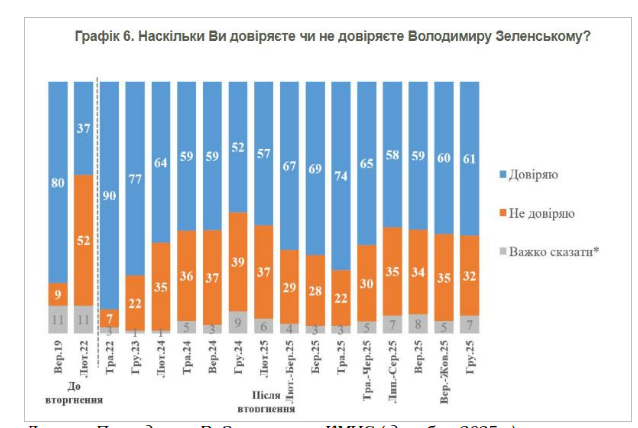
Confidence in President V. Zelenskyy. KIIS (December 2025)
According to KIIS, 61% of Ukrainians trust the President (in February 2025 – 57%), 32% do not trust (February 2025 – 37%) (balance +29%).
The sustainability of this indicator, despite the corruption scandals of "Mindichgate", this can be explained by several factors at once: the timely removal of the head of the OP Andriy Yermak, which reduced the level of toxicity around the institution of presidential power, as well as the increasing external pressure from the Administration of US President Donald Trump, which is increasingly perceived by society as an external threat and contributes to consolidation around the head of state (similar to the effect after the February scandal in the White House).
According to another poll by the Sociological Group "Rating" (from August 21-23, 2025), citizens trust former commander-in-chief V. Zaluzhny the most (74% versus 18%); President of Ukraine V. Zelensky is trusted by 68% versus 30%; Head of the Main Intelligence Directorate K. Budanov – 59% versus 19%.
Electoral preferences are characterized by high fragmentation. According to a study conducted by the Rating Sociological Group and commissioned by the International Republican Institute (July 22–27, 2025). In a hypothetical presidential election, 31% of all respondents (32% of those who have decided) are ready to vote for Volodymyr Zelensky, 25% (26%) for Valeriy Zaluzhny, 6% (7%) for Petro Poroshenko, and 5% (4%) for Kyrylo Budanov.
At the same time, the high level of trust in the President does not translate into party support for his political bloc.
According to a closed sociological study conducted by the Kyiv International Institute of Sociology (KIIS) at the end of 2025, the Zelenskyy Bloc is not among the top three party ratings.
Among those who have decided to vote, the hypothetical party of former Commander-in-Chief of the Ukrainian Armed Forces, Valeriy Zaluzhny, leads with 19.9%. Petro Poroshenko's European Solidarity is second (16.2%). Third place goes to the hypothetical party of Third Corps commander Andriy Biletsky (the Third Assault Brigade), with 11.9%. Zelenskyy's bloc, with 11.3% of the vote, ranks only fourth, slightly ahead of the hypothetical party of GUR head Kyrylo Budanov (10.4%). Dmytro Razumkov's "Reasonable Policy" (8.7%), Serhiy Prytula's "August 24" party (6.4%), Yulia Tymoshenko's "Batkivshchyna" (5%), and the hypothetical "Azov" party (5%) also surpassed the 5% threshold.
According to a study by the Rating Sociological Group commissioned by the International Republican Institute (July 22–27, 2025), the notional party of Valeriy Zaluzhny is in the lead in the parliamentary elections (22%), followed by the party of Volodymyr Zelenskyy (14%), the Azov Party (8%), European Solidarity (8%), the party of Kyrylo Budanov (7%), as well as the parties of Dmytro Razumkov and Serhiy Prytula (5% each).
In 2025, a sharp decline in trust in the United States and NATO was recorded.
Trust in the US has declined from 41% in December 2024 to 21% in December 2025 (KIIS survey November–December 2025), distrust increased from 24% to 48%. Trust in NATO decreased from 43% to 34%, distrust increased from 25% to 41%. Against this background, trust in the EU remains relatively stable: 49% trust, 23% distrust (versus 46% and 19% in December 2024).
In 2025, Ukrainian society is seeing a steady decline in expectations for rapid accession to NATO and the EU, while overall support for the Euro-Atlantic course remains.
According to a Gallup poll conducted in early July 2025, expectations of Ukraine's rapid accession to NATO continue to decline. While the majority held such expectations in 2022, this share fell to 51% in 2024, and to 32% in 2025, which is half the rate at the beginning of the full-scale war in 2022. At the same time, the share of those who believe Ukraine will never be admitted to NATO has increased to 33%, which is comparable to the number of respondents who expect accession in the more distant future (within the next 10 years).
Expectations for joining the European Union have declined less sharply, but still show a steady downward trend. In 2025, 52% of Ukrainians expect Ukraine to join the EU within the next decade, compared to 61% in 2024 and 73% in 2022–2023.
It is important to distinguish between realistic expectations and value-based support for the Euro-Atlantic course. According to the Rating sociological group, commissioned by the International Republican Institute (the survey was conducted July 22–27, 2025), the majority of Ukrainians still support the strategic course of integration with the West: 75% of respondents support joining the EU (3% oppose), and 70% support joining NATO (9% oppose).
Actions when US support ends. 76% of Ukrainians believe that even without US assistance, the country should continue to fight alongside the European Union (September 2025 KIIS survey) (in March 2025 – 82%). 14% believe that if American support is withdrawn, Ukraine should agree to any Russian demands (in March 2025 – 8%).
Overall, it can be noted that Ukrainian society in 2025 is increasingly shifting from the logic of mobilizational maximalism to the logic of pragmatic survival: the war is still perceived as an existential challenge, but the demand for its end, risk reduction, and restoration of state and economic governance is growing.
Public opinion in Ukraine is leaning more toward the formula: a ceasefire is possible, but peace agreements with Russia, let alone capitulation, are not. This creates pressure on both the government and external partners, and is becoming one of the key factors determining the political dynamics leading up to 2026. President Zelenskyy and the elites publicly adhere to this line. Therefore, having begun negotiations, the government is emphasizing their provisional and exploratory nature to its domestic audience, avoiding any preemptive decisions.
3. Mobilization. Society's response to mobilization processes.
In the final measurement of 2025, mobilization has increasingly transformed into a systemic political and social problem. Demographic depletion, public war fatigue, distrust of the TCK's practices, corruption, and the lack of clear terms of service and rotation have turned mobilization into one of the main factors of the state's internal vulnerability—alongside the reduction in foreign aid and the protracted nature of the war.
Following the entry into force of Law of Ukraine No. 3633-IX on May 18, 2024, the pace of mobilization increased briefly, but by 2025 it had become clear that this effect had been exhausted.
35,000 men were mobilized monthly in the summer of 2024, by the fall the figure had dropped to 20,000, effectively reaching the system's ceiling in 2025. This rate only partially compensated for combat losses and did not ensure the creation of reserves. According to the Secretary of the National Security and Defense Council, approximately 1.05 million men had been mobilized by October 2024. However, due to corruption, non-combat losses, and attrition, the actual number of service members directly on the front lines may be around 150,000. The plan to increase the army's strength by an additional 160,000 men by early 2025 was not fulfilled.
On average, Ukraine will mobilize approximately 30,000 troops per month into the armed forces in 2025. According to some estimates, the actual mobilization could be 27,000 per month, which is still significantly lower than the needs of the front.
Authorities explain this by the fact that citizens—approximately 6 million people—have failed to update their registration data en masse. Approximately 5 million Ukrainians liable for military service have their data updated as required by the new law. According to preliminary estimates by the Ministry of Defense, the total number of conscripts in Ukraine could be as high as 11 million, meaning that approximately 6 million have not updated their data at all and have not provided the TCK with up-to-date information about themselves. Furthermore, most of those who have updated their data have a deferment or are eligible for a deferment. However, the effectiveness of the TCK raids is very low due to corruption. In fact, only 10-15% of those detained are mobilized. And of these 10-15%, approximately a third (up to 30%) remain in the army as combat-ready service members. The remaining 70% of those mobilized are often found to be unfit for military service due to health reasons, alcoholism, or other problems. Some of these conscripts are sent to perform auxiliary work, such as digging trenches in the second or third line of defense.
The cumulative losses of the Ukrainian Armed Forces since the start of the full-scale war —as a result of deaths, injuries, and retirements—by the end of 2025 could reach up to 500,000, including 50,000–80,000 killed and approximately 54,000 missing. According to foreign estimates, Ukraine's losses in killed and wounded amount to approximately 400,000, including 60,000–100,000 killed (official figures are not disclosed).
At the same time, 2025 saw a sharp crisis in personnel retention. The scale of Absence without Leave (AWOL) and desertion has become comparable to mobilization. From January 2022 to October 2025, 311,327 criminal cases were registered in Ukraine, 255,000 of which were related to AWOL and 56,200 to desertion; in January–October 2025 alone, 161,461 cases were registered. In fact, the waves of mobilization in 2025 did not overlap the scale of personnel attrition.
Raids by conscription centers (TCKs) have become widespread across the country. In almost every region of the country, as well as in major cities (Kyiv, Kharkiv, Lviv, Odesa, and others), conscription centers conduct large-scale inspections in public places—shopping malls, restaurants, concerts, markets, gas stations, and so on. These actions are regularly criticized by public figures.
The TCK's mass raids are also aimed at maintaining the loyalty of the warring and passionate segment of society (they're catching everyone, everyone will fight), given that demobilization regulations have not yet been adopted. These actions were also aimed at Western partners, from whom the authorities expect increased support. In particular, Ukraine is demonstrating that it has taken all measures within its power to strengthen mobilization.
It's worth noting that control has been significantly strengthened: numerous checkpoints operate in every major city and town in Ukraine, the primary purpose of which is to screen males for draft evasion. A comprehensive system for identifying draft evaders has been established across the country.
A separate problem is the large number of people attempting to illegally leave the country, avoiding mobilization. This has forced the Ukrainian authorities to significantly strengthen security along the Western border. This is exemplified by reports of additional border reinforcements in Transcarpathia.
In 2025, the government continued to balance between the needs of the front and public order. The official position was that mobilization was primarily voluntary, and force was used only in exceptional cases.
However, local practices increasingly conflicted with official rhetoric. Numerous videos of arrests, reports from human rights activists, statements from military ombudsmen, and regional media documented instances of harsh actions by the TCK, including forceful arrests, conflicts, and mass raids. This created a persistent sense of a crisis of confidence in the mobilization mechanism itself.
Today, approximately 80-90% of those mobilized are people who initially did not want to serve. For them, mobilization is often forced; even if direct physical violence is not always used, people are often effectively forced to report voluntarily to the TCK. Under such conditions, the question on the effectiveness of such a contingent in the army inevitably arises. Officers interviewed note that even among those mobilized against their will, approximately 30% adapt and become capable soldiers after entering the military structure. These people undergo training, form new social connections, and gradually integrate into the military environment. At the same time, TCK raids are a necessity for the army to recruit new soldiers, and they also completely (up to 70%) disrupt mobilization plans.
Between late 2023 and December 2025, an estimated 60 to 90 incidents involving open resistance to the actions of territorial conscription centers (TCKs) were recorded in Ukraine—ranging from local clashes and attempts to disrupt arrests to group conflicts, attacks on staff, and spontaneous riots. Precise statistics are lacking because official bodies do not publish systematic data, and a significant portion of such cases are classified as "domestic conflicts," "hooliganism," or receive no public coverage at all. A significant portion of incidents only become known through eyewitness videos, social media posts, and regional media reports.
The most sensitive aspect has been the tragic incidents associated with mobilization processes. As of December 2025, based on open sources, regional media reports, human rights organizations, and official investigations, there are approximately 15–25 confirmed cases of deaths directly or indirectly related to the actions of the TCK and mobilization activities (during forceful arrests, after conflicts, or due to a sharp deterioration in health). The geography of such incidents covers at least 8–10 regions of Ukraine. However, official consolidated government statistics on such cases have still not been published, which increases public tension and mistrust.
At the same time, scandals surrounding territorial conscription centers (TCKs) related to forced mobilization, although regularly publicized, cannot be considered widespread. Despite the fact that mobilization involves tens of thousands of people, cases of forced mobilization involving violence account for approximately 10% of the total number of conscripts. Defense Minister Denys Shmyhal stated that "forced mobilization occurs in 5-10% of cases, while in most situations, citizens receive a summons and voluntarily enlist."
The increase in the number of incidents involving the TCK in 2025 reflects not so much organized resistance to mobilization as accumulated social stress, a crisis of trust in institutions, and a sense of the injustice of mobilization practices, which makes the issue of the TCK one of the most sensitive internal factors of destabilization.
Despite the traditionally high level of trust in the military in general among Ukrainian society, a significant majority of citizens view representatives of the TCK with distrust, viewing them primarily as instruments of repression rather than protectors. This confirms that forced mobilization is becoming an element of the latent conflict between society and the state. According to a study by the Sociological Group Rating (December 5-6, 2024), 67% of Ukrainian citizens distrust representatives of the TCK, while 29% do. By comparison, 94% trust military personnel on the front lines.
Due to problems replenishing the army, public discussion has once again intensified about lowering the age of mobilization, which is currently 25 years. Western allies have repeatedly called on Ukraine to lower the age of mobilization to 20-18 years. The Office of the President of Ukraine, however, refuses to do so. In particular, Zelenskyy's office has not ruled out the possibility that US President Donald Trump's peace initiatives will indeed lead to a cessation of hostilities, which would inevitably trigger the electoral process in the country. Refusing to lower the mobilization age would be a kind of bonus for the current government with voters.
On August 26, 2025, the Cabinet of Ministers of Ukraine updated the rules for crossing the state border (Resolution of the Cabinet of Ministers of Ukraine dated August 26, 2025 No. 1031), lifting restrictions on travel for all men aged 18 to 22 years for the period of martial law.
There are currently no precise official data on the number of young people aged 17–22 in Ukraine, but a rough estimate can be made based on public demographic estimates. According to former Deputy Prime Minister of Ukraine Oleksiy Chernyshov, in February 2025, the country's population in government-controlled territory was approximately 32 million. Based on the standard age pyramid and population structure (data from the World Bank, the UN, and estimates from the Institute of Demography of the National Academy of Sciences of Ukraine), the 17–22 age group typically comprises approximately 9–11% of the total population. This allows us to estimate the number of citizens in this age range at 2.8–3.2 million. Thus, this represents a significant socio-demographic group in the country, directly impacting the talent pipeline for higher education and Ukraine's mobilization potential in the coming years.
While some increase in emigration is possible in the short term, the government's primary objective is to prevent a mass exodus of young people from Ukraine.
Basic logic: Strengthen the country's long-term potential without stifling the freedom of young people. The government effectively acknowledges that deterring young people with bans alone is difficult and counterproductive. It's far more effective to provide them with opportunities and thereby increase their loyalty.
With the "18-22" initiative, the government is attempting to reduce protest sentiment and strengthen trust and electoral support among a key age group. The Ukrainian leadership is demonstrating that it values young people not only as a future resource for the front, but also as a generation that must develop, learn, and contribute to the country. People in this age group constitute a significant portion of President Zelenskyy's electorate, which could potentially give him a leg up in potential elections if they are held in the near future, perhaps as a result of peace negotiations.
It's worth noting that, according to Ukrainian mobilization legislation, men under 25 are not subject to conscription. This creates a legal conflict: those who left Ukraine before reaching adulthood were kept abroad by the fear of losing the opportunity to leave again, while other young men could not even study abroad. By allowing 18- to 22-year-olds to leave freely, the government eliminates this conflict. Simply put, since these young men are not immediately conscripted into the army anyway, there's no point in keeping them locked up and encouraging them to flee. It makes much more sense to allow them to leave temporarily, so they maintain ties with their homeland and, after completing their studies, return to life and work in Ukraine. In the long term, these young men, upon reaching 23-25, will remain in the country and can either voluntarily join the Armed Forces or be subject to conscription, if conscription is still an option. Relying on incentives (salaries, bonuses, transparent contracts) and voluntary decisions on the part of 18-22 year olds works better than strict prohibitions.
4. Socio-psychological consequences of the war and internal lines of tension.
Psychological consequences of war.
The mental health situation in Ukraine between September 2024 and June 2025 continued to deteriorate amid a protracted war, persistent air raids, destruction, loss, and instability.
According to the World Health Organization, approximately 10 million people are at risk of mental disorders of varying severity, from anxiety and depression to post-traumatic stress disorder (PTSD). In October 2024, the WHO recorded that 46 % of the population from the country – that's about 15-16 million people – experience serious psychological problems, of which 41 % have clinically significant mental disorders, and 39 % — neurological disorders. According to the eHealth electronic health system, 27 cases have been officially confirmed in Ukraine. 27 544 cases of PTSD, of which 8 888 were diagnosed only in 2024.
Children are especially vulnerable in this situation. Research shows that 73 % of respondents children do not feel safe, 64 % lost interest in learning, and almost half suffer from persistent anxiety caused by homelessness, disruption of family ties, and constant instability. According to UNESCO and the Ministry of Education, PTSD among adolescents in Ukraine reaches 26%. These data confirm that the generation growing up in war conditions bears a special psychological burden, the consequences of which can manifest themselves for years.
Constant air raid alarms play a key role in the development of chronic stress.
In several regions (Kyiv, Kharkiv, Dnipropetrovsk, and Sumy regions), between 500 and 800 alarms, including nighttime ones, were recorded during the specified period. This leads to regular sleep disturbances, feelings of helplessness, and anxiety disorders, even in those not directly exposed to attacks. According to doctors' observations, sleep disorders and panic attacks are more frequently diagnosed in these regions, and behavioral disorders are more common in children. An increase in depressive symptoms has also been noted in the elderly in southern regions (Odesa and Mykolaiv regions), where anxiety alternates with periods of relative calm, creating a "cumulative fear" effect.
Despite the efforts of the government and international partners, the psychological care system remains overburdened and understaffed. The Ministry of Health reported that since the beginning of 2025, more than 900 institutions have received licenses to provide psychiatric care, but fewer than ten fully functional inpatient facilities operate in the regions. Most care is provided on an outpatient basis or remotely. Volunteers and non-governmental organizations report a chronic shortage of psychiatrists, clinical psychologists, and crisis centers, especially for children and internally displaced persons.
Foundations such as "Ti Yak?" and Hotline LifeLine Ukraine provided primary care to tens of thousands of people, both civilians and military personnel. According to the Ministry of Health and relevant NGOs, the number of requests for psychological support increased by an average of 30-50 during the reporting period, especially in the regions most frequently hit by airstrikes. Despite the launch of several programs, including an initiative by First Lady Olena Zelenska and support from the WHO, aid remains inaccessible to a significant number of those in need.
Based on the results of the period, it can be concluded that the scale of psychological stress affects up to half of the country's population. Mental disorders have become the norm in the reality of war. The situation with children is of grave concern: over 70 % of them are exhibiting symptoms of anxiety, and the proportion of adolescents with signs of depression and PTSD is growing. More than 27,000 cases of post-traumatic stress disorder have been diagnosed, but this data may be incomplete. The increase in requests confirms the widespread need for assistance, but existing resources fall short of society's demands. Without a significant expansion of the mental health and crisis support system, including in small towns and war zones, the consequences of this war on Ukraine's mental health will be long-term and systemic.
The longer the war in Ukraine continues, the more it distorts social relations, reduces the value of human life, and destroys basic security mechanisms.
Kyiv has been ranked among the world's ten worst cities to live in for the third year in a row, according to The Economist magazine. The study covers 173 cities (Kyiv ranks 163rd overall) and evaluates them based on five criteria: healthcare, culture and environment, education, infrastructure, and stability. While most areas show slight improvement or stability, the overall score has worsened due to declining levels of security and political stability.
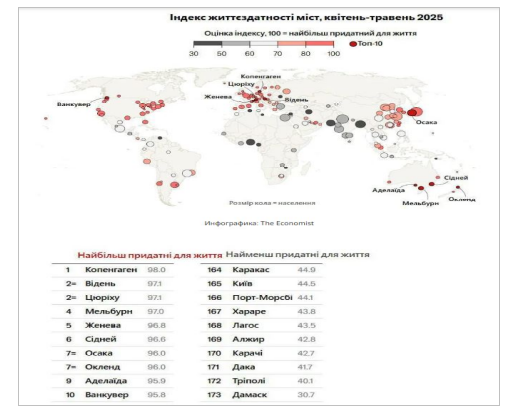
One of the main reasons was the full-scale war, which negatively impacted security, infrastructure and access to basic services.
Even far from the front, the consequences of this war live on in the streets, and in the psychological vulnerability of society.
For example, in early June 2025, a man was detained in Kyiv after he was drunk and strolling through the city with grenades and ammunition. He claimed the ammunition had been a birthday gift. This incident illustrates the proliferation of weapons among the population, with them falling into the hands of not only criminals but also ordinary people.
War radically transforms the everyday civilian environment, giving rise to new forms of crime for which society is unprepared. In particular, the rise in crimes involving firearms, grenades, explosive devices, and even drones is not just a side effect, but a symptom of the deep militarization of life, where weapons and aggression become part of everyday life.
The situation around the Ukrainian Orthodox Church (UOC).
In 2025, Ukraine continued to strengthen legal and administrative mechanisms that create the preconditions for banning the activities of the Ukrainian Orthodox Church (UOC). The previously adopted legislative framework began to acquire practical content, shifting the religious issue from a primarily political and discursive realm to the realm of concrete institutional decisions.
A key event occurred on July 8, 2025, when the State Service of Ukraine on Ethnopolicy and Freedom of Conscience (SSUEFC) published an official conclusion regarding the alleged affiliation of the Kyiv Metropolitanate of the Ukrainian Orthodox Church (UOC) with the Russian Orthodox Church (ROC). This conclusion could trigger a further wave of public debate, media attacks, political statements, and even administrative decisions regarding the property and status of the UOC.
In fact, the conclusion of the State Statistical Court creates a legal basis for two parallel processes: a judicial ban on the activities of the UOC in individual regions or as a whole; and administrative actions against property—churches, monasteries, and other objects used by UOC communities—even before a final court decision is made, through mechanisms for reviewing contracts, registration, and the status of use.
It is noteworthy that despite the widespread use of the name "UOC-MP" (Ukrainian Orthodox Church of the Moscow Patriarchate) in the media and political discourse, the SSUEFC has never used this term in its official documents. All texts refer exclusively to the "Ukrainian Orthodox Church" (UOC) or the "Kyiv Metropolitanate of the UOC" (KM UOC). This is no coincidence: legally, there is no organization in Ukraine called the "UOC-MP." All official documents, state registries, and court decisions refer specifically to the UOC.
The SSUEFC's conclusions are based on references to the Statute of the UOC (dated May 27, 2022), the 1990 Charter of Patriarch Alexy II, and Chapter X of the Statute of the Russian Orthodox Church, which describes the status of the UOC as a self-governing part of the ROC. The SSUEFC views these documents as continuing to regulate the legal and canonical status of the UOC. At the same time, the actual actions of the UOC since the Council of May 27, 2022, indicate profound changes—both in the legal situation and in canonical practice.
Lack of formal mechanisms of subordination:
In the Charter of the UOC after May 27, 2022, there are no provisions on the “Obligation to implement decisions of the Russian Orthodox Church,”, “Submission of candidates for approval,” “Mandatory participation in councils”, i.e. no mechanisms for “Connection of the part with the whole.”
The Ukrainian Orthodox Church (UOC) independently approved a new version of its Statute on May 27, 2022, without Moscow's consent. The new Statute makes no mention of the "blessing of the Patriarch of the Russian Orthodox Church" or participation in its bodies, but Kyiv is designated as the UOC's governing center. The UOC exercises independent governance in all canonical, administrative, and legal matters. The concept of "autocephaly" in canon law is not an absolute measure. The mere fact that the scope of rights "may be reduced" is invalid if the UOC itself ceased to recognize these powers of the ROC by removing the reference to the Russian Orthodox Church as a jurisdictional center from the Statute (which is what happened on May 27, 2022). Art. 5-1 of the Law of Ukraine No. 987-XII "On Freedom of Conscience and Religious Organizations " (the Law was supplemented with Article 5-1 in accordance with the Law "On the Protection of the Constitutional Order in the Sphere of Activities of Religious Organizations") No. 3894-IX of August 20, 2024) contains a direct exception: if the governing bodies have officially refused to participate in the governing bodies of a foreign organization and this is confirmed by practice, the "affiliation" criterion does not apply. The head of the UOC, His Beatitude Metropolitan Onufriy, in a letter to the State Service for Ethnopolicy and Freedom of Conscience dated September 28, 2022 (No. 0838), emphasized that the UOC now has not only administrative autonomy (which existed before), but also full canonical independence. Accordingly, Art. 7, 14, 16, 30 of Law No. 987-XII and Art. 35 of the Constitution of Ukraine, issues of subordination of religious organizations are determined by the organization itself through an approved charter, and not by external conclusions or traditions.
Canonical status in Ukrainian law:
Ukrainian legislation does not recognize the term "canonical connection" as a legal basis for restrictions. The law defines only the facts of subordination, obligations to implement decisions of an external center, participation in governance, etc. (Article 5-1 of Law No. 987-XII "On Freedom of Conscience and Religious Organizations "). The State Council of the Orthodox Church ignores the fact that after 2022, the Ukrainian Orthodox Church operates effectively independently, and "canonical subjectivity" is determined not by external recognition, but by the actual functioning of a religious organization.
It is worth noting that for Moscow itself, the modern UOC is no longer an “instrument of influence” in Ukraine, but a “rebellious structure” that is dangerous for Russian propaganda, which in fact:
-
Publicly condemned Russia's war against Ukraine from the first days of the invasion, unequivocally calling it a crime;
-
Dissociated itself from the ideology of the "Russian world" and directly condemned the so-called "Order" of the 25th World Russian People's Council, which promoted the aggressive ideas of a "special civilizational space" adopted by the Russian Orthodox Church (it was approved by the ROC). March 27, 2024);
-
It independently elects its leadership and makes key decisions, without coordination with Moscow or accountability to external centers. The updated Statute of the UOC (2022) contains no mention of the Moscow Patriarchate, its structures, blessings, synods, or councils. The center of governance is located in Kyiv.
-
Stopped mentioning Patriarch Kirill in church services;
-
The Church makes her own holy myrrh, which is a sign of independence;
-
It declared a course for complete independence in the canonical dimension.
-
Provides active humanitarian, social and spiritual support to the Ukrainian army and civilians – dozens of dioceses and monasteries help the Ukrainian Armed Forces, volunteers and displaced persons;
At the same time, the issue of the Ukrainian Orthodox Church remains one of the most sensitive elements of possible future negotiations. According to sources close to the decision-making process, it is the religious issue that is causing the greatest concern among some of Ukraine's Western partners, particularly among conservative-minded members of the US Republican establishment, including certain members of Donald Trump's team. For them, banning a major religious organization is perceived not as a security issue, but as an issue of religious freedom and human rights, potentially complicating foreign policy arguments in support of Ukraine.
At the same time, Ukraine's policy towards the UOC has already sparked critical reactions internationally.
A report by the Office of the UN High Commissioner for Human Rights, published in December 2025, contains language about the inadmissibility of banning religious organizations solely on the basis of historical or canonical ties to a foreign religious center, as well as warnings about the risk of collective liability and disproportionate restrictions on religious freedom. "A canonical or historical tie to a foreign religious center cannot, in itself, serve as grounds for banning a religious organization. Measures affecting religious freedom must be strictly individualized, evidence-based, and consistent with the principle of proportionality. Otherwise, such measures may violate the right to freedom of thought, conscience, and religion, as guaranteed by international law," the UN report states.
The UN also warns of the risk of collective responsibility, when criminal, administrative, and other restrictive measures are applied not based on the individual conduct of specific individuals, but against a religious group as a whole under the pretext of national security. The report emphasizes that any state interference in religious freedom must be necessary and proportionate to the legitimate aim pursued.
The report also notes that searches, investigative actions, and interrogations at religious institutions continue in Ukraine, as well as instances where local authorities have restricted or terminated the activities of religious communities, including refusing to renew leases for religious buildings. "Authorities continued to apply criminal, administrative, and other restrictive measures against representatives of religious organizations, citing national security concerns. Such measures create a risk of collective liability when restrictions are applied not based on individual behavior, but against a religious group as a whole. Any state interference with freedom of thought, conscience, and religion must be necessary and proportionate to the legitimate aim pursued," the report states.
At the same time, forcing a ban on the UOC faces objective limitations. Firstly, legal proceedings in such cases are protracted and cannot be completed quickly. Secondly, large-scale attempts to confiscate churches and monasteries carry the risk of fierce resistance from believers, which could lead to local conflicts, increased internal tensions, and the undermining of social stability. In a wartime environment, this creates additional vulnerabilities that potentially weaken Ukraine's position both on the front lines and at the negotiating table.
IV . Macroeconomic situation.
1. Key economic indicators.
The economy is primarily constrained by uncertainty and the protracted war. The World Bank, the European Commission, and the UN have increased their estimates of the total cost of reconstruction and recovery in Ukraine to $524 billion over the next decade. A year ago, the cost was estimated at $486 billion. A significant shortage of skilled labor remains. The number of working-age Ukrainians has decreased by 5.5 million, or 30%, since the beginning of the invasion. Limited production capacity, including due to destruction, is becoming increasingly acute, while businesses are cautiously making capital investments to expand production. Furthermore, economic activity has been negatively impacted by the destruction of natural gas infrastructure facilities as a result of Russian shelling, which has led to a significant reduction in natural gas production and an increase in imports. The expiration of EU trade preferences and the impact of global trade disputes have become new risks for Ukrainian exports. Consumer demand, supported by rising real wages, remains the main driver of economic growth. Another factor is the continued high budget expenditure on defense, a significant portion of which is allocated to the purchase of products from domestic enterprises.
By mid-2025, the Ukrainian economy was on the brink of stagflation —a combination of high inflation (in June 2025, annual inflation was approximately 14.3%) and a decline in business activity. The main reasons were the disappearance of the low base effect, losses at the front, blows to the energy sector and infrastructure, a poor harvest, a decline in construction, and a labor market crisis due to mobilization. Overall, from December 2024 to December 2025, Ukraine experienced a moderate decline in inflationary pressure: annual inflation dropped from double-digit levels (from a peak of 14%) to around 9–10%.
An additional risk was the default on domestic debt obligations, which was technically recognized in May-June 2025 due to the revision of the terms of Ukrainian domestic government loan bonds (OVGZ). This weakened investor confidence and increased pressure on the budget.
The level of economic growth.
By the end of 2024, Ukraine's GDP grew by 2.9%. In nominal terms, the economy reached approximately UAH 7.6–7.8 trillion, or $195–200 billion.
For comparison, by the end of 2023 it was 5.5%, while in 2022 a decline of 29.1% was recorded.
The IMF forecasts Ukraine's GDP growth to be 2% in 2025. The World Bank also forecasts Ukraine's economic growth at 2% in 2025. The National Bank of Ukraine, in one of its most recent forecasts, estimated growth at 3.1%, but subsequently revised it down to approximately 1.7% y/y, citing high risks. Taking these estimates into account, the consensus range for GDP growth in 2025 is 1.7–2.0%. In nominal terms, this corresponds to an economy of approximately UAH 8.6–8.8 trillion, or approximately $215–225 billion, depending on the hryvnia exchange rate and inflation dynamics.
Hryvnia exchange rate dynamics: December 2024 – December 2025.
Between December 2024 and December 2025, the hryvnia demonstrated a moderate devaluation against the US dollar and a more pronounced weakening against the euro, reflecting both external currency factors and the domestic financing structure of the economy and debt.
Hryvnia to US Dollar Exchange Rate (USD/UAH). In December 2024, the official hryvnia exchange rate was around 41.0–41.2 UAH per USD. By December 2025, the exchange rate stabilized in the range of 42.1–42.3 UAH per USD. Thus, over the year, the hryvnia has weakened against the dollar by approximately 2.5–3.0% (approximately +1.0–1.2 UAH). This indicates a controlled devaluation, supported by the NBU's foreign exchange interventions and a stable inflow of external financing, despite military and fiscal risks.
The hryvnia exchange rate against the euro (EUR/UAH). In December 2024, the euro exchange rate was approximately 46.0–46.2 UAH per euro. By December 2025, it had risen to 49.4–49.7 UAH per euro. Over the past year, the hryvnia has weakened against the euro by approximately 7.5–8.0% (approximately +3.5–3.7 UAH). The sharper devaluation against the euro reflects both the strengthening of the European currency itself on global markets and the high structural linkage of the Ukrainian economy and debt to the eurozone.
In 2025, the purchasing power of most Ukrainians declined significantly, becoming one of the key socioeconomic trends of the year. With annual inflation in the range of 9-12%, and 12-20% and higher for food and basic services, the growth in nominal incomes (7-9% on average) did not compensate for the rising cost of living, resulting in real incomes falling by 5-10%, and for certain social groups, by up to 15-20%. This hit pensioners, public sector employees, internally displaced persons, and households without foreign currency or military income particularly hard, whose pensions and social benefits were indexed only sparingly and effectively lagged behind price increases. The weakening of the hryvnia and the high share of imports increased pressure on prices for fuel, medicine, and essential goods, further limiting options for everyday consumption. As a result, in 2025, a situation of hidden impoverishment developed: while incomes were formally maintained, the population's real ability to meet basic needs was systematically declining, and one-time social payments (the "Zelensky’s thousand [of hryvnias or around $25, – translator’s note]," the "winter thousand," and similar measures) only temporarily alleviated the situation, without eliminating the structural decline in purchasing power.
Migration rates in 2025 have slowed compared to the first phase of the war, but the return of refugees is hampered by ongoing fighting and destroyed infrastructure. Since the beginning of the war, approximately 9.5 million Ukrainian citizens have been forced to flee their homes, representing approximately 22% of the country's pre-war population. Of these, approximately 5.7 million have become refugees abroad, primarily to European countries, and another 3.8 million are internally displaced persons within Ukraine (data as of autumn 2025).
Ukraine is currently experiencing a population decline due to low birth rates and high mortality rates. The death rate in Ukraine is three times higher than the birth rate, stated Anatoliy Kinakh, President of the Ukrainian Union of Industrialists and Entrepreneurs. According to official data, 177,000 people were born in 2024, while 495,000 died. Ukraine currently has the worst demographic situation in the world.
The UN has recorded a significant increase in civilian casualties in Ukraine due to regular Russian air strikes. In just 11 months of 2025, 2,311 civilians were killed and 11,084 were injured. This represents a 26% increase compared to the same period in 2024 and a 70% increase compared to 2023. In 2023, 1,847 civilians were killed and 6,054 were injured due to Russian aggression in Ukraine. In 2024, the number of civilian casualties was 1,979 and 8,616 were injured.
The number of Ukrainian refugees wishing to return to Ukraine is gradually decreasing. This can be partly explained by the fact that those who wanted to return have already returned. Those who remain abroad are forming connections, finding work and social connections, and therefore are more comfortable living there. Clearly, the longer the war lasts, the more people will adapt abroad and will not return. The main factor that may influence people's decisions to return to Ukraine is safety. Since there's no certainty about safety, people abroad can't make any plans.
According to a UN survey published in the spring of 2024, the number of refugees planning or hoping to return to Ukraine has decreased from 77% to 65% compared to 2023. For example, in Germany, where 1.18 million Ukrainian refugees currently reside, just a year and a half ago, the majority stated their intention to return to Ukraine.
The future of Ukraine's economy continues to depend on the progress of the war and the state of the global economy. A recession and trade war could reduce demand for Ukrainian exports. The country could partially offset this by substituting American agricultural products in certain markets, but a rift between the US and the EU or a collapse in global trade would create the threat of isolation. Everything would then depend on whether and under what conditions Ukraine can integrate into a regional economic bloc.
A fundamental difference this year is the absence of direct bilateral funding from the United States: since the beginning of 2025, no US budget support has been provided due to a change in White House policy following Donald Trump's victory. The United States now participates exclusively in G7 multilateral initiatives, without providing independent grants or loans. Previously, US support was provided primarily in the form of grants, which significantly reduced the debt burden on the Ukrainian budget, and was also implemented through separate, large military aid packages financed outside the main budget.
The shift in the structure of foreign aid is creating new strategic risks for Ukraine. The key ones among these are its dependence on collective decisions and the political will of European partners, the need for each tranche to undergo complex, multi-stage approval procedures, and its high sensitivity to domestic political processes in EU countries. Thus, Ukraine is becoming increasingly dependent not only on the volume of international support but also on the terms and mechanisms for its delivery. Unlike previous years, when a significant portion of American aid was provided gratuitously, the current architecture of external financing is built primarily on multilateral instruments, with the EU, G7, IMF, and other international organizations playing a leading role.
The sustainability of Ukraine's macroeconomic system is increasingly determined not only by the government's internal decisions but also by the willingness of international donors to continue funding on their terms. Access to international resources is becoming closely linked to the fulfillment of a number of structural, macroeconomic, and institutional requirements—from budget deficit targets and fiscal reforms to the implementation of anti-corruption policies and increased governance transparency.
2. Financing the State Budget of Ukraine. The impact of assistance from Western partners and international financial institutions, and the conditions for providing assistance.
Ukraine's 2025 budget remained critically dependent on external financing. According to the Ministry of Finance of Ukraine, in 2025, the total funding for the state budget (general fund) amounted to USD 62.7 billion, or UAH 2.61 trillion. These funds were raised through both domestic borrowing and external official financing —loans and grants from international partners.
Domestic sources: government bonds. The only significant domestic source of budget financing in 2025 was government bonds.
The volume of domestic bonds: USD 13.35 billion or UAH 556.4 billion. Thus, approximately 21% of the total budget financing in 2025 was provided by Ukraine's own borrowing. This indicates the state's continued ability to mobilize domestic resources even during wartime, but the scale of these resources remains limited compared to external support.
External financing: loans and grants from partners.
The remaining 79% of the budget was financed from external sources – primarily credit mechanisms rather than direct grants.
The key element of external financing was ERA loans (including loans channeled through special funds of the state budget):
ERA loans: USD 37.93 billion or UAH 1.58 trillion.
This means that more than 60% of Ukraine's entire 2025 budget was financed through a single instrument—credit programs secured by Western partners, primarily through mechanisms related to the use of future income from frozen Russian assets.
ERA loans (Extraordinary Revenue Acceleration) are a special mechanism for concessional credit financing for Ukraine, whereby borrowed funds are provided against future revenues from frozen Russian assets. Unlike grants, these funds are formally considered government debt, but are serviced from extra-budgetary sources. The mechanism allows partners to support Ukraine without direct budget transfers, shifting the financial burden into the long term.
Additional sources of external funding :
European Union: USD 9.43 billion (UAH 391.1 billion)
International Monetary Fund: USD 0.91 billion (UAH 38.0 billion)
World Bank: US$0.59 billion (UAH 24.8 billion)
Japan: USD 0.27 billion (UAH 11.3 billion)
Council of Europe/CEB: USD 0.23 billion (UAH 9.7 billion)
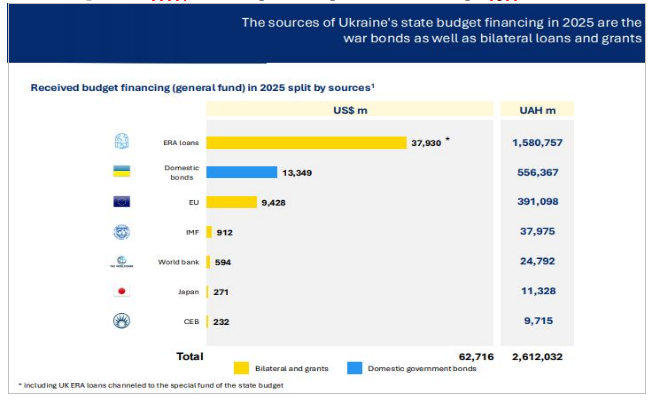
Together, these sources generated approximately USD 49.36 billion in external budget financing.
Since the start of the full-scale war in February 2022 and as of December 2025, Ukraine has attracted approximately $164.59 billion in external budget financing (general fund of the state budget). These funds came in the form of loans and grants from the United States, the European Union, international financial institutions, and individual partner countries and have become a key factor in maintaining the country's macro-financial stability during the war.
Of the total external financing for 2022–2025, approximately 59% was in the form of loans and approximately 41% in grants. However, this is an average picture: the actual structure of aid has varied radically over the years, reflecting both political cycles in donor countries and the transformation of the support model for Ukraine.
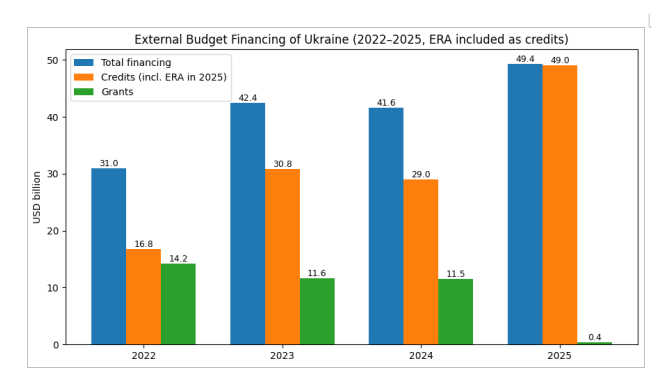
Financing of the State Budget of Ukraine for 2022-2025 according to the Ministry of Finance of Ukraine.
(Note: in 2025, the difference between the total volume of external financing and the amount of loans and grants is due to the use of the ERA mechanism (reparation lending against future income from frozen assets of the Russian Federation), which does not apply to classical forms of external assistance.)
2022: Emergency support and a high share of grants.
In 2022, Ukraine received $31 billion in external budget financing. This period was characterized by a relatively balanced ratio of loans and grants. The United States played a significant role, providing a significant portion of its aid in the form of non-repayable grants, which allowed the budget deficit to be quickly closed without increasing the debt burden. The European Union and international financial institutions complemented this support.
2023: Peak financing and a shift towards loans.
The year 2023 marked the peak in terms of external support, reaching approximately $42.4 billion. However, it was during this period that a qualitative shift occurred: the share of loans increased sharply, while the grant component began to decline.
The European Union emerged as a key donor, providing large-scale macro-financial assistance, primarily in the form of loans. The role of the United States declined in relative terms, although it remained an important political and financial actor.
2024: Stabilization of volumes and institutionalization of aid.
In 2024, external budget financing remained high—approximately $41.6 billion —but the aid model became more institutionalized and predictable. EU and international financial institution loans dominated, while grants remained but stopped growing. US support continued to decline, particularly in terms of direct budget transfers, increasing Ukraine's dependence on European mechanisms.
2025: Structural break and disappearance of grants.
The year 2025 marked a qualitatively new stage. In fact, by December, Ukraine received approximately $49.36 billion in external budget financing, but almost all of this amount came from loans. Grant support was reduced to a symbolic level, and the key source became ERA loans secured by special mechanisms, including future income from frozen Russian assets. Crucially, in 2025, the United States effectively ceased providing direct budget funding to Ukraine —either grants or loans. This signifies the United States' de facto withdrawal from its role as a direct budget donor, while maintaining political and strategic influence.
***
Thus, the financial stability of the budget in 2025 was ensured not by the growth of economic revenues, but systemic external support, making the issue of continued international support central to 2026. The entire external financing system has transitioned to an almost entirely debt-based model.
The key transformation of 2025 is the transition from grants to credit and instrumental schemes (ERA loans), which formally reduces the current fiscal burden but increases long-term liabilities.
The US role has undergone the most dramatic transformation. While in 2022–2023, Washington was a key source of budget funds, especially grants, by 2025, direct US participation in financing the Ukrainian budget has ceased. Support has shifted to political guarantees, defense decisions, and indirect financial mechanisms.
The European Union, by contrast, became a systemic donor in 2023–2024 and retained its participation in 2025, but on a limited scale. At the same time, the EU also transitioned from a solidarity grant model to a loan-based model, reducing the direct burden on member states' budgets.
This means that sustainability Ukraine's budget in 2026 will depend not so much on the volume of aid as on the terms of debt servicing, the political will of partners, and the ability of the economy to adapt to life in a “future-financing” mode.
According to the debt strategy approved by the government, Ukraine will spend approximately 10% of its expected GDP annually on servicing and repaying its public debt over the next three years, which will create a significant fiscal burden on the budget. In 2025, total debt repayment and interest costs are estimated at UAH 1.05 trillion (11.7% of GDP), in 2026 – UAH 1.17 trillion (11.3% of GDP), in 2027 – UAH 1.26 trillion (10.5% of GDP), and in 2028 – UAH 1.29 trillion (9.5% of GDP).
The debt structure increases sustainability risks: approximately 75% of government debt is external, and 77% of liabilities are denominated in foreign currency (including approximately 2% of government bonds denominated in foreign currency). The Ministry of Finance notes that this configuration creates increased currency risks, making government debt dynamics sensitive to exchange rate fluctuations and external financing conditions in the medium term.
3. State budget of Ukraine for 2026.
On December 3, the Verkhovna Rada adopted the Law of Ukraine (Bill No. 14000) "On the State Budget for 2026" in its second reading. The document confirms the main priority of state funding: defense and national security. According to the Ministry of Finance, all domestic revenues and borrowings in 2026 will be allocated exclusively to strengthening defense capability: military personnel, weapons procurement, combat readiness support, logistics, and the formation of strategic reserves. This represents almost 60% of all budget expenditures. However, the 2026 budget does not provide for an increase in military salaries.
Following the government's revision of the budget conclusions for the second reading, revenues were increased by UAH 27.8 billion to UAH 2 trillion 904.6 billion. The general fund amounts to UAH 2 trillion 610.9 billion, while the special fund amounts to UAH 293.7 billion. Revenues in 2026 will be UAH 402 billion higher than in 2025.
The main structure of own revenues in 2026:
VAT on imports - UAH 683.6 billion (+ UAH 89.8 billion by 2025);
Personal income tax and military tax - UAH 560.3 billion (+ UAH 78.3 billion);
VAT on goods and services produced in Ukraine — UAH 393.4 billion (+ UAH 75.4 billion);
Corporate income tax - UAH 325.3 billion (+ UAH 34.3 billion);
Excise tax – UAH 328.8 billion, namely:
- from imported goods – UAH 167.2 billion (+ UAH 6.7 billion);
- from Ukrainian goods – UAH 161.6 billion (+ UAH 26.7 billion).
Need for external support. The need for external support by 2026 will amount to UAH 2 trillion 79 billion. Resources are expected to be attracted from the World Bank, the EU, the UK, the IMF, and the G7 countries.
State Budget Expenditures. State budget expenditures and loans in 2026 will total UAH 4.824 trillion, an increase of UAH 121.2 billion compared to 2025. The general fund will total UAH 4.402.3 trillion, while the special fund will total UAH 421.8 billion.
The budget deficit for 2026 will increase to UAH 1.9 trillion, amounting to 18.5% of GDP.
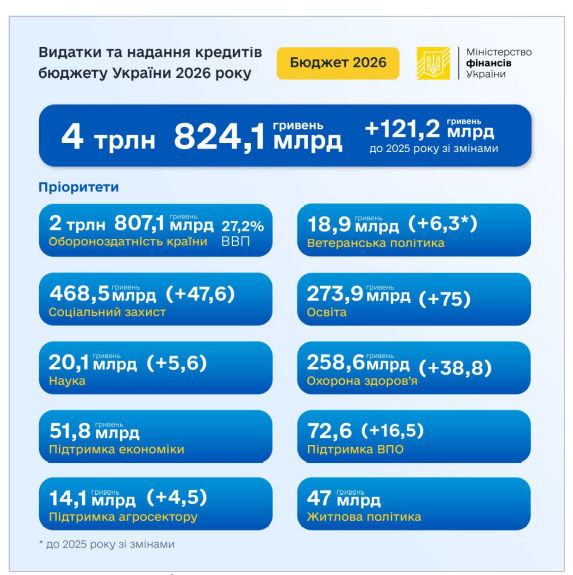
Budget financing:
Total funding – UAH 1 trillion 902.2 billion;
Government borrowings – UAH 2 trillion 549.8 billion, of which:
- external – 2 trillion 130.3 billion UAH;
- domestic – 419.6 billion UAH.
Debt repayment – UAH 656.8 billion, namely:
- external – 132.4 billion UAH;
- domestic – 524.4 billion UAH.
Privatization of state property – 2 billion UAH;
Changes in budget funds – UAH 7.2 billion.
Total expenditure on the defense and security sector in 2026 amounts to UAH 2 trillion 807.1 billion, or 27.2% of GDP. The general budget fund provides for UAH 2 trillion 495.4 billion, of which:
1 trillion 272.9 billion UAH – monetary allowances for military personnel and salaries of employees in the security and defense sector;
709.8 billion UAH (+1 billion UAH compared to the second reading) – purchase of weapons and military (special) equipment, in particular, drones, ammunition and equipment;
373.7 billion UAH – other defense-related areas;
139 billion UAH – reserve funds (rapid response to emergency calls).
The budget also provides UAH 30 billion in state guarantees for enterprises fulfilling critical defense contracts and expanding the defense industry.
The special fund provides an additional UAH 281.7 billion for defense programs and investments in weapons production.
A separate priority is the development of the defense-industrial complex: UAH 44.4 billion will be allocated to the creation of new and expansion of existing production capacities for the manufacture of ammunition, missiles, air defense systems, and other defense products.
Almost 21 billion hryvnias have been allocated to strengthen the country's energy security. Specifically, expenditures are planned for:
restoration and development of energy infrastructure – UAH 3.7 billion;
implementation of the energy sector reform and development program – more than 11 million UAH;
physical protection of nuclear facilities and materials – almost 81 million UAH;
implementation of work in the field of non-nuclear cycle radioactive waste management, construction of the Vector complex and operation of its facilities – UAH 714 million;
maintaining the Shelter units and facilities in a safe condition and measures to decommission the Chernobyl Nuclear Power Plant – UAH 1.6 billion;
maintaining environmental safety in exclusion zones and unconditional (mandatory) resettlement – more than UAH 490.6 million;
radiological protection of the population and improvement of the environment of the territory subject to radioactive contamination – more than 166.4 million UAH;
Budget programs financed by international loans for the preparation and implementation of public investment projects total nearly UAH 10 billion. Specifically, these projects focus on the reconstruction of hydroelectric power plants, improving the reliability of electricity supply in Ukraine, supporting critically needed distributed generation and modernizing substations, and more.
The 2026 Budget allocates over UAH 1.5 billion to finance the United Marathon [it’s a unified national 24/7 TV news broadcast created during the war, where all major Ukrainian TV channels merged into one coordinated program to provide verified information, – translator’s note].
Veterans policy.
18.9 billion (+6.3 billion UAH by 2025), in particular:
5.7 billion UAH (+1.7 billion UAH) – compensation for housing for veterans with disabilities;
4 billion UAH (+2.6 billion UAH) – national military memorial cemetery;
4 billion UAH (+0.5 billion UAH) – measures to support and assist veterans, in particular:
1.4 billion UAH (0.2 billion UAH) – "Sports Assistance," training certificates, Ukrainian Veterans Fund
UAH 0.3 billion – new projects: vehicle refurbishment, palliative care, burn treatment, and rehabilitation for the blind
2.9 billion UAH (+0.9 billion UAH) – support specialists;
1.1 billion UAH (+0.6 billion UAH) – veteran spaces;
1 billion UAH (+0.2 billion UAH) – dental prosthetics and dental treatment.
Social protection.
468.5 billion UAH (+47.6 billion UAH by 2025), including:
251.3 billion UAH (+14.4 billion UAH) – transfer to the Pension Fund (annual transfer will be made from March 1) indexing pensions. Coefficient growth pensions will defined in February 2026);
UAH 133.5 billion (+ UAH 3.8 billion) – social payments to vulnerable categories:
9.2 billion UAH (+4.8 billion UAH) – basic assistance;
48.4 billion UAH – support for IDPs [internally displaced persons],
42.3 billion UAH – benefits and subsidies;
UAH 24.5 billion – programs to support families with children (in particular, new programs):
- increase in the one-time payment at birth from 10,000 to 50,000 UAH;
- increasing the amount of the monthly child care allowance for a child under one year of age from UAH 860 to UAH 7,000;
- introduction of a new monthly allowance for child care from one to three years of age when parents return to work – 7,000 UAH;
- continuation of the provision of one-time financial assistance to first-grade students “Schoolchild’s Package” - 5000 UAH,
9.9 billion UAH (+3.2 billion UAH) – support for persons with disabilities;
UAH 2.4 billion (+ UAH 0.8 billion) – provision of national social services (Resilience Centers, screening services and shelters for IDPs, supported housing "money follows the person").
Education.
278.7 billion UAH (+79.8 billion UAH by 2025), including:
UAH 195.3 billion (+ UAH 55.4 billion by 2025), which takes into account a 30% increase in the salaries of teaching and research and teaching staff from January 1, 2026. The Government has also been instructed to develop a new system of teacher remuneration, which should be implemented from September 2026;
14.4 billion UAH – free school meals (within a year, the reform will cover 3.5 million students in grades 1-11);
6.6 billion UAH (+1.2 billion UAH) – doubling of academic scholarships from September;
2.1 billion UAH (+0.7 billion UAH) – purchase of 14.1 million textbooks for grades 4 and 9;
17 billion UAH (+5.2 billion UAH by 2025) – investment projects (construction of food facilities and shelters, including in kindergartens – 1 billion UAH, as well as the purchase of buses).
Science.
20.1 billion UAH (+5.6 billion by 2025), in particular:
3.2 billion UAH (+3 billion UAH by 2025) – support for science based on the principle of “funding where there are results”;
1 billion UAH – creation of scientific centers for defense developments (new experimental project);
0.7 billion UAH (+0.4 billion UAH) – support for scientific projects of young scientists;
0.1 billion UAH – business and science: effective cooperation (new competition for applied developments).
Healthcare.
258.6 billion UAH (+38.8 billion UAH by 2025), including:
UAH 191.6 billion (+ UAH 16.1 billion) – medical guarantees program, in particular:
UAH 141.9 billion (+ UAH 8.6 billion) – treatment, rehabilitation, severe injuries, burns, cardiac surgery, oncology
41 billion UAH (+5.1 billion UAH) – increase in salaries for primary and emergency medical care physicians to 35 thousand UAH;
8.7 billion UAH (+2.4 billion UAH) – free medications, in particular for the treatment of cardiovascular diseases, diabetes and other chronic diseases.
15.2 billion UAH – centralized procurement of medicines (oncology drugs, cardiovascular drugs, drugs for orphan diseases, endoprosthetics, donation, etc.);
10 billion UAH – a new health screening program for people aged 40 and over (targeted payments of 2,000 UAH for 5 million people);
UAH 19.1 billion (+ UAH 8.3 billion) – public investment projects: maternity and childhood care, rehabilitation, psychiatric care, medical equipment. Measures to support demographic development – UAH 24.5 billion.
Support for people who left their homes due to war (internally displaced persons) - UAH 72.6 billion (+ UAH 16.5 billion by 2025).
Economic support – UAH 51.8 billion, namely:
18 billion UAH – the entrepreneurship development fund "Affordable loans 5-7-9%";
UAH 17.1 billion – eOselya [eOselya is a Ukrainian government‑backed mortgage program that offers low‑interest home loans to eligible citizens, – translator’s note];
7.4 billion UAH – innovation fund;
4.9 billion UAH – business support programs;
1.9 billion UAH – decarbonization fund;
1.9 billion UAH – American-Ukrainian investment recovery fund;
0.6 billion UAH – energy efficiency fund.
Housing policy – 47 billion UAH.
Agro-industrial complex – 14.1 billion UAH (+4.5 billion UAH until 2025), namely:
9.5 billion UAH – financial support for agricultural producers (subsidy per 1 hectare for frontline territories, insurance of agricultural products, irrigation/land reclamation – 0.2 billion UAH);
2.6 billion UAH – support for farmers (loans, subsidies per 1 hectare, subsidies for cows, goats and sheep);
2 billion UAH – humanitarian demining of agricultural lands.
Transfers to local budgets – UAH 283.9 billion, namely:
167.8 billion UAH – salaries of school teachers (additional resources for increasing prestige are taken into account – 59.9 billion UAH);
30.4 billion UAH – additional subsidy to local governments;
30.8 billion UAH – basic subsidy;
14.4 billion UAH – subvention for children’s nutrition;
14 billion UAH – subvention for education/public investment projects;
12 billion UAH – subventions for social protection;
5.2 billion UAH – healthcare subventions;
5.2 billion UAH – additional subsidy for the functioning of territories where military operations are taking place;
4.1 billion UAH – other subventions and grants.
Public investments.
111.5 billion UAH (+14.5 billion UAH by 2025), including:
UAH 41.2 billion – transport;
19.1 billion UAH – healthcare;
17.0 billion UAH – education and science;
13.6 billion UAH – energy;
9.4 billion UAH – municipal infrastructure and services;
5.7 billion UAH – social sphere;
2.0 billion UAH – state fund for regional development;
UAH 3.5 billion – other areas (legal activities, public safety, digitalization, environment, housing, public finance).
Ukraine's draft budget for 2026 does not include any election-related expenses. However, the very nature of the document may indicate that the government is indirectly laying the groundwork for potential electoral processes. Notably, the draft budget for 2026 includes increased social spending, wage and pension increases, and maintains significant funding for state media tools, including the telethon (UAH 1.5 billion) [it’s a unified national 24/7 TV news broadcast created during the war, where all major Ukrainian TV channels merged into one coordinated program to provide verified information, – translator’s note]. This set of priorities indicates the government's attempt to secure public loyalty and create a positive atmosphere ahead of potential electoral processes.
Ukraine's budget deficit: "military reality" and prospects.
Ukraine's fiscal sustainability is directly dependent on international support and success in securing long-term financing. However, there is a growing risk that, given low growth rates, the country's economy will not be able to sustain such a high debt burden without serious structural reforms.
$40 billion and $50 billion in external financing annually to cover its basic budget needs in 2026–2027. Moreover, a significant portion of the costs for the procurement of weapons and military equipment remains outside the state budget, further increasing the burden on partners and donors.
UAH 300 billion (approximately USD 7.2 billion ) as early as 2026. Ukrainian Finance Minister Serhiy Marchenko specifically stated that at least USD 6 billion will be needed to be raised by the end of the year to cover current needs. And according to Defense Minister Denys Shmyhal, the country will need at least USD 120 billion in defense spending in 2026 to approach parity with the Russian Federation in the military sphere.
In 2025, the deficit will amount to almost UAH 1.9 trillion, or 18.4% of GDP. This is an extremely high figure, but without this level of borrowing, it is impossible to provide for the army, with defense spending exceeding UAH 2.8 trillion, or to fulfill the state's social obligations—increasing wages, pensions, and the cost of living, which are devalued by inflation. Based on European standards, the optimal deficit level for an EU candidate country should be within 3% of GDP, as required by the Maastricht criteria. Ukraine adhered to this framework from 2015 to 2019 and plans to return to it in the future. According to the forecast, the deficit should gradually decline: to 5.1–5.2% of GDP in 2027 and to 3.8% of GDP in 2028. However, such figures are only possible with accelerated economic growth (+5% in 2027 and +5.7% in 2028). In reality, the situation is much more complex: in 2026, the minimum economic growth since 2023 is expected – only +2.4%.
-
Conclusions and forecasts for 2026.
In 2026, Ukraine will likely face the need to appeal to a direct popular mandate— through elections and/or a referendum— since breaking the current military-political and institutional impasse without renewing the government's legitimacy will be extremely difficult.
Achieving a ceasefire or any peace format —even a compromise or partial one—will trigger the opposite dynamic. Peace will automatically lead to a resumption of active political life, the return of competition, the unblocking of electoral processes, and a rebalancing of the balance of power, a shift that was already evident in late 2025. In this case, 2026 could bring a new parliamentary coalition, a renewed government, and, in the medium term, a real possibility of a change of the President of Ukraine.
If a sustainable ceasefire is not achieved in 2026 and hostilities are not stopped as a result of any political agreements, the Russian offensive will continue, and its pace may accelerate due to accumulated resources, the adaptation of the Russian military-industrial complex, and the depletion of Ukrainian reserves.
Russia will attempt to seize the entire Donetsk region and create a so-called "buffer zone." The Zaporizhzhia region remains the most vulnerable. (with a direct threat to the city of Zaporizhia) – Chernihiv, Sumy, and Kharkiv regions. Fighting for this "buffer zone" could become protracted, without any sudden breakthroughs, but with a gradual expansion of the instability zone along the border.
From a military perspective, the likelihood of Ukraine losing all of Donbas remains high, although this scenario would not necessarily involve capitulation or a complete collapse of the front. Rather, it would involve gradual displacement, localized retreats, and resource depletion while maintaining control of the army and state.
The continuation of the war automatically leads to a further tightening of the internal "screws": strengthening mobilization practices, tightening control over society, lowering the mobilization age, and also to a reduction in civil and political liberties.
In this case, the harsh mobilization policy will continue: pressure on the Ukrainian Armed Forces' recruitment system will mount, and the risk of lowering the mobilization age to 22–23 years (in some scenarios, to 20 years) will increase significantly. This will be less a political choice than a necessary response to demographic decline and combat losses.
The socio-demographic consequences will intensify. Population outflow will continue (including general migration and the departure of young men of pre-conscription age), further narrowing the economic base, exacerbating the labor market crisis, and increasing the burden on the social support system.
Taken together, 2026 in this scenario looks like a year of protracted attrition: without a sharp defeat, but also without a strategic turning point, with growing military, demographic, and socio-political risks for Ukraine.
The likelihood of continued war is higher than the likelihood of achieving a real peace agreement in the near future. Therefore, Ukraine will continue to prepare for active defense and asymmetric warfare: defensive actions on the front line will be accompanied by attacks on the Russian rear, energy infrastructure, warehouses, railway junctions, and sabotage on Russian territory .
A compromise scenario for a peace settlement is also currently considered less likely. The Ukrainian government might begin to seriously consider compromise scenarios involving strategic concessions only if Europe's position changes—specifically, the European "troika" of Great Britain, France, and Germany. And only if Ukraine faces the threat of a complete loss of their aid and support or inevitable military defeat. In that case, Ukraine will be forced to seek compromise, temporary solutions with Russia. But before that point, this is unlikely. This is precisely why it is currently virtually impossible to find a realistic balance of compromises between the parties. Russia, for its part, also believes that it is gradually and slowly winning this war and will achieve all its goals within a year or several years. Therefore, Russia, too, is in no rush to make any strategic concessions. And this is a problem for Ukraine.
The Trump administration will seek to push through the signing of interim agreements with Kyiv, which it will then present to Moscow as a demand. Therefore, increased pressure on Kyiv is possible: increased public criticism of Ukrainian President Volodymyr Zelenskyy, an emphasis on Ukraine's "ingratitude," possibly a temporary suspension of some aid or delays in approving military supplies, or a temporary suspension of intelligence sharing. However, a complete breakdown in relations is not expected: the US will maintain a negotiating channel to avoid completely ceding the initiative to Russia and provoking a sharp destabilization of the front. This is because, according to the US plan, approximately 80% of Ukraine should remain within the Western zone of influence.
Representatives of the Ukrainian elite also continue to count on future political changes, a shift in agenda, or internal crises in Russia and the United States.
Moscow and Washington could similarly adopt a wait-and-see approach, assuming that the Russian army will capture the entire Donbas within 12–24 months and gain a more advantageous position, thereby creating new leverage over Kyiv.
In such a situation, there is no realistic scenario for ending the war in the short term (up to 3 months).
In the long term, realistic scenarios for ending the war could be:
- the removal/resignation/significant weakening of Vladimir Putin or Volodymyr Zelenskyy (elections, referendums on a peace settlement); the replacement of one of the key leaders could create a window of opportunity for a radical reconsideration of approaches to the war. In the case of Ukraine, this would potentially lead to a shift in strategy, allowing forces oriented toward compromise and peace on Trump's terms to come to power. In the case of Russia, the removal of Putin, while less likely (due to illness, aging elites, a “palace coup”, etc.), could generally prompt a reassessment of foreign policy priorities and a willingness to negotiate, but the prospect of replacing Putin is more likely to lead to further radicalization of Russia's stance on Ukraine.
- Internal destabilization of Russia, Ukraine, or their most important allies—the US, EU, and China; any major domestic crises—mass protests, new corruption scandals involving the government, economic collapse, regime change, or military mutinies—could abruptly shift attention from foreign policy priorities to domestic survival. For Ukraine, this could mean a loss of governance and, as a consequence, an accelerated peace agreement under the proposed terms. For Russia, this could mean regime undermining, but for now, this scenario is less likely than in Ukraine. For the US, EU, or China, this could mean abandoning the Ukrainian issue for the sake of their own stabilization (e.g., internal and regional conflicts over elections, recession, etc.).
- termination of military aid (intelligence, target designation, early missile warning, etc.) and the US presence in the conflict; the US could implement this scenario if it becomes completely convinced of Ukrainian sabotage. The cessation of Pentagon (or key intelligence agencies) assistance would create an asymmetry in Russia's favor. Without American technical support, Ukraine would lose the ability to carry out precision strikes, defend against missiles, and coordinate the front. This would create pressure on Kyiv to accept unfavorable terms or lose control of new territories.
- a sharp reduction (by a factor of 2 or more), or even a cessation of EU aid, and especially the "European Troika" (Britain, France, Germany), to Ukraine. If the "European Troika" curtails financial, military, and political support, Ukraine will find itself in a situation of unilateral dependence on the US or will be forced to seek its own options for freezing the conflict. This could be caused by internal crises (budget, elections, migration) or a political turnaround under US pressure. A refusal of aid will impact economic stability, arms supplies, and the motivation of Ukrainian elites. Or, sanctions will close Russia's international trade.
- military exhaustion of both sides (mobilization, financial, and so on); a protracted war of attrition will lead to critical depletion of both countries' resources, especially Ukraine, which suffers from a shortage of manpower, finances, and ammunition. The structural parity of forces is not in its favor: Russia has a larger mobilization reserve, a more resilient economy under mobilization, etc. If the current phase of the conflict persists—i.e., high-intensity fighting, limited Western supplies, and fatigued mobilization resources—Ukraine is capable of maintaining the frontline in relative equilibrium for 6 to 12 months (when the frontline gradually begins to crumble), but with increasing tension.
- Russia's achievement of its stated goals of occupying five regions of Ukraine and creating buffer zones around the perimeter. If Russia succeeds in capturing the entire Donbas, its further advance through Ukrainian territory will run into the White House's position—Trump's, who will be categorically opposed to further seizures. And then this will become a matter of complex US-Russian relations.
- a military defeat of one of the parties as a result of a long, exhausting war.
In a more protracted scenario, the US could also wait until Russia seizes the entire Donetsk Oblast and a significant portion of the Zaporizhia Oblast —and then attempt to persuade Russia, through pressure and negotiations, to stop moving forward and settle for the territories already captured in exchange for the lifting of sanctions and recognition of these territories as Russian territory. The issue could also be resolved through referendums in Ukraine. For example, complex peace settlement issues could be put to a nationwide referendum.
On the international situation in 2026.
Two interconnected geopolitical fault lines will become increasingly apparent in the international system and will intensify in parallel.
The first line of cleavage, associated with the transformation of the world order, will continue to divide the global space into the "Global West" and the "Global South." This represents a stratification of the world into two macro-blocs with different logics of development, security, trade, and technological sovereignty. Until the new international system is stabilized, the areas of contact between these blocs will become hotbeds of instability. This is why the confrontation is concentrated on the periphery—in Eastern Europe, the Caucasus, the Middle East, Latin America, and Southeast Asia, where the boundaries between the blocs are fluid. In 2026, the likelihood of various conflicts escalating in these regions is high.
The second line of rift runs within the West itself. It manifests itself in the growing confrontation between the conservative camp, associated with Donald Trump and the sovereigntist approach, and the liberal camp, whose core remains Brussels and institutional Europe. This rift does not destroy the Western world as a whole, but it fragments it internally, slows decision-making, and weakens the capacity for strategic consolidation and long-term leadership.
In this context, the 2026 elections take on strategic significance. The key election will be the US Congressional elections (November 3, 2026), which will determine the political future of incumbent President Donald Trump and the prospects for conservative American policy (depending on whether Republicans or Democrats win the majority in the House of Representatives and the Senate).
The elections in Hungary (April 2026) will influence the balance of power within the EU and the relationship between liberal and sovereigntist approaches in Europe.
The elections in Armenia (June 2026), in turn, could set new lines of tension in the Caucasus, becoming a point of intersection of the interests of the global South and the global West.
APPENDIX
Political calendar 2025
-
Republicans hold the White House and the US Congress, Washington transitions to an "America First" policy – January 2025.
-
The inauguration of US President Donald Trump is scheduled for January 20, 2025.
-
Suspension of USAID programs by Executive Order of the President of the United States. An executive order was signed to freeze foreign aid programs for 90 days for audit purposes. — January 20, 2025.
-
Russian control over Kurakhovo (Donetsk Oblast) was confirmed. Russian troops eventually captured the city after protracted fighting. — January 6, 2025.
-
Establishing Russian control over Velyka Novosilka (Donetsk Oblast). Consolidating Russian advance in the south of Donetsk Oblast. — January 26, 2025.
-
Ukrainian President V. Zelenskyy's controversial visit to the United States. White House talks culminated in a public confrontation with US President D. Trump. — February 28, 2025.
-
First US temporary suspension military assistance to Ukraine, including intelligence sharing. — March 1–7, 2025.
-
Discussions on the creation of an American-Ukrainian "reconstruction fund" begin in March 2025.
-
Telephone conversation between US President Donald Trump and Russian President Vladimir Putin. The contact marked the beginning of multi-channel negotiations between the US and Russia. — March 18, 2025.
-
The US and Russian delegations on Ukraine met in Riyadh. The parties failed to reach any agreements but agreed to continue the dialogue. — March 24, 2025.
-
The US will introduce a basic import tariff of 10% on all imports in April 2025.
-
The signing of an agreement on natural resources between the United States and Ukraine. Establishing a long-term US economic presence in Ukraine. – May 1, 2025.
-
A round of negotiations between Ukraine and Russia in Istanbul. Confirmation of the parties' rigid and incompatible positions. — May 15, 2025.
-
G7 Finance Ministers' Meeting in Banff, Canada. The United States did not support language on continued support for Ukraine in the final statement. — May 20–22, 2025.
-
SBU Operation "Web." Ukraine launched a massive drone strike against Russian strategic aviation on its territory. — June 1, 2025.
-
Exchange of memoranda between Ukraine and Russia during negotiations in Istanbul. The documents reiterated the parties' previous ultimatum positions. — June 2, 2025.
-
The third round of talks between Ukraine and Russia in Istanbul. The negotiation process continues without any real rapprochement between the two sides. — June 23, 2025.
-
NATO summit in The Hague. Support for Ukraine is confirmed, but its political level has clearly been downgraded. — June 24–25, 2025.
-
The second temporary suspension of US critical weapons supplies to Ukraine will take effect on July 1, 2025.
-
Donald Trump's announcement on resuming defensive arms deliveries to Ukraine. A tactical reversal without approving new large-scale aid packages. — July 7, 2025.
-
Reshuffle of the Ukrainian government, appointment of Yulia Svyrydenko as prime minister. An attempt to stabilize executive power. — July 17, 2025.
-
Signing of the Treaty of Friendship and Cooperation between Germany and Great Britain – July 17, 2025.
-
The EU approves the 18th sanctions package against Russia. Increased pressure on Russia's energy and financial sectors. — July 18, 2025.
-
The adoption by the Verkhovna Rada of Ukraine of crisis law No. 12414, which limited the independence of anti-corruption bodies – the National Anti-Corruption Bureau of Ukraine (NABU) and the Specialized Anti-Corruption Prosecutor's Office (SAPO). – July 22, 2025.
-
US President Donald Trump and European Commission President Ursula von der Leyen sign the US-EU trade framework agreement. in Turnberry (Scotland): - July 27, 2025.
-
Repeal of key provisions of Law No. 12414. Restoration of the institutional independence of NABU and SAPO. — July 31, 2025.
-
Signing of a peace treaty between Azerbaijan and Armenia – August 2025.
-
The mandate of Russian peacekeepers will end and they will withdraw from Karabakh in August 2025.
-
Russia establishes control over Toretsk (Donetsk Oblast). One of the longest defensive operations of the Ukrainian Armed Forces ends. — August 1, 2025.
-
Russia's lifting of unilateral restrictions under the INF Treaty. Escalation signal in the missile weapons sphere. — August 4, 2025.
-
Donald Trump and Vladimir Putin meet in Alaska to try to agree on a framework for a future settlement of the war. August 15, 2025.
-
Meeting between Donald Trump and Volodymyr Zelenskyy at the White House. Discussion of the peace track with the participation of European leaders. — August 18, 2025.
-
SCO summit in Tianjin — August 31 – September 1, 2025.
-
Presentation of the Global Governance Initiative by Chinese President Xi Jinping – August 31, 2025.
-
Violation of Polish airspace by Russian drones – September 10, 2025.
-
NATO announces Operation Eastern Guardian. The Alliance's response to Russian provocations on its eastern flank. — September 12, 2025.
-
The Zapad-2025 exercises will be held in Belarus from September 12 to 16, 2025.
-
A ceasefire agreement was reached between Israel and Hamas. — end of the active phase of the war in the Gaza Strip and transition to a regional de-escalation regime mediated by the United States. — October 9, 2025.
-
The introduction of the 19th EU sanctions package against Russia. Further expansion of economic and individual restrictions. — October 23, 2025.
-
The Mindichgate corruption scandal in Ukraine begins. One of the largest crises of power during the war. — November 10, 2025.
-
Publication of the full text of Donald Trump's 28-point peace plan. — November 20–21, 2025.
-
The resignation of the head of the Office of the President of Ukraine, Andriy Yermak. A key personnel change within the presidential vertical. — November 28, 2025.
-
Adoption of the State Budget of Ukraine for 2026. The budget remains critically dependent on external financing. — December 3, 2025.
-
The release of the new US National Security Strategy. The document enshrines the "America First" policy and the transactional model of alliances. — December 5, 2025.
-
Russia asserts control over Siversk (Donetsk Oblast). Another of the last Ukrainian Armed Forces strongholds in the region falls. — December 21, 2025.
-
Donald Trump and Volodymyr Zelenskyy's talks in Florida are Ukraine's attempt to amend key provisions of Trump's peace plan and restart US-Ukraine dialogue at the end of the year. — December 28, 2025.
Political calendar 2026.
-
NATO exercise Steadfast Dart 2026 will test the Alliance's ability to rapidly deploy forces and deter forces on its eastern flank against the backdrop of the ongoing war in Ukraine. January–February 2026.
-
In April 2026 – potentially changing the balance of power within the European Union.
-
The G7 summit in France (Evian) will discuss sanctions against Russia, further support for Ukraine, energy security, and the architecture of post-war reconstruction. June 14–16, 2026.
-
Parliamentary elections in Armenia—a de facto plebiscite on the Pashinyan government's foreign policy course and the country's orientation between the global West and alternative centers of power—will take place in June 2026.
-
NATO leaders' summit in Ankara – strategic decisions on Ukraine, the eastern flank, and the format of the Alliance's long-term relations with Kyiv – July 7–8, 2026.
-
The extension of EU sectoral sanctions against Russia is expected to be considered on July 31, 2026, as an indicator of the EU's ability to maintain unity and pressure on the Kremlin.
-
Parliamentary elections in the Russian Federation—an instrument of internal legitimization of power, mobilization policy, and possible voting in the occupied territories of Ukraine—will be held by September 20, 2026.
-
The 81st session of the UN General Assembly—a key global diplomatic platform where the Ukrainian issue, Russia's responsibility, and the humanitarian agenda will once again be at the center of international debate—will take place from September 22–29, 2026.
-
The midterm elections to the US Congress are a test of the viability and sustainability of Donald Trump's political course, determining the capabilities of his administration in the second half of his presidential term, including policy towards Ukraine. November 3, 2026.
-
The G20 Miami Summit, USA, will discuss the global economy, energy, and conflicts; Russia's possible participation creates the risk of diplomatic crises and new fault lines. December 14–15, 2026.
Ruslan Bortnik, Oksana Krasovskaya, Andrey Timchenko
UIP, 2025