Introduction
The People’s Republic of China is entering a new stage of modernization, as traditional sources of growth—demographic advantage, export expansion, and infrastructure investment—have exhausted their potential. Intensifying technological competition, sanctions pressure, and global fragmentation of the world economy compel Beijing to rethink its development strategy. In this context, the meetings of the National People’s Congress and the Chinese People’s Political Consultative Conference in March 2026 (“Two Sessions”) acquired key significance: they approved the Fifteenth Five-Year Plan (2026–2030), consolidating the transition from extensive growth to a model of “high-quality development.”
Within the political system of the PRC, the “Two Sessions” occupy a special place. They are not merely parliamentary and consultative procedures: they concentrate the political will of the country’s leadership, set strategic guidelines, and shape the long-term trajectory of development. Within their framework, plans for socio-economic development are approved, laws are adopted, and signals are transmitted both to society and to the international community. Thus, the “Two Sessions” function not only as an institutional mechanism but also as a symbol of the political system’s capacity for mobilization and strategic planning.
A distinctive feature of the 2026 meetings was that their agenda went beyond the usual annual cycle. Alongside the review of current reports and the budget, the draft of the Fifteenth Five-Year Plan was discussed, giving the meetings a dual character: summing up the results of the Fourteenth Five-Year Plan and setting strategic guidelines for the next five years. The year 2026 became a transitional milestone, when short-term measures and long-term strategies merged into a unified politico-economic system.
The relevance of analyzing the “Two Sessions” of 2026 lies in the fact that the Fifteenth Five-Year Plan institutionalizes the concept of “new productive forces” (新质生产力), proposed by Xi Jinping in 2023. The decisions adopted exert a direct influence on China’s long-term development strategy, defining priorities of sustainable growth, social harmony, and technological leadership. In the context of post-pandemic challenges and intensifying international competition, it is important to understand how these priorities are integrated into the new architecture of modernization.
The purpose of this study is to identify the key themes and tasks discussed at the meetings, compare them with previous planning cycles, and analyze macroeconomic signals. This approach makes it possible to assess how China adapts its strategies to new challenges and which directions determine the trajectory of its modernization in the coming years.
1. Agenda of the “Two Sessions” 2026: Institutional and Macroeconomic Signals.
In March 2026, meetings of the National People’s Congress (NPC) and the Chinese People’s Political Consultative Conference (CPPCC) were held in Beijing, marking an important historical milestone—the official approval of the Fifteenth Five-Year Plan (2026–2030). These “Two Sessions” served not only as a platform for summing up results but also as an institutional mechanism consolidating the transition of China’s economy from extensive growth to a model of “high-quality development.” The approved agenda reflects Beijing’s strategy of adapting to global geopolitical turbulence and technological pressure, setting macroeconomic and governance benchmarks for the coming five years [1].
The main outcome of the work was the adoption of the “Fundamental Provisions of the 15th Five-Year Plan for National Economic and Social Development,” a comprehensive document comprising 18 sections and 62 chapters [2]. The plan formulates China’s tasks at the stage of preparing to achieve the goals of socialist modernization by 2035. Among the conceptual innovations is the expansion of the doctrine of the “powerful state” (强国): in addition to previously established goals, new tasks were added for building agricultural, aerospace, energy, financial, and tourism powers, bringing their total number to sixteen [3]. This demonstrates the PRC leadership’s aspiration for comprehensive self-sufficiency in key sectors.
The institutional foundation of the new decisions rests on the development of “new productive forces” (新质生产力). A term actively used in political rhetoric in recent years, it was consolidated in the form of 109 megaprojects included in the Fifteenth Five-Year Plan [1]. These involve the introduction of breakthrough technologies—quantum computing, artificial intelligence, advanced semiconductors—into production chains. Particular emphasis was placed on the integration of the civilian technology sector and the defense-industrial complex, reflecting the course toward ensuring national security through technological development [4].
From an institutional perspective, the “Two Sessions” of 2026 recorded a departure from the model of fragmented market growth in favor of technological sovereignty based on centralized governance. Under conditions of external containment, the PRC leadership highlights the priority of mobilizing domestic resources for technological breakthroughs. The architecture of the Fifteenth Five-Year Plan is built on a combination of strategic centralization and stimulation of innovative activity at the regional level.
The macroeconomic agenda demonstrates a shift in the criteria of success for state governance. The document establishes 20 key indicators, more than a third of which are related to the social sphere and demography—employment, education, support for the aging population [3]. This requires regional authorities to move from a “GDP-centric” approach to a comprehensive assessment of sustainability. At the same time, the target GDP growth range is maintained at 4.5–5%, providing the macroeconomic foundation.
In the field of climate policy and energy security, new parameters were approved. A key benchmark is the reduction of GDP carbon intensity by 17% by 2030 compared to the 2025 level, as well as the doubling of renewable energy capacity [5]. The green transition is viewed not only as the fulfillment of international commitments but also as a tool for strengthening China’s position in global clean technology markets—electric vehicles, intelligent energy storage systems.
Significant changes also affect the financial sector. The creation of mechanisms for accelerated IPO access for strategic technology companies and the reform of the capital market are aimed at concentrating liquidity in priority innovative industries [6]. The state apparatus is tasked with coordinating fiscal, monetary, and industrial policy to form a “closed cycle” of financing science and technology.
Taken together, the institutional and macroeconomic signals of the “Two Sessions” 2026 record China’s transition to an economy of high-tech self-sufficiency. The emphasis is placed on the development of the domestic market, social resilience, and control over critical supply chains, while maintaining selective openness to foreign investment in high-tech clusters. Economic growth in the new paradigm is interpreted not as an end in itself but as a means of ensuring national security and technological leadership in the 21st century.
2. The New Architecture of Chinese Modernization.
In March 2026, the agenda approved at the “Two Sessions” marked the transition of China’s economy to a new architecture of modernization, where innovation and “new productive forces” became the central element of the Fifteenth Five-Year Plan. Unlike previous cycles, the emphasis shifted from quantitative growth to qualitative development, reflecting the strategic course toward technological sovereignty and comprehensive security.
The concept of “new productive forces” (新质生产力), proposed by Xi Jinping in 2023, received institutional consolidation and became the foundation of the Fifteenth Five-Year Plan. Official speeches emphasized that the development of these forces must ensure high-quality growth and economic competitiveness [10, 11]. This refers to the systemic introduction of advanced technologies—quantum computing, artificial intelligence, new materials, and semiconductors—into production chains. Chinese political advisors noted that such areas as superconductivity and quantum materials are considered key to overcoming technological bottlenecks and achieving the state’s strategic goals [9].
Overall, modernization is interpreted not as a quantitative increase in national wealth but as the creation of a high-tech, closed, and protected system capable of functioning under external pressure. This architecture rests on two pillars: innovative breakthroughs through the development of “new productive forces” and integral security encompassing ecology, demography, and domestic consumption.
The central element of the new model is the accelerated development of “new productive forces,” understood as a qualitative leap in production through technological innovation and digitalization. Unlike traditional growth factors, the new paradigm focuses on industries with high added value—photonics, bioengineering, deep-sea research. Within the framework of the Fifteenth Five-Year Plan, the implementation of ten national megaprojects was initiated, aimed at overcoming technological “chokepoints” created by Western export restrictions.
Special attention is given to the creation of integrated scientific and industrial clusters in the Greater Bay Area (Guangdong–Hong Kong–Macau) and the Yangtze River Delta. These regions are becoming testing grounds for mechanisms of a “new type of nationwide resource mobilization,” where state strategic planning is combined with the flexibility of private venture capital. Projects such as the national quantum communication network and fully automated intelligent factories are intended not only to meet domestic demand but also to establish new global standards for Industry 4.0.
Thus, a transition is taking place from a catch-up development model to one of technological leadership. The Fifteenth Five-Year Plan consolidates megaprojects as institutional mechanisms for the accelerated introduction of innovations. Unlike previous cycles, innovation is viewed not as the result of market competition but as the product of targeted resource mobilization under state control [7, 8].
The new architecture of modernization is built on the principle of comprehensive security, where economic, social, and ecological factors are interconnected. In the 2026 government report, the target GDP growth range was set at 4.5–5%, reflecting the abandonment of the previous “GDP-centric” approach and the emphasis on sustainability [12].
An important place is occupied by internal resilience. The Five-Year Plan establishes indicators related to employment, education, and support for the aging population, requiring regional authorities to conduct a comprehensive assessment of sustainability [13]. The strategy of “new productive forces” is aimed at overcoming the “middle-income trap” through the creation of an independent technological ecosystem. Under conditions of sanctions and trade barriers, China is undertaking large-scale investments in fundamental science, recognizing that leadership in artificial intelligence and new materials is a key condition for competitiveness in the 2030–2050 horizon. This effectively signifies a transition to a model of “innovation mercantilism,” where the state acts as the main investor and customer of innovations.
The second contour of the architecture is linked to domestic demand. In the context of volatile external markets, Beijing is strengthening the strategy of “dual circulation,” emphasizing domestic consumption as the primary driver of growth. In 2026, this process was tied to reform of the income distribution system and the strengthening of social protection. To stimulate demand, mechanisms of direct household subsidies through “digital yuan” programs are being introduced, and access to social services in rural areas is being expanded, which should reduce the savings rate and activate consumer activity.
Social stability is viewed through the prism of demographic adaptation. Population aging implies not only measures to increase birth rates but also the development of the “silver economy”—an industry of goods and services for the elderly, integrated with digital healthcare technologies. At the same time, the accelerated ecological transition is becoming an instrument of industrial modernization. China seeks leadership in “green inflation,” using environmental standards to eliminate outdated industries and stimulate demand for clean technologies.
Energy sovereignty remains a key element of comprehensive security. Within the framework of the “Beautiful China Initiative,” measures were approved to reduce carbon intensity and double renewable energy capacity. In 2026, mass deployment of carbon capture technologies and the development of next-generation nuclear energy began, reducing dependence on hydrocarbon imports via vulnerable maritime routes. The Chinese press emphasizes that harmony between man and nature is now regarded as a distinctive feature of modernization [16]. An example is the management of the Yellow River basin, where ecological security is linked to high-quality development [14].
Thus, the ecological agenda has been transformed from a burden into a strategic advantage and an instrument of national security. China is shaping a model of “high-quality development,” where economic growth becomes a tool of national security, social resilience, and technological leadership. The new architecture of modernization demonstrates a combination of state control and social engineering. The key challenge remains the ability of the administrative apparatus to balance expenditures on technological megaprojects and social commitments without increasing the debt burden, which requires high efficiency of state governance.
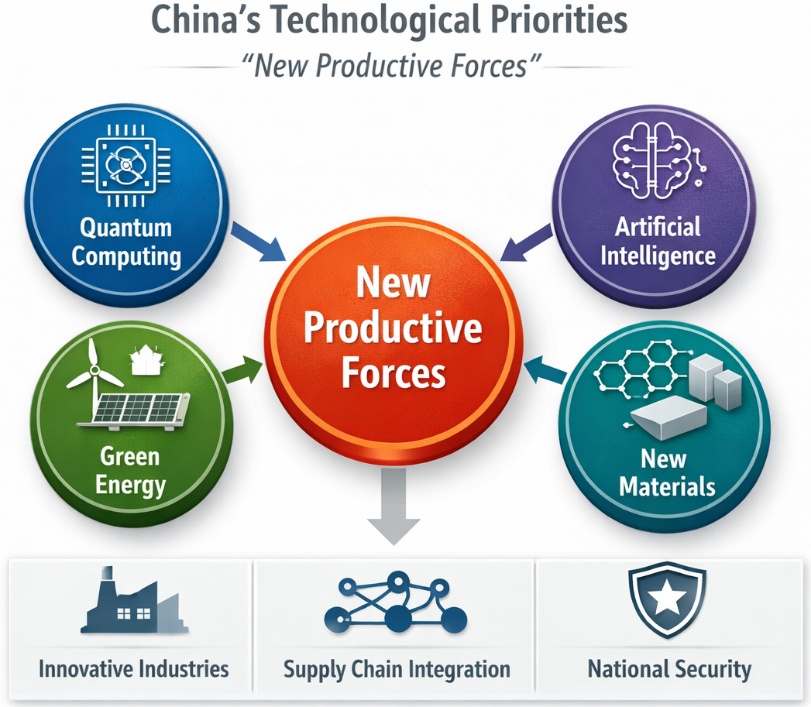
Thus, the transition to the new architecture of modernization in China signifies a departure from the catch-up development model and a shift to a strategy of technological leadership. At the center of this transformation stands the concept of “new productive forces,” consolidated in the Fifteenth Five-Year Plan and encompassing key areas—quantum technologies, artificial intelligence, new materials, and green energy. These spheres are integrated into national megaprojects, where the state acts as the main coordinator and investor, while private capital and science are incorporated into a unified system. This model is aimed at building a closed technological ecosystem capable of functioning under external pressure, placing emphasis on autonomy and resilience as the foundation of economic security
3. Evolution of Planning: Comparative Analysis of the 14th and 15th Five-Year Plans.
The contours of the Fifteenth Five-Year Plan (2026–2030), approved at the “Two Sessions” of 2026, represent an important stage in the development of China’s planning system. The main emphasis has shifted from crisis stabilization to long-term structural transformation. Whereas the Fourteenth Five-Year Plan (2021–2025) functioned as a “buffer” after the pandemic, helping to adapt to external shocks and launching the strategy of “dual circulation,” the new cycle consolidated the concept of “new productive forces” as the main driver of modernization. Documents presented at the NPC sessions record the abandonment of the race for high GDP growth rates: the target indicator for 2026 was set at 4.5–5% [17]. Instead, a system of qualitative indicators is introduced—energy intensity, share of the digital economy, level of technology adoption—reflecting the aspiration for flexible economic management under conditions of global uncertainty.
The shift from a catch-up growth model to structural transformation became the central element of the Fifteenth Five-Year Plan. Previously, economic success was ensured by infrastructure investment, demographic advantage, and export expansion. These resources have been exhausted, while the global economy has become more fragmented. Unlike the Fourteenth Plan, which emphasized the need for scientific breakthroughs and the first steps toward technological independence, the new document focuses on applied implementation of innovations. Quantum computing, biomanufacturing, and artificial intelligence are to be integrated directly into production chains [18]. China’s goal is not catch-up development but the creation of its own technological ecosystems capable of setting global standards and modernizing traditional industries through digitalization and ecological transition [19].
These changes directly affect strategic priorities. In the Fifteenth Five-Year Plan, social policy, technological sovereignty, openness, and defense are considered interconnected elements of a unified system of national security and development. Thus, while in the Fourteenth Five-Year Plan social policy was focused on poverty alleviation, it is now linked to the technological course: robotics and AI development are interpreted as responses to population aging and shrinking labor resources [17].
The understanding of “openness” has also changed. China is moving away from simply increasing foreign trade turnover and toward selective openness: foreign investment is permitted primarily in high-tech industries and green energy. At the same time, integration of civilian technologies into the defense sector is being strengthened, intended to ensure resilience under sanctions pressure [18].
Technological sovereignty is now directly tied to national security. Whereas earlier the focus was on gradual modernization and import substitution, today’s strategy envisions the creation of asymmetric capabilities under conditions of strict external containment. Artificial intelligence, quantum technologies, and new semiconductors are becoming not only economic drivers but also the foundation of strategic survival [20]. China is betting on the broad application of AI in traditional industries—for example, through the “AI Plus” initiative. This is intended to create redundant supply chains and guarantee uninterrupted functioning of both civilian and defense sectors even under technological blockade.
Against this backdrop, “high-level openness” and social policy acquire a pragmatic character. Despite statements about stimulating domestic consumption, the real priority is industrial modernization. Social stability is interpreted as the result of citizens’ involvement in the high-tech economy [21]. Foreign investment is attracted only in areas where China requires additional competencies.
Thus, the transition from the Fourteenth to the Fifteenth Five-Year Plan signifies the abandonment of hopes for global interdependence. China is shaping a self-sufficient system in which technological leadership and industrial strength become key instruments of national security in a multipolar world.
It is important to emphasize that each Five-Year Plan has led to transformations in the strategic logic of China’s development, resulting in a planned shift of emphasis—from extensive growth and orientation toward global integration to an innovative and self-sufficient model. Whereas earlier plans concentrated on infrastructure, demographic advantage, and exports, subsequent cycles gradually increased attention to domestic demand, ecological policy, and innovation. The Fourteenth Five-Year Plan became a transitional stage, consolidating the strategy of “dual circulation” and the first steps toward technological independence, while the Fifteenth institutionalized the concept of “new productive forces” and set the framework for qualitative development.
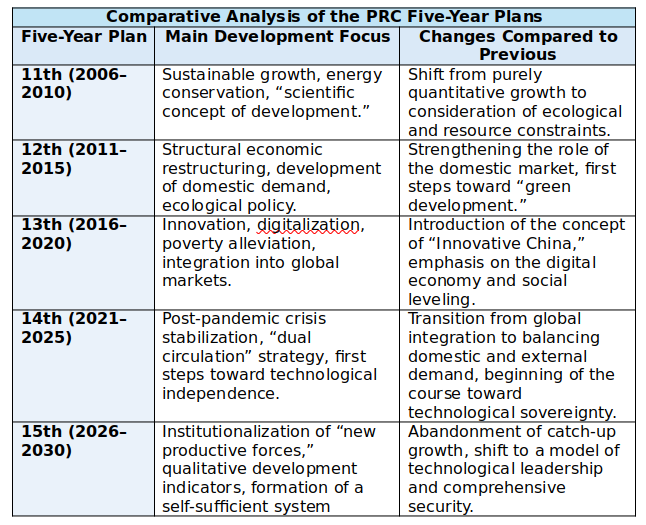
It should be noted that China has generally managed to achieve the key goals of its Five-Year Plans, but the degree of implementation has been uneven. The 11th and 12th Plans ensured sustainable growth and the first steps toward ecological restructuring, yet dependence on exports remained. The 13th Plan brought successes in digitalization and poverty alleviation, but technological independence remained limited. The 14th Plan stabilized the economy after the pandemic and launched the “dual circulation” strategy, but the course toward technological sovereignty only began to take shape. The 15th Plan marks the transition to qualitative indicators and the institutionalization of “new productive forces,” but its success will depend on the ability to secure real breakthroughs in key technologies and to cope with demographic challenges.
Therefore, by 2030 China will most likely achieve its goals in labor productivity growth and consolidate leadership in certain technological sectors. However, full self-sufficiency remains a challenge: dependence on external raw material markets and the need for large-scale investment in fundamental science may slow implementation. In the long-term perspective (up to 2035), success will be determined by the ability of the administrative apparatus to combine the economy of the future, social resilience, and political resolve into a unified system, minimizing the costs of transition to an autonomous development model.
4. Long-Term Trajectory of PRC Development: Integration of the Decisions of the 2026 “Two Sessions” into the Strategy up to 2035 and Prospects for Modernization under Global Uncertainty.
The decisions adopted at the “Two Sessions” of 2026 officially launched a key stage of the long-term strategy “Vision 2035,” aimed at achieving the goals of socialist modernization. In this logic, the Fifteenth Five-Year Plan (2026–2030) plays the role of a transitional bridge: it must transform accumulated quantitative growth into qualitative structural advantage. The documents approved in Beijing record a rethinking of the criteria of national success: instead of focusing on rapid GDP growth, the main benchmarks become system resilience, technological independence, and quality of life for citizens [22].
Integration of the 2026 decisions into the strategy up to 2035 is built on the accelerated introduction of “new productive forces” into the real sector. China is abandoning the role of the “world’s factory” of cheap goods and seeks to become the architect of advanced industrial ecosystems. The country’s new role in the global economy is linked to leadership in quantum computing, mechanical engineering, and green energy [23].
In conditions of global uncertainty, technological competition, and geopolitical fragmentation, China positions itself as a macroeconomic stabilizer. In official rhetoric, the Fifteenth Five-Year Plan is presented as an “oasis of certainty” in an unstable world, intended to strengthen the confidence of investors and partners in the Global South [1]. Behind this lies pragmatic calculation: Beijing uses external shocks to restructure its foreign economic model. Instead of maintaining previous globalization, a strategy of selective openness is being formed, including subsidies for key industries and occupation of critical technological and raw material niches associated with the energy transition [7]. This creates asymmetric interdependence: for Western countries, breaking with China becomes too costly, while for the PRC it serves as a guarantee of long-term security.
In the technological sphere, the Fifteenth Five-Year Plan changes the approach to resource mobilization. Whereas previously the emphasis was on the state sector, the 2026 decisions demonstrate reliance on private initiative. This is supported by a legal framework, including the Law on Supporting the Private Economy. The Chinese leadership seeks to stimulate new breakthroughs—such as the recent success of Chinese AI models at the DeepSeek level—through the involvement of non-state structures [24]. For this purpose, accelerated IPO mechanisms for high-tech companies are being created, allowing private capital to be directed into strategic industries [6]. Thus, the strategy of technological sovereignty ceases to be merely a defensive reaction to sanctions and turns into a proactive model. The formation of autonomous supply chains in quantum computing, robotics, and AI now relies not only on directive planning but also on internal competition, which should ensure China’s sustainable leadership.
In this context, China’s role as a global stabilizer acquires new significance. The target GDP growth rate for 2026 was set at 4.5–5%, signaling a rejection of investment for the sake of statistics and an emphasis on qualitative modernization [25]. This approach allows external shocks and internal imbalances to be smoothed without excessive credit issuance. China’s stabilizing function is expressed not in the export of cheap goods but in the supply of equipment for the green transition, the introduction of new technological standards, and the creation of intelligent infrastructure [26]. This turns the Chinese economy into a pillar not only for achieving the goals of 2035 but also for dozens of Global South countries seeking stability amid global crises.
One of the key challenges on the path to 2035 remains the demographic transition. Whereas earlier growth was ensured by an abundance of labor, the Fifteenth Five-Year Plan now views population aging as a stimulus for automation and the development of the “silver economy” [27]. China is actively introducing artificial intelligence systems to compensate for shrinking labor resources, reforming education to meet the needs of high-tech industries, and expanding preventive healthcare infrastructure [12]. As a result, the goal of doubling GDP per capita by 2035 relies not on market expansion but on labor productivity growth and investment in human capital.
In foreign policy, China seeks to consolidate its role as a provider of global public goods—primarily in ecology and digital infrastructure. The transformation of the “Belt and Road Initiative” reflects this shift: instead of large construction projects, the emphasis is placed on the export of clean energy technologies and data management systems [28]. Under conditions of Western protectionism, Beijing is shaping a cooperation architecture for Global South countries, offering them not only financing but also ready-made models of digitalization and decarbonization [29]. Thus, the implementation of the tasks of the Fifteenth Five-Year Plan should not only secure national modernization goals by 2035 but also consolidate China’s status as the architect of a new multipolar economic order.
Conclusions.
The decisions of the “Two Sessions” of 2026 and the approval of the Fifteenth Five-Year Plan mark a qualitative turning point in China’s planning system. Macroeconomic signals demonstrate the abandonment of the previous paradigm of quantitative growth and the transition to a system of qualitative indicators. The target GDP growth range (4.5–5%) sets a conservative foundation, but the key benchmarks become energy efficiency, the level of digitalization, the adoption of advanced technologies, and social resilience. This means that economic growth is interpreted as an instrument rather than a goal, serving national security and technological leadership.
The formula of the new architecture of modernization—economy of the future + social resilience + political resolve—sets the framework of the long-term strategy:
-
Economy of the future is built on the development of “new productive forces” (quantum computing, AI, new materials, semiconductors), their integration into production chains, and the formation of national megaprojects.
-
Social resilience is ensured through reform of income distribution, support for the aging population, development of the “silver economy,” and stimulation of domestic demand.
-
Political resolve is expressed in the state’s ability to centrally mobilize resources, integrate civilian and defense technologies, and maintain strategic control over critical sectors.
The new direction of modernization is linked to the exhaustion of traditional sources of growth and the changing global environment. Demographic advantage, export expansion, and infrastructure investment no longer ensure sustainability, while external factors—sanctions, technological rivalry, and fragmentation of the world economy—compel Beijing to build a self-sufficient system. Under these conditions, reliance on “new productive forces” becomes not only an economic course but also an instrument of national security: technological independence and internal resilience must compensate for the vulnerability of external markets.
Macroeconomic signals indicate the formation of a self-sufficient system to replace the previous model of global interconnection. China is moving away from hopes of interdependence with world markets and is building an autonomous technological and industrial ecosystem. Selective openness is limited to high-tech and ecological sectors, creating asymmetric interdependence: for the West, breaking with the PRC becomes too costly, while for China it becomes a source of long-term security.
On this basis, the period 2026–2030 presupposes the preservation of moderate GDP growth rates alongside rising labor productivity and technological modernization. By 2035, in theory, China will be able to significantly increase GDP per capita through automation, digitalization, and investment in human capital. In the technological sphere, consolidation of leadership in quantum computing, artificial intelligence, and green energy is expected, providing a sustainable foundation for independence from external supplies. The demographic transition will serve as a stimulus for accelerated robotization and the development of the “silver economy,” while social policy will be linked to the technological course.
In foreign policy, China will position itself as a macroeconomic stabilizer and provider of global public goods. The export of clean energy technologies and digital infrastructure will become a tool for strengthening ties with the Global South. Under conditions of Western protectionism, Beijing will build a cooperation architecture based on asymmetric interdependence.
Thus, the Fifteenth Five-Year Plan and the decisions of the 2026 “Two Sessions” form a long-term trajectory in which the economy of the future, social resilience, and political resolve are combined into a unified system. This model of self-sufficient development is intended to ensure China’s resilience under global uncertainty and consolidate its status as the architect of a new multipolar economic order by 2035.
These changes reflect China’s course toward strengthening economic and technological security. The emphasis on autonomy is explained by three factors: the need to reduce dependence on Western supplies and sanctions, adaptation to the fragmentation of the world economy and the rise of protectionism, and the response to demographic and ecological challenges. At the same time, there is an element of mobilization—the state strengthens control over critical sectors and concentrates resources. The goal of this course is technological independence and resilience of the internal system. In foreign policy, China seeks to consolidate its image as a provider of global public goods, offering the world clean energy and digital infrastructure, which should reduce the risks of direct confrontation.
The experience of previous Five-Year Plans has shown that China is capable of achieving declared goals, though their implementation has been selective: social tasks are fulfilled almost completely, while technological independence and ecological restructuring remain only partially realized. Within the framework of the Fifteenth Five-Year Plan, success will depend on breakthroughs in quantum computing, AI, and green energy, while simultaneously managing the demographic transition and regional debt burden.
By 2030, China will most likely achieve its goals in labor productivity growth and strengthening its position in key technological spheres, but full self-sufficiency will remain a difficult objective. Dependence on external raw material supplies and the need for large-scale investment in fundamental research may slow the process. In the perspective up to 2035, the outcome will be determined by the state’s ability to combine the economy of the future, social resilience, and political resolve into a unified strategic system, minimizing the costs of transition to an autonomous development model.
Ruslan Bortnik
References:
1. The 15th Five-Year Plan: China’s blueprint for a brighter future, and a list of opportunities for the world – Remarks by H.E. Ambassador Xie Feng at the “China in Springtime: China’s Development Opportunities for the World” Global Dialogue U.S. Session. 13 March 2026.
https://us.china-embassy.gov.cn/eng/dshd/202603/t20260314_11874964.htm
2. Xinhua. What to watch at China's 'two sessions' as new five-year plan begins. 3 March 2026.
https://english.www.gov.cn/news/202603/03/content_WS69a6a2b0c6d00ca5f9a09773.html
3. 蓝图已经绘就 奋进正当其时 – 习近平总书记同出席2026年全国两会人大代表、政协委员共商国是纪实. 12 March 2026.
4. 《中华人民共和国国民经济和社会发展第十五个五年规划纲要(草案)》摘要. 5 March 2026.
http://lianghui.people.com.cn/2026/n1/2026/0305/c461827-40675523.html
5. REACTION: China's 15th five year plan. 6 March 2026.
https://climateactiontracker.org/press/reaction-chinas-15th-five-year-plan/
6. China Europe International Business School (CEIBS). China's 15th Five-Year Plan & Two Sessions Explained for Global Investors. 17 March 2026.
https://www.ceibs.edu/video-podcast/28651
7. The State Council of the PRC. China approves 2026–2030 blueprint, maps out high-quality path toward modernization. 13 March 2026.
https://english.www.gov.cn/news/202603/13/content_WS69b36c11c6d00ca5f9a09d96.html
8. IMD Business School. China’s 2026 playbook: Redefining global tech, industry, and governance. 22 December 2025.
9. Xinhua: Xi Focus: Charting a course for China's growth with new quality productive forces. 9 March 2026.
https://english.www.gov.cn/news/202603/09/content_WS69ae1095c6d00ca5f9a09bb2.html
10. State Council / Xinhua. Xi Focus: Charting a course for China's growth with new quality productive forces. 9 March 2026.
https://english.news.cn/20260308/c73aee398dac4071bff7e7f4f64233a4/c.html
11. People’s Daily Online. Charting a course for China's growth with new quality productive forces. 9 March 2026.
http://www.chinatoday.com.cn/ctenglish/2018/ttxw/202603/t20260309_800432378.html
12. China Briefing. Two Sessions 2026: Key Takeaways from the Government. Work Report. 5 March 2026.
https://www.china-briefing.com/news/two-sessions-2026-gdp-target-key-takeaways/
13. APCO Worldwide. China’s 2026 Two Sessions: 6 Key Takeaways. 11 March 2026.
https://apcoworldwide.com/blog/chinas-2026-two-sessions-6-key-takeaways/
14. China Daily. Shanxi strengthens Yellow River basin governance. 6 March 2026.
https://www.chinadaily.com.cn/a/202603/06/WS69aad94ca310d6866eb3c385.html
15. People’s Daily Online. China to drive full green transition and build a Beautiful China during 15th Five-Year Plan period. 10 March 2026.
https://en.people.cn/n3/2026/0310/c90000-20434402.html
16. Xinhua. China to drive full green transition and build a Beautiful China during 15th Five-Year Plan period. 10 March 2026.
https://english.news.cn/20260310/954de16d52f840e2a9cd0394da4f3dc7/c.html
17. Tony Blair Institute for Global Change. Preparing for “Changes Unseen in a Century”: What to Expect From China's New Five-Year Plan. 18 February 2026.
18. Xinhua. China's five-year blueprint set to fast-track tech adoption on factory floor. 15 March 2026.
https://english.news.cn/20260315/f9bc0f36ebc240299d3b2d47a558da29/c.html
19. Carbon Brief. Q&A: What does China's 15th 'five-year plan' mean for climate change? 6 March 2026.
https://www.carbonbrief.org/qa-what-does-chinas-15th-five-year-plan-mean-for-climate-change/
20. MERICS. China's next five-year bet on AI: Self-reliance, diffusion, and a lot of hype. 26 February 2026.
https://merics.org/en/comment/chinas-next-five-year-bet-ai-self-reliance-diffusion-and-lot-hype
21. MERICS. China's new Five-Year Plan will embrace industry – and once again give consumers the cold shoulder. 26 February 2026.
22. China Daily. 15th Five-Year Plan period crucial for realizing Chinese modernization. 14 March 2026.
https://www.chinadailyasia.com/article/630466
23. State Council Information Office of China. 15th Five-Year Plan to guarantee steady, long-term advancement of Chinese modernization. 19 March 2026.
http://english.scio.gov.cn/in-depth/2026-03/19/content_118390716.html
24. Brookings Institution. (2026). What to look out for at this year's meeting of China's legislature.
https://www.brookings.edu/articles/what-to-look-out-for-at-this-years-meeting-of-chinas-legislature/
25. ING THINK. (2026). Unpacking China's Two Sessions: takeaways for 2026 and beyond.
https://think.ing.com/articles/unpacking-chinas-two-sessions-key-takeaways/
26. China Daily. (2026). 'Robust start' on track for 15th Five-Year Plan. Извлечено из: http://global.chinadaily.com.cn/a/202603/05/WS69a8d76aa310d6866eb3bc2d.html
27. Global Times. (2026). China's new five-year plan charts world's largest modernization by population.
https://www.globaltimes.cn/page/202603/1356827.shtml
28. Xinhua. (2026). 15th Five-Year Plan to guarantee steady, long-term advancement of Chinese modernization.
https://english.news.cn/20260319/c106e0893f5b49e2bdb92eb7b781cbe3/c.html
29. Global Times. (2026). 'Decoding the Book of Xi Jinping': How 15th Five-Year Plan blueprint becomes a shared global 'opportunity list'.