Introduction
Personnel purges in the defense sector of the People’s Republic of China (PRC) in recent years, and especially those that occurred in early 2026, have become one of the most notable phenomena in the country’s domestic politics. Large-scale dismissals and investigations within the upper echelons of the People’s Liberation Army (PLA) and the defense industry indicate that the PRC leadership views personnel policy not only as a tool for combating corruption and strengthening Party control over key security institutions, but also as an instrument of strategic mobilization. The purges enable the redistribution of resources, the tightening of discipline, the preparation of the military for modern warfare, and the enforcement of financial oversight under conditions of economic challenges. Thus, personnel policy becomes a mechanism linking internal political consolidation with the tasks of military modernization and external demonstrations of power. Within the framework of this campaign, in 2023–2024 alone, dozens of senior military officials and executives of defense enterprises were dismissed or arrested, including generals responsible for the Rocket Force and the space program [1]. The arrests of high-ranking generals in early 2026 were particularly atypical and publicly demonstrative.
At the same time, given that internal processes within China’s defense sector are directly linked to global security, Xi Jinping’s tightening control over the military and the defense industry is unfolding against the backdrop of accelerated PLA modernization, rising tensions around Taiwan and the South China Sea, and intensifying confrontation with the United States. In U.S. strategic documents, China is increasingly regarded as a key factor capable of altering the balance of power, including in the realm of nuclear deterrence. The PRC’s growing capabilities make the issue of control and command over the Rocket Force particularly significant. Yet under these conditions, purges within the military may simultaneously enhance system manageability while undermining its resilience, thereby creating the risk of strategic miscalculations in the midst of an international crisis [2].
These personnel purges in the PRC’s defense sector must be viewed as a phenomenon situated at the intersection of domestic political struggle and the expansion of military power. Understanding the causes and scope of the purges, their role in consolidating Xi Jinping’s authority, as well as the linkages between personnel reshuffles and the processes of military modernization, makes it possible to grasp the broader trajectory of China’s state development. The impact of these purges on regional and global security is beyond doubt, as they directly affect the combat readiness of the PLA. Personnel purges should be regarded not as an isolated episode, but as part of a broader transformation of China’s military and defense industry – one with direct implications for international security.
1. The Role of the PRC’s Defense Sector in the Country’s Political System and Its Evolution, the Specifics of Party Control over the Military, and Precedents of Personnel Purges in the Past.
The defense sector of the People’s Republic of China occupies a special place within the country’s political system. The People’s Liberation Army (PLA) has historically been regarded not only as a military institution, but also as a political instrument ensuring the stability of the Chinese Communist Party’s (CCP) rule. Unlike in many other states, where the military is formally separated from party institutions, the PRC adheres to the principle that “the Party commands the gun,” established by Mao Zedong. This principle means that the military is not an autonomous actor, but is subordinated to the Central Military Commission, which is chaired by the CCP General Secretary.
The evolution of China’s defense sector has been closely tied to processes of modernization and political consolidation. In the 1980s and 1990s, the PLA gradually moved away from its role as a “mass army” and transformed into a more professional force, oriented toward regional conflicts and technological upgrading. However, Party control remained unchanged. As noted by research published in East Asia Forum, even under conditions of modernization Xi Jinping continues to strengthen political intervention in military affairs, manifested in regular purges and organizational reforms [3].
The specifics of Party control are manifested in the fact that key appointments within the military and the defense industry undergo political vetting. This creates a dual effect: on the one hand, the armed forces remain manageable and integrated into the Party system; on the other hand, risks emerge of reduced efficiency and combat effectiveness due to politicized personnel selection.
Precedents of personnel purges in the PRC’s history confirm the persistence of this practice. During Mao Zedong’s rule, purges served as an instrument for eliminating potential rivals within the Party and the military. The most well-known example is the fate of Marshal Lin Biao, who, after clashing with nearly all influential members of the Politburo, died under mysterious circumstances in a plane crash in 1971 while attempting to flee the country. Posthumously, he was declared a traitor and erased from the CCP’s official records.
In the 1950s, the Chinese leadership also carried out a campaign against regionalism within the military, when a number of commanders who had held strong positions in field armies after the Korean War were dismissed or reassigned in order to strengthen centralized control and eliminate the threat of autonomy among military regions. Following the civil war, the PLA comprised four major armies with distinct command structures. These were reorganized into the First, Second, Third, and Fourth Field Armies, a step aimed at eradicating regional autonomy and reinforcing Party control [19].
In subsequent decades, personnel reshuffles continued, although their intensity diminished. Under Deng Xiaoping, during the 1980s and 1990s, the emphasis shifted toward the professionalization of the military, yet Party control remained intact.
In a later period, under Xi Jinping, a prominent example was the 2014 purge, when former Vice Chairman of the Central Military Commission Xu Caihou was accused of large-scale corruption and expelled from the Party.
Since 2015, Xi Jinping’s reforms have been accompanied not only by structural transformations but also by personnel purges, which have served not only to modernize the PLA but also to eliminate potential centers of autonomous power, making the military more controllable and loyal to the CCP leadership. In December 2015, the Rocket Force and the Strategic Support Force were established, reflecting an emphasis on nuclear deterrence, space, and cyber operations.
Parallel to these reforms, investigations were launched against senior officers. Between 2015 and 2017, dozens of generals were arrested, including Guo Boxiong, who also held the position of Vice Chairman of the PRC’s Central Military Commission.
The contemporary purges under Xi Jinping have become part of a broader campaign against corruption and a consolidation of personal power. According to the Lowy Institute, in 2024–2025 two waves of purges targeted the senior leadership of the Rocket Force and the Central Military Commission. Among those removed were former defense ministers Wei Fenghe and Li Shangfu, accused of violating “political discipline” [4]. Similar processes affected other high-ranking military officials, including Admiral Miao Hua, who was arrested in November 2024 on corruption charges [5].
According to researchers, such purges serve a dual function. First, they strengthen Xi Jinping’s personal control over the military by eliminating potential centers of alternative authority. Second, they act as a signal to the entire officer corps regarding the inadmissibility of autonomy and the necessity of unconditional loyalty. As emphasized by the Centre for International Governance Innovation, even the most loyal generals may be removed if there is a perceived threat to the centralization of power or suspicion of insufficient allegiance [6, p. 3].
Thus, the historical and political context demonstrates that personnel purges in the PRC’s defense sector are not a temporary phenomenon but a systemic instrument of Party control. They reflect the specificity of the Chinese model, in which the military functions as an extension of political authority, and its modernization is accompanied by constant intervention from Party leadership.
2. Stages of Reforming China’s Defense Sector, Comparison of the Current Wave with Previous Reforms, and the Military and Defense Objectives of the Chinese Government.
The process of reforming the PRC’s defense sector has been long and multi-staged, closely linked to the political logic of state development and the strategic objectives of the CCP. Since the founding of the PLA, its structure and functions have undergone repeated transformations, reflecting both the regime’s internal needs and external challenges.
The process can be conditionally divided into the following stages:
1. After Deng Xiaoping’s reforms in the 1980s–1990s, a transition began from the concept of a “mass army” to a more compact and professional structure. The main objective was to reduce troop numbers and reallocate resources in favor of technological modernization. During this period, China reduced the size of its military by more than one million personnel, while simultaneously increasing attention to officer training and budget redistribution [7].
2. In the late 1990s, the emphasis shifted to reforming the defense industry. In 1998–1999, structural transformations were carried out to improve the efficiency of enterprises and integrate them into the market economy. At the same time, the reforms were part of a broader “dual construction” program (mechanization and informatization), rather than solely market integration. These reforms made it possible to establish a more resilient weapons production system, while maintaining strict Party control [8].
3. The most extensive wave of reforms was initiated by Xi Jinping in 2015–2016. It included:
-
the establishment of new commands (Rocket Force, Strategic Support Force);
-
the reduction of the army’s size by 300,000 personnel – to 2 million;
-
the transition to a “joint operations” model [9, p. 2];
-
the strengthening of the role of the Central Military Commission as an organ of Party control [9, p. 6], which was part of the overall reform of the command structure rather than a separate step.
These reforms were aimed at enhancing the PLA’s ability to wage modern wars, including operations in space and cyberspace.
4. The next wave of reforms (2023–2025) differs from the previous ones in that it was accompanied by large-scale personnel purges. According to the Lowy Institute, in 2024–2025 key figures of the Rocket Force were removed, including commanders responsible for strategic nuclear forces [4]. Unlike the reforms of the 1990s and 2015–2016, this wave was directed not only at structural changes but also at eliminating potential centers of autonomous power within the military.
The latest wave of reforms pursued several key objectives:
-
Strengthening Party control, under which the military must remain fully loyal to the CCP leadership and personally to Xi Jinping.
-
Enhancing the combat effectiveness of the military through the development of high-tech branches: cyber forces, space forces, and the Rocket Force.
-
Preparing for potential regional conflicts, primarily around Taiwan and the South China Sea.
-
Achieving information superiority, since the Strategic Support Force was created to conduct operations in the digital domain.
As noted by Foreign Affairs, the current purges and reforms simultaneously increase the manageability of the military and create a risk of strategic instability, as the removal of experienced commanders may lead to a shortage of competent leaders [2]. A comparison of the latest wave of reforms with previous ones shows that China is moving from quantitative reductions and technological modernization toward political and personnel consolidation. Whereas the reforms of the late 1990s and 2015–2016 were aimed at structural renewal of the military and industry, the reforms of 2023–2025 have focused on eliminating corruption and consolidating Xi Jinping’s personal power. Taken together, this reflects the strategic goal of the Chinese leadership – to prepare the PLA for a demonstration of force amid growing competition with the United States and its allies.
However, it cannot be ruled out that a parallel objective of the purges is precisely the enhancement of the military’s combat effectiveness. The elimination of corrupt practices and disciplinary pressure on the senior command may be regarded as a way to strengthen management efficiency and reduce the risks of resource leakage. Against the backdrop of intensifying competition over Taiwan and rising tensions in the South China Sea, the Chinese leadership seeks to ensure that the military will be not only loyal but also capable of rapid mobilization and conducting modern operations. In this context, the purges can be interpreted as an element of preparation for a possible military crisis: they are intended to guarantee the reliability of the command staff, the concentration of resources on priority directions, and the elimination of any doubts regarding the military’s readiness to fulfill strategic tasks.
3. The nature, characteristics, and scale of the 2026 purges and their interpretations.
At the beginning of 2026, China experienced one of the most extensive and public purges in military leadership in recent decades. Arrests and investigations against senior generals, including figures from Xi Jinping’s inner circle, became not only an internal signal of disciplinary control but also a demonstration of political power.
The distinctive feature of the current campaign lies in its publicity. The Ministry of Defense of China officially announced the investigations, using the traditional formulation “serious violations of discipline and law” [10] – a euphemism that usually denotes corruption or the loss of political trust.
Whereas earlier investigations mainly concerned the middle command level, now they involve senior generals, including Vice Chairman of the Central Military Commission (CMC) Zhang Youxia, one of the most influential military leaders and a long-standing ally of Xi Jinping.
The management scheme of the PLA’s top-level command before the purges of the past year looked as follows:
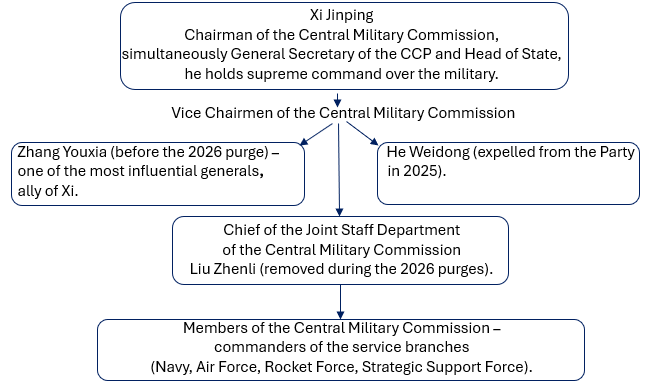
This configuration demonstrates that the purges of 2025–2026 affected not the periphery but the core of military governance, which may indicate an attempt at a complete reset of the command hierarchy under conditions of strategic mobilization.
Zhang Youxia – the highest-ranking general, a long-time ally of Xi, who held key positions in the Central Military Commission. His removal became the most significant event in the PRC’s military politics in recent years. In addition, Liu Zhenli – a Chinese general-colonel and Chief of the Joint Staff Department of the Central Military Commission of China, responsible for coordinating joint operations – was also removed. His dismissal indicates that the purge is targeting key links in the command structure. In October 2025, eight generals were expelled from the Party, including He Weidong, which became a precursor to the current wave. The scale of the purge is such that it is described as “unprecedented” in terms of the level of figures affected and the possible consequences for the manageability of the military.
The CCP Central Committee explains what is happening as the necessity of combating “serious violations of law” and declares zero tolerance for abuses [11]. In Chinese official media, problems in the military and defense industry are described as a threat to combat effectiveness and the political purity of the troops, but are presented exclusively within Party rhetoric – as part of the CCP’s “resolute struggle” against disciplinary violations. At the same time, in official texts such phenomena are interpreted not as a systemic problem of governance but as individual deviations of certain persons.
Analysts note that such practices are systemic in nature and are effectively embedded in the process of military governance. The enormous funds allocated for the modernization of the People’s Liberation Army of China are distributed through a complex network of defense enterprises and military structures, where oversight of expenditures remains largely formal. As Asia Times observed, it is precisely weak control over resources that undermines the effectiveness of modernization programs and raises doubts about the real combat capability of the military [12]. Reports by the U.S. Department of Defense and the IMF also emphasize that problems of financial transparency in the PLA remain a serious challenge despite years of campaigns to eradicate them, and directly affect China’s ability to achieve strategic objectives. Despite regular campaigns to restore order, systematic abuses continue to pose a threat to the integrity of command, budgetary efficiency, and the strategic cohesion of the armed forces [13].
Against the backdrop of the systemic nature of the problem, accusations of violations in China often carry a political dimension and are used as a tool of elite control. Since campaigns increasingly affect senior leadership rather than only the middle level, this may indicate the political motivation behind the purges. In circumstances where such practices are perceived as a “habitual part of the process,” real investigations against generals may signify not so much a fight against financial abuses as the removal of figures whose loyalty is in doubt or who have lost political trust. Thus, governance problems in the defense sector perform a dual function: they represent a chronic challenge to the system and simultaneously serve as a convenient mechanism for political selection at the top.
Given the limited information from the Chinese side, there are several competing interpretations of what has occurred, which may complement each other:
-
The most obvious and official version – the fight against corruption and abuses, an attempt to disrupt entrenched corrupt networks within the military.
-
Power struggle. The blow against Zhang Youxia and other heavyweights may signify a redistribution of influence at the top. Xi Jinping demonstrates that even the closest allies are not protected if their loyalty is in doubt. Moreover, in the context of Xi Jinping’s further consolidation of power, the military-political nexus could potentially compete with him, or even challenge his authority.
-
Disciplinary measures ahead of crisis. In the context of possible escalation around Taiwan and intensifying confrontation with the United States, Xi may be preemptively removing figures who appear insufficiently reliable. For similar reasons, Joseph Stalin carried out purges of the Red Army on the eve of World War II in the USSR.
-
Accelerating the preparation of the military for a new war and renewing the command staff with younger and more modern cadres.
-
The publicity of arrests – a demonstration of power and a warning to the elites that the governance system is shifting into a more rigid mode.
Кадровые чистки в оборонном секторе КНР также можно рассматривать как способ усилить надзор за закупками критических ресурсов и технологий. НОАК и оборонная промышленность остаются зависимыми от импорта ряда компонентов, которые невозможно быстро заместить собственным производством. Так, Китай продолжает закупать высокопроизводительные микросхемы и полупроводники за рубежом. По данным Global Defense Corp, поставки двойного назначения (включая микрочипы) идут из стран Европы, Японии, Южной Кореи и Тайваня, что делает военные программы уязвимыми для внешнего давления [23].
Китайские истребители и транспортные самолёты до сих пор используют импортные или лицензионные двигатели. Это остаётся слабым местом национальной оборонной промышленности, и контроль над закупками критически важен для модернизации ВВС. Кроме того, Китай активно развивает собственную спутниковую группировку, но часть ключевых элементов (оптика, сенсоры, материалы) тоже закупается за рубежом. По данным Indian Military Review, военные спутники серии «Fen Yung» обеспечивают раннее предупреждение о ракетных пусках, связь и разведку, однако их производство требует сложных технологий, часть которых Китай получает через импорт или двойное назначение [24].
Purges in defense corporations and the military command may be linked to the need to tighten control over these procurements. For Xi Jinping, it is crucial that resources allocated for the import of critical technologies do not flow into “grey schemes” and are used strictly for their intended purpose. This not only strengthens discipline but also reduces the risk of technology leakage beyond Party control.
The fact that the current wave of purges has affected the top of the military hierarchy may indicate that Xi Jinping seeks full centralization of military governance. In the context of preparations for a possible crisis around Taiwan and intensifying confrontation with the United States, such steps appear as a preventive strategy: the elimination of any potential centers of power capable of acting autonomously.
Thus, the 2026 purges should be viewed not only as an anti-corruption campaign or the centralization of defense financial management, but also as a systemic element of mobilizing the Chinese political model. They perform a dual function: on the one hand, they strengthen discipline and demonstrate to the people the Party’s determination to fight violations; on the other hand, they serve as a signal to the elites that in conditions of turbulence any doubts about loyalty will be harshly suppressed. This is not a sign of fragmentation or contradictions, but rather an indication that the Chinese governance system is shifting into a more rigid mode, preparing for a period of heightened tension.
4. The significance of the 2026 purges for the global security system.
The purges in the Chinese military in 2026 go beyond ordinary disciplinary measures and affect the global security system. We are speaking about the largest army in the world, possessing nuclear capabilities and actively developing capacities in space and cyberspace. These events touch upon the following key areas: the increased role of the General Secretary of the CCP Central Committee, the impact on regional stability, the state of strategic forces, the technological factor, China’s immediate allies, and the perception of developments by the international community that is not a direct ally of China.
1. Strengthening Xi’s personal control and its international consequences.
Arrests and investigations against senior military leaders have demonstrated that even the most influential figures are not immune to disciplinary measures. The strengthening of Xi Jinping’s personal control over the military enhances the manageability of the military system and allows for faster decision-making, which is particularly important in the context of potential crises, for example, around Taiwan. At the same time, the concentration of power in the hands of a single leader may increase the unpredictability of Chinese policy, thereby raising concerns among other regional and global actors, leading the United States and its allies to reinforce their military presence in the Indo-Pacific region [14].
2. The impact of the purges on regional stability and the nuclear factor.
For East Asia, the consequences of the purges are manifested in the strengthening of the PLA’s mobilization capabilities and the reduction of risks of internal disagreements. Public arrests are perceived as preparation for possible military crisis scenarios, which raises concerns among neighboring countries – Japan, South Korea, and India.
Of particular importance is the fact that the purges affected the command of the Rocket Force and the Strategic Support Force. According to RAND Corporation, these structures are responsible for nuclear deterrence and cyber operations. Their personnel instability may be perceived by neighboring countries as a risk factor, intensifying regional tensions [15, p. 2].
At the same time, the purges cannot be considered in isolation from the processes of modernization of governance and the military as a whole. Xi Jinping’s reforms after 2015 included the creation of new command structures, the transition from seven military regions to five theaters of operations, and the establishment of the Joint Staff Department of the CMC, which strengthened centralized governance. These measures were aimed at enhancing the PLA’s ability to conduct joint operations and respond more rapidly to crises. In combination with personnel reshuffles, they form a more manageable and disciplined system, where political loyalty is combined with institutional modernization.
Thus, the purges simultaneously strengthen the internal manageability of the military and increase the level of anxiety among external observers and adversaries. For neighboring countries, this means that China is not only eliminating corruption and internal risks but also preparing its military for more effective use of modern means of warfare. As a result, the regional security system becomes more tense and less predictable.
3. The technological factor.
The purges that affected the command of the Rocket Force and were connected with defense corporations can be regarded as a step toward strengthening control over the allocation of resources. This concerns China’s military budget, which in 2025 amounted to 1.78 trillion yuan, or 246 billion USD, representing a 7.2% increase compared to the previous year [20]. A significant portion of the budget is directed toward the development of the Rocket Force – China’s nuclear arsenal and ballistic missiles. According to the Lowy Institute, this structure is precisely the key to strategic deterrence and therefore became the target of purges [4].
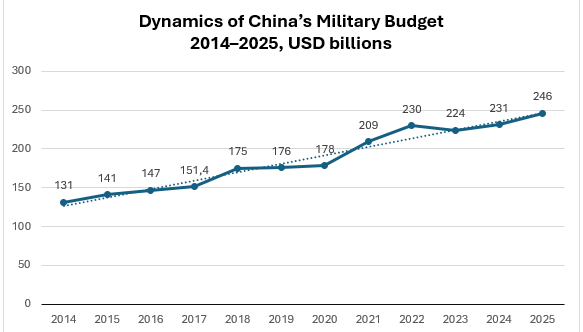
China publishes only general data on military expenditures, without detailing the allocation of funds across major areas. However, increases or decreases in spending can be inferred from the expansion or reduction of the main service branches. At the same time, according to SIPRI estimates, the Chinese government understates the actual military budget, which in reality is significantly higher. Thus, by the end of 2024, it may have amounted to around 318 billion USD [21].
If we compare China’s military expenditures with those of the United States, in 2012 China’s spending was only one-sixth of the American level, while by 2024 it had already reached one-third. In the Indo-Pacific region, China spends five times more than Japan and almost seven times more than South Korea. The most noticeable growth has been in the navy. The PLA Navy has transformed from a coastal force into a full-fledged fleet capable of operating globally. The number of warships surpassed that of the U.S. Navy as early as 2014, although in terms of tonnage and armament China still lags behind. The PLA Air Force is actively modernizing its fleet, replacing outdated aircraft with modern 4.5- and 5th-generation fighters. The nuclear arsenal grew to approximately 600 warheads in 2025 (twice as many as in 2019), with projections of growth to 1,500 by 2035. The PLA Rocket Force possesses the world’s largest arsenal of land-based missiles, including the DF-26 with a range of up to 4,000 km, capable of striking U.S. bases on Guam. In addition, China is actively developing its satellite constellation (hundreds of military and dual-use satellites), which enhances its reconnaissance, communications, and navigation capabilities. Against this backdrop, for the sake of modernization and the transition to joint operations, the army was reduced by 300,000 personnel (primarily ground forces) [22].
Thus, China’s military expenditures are growing unevenly: while ground forces are being reduced, priority is given to the navy, air force, rocket forces, space, and cyber operations. This reflects the strategic goal of preparing the PLA for operations beyond China’s borders and for a possible crisis around Taiwan.
Xi Jinping may be removing figures who in one way or another obstructed his plans for accelerated military modernization. Based on this, the purges serve a dual function: they discipline the elite and create conditions for tighter control over technological projects.
At the same time, personnel instability in the defense industry may be perceived by external actors as a risk factor. CSIS, in its discussion of the Pentagon’s 2024 report, emphasized that corruption and personnel reshuffles could slow the pace of modernization planned for 2027, but would not stop it [16]. For global security, this means that China will continue to build up its capabilities.4. Влияние на союзников и партнёров Китая.
The 2026 purges in China’s military leadership also have significance for countries that maintain close military cooperation with Beijing. Primarily, this refers to Russia and Pakistan, for whom China is a strategic partner.
For Russia, personnel reshuffles in the PLA may be perceived as an element of strengthening discipline and the manageability of the Chinese military. In the context of ongoing military interaction, including joint exercises and technology exchanges, Moscow may view the purges as confirmation of Beijing’s seriousness in matters of control over the armed forces. At the same time, the unpredictability of personnel decisions may cause caution on the Russian side due to the risk of power concentration and political moves that could affect the balance in bilateral relations.
For Pakistan, which traditionally relies on China for military modernization and arms procurement, strategic partnership with Beijing remains a key element of national security. Researchers noted as early as 2025 that cooperation is built on the perception of China as a stable and consistent ally, especially in the field of defense technologies [17]. There have been no official comments from Pakistan regarding the purges in China’s military leadership: Islamabad traditionally avoids public assessments of internal processes in the PRC, limiting itself to general statements about “iron friendship” and strategic partnership. Given this, in Pakistan the purges may be regarded as confirmation of Beijing’s ability to maintain discipline and control corruption, which may strengthen trust in joint projects, albeit with a certain factor of uncertainty due to abrupt reshuffles in leadership.
5. Interpretations and signals for the rest of the world.
Official publications emphasize that the purges are connected with “serious violations of discipline and law” and are aimed at strengthening the combat readiness of the military [11]. For the outside world, this is a ыdemonstration of Beijing’s determination to maintain strict discipline and eliminate disloyalty in key defense structures. Western analysts generally interpret the events in the following way: according to BBC News, the arrests of senior generals became “a signal of full centralization of power in the military,” which may indicate preparation for more decisive actions in times of crisis [14]. For U.S. allies in the region – Japan, South Korea, and Australia – the purges are perceived as a factor of uncertainty and anxiety, stimulating further militarization, the strengthening of defense alliances, and the growth of military expenditures. Neighbors and international actors are compelled to take into account the likelihood of a more rigid and centralized Chinese military policy.
However, it is important to note that such measures have not only a destabilizing effect but may also lead to a tactical reduction of tensions and long-term stability. A change in military leadership always entails a significant period of situational assessment by the new leadership, internal perturbations, and audits, during which the likelihood of proactive actions is substantially reduced.
Therefore, from the perspective of global security, such a transformation has a dual effect. On the one hand, China may become more consistent in implementing its military strategy: decisions will be made more quickly, and control over key areas such as the Rocket Force, cyber operations, and space programs will become more stringent. On the other hand, the strengthening of power in the hands of a single leader increases the risk of unpredictable steps in crisis situations. Xi’s drive for complete loyalty among commanders creates the risk that the military will be unable to prevent erroneous decisions.
Thus, short-term instability and reduced combat readiness associated with the purges may be replaced by long-term stability if the military becomes fully integrated into Xi’s system of personal control. For the international community, this means the need to take into account a new balance: China will be more disciplined and consistent in pursuing strategic objectives, but less predictable in crisis conditions, where decisions will depend on a narrow circle of individuals.
Conclusions
Personnel purges in the PRC’s defense sector, especially at the beginning of 2026, are not an isolated episode but part of a systemic process of strengthening Party control over the military and the defense industry. They demonstrate a trend toward the full centralization of power in the hands of Xi Jinping and the elimination of potential centers of autonomy within the security structures. On the one hand, such measures increase manageability and discipline, reducing corruption risks and reinforcing the loyalty of the command staff; on the other hand, future possible decisions regarding the use of the PLA will become even less predictable.
The historical context shows that the practice of purges in the Chinese military has a long tradition. Contemporary campaigns differ in scale and publicity, which turns them into an instrument of demonstrating power both domestically and internationally. In the context of preparations for possible regional crises, including Taiwan and the South China Sea, purges can be regarded as a preventive strategy aimed at ensuring the complete loyalty of the military leadership.
The particular significance of the purges lies in their connection to preparations for possible modern wars. The strengthening of control over military structures is accompanied by strict oversight of financial flows in the defense sector. In the context of a difficult economic situation, the PRC leadership seeks to ensure the concentration of resources on priority directions of military modernization and to prevent their inefficient use. Thus, purges simultaneously reinforce discipline and serve as a mechanism of control over funds necessary for the implementation of strategic projects.
Therefore, personnel reshuffles in the PLA and the defense industry should be interpreted as an element of a broader process of transforming the Chinese political model. They simultaneously strengthen discipline and increase the risk of unpredictability, which makes China more consistent in implementing its long-term military strategy but less predictable in the context of international crises. For global security, this means the necessity of taking into account not only the growth of the PRC’s military power but also the internal mechanisms of its political governance and decision-making.
Yeva Antonenko, Political Analyst, Ukrainian Institute of Politics
References:
1. Bloomberg: Xi’s Purge of Top General Spurs Questions on Taiwan, Succession. 26 January 2026.
2. Foreign Affairs: The Unsettling Implications of Xi’s Military Purge. 30 January 2026.
https://www.foreignaffairs.com/china/unsettling-implications-xis-military-purge
3. East Asia Forum. Xi balances between professionalism and political control of the PLA. 15 August 2024.
4. Lowy Institute. Explaining Xi’s PLA purges. 30 April 2025.
https://www.lowyinstitute.org/the-interpreter/explaining-xi-s-pla-purges
5. Raisina Debates. Corruption and purge in the PLA: Apprehension and distrust. 2 December 2024.
https://www.orfonline.org/expert-speak/corruption-and-purge-in-the-pla-apprehension-and-distrust
6. Centre for International Governance Innovation (CIGI). China, the PLA and Xi’s Ongoing Purges: The Corruption Conundrum. 15 December 2025.
7. The State Council Information Office of China, The Reduction of One Million Troops. 13 July 2022
http://english.scio.gov.cn/m/featured/chinakeywords/2022-07/13/content_78321930.htm
8. ANU Press: Reforming China’s defense industry, 1997 to the present.
https://press.anu.edu.au/downloads/press/p61661/mobile/ch11s03.html
9. National Defense University Press: Chairman Xi Remakes the PLA. 2019.
https://ndupress.ndu.edu/Portals/68/Documents/Books/Chairman-Xi/Chairman-Xi.pdf
10. Sky News. Xi's purge of top general paints a fascinating picture of power and control within a ruthless and unforgiving system. 26 January 2026.
11. 坚决打赢军队反腐败斗争攻坚战持久战总体战, 25 January 2026.
http://politics.people.com.cn/n1/2026/0125/c1001-40652025.html
12. Asia Times. The rot eating at China’s war machine. 1 December 2025.
https://asiatimes.com/2025/12/the-rot-eating-at-chinas-war-machine/
13. Institute for Security and Development Policy. Marching on Quicksand: How Corruption is Undermining China’s Military. 19 June 2025.
https://www.isdp.eu/marching-on-quicksand-how-corruption-is-undermining-chinas-military/
14. CBC News. Xi Jinping’s purge of China’s top general spells uncertainty for world’s largest military. 31 January 2026.
https://www.cbc.ca/news/world/xi-jinping-china-zhang-youxia-purge-military-9.7067287
15.RAND Corporation. PLA Rocket Force Modernization and China’s Military Reforms. 15 February 2018.
https://www.rand.org/content/dam/rand/pubs/testimonies/CT400/CT489/RAND_CT489.pdf
16. CSIS. A Discussion on the Defense Department’s 2024 China Military Power Report. 18 December 2024.
https://www.csis.org/analysis/discussion-defense-departments-2024-china-military-power-report
17. Yasir, M. China-Pakistan Strategic Partnership: An Examination of Defense Cooperation and Security Implications. International Journal of Multidisciplinary Research and Growth Evaluation. July 2025.
18. Institute for the Study of War. Xi Jinping’s Military Purges Leave Him Powerful but Isolated. 30 January 2026.
19. Article 20 of the Common Program of the PRC 1949-1954.
https://commonprogram.science/art20.html
20. Laurie Chen and Greg Torode. China maintains defence spending increase at 7.2% amid roiling geopolitical tensions. 5 March, 2025.
https://www.reuters.com/world/china/china-maintains-defence-spending-increase-72-2025-03-05/
21. SIPRI Military Expenditure Database (1949-2024).
https://www.sipri.org/databases/milex
22. CSIS. China’s Military in 10 Charts. 2 September, 2025.
https://www.csis.org/analysis/chinas-military-10-charts
23. Global Defense Corp. The U.S., Australia, the UK, Germany, Spain, Italy, France, Sweden, Canada, Switzerland, Japan, South Korea, Malaysia and Taiwan are directly arming the Chinese Military by supplying dual-use technology and microchips to the PLA. 16 December, 2025.
https://www.globaldefensecorp.com/2025/12/16/chinese-imports-dual-use-tech/
24. Indian Military Review. China’s Fleet of Military Satellites. 6 May, 2025.