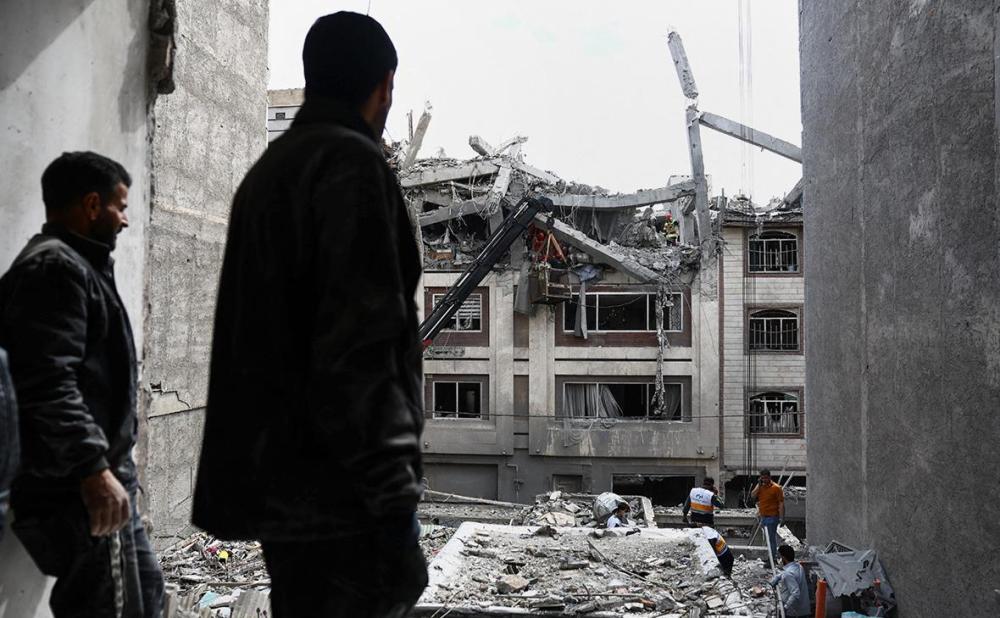
In the spring of 2026, the confrontation between the United States and Iran reached its peak. After the February strikes, the military crisis intensified by April, when the Strait of Hormuz was blocked, global logistics became extremely complicated, oil prices rose, and the United States declared its readiness to strike Iranian infrastructure and “destroy an entire civilization.”
In the absence of communication channels, Pakistan acted as the initiator of a possible truce. On the night of April 8, when U.S. President Donald Trump voiced threats against Iran, it was Islamabad that proposed mediation, which helped quickly and effectively (though, with high probability, temporarily) reduce the level of escalation. Thus, a country that had previously distanced itself from Middle Eastern conflicts for the first time assumed the position of a key mediator.
From this arose a natural question: why was it Pakistan that found itself at the center of this most complex diplomatic initiative? A whole set of reasons that led to this situation will be analyzed below.
1. Historical Context of Current Pakistani Diplomacy and the Tradition of Mediation.
Pakistan’s foreign policy, since gaining independence in 1947, has been shaped by geography and the need to balance between the interests of major powers. Over time, this evolved into a tradition of providing a platform for informal dialogue in the absence of direct contacts between parties.
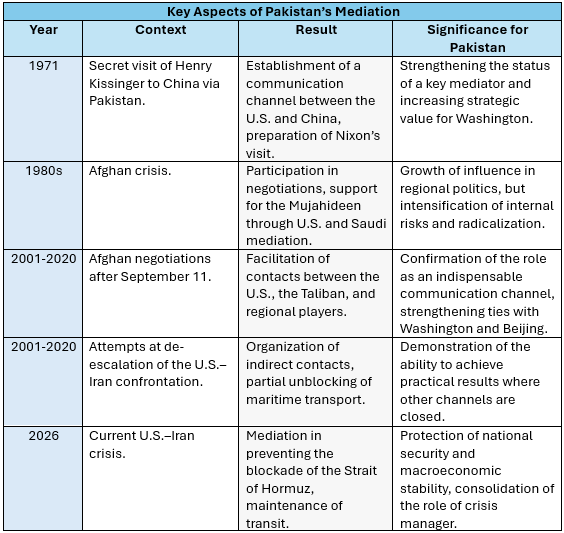
In the early 1970s, Pakistan played a key role in normalizing relations between the United States and China, organizing secret communications between Washington and Beijing, including Henry Kissinger’s visit to China in 1971. This shifted the global balance of power and secured Islamabad’s reputation as a mediator capable of ensuring confidentiality and effectiveness in negotiations. Since then, the country has been perceived as a reliable neutral channel and continues to perform this function in international crises, where trust and the ability to maintain dialogue are valued more than formal alliances.
It is important to emphasize: a mediator in diplomacy must possess both the ability to organize negotiations and sufficient political weight. Pakistan has confirmed the presence of these qualities by participating in closed consultations on regional security issues, where the ability to maintain confidentiality was highly valued. Such practice allowed parties to exchange views without the risk of disclosure. Today this line is continued by Prime Minister Shehbaz Sharif’s government: Pakistan avoids sharp statements and bloc confrontations, while maintaining working contacts with Western countries, Asia, and the Middle East.
The stability of the process is ensured by the features of Pakistan’s political system, in which the military plays a significant role in foreign policy, creating continuity and predictability regardless of changes in civilian governments. Economic difficulties in the country reinforce caution: Pakistan is compelled to maintain ties with Western financial institutions, Middle Eastern investors, and China, which turns multi-vector diplomacy into an advantage.
The main challenge of such neutrality is the constant need to balance between competing centers of power. Pakistan divides its cooperation tracks: working with China in infrastructure and the economy, while conducting dialogue with the United States on security. This helps build trust among different parties—so essential for a mediator—and makes bias on Pakistan’s part unlikely.
2. Geopolitical Factors of Pakistan’s Diplomacy.
Pakistan’s geography directly determines its foreign policy. The long border with Iran makes any crisis around Tehran an immediate threat to Islamabad. At the same time, Balochistan remains the most vulnerable region due to ethnopolitical issues and separatism. In the event of escalation in the region, Pakistan risks not only losing control over border territories but also facing a humanitarian crisis: a flow of refugees and increased activity of radical groups. Meanwhile, Balochistan has significant economic importance — the China–Pakistan Economic Corridor passes through it, and the Gwadar Port is located there, making border stability a prerequisite for preserving strategic investments and the country’s economic resilience. Therefore, instability in Balochistan automatically threatens Chinese investments and thus turns a domestic factor into an international one.
An additional risk is linked to the religious structure. In Iran, the majority of the population are Shiites, while in Pakistan Shiites constitute a very significant minority. Hence, any external confrontation with Iran easily resonates inside the country and may cause tension between religious communities, threatening Pakistan’s internal stability. At the same time, Pakistan, as the only Muslim nuclear power, is perceived in the Islamic world as a potential protector, which strengthens its diplomatic weight within the OIC and across the Middle East.
Pakistan’s nuclear arsenal makes it a country that cannot be ignored, and its position highly significant for external actors, since any clash near the borders of a nuclear state is perceived as a factor of global instability. The army also plays a key role in shaping foreign policy, ensuring continuity and predictability of the course regardless of changes in civilian governments.
At the end of the 20th century, Pakistan had already faced internal consequences of external conflicts. The Afghan war of the 1980s led to a massive influx of refugees and the growth of armed groups, while the rivalry between Iran and Saudi Arabia intensified tensions between Sunnis and Shiites. These factors triggered a surge of violence and instability in border areas, demonstrating the danger of turning the country into an arena for others’ confrontations. The current leadership seeks to prevent a recurrence by building preventive diplomacy with Iran and Arab monarchies to reduce the influence of external forces on domestic communities.
The nuclear arsenal and the professionalism of the armed forces provide Pakistan with a unique position within the system of regional deterrence factors. Ties with the Gulf monarchies, especially with Saudi Arabia, have sometimes been perceived as a tilt at the expense of relations with Iran. Yet it is precisely the nuclear status that allows Pakistan to maintain autonomy and offer mediation instead of joining anti-Iran coalitions. This strengthens its reputation as a predictable and independent actor.
For Pakistan, peace on the western borders remains a priority. Weak sections of the frontier, social challenges, and the need to protect international investments require active measures. Military potential and nuclear status are used not for escalation but to initiate negotiation processes.
3. The Poverty Factor and Survival Strategy.
Pakistan’s diplomatic activity is also linked to the need to sustain the functioning of its economy. The country is critically dependent on energy imports, and any disruption in oil supplies or blockade of trade routes would have severe consequences, primarily for the low-income population.
According to World Bank data, in 2023–24 the poverty rate in Pakistan stood at 25.3%, while SPDC estimates in 2026 already note 43.5% of the population — meaning more than 100 million people live below the poverty line. Under such conditions, any external shock can quickly turn into an internal crisis. Mediation in international conflicts is used as a tool to prevent social unrest and protect basic stability. Pakistan is effectively located in a zone of direct threat, and therefore seeks to maintain balance and reduce risks before they begin to affect the domestic situation.
4. Pakistan’s international leverage.
Pakistan’s foreign policy is built on multi-vectoralism, which compensates for economic weaknesses and enhances its diplomatic significance:
-
The alliance with China remains pivotal: for Beijing, Pakistan is an infrastructure hub in South Asia and a partner in the Islamic world, while for Islamabad, China’s support provides an additional political resource and the opportunity to act as a mediator. Joint initiatives go beyond bilateral relations and include coordination of positions among Global South countries, enabling Pakistan to participate in shaping the global security architecture. In practice, China uses Pakistan as a “testing ground” for its diplomacy in the Islamic world, while Pakistan gains the ability to act as a bridge between Beijing and the Arab monarchies.
-
Relations with the United States are not allied but rather a balancing instrument. Despite tensions and mutual distrust, Islamabad maintains working channels in the fields of security and counterterrorism. This allows Pakistan to remain in dialogue with the West and to use the American factor as a counterweight to dependence on China and the Gulf monarchies. Thus, the U.S. functions not as a donor or patron, but as a necessary element of diplomatic equilibrium
-
Ties with the Gulf monarchies, especially Saudi Arabia, remain an important direction. Financial and military cooperation makes Pakistan part of the region’s security system, but it seeks to avoid direct confrontations, using its allied status to soften Arab states’ policies and preserve communication channels. The energy factor strengthens its importance: a significant share of global oil exports passes through the Strait of Hormuz, and the participation of Pakistan’s Navy in international operations to protect maritime routes reinforces the country’s diplomatic standing. A special role belongs to Gwadar Port, developed within the framework of the China–Pakistan Economic Corridor, which can offer alternative routes for energy transportation and increase Pakistan’s role in global energy pathways.
-
Pakistan actively participates in the UN, the OIC (Organization of Islamic Cooperation), and the SCO (Shanghai Cooperation Organization). These platforms enhance its diplomatic weight and allow it to advance initiatives in a multilateral format.
-
As the only Muslim country with an official nuclear arsenal, Pakistan possesses a unique lever of influence: its position is taken into account in the global security architecture.
-
Historical experience in mediation demonstrates that Pakistan knows how to use diplomatic channels as an instrument of influence.
-
More than 4.4 million Pakistanis live in Gulf countries, including over 1.8 million in Saudi Arabia and more than 1.6 million in the UAE, plus hundreds of thousands in Kuwait, Oman, Qatar, and Bahrain. Their remittances constitute a significant part of the economy. This creates an additional lever of pressure and interdependence in relations with the Arab monarchies.
Thus, Pakistan’s mediating role in the situation around Iran is explained by a combination of its strategic ties and its internal need to maintain balance. Islamabad has communication channels with China and the Gulf monarchies as well as with the U.S., which makes it an acceptable partner for all sides of the conflict. Its nuclear status and experience in international settlements strengthen trust in its mediation. At the same time, dependence on energy routes and diaspora remittances makes regional stability a matter of Pakistan’s own security.
5. Prospects and Limitations of Pakistan’s Diplomacy in the U.S.–Iran Crisis.
It should be emphasized once again: Pakistan’s diplomatic strategy in the context of U.S.–Iran confrontation is a matter of national security. For Islamabad, it is about preventing a direct military clash at its own borders and preserving the vital transit of energy resources through the Strait of Hormuz. In this situation, this diplomatic track is highly advantageous for Pakistan.
Moreover, Pakistan enjoys Iran’s trust, the clearest example being Iran’s consent to allow Pakistani vessels to pass through the Strait of Hormuz at a time when passage was blocked for other countries. For the U.S. and its allies, this fact is highly indicative: Islamabad is capable of achieving practical results where other channels remain closed.
A limiting factor is the influence of Saudi Arabia, which acts as a donor, military partner, and political reference point for Pakistan. Riyadh provides loans and oil, expects expanded military assistance, and anticipates Pakistan’s involvement in anti-Iran initiatives. This creates constant pressure: Islamabad is compelled to take into account the interests of its key donor while maintaining neutrality so as not to lose Tehran’s trust. Balancing within the triangle of “U.S.–Iran–Saudi Arabia” becomes a complex diplomatic task.
Pakistan’s capabilities are constrained by the very nature of the conflict. It cannot eliminate its fundamental causes: ideological contradictions, sanctions, Tehran’s regional ambitions, and Washington’s objectives. Therefore, mediation is unlikely to lead to peace and may instead take on a cyclical character—intensifying during crises and receding during de-escalation.
The effectiveness of Pakistan’s efforts is further reduced by economic weakness and internal risks, including dependence on loans and separatist threats in Balochistan. Thus, the most realistic outcome is the consolidation of Pakistan’s role as a crisis manager: it is capable of preventing worst-case scenarios, remaining a sought-after channel for the U.S., a guarantor of projects for China, and a balancing player in the region. The primary goal of such diplomacy is the protection of national survival, although a prolonged crisis could theoretically force Islamabad to lean toward one partner and lose the trust of another.
Key Conclusions
Thus, Pakistan’s mediation in the crisis between the U.S. and Iran is not an attempt to play the role of peacemaker, but a pragmatic way to maintain stability within its own system. Islamabad has found itself in a situation where external escalation directly threatens internal crisis: instability in Balochistan, religious tensions, and dependence on energy imports make war at its borders unacceptable. Therefore, diplomacy here is an instrument of protection, not ambition.
At the same time, Pakistan employs all the strengths it possesses: nuclear status, ties with China, Saudi Arabia, and the U.S., as well as experience in confidential negotiations. This enables it to be a party trusted by different sides, even if that trust is limited. Yet its capabilities are objectively constrained: it cannot eliminate the causes of the conflict, but can only reduce the risk of excessive escalation.
In the end, Pakistan plays the role of a “crisis manager”—a state that does not resolve contradictions but makes them manageable. For Pakistan, this is not a choice but a necessity, since mediation here is a way to preserve the balance of power around it and minimize internal threats. In practice, it seeks not peace, but the preservation of manageability under conditions of regional instability.
Yeva Antonenko, Political Analyst, Ukrainian Institute of Politics