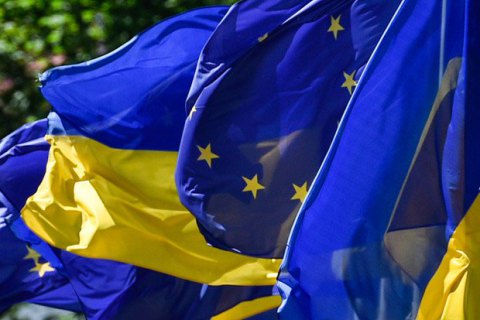
Germany and France offer Ukraine an interim status on the way to EU membership, which involves gradual integration without a full set of rights.
This format is largely political and symbolic, making it possible to demonstrate support for Kyiv without immediate financial and institutional obligations. We are talking about models in which Ukraine will be able to participate in EU institutions, but without the right to vote and access to key financial instruments.
In the German version, it is "associate membership" with participation in summits without influencing decisions; in French, it is the "integrated state" model, where access to mechanisms such as the Common Agrarian Policy and the Cohesion Policy is postponed until full accession. Both concepts are presented as an accelerated and simplified path to membership, which can be implemented by a political solution.
In a broader context, it is important to consider that there is still no consensus within the EU on Ukraine's accelerated accession.
Previously, the European Commission proposed a model of gradual integration. Ukraine would become a formal member of the EU, but without access to most of the benefits – voting rights, the Common Agricultural Policy (CAP) and the EU's cohesion policy funds. BUT these benefits would be provided gradually, as progress is made, the necessary requirements and criteria are met.
However, most member states opposed this logic, as it would mean including Ukraine in the EU's budgetary and institutional mechanisms without completing the full accession procedure.
Against this background, the initiatives of Germany and France have been proposed, they represent a different approach: institutional convergence without the provision of rights and resources.
In the Franco-German model, there is no guaranteed step-by-step dynamics of empowerment: full access to the budget, subsidies and mechanisms of influence is postponed to the time of full accession.
In a metaphorical sense, Ukraine finds itself, as it were, inside the system of the "EU castle", but outside its key premises – in a "hall of constant waiting" without full participation, rights and voice.
While the model previously proposed by the European Commission can be compared to Ukraine's successive transition from the "hallway" to the "living room" and then to the "central hall" – with each stage, opportunities, resources and influence expand.
To simplify, the difference is fundamental: the approach of the European Commission is one of dynamics and gradual acquisition of rights, while the approach of Germany and France is participation without rights until full accession (which, by the way, can take place in 10 or 20 years). That is, we are no longer talking about gradual integration with the expansion of opportunities, but about a format that minimizes the EU's obligations. postponing the key elements of membership for later.
There is another interesting detail. It is reported that within the framework of the discussed interim status, the possibility of extending elements of the EU's mutual defense to Ukraine is being considered.
The idea of "extending elements of the EU's mutual defense" in an interim status is primarily a political deterrence signal for Moscow, not a ready-made NATO-level collective defense mechanism.
There is no consensus in the EU for direct military involvement in the war for Ukraine, so such wording is only a symbol of guarantee without any legal obligations: they can be activated by a statement by leaders, but the scale and form of assistance are left to the discretion of the countries themselves.
As for the flip side, can this turn into obligations for Ukraine? For example, in the event of a crisis in the Baltic States. Formally, mutual defense in the EU is not automatic and symmetrical: even for member states, it is enshrined in Article 42 (7) of the Treaty on European Union (TEU), which is a policy and legal norm with flexible application and leaves countries free to choose the form of assistance. For a country with an intermediate status, this does not look like a legally strict obligation.
At the same time, the political risk, taking into account the wording, probably still exists. It is possible that with increased threats on the eastern flank, the EU may exert political pressure on Ukraine to expand its participation in pan-European security (taking into account Ukraine's complete financial dependence). But this will be the subject of individual political decisions, not an "automatic consequence."
Rather, we could talk about voluntary formats of contribution: training, logistics, cyber defense, intelligence sharing, etc.
In Ukraine, these initiatives are still treated with caution, since there is a risk that such formats may be perceived as a substitute for full membership ("shadow membership"). At the same time, Kiev continues its dialogue with Berlin and Paris, recognizing that certain elements of rapprochement can be useful. Not a full-fledged integration, but more than its absence.
The Franco-German approach can be considered, among other things, as a compensatory political mechanism that allows the Ukrainian authorities to smooth out internal contradictions around potentially difficult peace solutions, presenting Ukraine's movement into the Western zone of influence and the beginning of integration into the EU as a political victory, even if we are not yet talking about full membership.
In a broader sense, this can be described as a special integration format that allows Ukraine to be "embedded" into the European system, reducing the costs for the EU itself: Ukraine gets political inclusion, and the EU gets the opportunity not to change the balance of governance and not to put pressure on its markets and budgets.
That is, the Franco-German model simultaneously solves two problems: within Ukraine, it creates a sense of strategic success, and within the EU, it minimizes the points of resistance to Ukraine's integration without systemic shocks for the EU countries.
Oksana Krasovskaya
political analyst at the Ukrainian Institute of Politics