Ukrainian Institute of Politics,
Kyiv, Ukraine,
February 26, 2026
Monitoring statements by officials and pro-government Ukrainian media
on Trump’s peace plan
(January-February 2026)
In the Ukrainian media landscape, within pro-government sources, the topic of Trump’s peace plan is covered in a negative and cautious tone. Almost all key politicians and officials convey a unified line: the plan may be considered as a tool, but only on the condition that it is integrated into a system of pressure on Russia and reinforced by legally binding security guarantees. Otherwise, the peace plan is presented as a fictitious compromise beneficial to the Kremlin.
The tone of statements is characterized by distrust toward compromise-based forms of settlement. President of Ukraine Volodymyr Zelenskyy, Minister of Defense Mykhailo Fedorov, Commander-in-Chief of the Armed Forces of Ukraine Oleksandr Syrskyi, and others emphasize that Ukraine will not sign a “piece of paper” for the sake of U.S. image or a pause in the war. The central focus is placed on strength, sanctions, military mobilization, and the institutionalization of Western support. Even those figures who speak about the legal architecture of the process – Chairman of the Verkhovna Rada Ruslan Stefanchuk, Member of Parliament and Head of the “Servant of the People” faction Davyd Arakhamia, Secretary of the National Security and Defense Council Rustem Umerov – link legitimacy and legal mechanisms exclusively to strict guarantees and the exclusion of territorial concessions.
Thus, the information space forms a stable narrative: Ukraine is fundamentally not ready to accept Trump’s basic plan, its initial model. Readiness for discussion arises only after radical changes are introduced, related to legal guarantees, U.S. military presence, and the exclusion of territorial concessions. In the rhetoric of officials and government websites, there is a warning about the inadmissibility of repeating the mistakes of the Budapest Memorandum and the Minsk Agreements.
Differences in emphasis among individual speakers (military strength from Defense Minister Fedorov and Commander-in-Chief Syrskyi, legal legitimacy from Chairman of the Verkhovna Rada Stefanchuk and faction leader Arakhamia, energy integration from Minister of Energy Denys Shmyhal) do not change the overall tone: it remains negative and skeptical toward the compromise elements of the plan. Overall, the information field conveys the position that Ukraine is ready to discuss the format only if it strengthens pressure on Moscow, secures real protection mechanisms, and excludes concessions on sovereignty and territory.
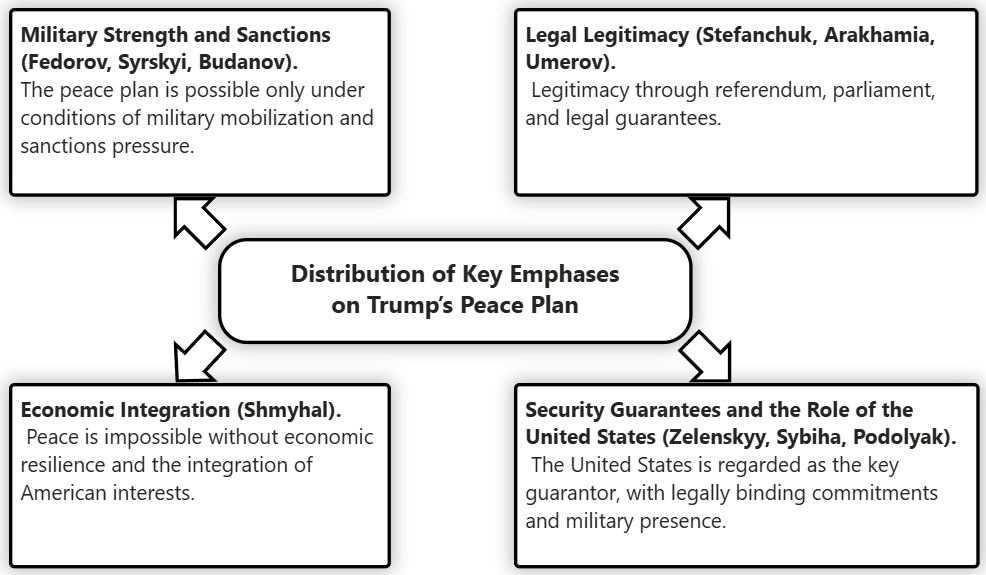
In the rhetoric of the Ukrainian side, points of convergence with Trump’s peace plan can also be traced. First, the necessity of a negotiation process and international participation is acknowledged. Second, Trump’s plan and the Ukrainian position coincide in that the United States must play a key role – as a guarantor of security and as a participant in negotiations. Third, convergence is observed in the recognition of the importance of certain economic issues: Ukraine’s recovery and the integration of American interests in energy and infrastructure are regarded as part of the overall architecture of the agreement.
However, these points of convergence are limited. The Ukrainian side insists that any arrangements must be accompanied by legally binding documents, U.S. military presence, and a constant increase in the cost of war for Russia. In this, it diverges from the compromise logic of Trump’s plan, where the emphasis is placed on negotiations and concessions.
Coincidences with Trump’s Plan
Differences with Trump’s Plan
Recognition of the necessity of a negotiation process.
Ukraine demands legally binding documents, not political declarations.
International participation is regarded as a mandatory condition.
Persistent requirement for U.S. military presence and institutionalized guarantees.
The United States is acknowledged as a key partner and guarantor of security.
Complete rejection of territorial concessions and compromises for the sake of ending the war.
The economic dimension: Ukraine’s recovery and the integration of American interests (energy, infrastructure).
Emphasis on strength, sanctions, and military mobilization as the basic condition of any negotiations.
The idea of a comprehensive approach (politics + economy + security).
Distrust toward the compromise logic of the plan, perceiving it as a possible “fictitious agreement”
Here it is important to emphasize: based on an approximate analysis of the ratio of theses in the statements of key public figures and pro-government media resources, a negative assessment of Trump’s plan prevails. If one tries to conditionally divide the tone, about 80–85% of the rhetoric is negative, while positive elements (recognition of the necessity of negotiations, international participation, the role of the United States, economic recovery) account for only 15–20% and are presented as secondary, limited conditions.
The final image formed in the media space is that of a state ready for negotiations, but exclusively from a position of strength and with the support of allies. In this logic, Trump’s peace plan becomes not an independent solution, but a possible instrument within a broader strategy of pressure on Russia and the institutionalization of security guarantees.
Ukraine demonstrates readiness for negotiations only on conditions that radically change the original document. These changes include demands that Moscow will categorically not accept (for example, rejection of territorial concessions and mandatory U.S. military presence). In the quotations, a tendency can be traced whereby Ukrainian rhetoric makes the plan “non-functional.” Such a position may be calculated so that either the United States will not support it in its original form, or, if they do, Moscow will reject it. That is, Ukraine shows readiness for dialogue but in fact blocks the implementation of a compromise scenario, intending to maintain pressure on Russia and the mobilization of allies.
More detailed positions of key public figures and media resources are considered below.
1. Statements of Officials.
Coverage of Trump’s peace plan specifically by Ukrainian officials has particular significance, since their statements set the framework for the perception of the document in society and in the media. The position of the president, government leaders, and heads of security agencies determines the tone of the discussion. Official comments not only reflect internal political priorities but also serve as a signal to international partners, demonstrating Kyiv’s readiness or unwillingness to make compromises. Therefore, the analysis of these statements makes it possible to understand how the authorities seek to shape public opinion and manage societal expectations under conditions of external pressure.
1. Volodymyr Zelenskyy, President of Ukraine, clearly outlined the red lines: Ukraine will not sign a “piece of paper” that repeats the fate of the Budapest Memorandum or the Minsk Agreements. For him, Trump’s peace plan is not a chance for a symbolic gesture, but an instrument that can end the war only under the condition of strict security guarantees, enshrined by the parliaments of the United States, the EU, and Ukraine.
Special attention is given to security guarantees. The President calls the future document “historic” and links the success of the peace process to legally binding commitments of the partners. He is ready to continue the war if the agreement turns out to be “bad,” and formulates a tough message: Ukraine will not lose.
Legitimacy, according to him, must come from the people – through a referendum or parliamentary vote; otherwise, the document will be perceived as an imposed deal. Zelenskyy is ready for dialogue and compromises, but his position is extremely strict: territorial concessions and renunciation of independence are excluded.
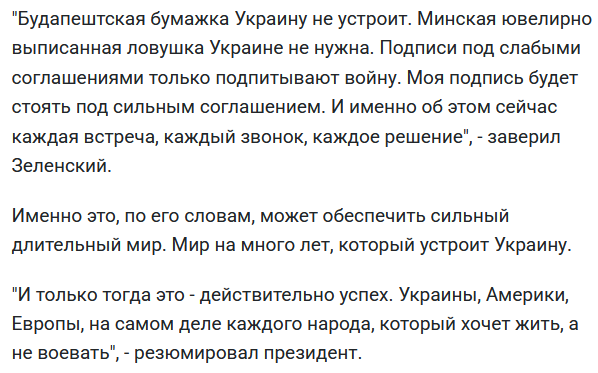
He states directly that his signature can only be placed under a “strong agreement,” not under a trap that fuels the war. Zelenskyy’s strategy is a dual track: negotiations with the United States and parallel mobilization of defense structures, to show society and partners that peace is sought not at any price, but under conditions of justice and security.
In his rhetoric about “strong partners” and “pressure,” he seeks to mobilize the West, demonstrating that only strict pressure on the Kremlin can bring real peace, not a fictitious compromise. In addition, Zelenskyy emphasizes that he will not agree to a “bad” deal. That is, his position makes the peace plan an instrument of consolidating society and mobilizing allies, not a compromise at any cost.
2. Mykhailo Fedorov, Minister of Defense, in his statements considers Trump’s peace plan as a diplomatic track that can have significance only on the condition that Ukraine itself creates a military and economic reality forcing the Kremlin to make concessions. His position emphasizes: without pressure and military power no plan will work. Unlike Trump’s logic, where the emphasis is placed on negotiations and compromises, Fedorov shows that the diplomatic process is possible only against the backdrop of strength.
Thus, his rhetoric reinforces skepticism toward the plan itself: Ukraine cannot rely solely on external guarantees if it does not create conditions under which the war becomes unbearable for Russia. In this context, Trump’s peace plan is perceived as an instrument that may be useful, but only with a real military and sanctions base. Otherwise, it turns into an empty declaration devoid of practical value.
3. Oleksandr Syrskyi, Commander-in-Chief of the Armed Forces of Ukraine, emphasizes that even within the framework of the proposed plan Ukraine must maintain powerful armed forces – at least 800,000 personnel. For him, this is not a limitation but a guarantee of the ability to mobilize and repel aggression. He accepts the diplomatic track but insists that no negotiations make sense without the parallel strengthening of the army and the defense industry.
In his position, the peace plan is considered as a possible instrument, but only as a supplement to the military strategy, not as its replacement. Agreement on the figure of 800,000 military personnel becomes a signal: Ukraine is ready to participate in the diplomatic process, but exclusively from a position of strength. This sounds like a warning that the document may be useful, but without reinforcement by military power it will turn into a fictitious compromise beneficial to Russia.
Thus, Syrskyi emphasizes that the sustainability of any agreement depends on maintaining a strong army and the ability to force the enemy to make concessions. In his interpretation, the peace plan can work only in conjunction with military and sanctions support; otherwise, it will not become a real security mechanism.
4. Kyrylo Budanov, Head of the Office of the President of Ukraine, adheres to rhetoric similar to Syrskyi: he constantly emphasizes that Ukraine’s goal is a just peace, not “peace on paper”. He notes that negotiations are ongoing, but their results must be real and protect national interests. His rhetoric is tough: talking to Russia is possible only from a position of strength and unity; otherwise, it will be capitulation.
In his statements, he emphasizes that negotiations are possible only under the condition of real protection of national interests and consolidation of allies. He notes that the diplomatic process is underway, but its results must be supported by concrete security guarantees and practical steps.
In this context, his attitude toward Trump’s peace plan expresses caution and skepticism: the document may be an instrument, but only when it does not turn into a fictitious agreement. Budanov insists that a weak position makes dialogue impossible, therefore unity of allies and their assistance – from weapons to political pressure – is critically important.
Thus, he forms the narrative of “real peace versus paper peace,” reinforcing doubts that the proposed plan can ensure a sustainable security architecture. For him, the key requirement remains that any arrangements should not look like a concession or a temporary pause, but become part of a system of pressure on Russia and consolidation of the West.
5. Rustem Umerov, Secretary of the National Security and Defense Council, structures the negotiations into three blocks: documents, the economic package, and military-political issues. This shows that Ukraine perceives the process as comprehensive and demands a balance between security, recovery, and politics. His rhetoric emphasizes the transition from words to practical steps: “approaches are moving from the plane of political statements to the plane of practical decisions.” He constantly repeats: the goal is a just and sustainable peace, supported by security guarantees and economic recovery.
An important emphasis: according to him, a bilateral document with the United States on security guarantees is already prepared, and it is precisely this document that should become the foundation for trust and sustainability.
Umerov demonstrates diplomatic pragmatism: he does not speak of war as an endless process, but of negotiations as step-by-step work. His position firmly states: peace must be “dignified,” “just,” and “sustainable” – otherwise it will be only a pause before new aggression. His emphasis on the bilateral agreement with the United States and on the economic package demonstrates: Ukraine will not agree to peace for the sake of Washington’s image; it needs a real mechanism of protection and development.
6. Andriy Sybiha, Minister of Foreign Affairs, speaks on the topic of the peace plan in different tones: in posts in Ukrainian his rhetoric is more cautious and diplomatic, while in English-language publications and interviews it is much tougher. Overall, he emphasizes that the negotiation process is possible only under the condition of pressure on Russia and legally binding security guarantees.
The key element of his position is precisely legally binding guarantees, prepared for ratification in the U.S. Congress and the Verkhovna Rada. He notes that without American military presence an effective security system is impossible, and thus Ukraine regards the United States as the central guarantor of the architecture of the future agreement.
Sybiha’s position partially coincides with the logic of Trump’s peace plan, since both assume a negotiation process and international participation. However, his emphasis on mandatory guarantees, U.S. military presence, and constant increase in the cost of war for Russia contradicts the compromise settlement embedded in the document. For him, the plan can be implemented only through strength and institutionalized pressure, not through political arrangements without strict enforcement mechanisms.
7. Denys Shmyhal, Minister of Energy, after his appointment to the position addressed energy issues and did not directly comment on political matters related to the peace process. While serving as Minister of Defense in 2026, he used theses about a just and long-term peace.
In the position of Minister of Energy, his stance toward the Russian Federation is tough: following meetings with Western partners, the minister advocates for strengthening sanctions, especially in the energy sector, which, in his opinion, should deprive Russia of resources to wage war.
At the same time, he actively works within the logic of Trump’s plan and integrates American economic interests into Ukraine’s strategy. These are plans for LNG supplies from the United States, discussions of joint projects in nuclear energy, and purchases of American equipment for the restoration of energy infrastructure.
8. Ruslan Stefanchuk, Chairman of the Verkhovna Rada of Ukraine, focuses on the legal and institutional side of the peace process. He emphasizes that constitutional issues cannot be submitted to a referendum, and the subject of voting can only be one clearly formulated question – support or non-support of a specific agreement. Thus, Stefanchuk defines the boundaries of legitimacy: popular will is possible, but exclusively within the framework of an agreed text.
He draws attention to the security factor: for the preparation of elections and a referendum at least 60 days are required, and holding them is possible only with guarantees of protection for the population. This shows that parliamentary authority considers the peace process not only as political, but also as an organizational and legal challenge.
In international contacts, Stefanchuk emphasizes sanctions against Russia and the necessity of binding security guarantees, which must be ratified both in the U.S. Congress and in the Verkhovna Rada. He links a just peace with Russia’s responsibility, compensation for damages through Russian assets, and the creation of international mechanisms – a tribunal and a recovery fund.
His position demonstrates: the peace plan can be adopted only as part of the system of international law and sanction instruments. For the domestic audience this is a signal that parliament will provide legal protection of the process, and for external partners it is confirmation of Ukraine’s readiness to secure agreements at the legislative level.
9. Davyd Arakhamia, Member of Parliament and Head of the “Servant of the People” faction, directly links the holding of elections and a referendum to the existence of an agreed peace treaty. His position demonstrates caution and an emphasis on legitimacy: any political steps inside the country are possible only after the text of the agreement is approved by all parties – Ukraine, the United States, Russia, and European partners.
He emphasizes the legal side of the process: for elections a special law is required, and the results of a referendum will be valid only with the participation of at least half of the voters. Under conditions of war and mass migration, achieving such turnout is extremely difficult; therefore, it is proposed to combine the referendum with presidential elections to increase legitimacy.
Arakhamia sets a key principle: the decision on a peace agreement must be made by the nation. This means that even with international consent, the fate of the plan will depend on the internal mandate. His position turns the voting procedure into an instrument of control over external initiatives and shows that without a ceasefire and a final text of the treaty there will be neither elections nor a referendum.
Thus, Arakhamia acts as a guarantor that the peace process cannot bypass the position of Ukrainian society and parliamentary procedures, and legitimacy through these procedures will become the main filter for any external proposals.
10. Mykhailo Podolyak, Advisor to the Head of the Office of the President, formulates his position in maximally pragmatic and tough terms. His key idea is that the peace process is impossible without collective participation of the West and legally binding guarantees. According to him, Ukraine should not bear the burden of deterring Russia alone: this is the responsibility of international partners, above all the United States and the EU.
Podolyak emphasizes that any arrangements lose meaning if Washington is not ready to respond to violations by Moscow. He links the success of negotiations to an objective assessment of Russia’s actions and the readiness of the United States to act as an arbiter, not merely a moderator.
An important element of his position remains the demand for international-level legal documents that fix the reaction of partners to possible violations. This demonstrates distrust of political promises and the desire to institutionalize support.
Thus, Podolyak views negotiations not as a search for compromise, but as an instrument of pressure on Russia and mobilization of allies. His rhetoric conveys the firmness of the authorities inside the country and signals to external partners: Ukraine will not accept a peace plan without real guarantees and enforcement mechanisms.
Conclusions:
Thus, when analyzing the statements of 10 key Ukrainian politicians, a unified line can be traced: peace is possible only through a combination of diplomacy and strength, while the key condition remains legally enshrined security guarantees and pressure on Russia. All speakers emphasize that compromise for the sake of compromise is unacceptable – from Zelenskyy and Podolyak to Sybiha and Stefanchuk comes the demand to institutionalize Western support and to exclude the repetition of the mistakes of the Budapest Memorandum and the Minsk Agreements.
Differences appear in the emphases: some figures (Zelenskyy, Umerov, Stefanchuk, Arakhamia) focus on legitimacy and the legal architecture of the process, others (Fedorov, Syrskyi, Budanov) on military strength and sanctions pressure, while Shmyhal emphasizes energy resilience and the integration of American interests. Regarding Trump’s peace plan, the overall conclusion is tough: it can be used as an instrument, but only on the condition that it becomes part of the system of pressure and guarantees, and not a fictitious compromise beneficial to Moscow.
2. Position of Official Websites.
Publications on Ukraine’s official resources play a special role in shaping the perception of Trump’s peace plan. Unlike individual statements of politicians, they reflect the coordinated position of the state and transmit it both to the domestic audience and to international partners. Through such materials, the authorities demonstrate their priorities. The analysis of these publications makes it possible to understand which emphases Ukraine considers strategically important and how it seeks to manage the expectations of society and allies under conditions of ongoing war.
President of Ukraine – president.gov.ua. Information from the resource is duplicated on the official Telegram channel of the Office of the President @OP_UA and on the official Telegram channel of President Zelenskyy Zelenskiy / Official @V_Zelenskiy_official. Therefore, the theses disclosed in p.1.1 are repeated here.
Cabinet of Ministers of Ukraine – www.kmu.gov.ua. Quotes from the Cabinet’s website show a clear line of parliamentary diplomacy: the peace process in the logic of Ukrainian authorities is possible only with a combination of pressure on Russia and legally enshrined security guarantees. There is no trust in compromise forms – Russia is described as a party that deliberately escalates the war. The central conditions are sanctions, military support, strengthening of air defense, as well as economic recovery through integration into the EU. In the context of Trump’s peace plan this means: Ukrainian authorities are ready to discuss the format, but only if it becomes an instrument of pressure and protection, not a deal with concessions. Territorial compromises contradict the position being transmitted. The plan can be adopted only in a format that increases pressure on Moscow and secures real mechanisms for Ukraine’s protection.
Verkhovna Rada of Ukraine – rada.gov.ua. The VR portal largely duplicates the statements of Ruslan Stefanchuk and his position, which was outlined above. Other quotes from the VR website show that the parliamentary line rejects the possibility of a compromise peace in the logic of “concessions for the sake of ending the war.” Russia is described as a party that deliberately escalates the conflict and demonstrates unwillingness to negotiate. Peace is linked exclusively to strength, international law, and respect for sovereignty. Domestic political procedures such as elections and referendums are mentioned only as technical elements, but not as instruments for revising territorial integrity. That is, representatives of the Rada are ready to discuss the format of the peace plan, but only if it consolidates pressure on the Russian Federation and real security guarantees.
Ministry of Foreign Affairs of Ukraine – mfa.gov.ua. On the website, in the context of the peace plan and the path to peace, the position of Andriy Sybiha is transmitted, as outlined above, as well as that of his deputy Marianna Betsa, whose position is completely identical even in wording.
Ministry of Defense of Ukraine – mil.gov.ua. On the Ministry of Defense website there is essentially no data regarding coverage of the peace process, since it focuses on military news, technical aspects of defense, and cooperation with partners, rather than on the political-diplomatic agenda. Political statements regarding the peace track were outlined above in the quotations of Mykhailo Fedorov, Minister of Defense.
Conclusions:
The official position of Ukraine, transmitted through state websites, is only partially comparable with Trump’s peace plan. There is overlap in the readiness to discuss the format of negotiations and the need for international participation, but the key differences concern the essence: Ukrainian authorities reject territorial compromises and insist on strengthening pressure on Russia through sanctions, military support, and legally enshrined security guarantees. For the Ukrainian authorities, the peace plan may be acceptable only as an instrument of pressure and protection, not as a deal with concessions.
3. Telethon “We Are Ukraine”.
Statements of key politicians and public figures voiced within the framework of the telethon and quoted on its website have special significance, since this format ensures daily and mass communication of the authorities’ position to society. Unlike official websites or individual interviews, the telethon works as a tool of direct communication with the population, where emphases are formulated in the most accessible and emotional way. The analysis of these materials makes it possible to understand which messages the authorities consider critically important for the domestic audience. Thus, the telethon becomes not only an information platform but also a mechanism for shaping public perception of Trump’s peace plan under conditions of war.
The informational presentation of the telethon can be conditionally divided into the following theses:
-
Russia’s strategy is such that it does not respect any agreements, deliberately strikes civilian infrastructure and enterprises, including American ones. This forms a tough narrative: any talk of a truce is meaningless as long as the Kremlin retains resources and intentions to continue the war.
-
Pressure on the Russian Federation is presented as the key instrument of the peace process, the general message being that there must be no pause in sanctions and military support. Lindsey Graham directly speaks about the necessity of transferring “Tomahawks” to Ukraine, acknowledging that the current pressure is insufficient. Sybiha and other representatives of the authorities note: the strategy is constant strengthening of pressure, not concessions.
-
There is an emphasis on security guarantees and the model of a “bright future” through a conditional “prosperity plan” – an economic plan for Ukraine’s post-war recovery.
-
Two main messages regarding international support: the United States is the key partner whose support must be enshrined in commitments, and Europe, which pays the price of war, must be a key participant in negotiations. At the same time, any U.S. initiatives are perceived as instruments that work only with sanctions, weapons, and legal guarantees.
-
Ukraine’s position: no concessions on independence and territory, while Ukraine remains open to negotiations so that no one can say it does not want peace.
That is, the Telethon transmits the same line as public figures: the peace plan can be used, but only as part of the system of coercion of Russia. Without sanctions, weapons, and legal guarantees, it turns into an empty declaration beneficial to the Kremlin.
4. Position of Key Media.
Materials in key pro-government media perform the function of transmitting the official line of the authorities in a more mass and operational format. Unlike statements of politicians or publications on government websites, here the emphasis is placed on informational support and the shaping of public perception. The analysis of these publications makes it possible to see how the authorities consolidate key theses through the media agenda.
RBC-Ukraine transmits: Trump’s peace plan is not a guarantee of peace, but an instrument of pressure and bargaining between Washington and Moscow. The central risk is territorial concessions, which journalists directly call “rewarding the aggressor” and a threat of new attacks. The “Peace Council” and other initiatives of Trump are described as political projects to strengthen his image, not real mechanisms of settlement.
In RBC materials skepticism is voiced: sanctions, weapons, and pressure on the Russian Federation are the only path to compromise, while negotiations in the current format only give the Kremlin an opportunity to manipulate.
The narrative of the publication is built around the fear that Ukraine’s fate may become part of a “big deal” between the United States and Russia – from control over nuclear arsenals to the global security architecture. Thus, the editorial office transmits a position of distrust: Trump’s plan is not completely rejected, but its implementation is seen as extremely problematic without real security guarantees and respect for Ukraine’s territorial integrity.
The publication transmits its position not only in the materials themselves, in the specifics of quoting and translations of foreign outlets, but also in the introductions to links under the main texts. In addition, they have retained the Russian-language version of the site, that is, they are aimed at promoting these ideas also among that part of Ukraine’s population which continues to use Russian.
Ukrinform, unlike RBC, does not have a Russian-language version of the site, meaning its materials are aimed at the Ukrainian-speaking part of the population and at foreign readers (there are 7 languages, including Chinese).
The publication in its materials transmits a clear position: the peace process is impossible without active and tough participation of the United States. The outlet systematically highlights several key lines.
First, it emphasizes that Russia does not demonstrate real willingness for peace and uses negotiations as a tactic of delaying time. Hence the conclusion: the only instrument to change its calculations remains pressure – sanctions, military, and political, primarily from the United States and Europe.
Second, Ukrinform shows skepticism toward the idea of a “global deal” between Trump and Putin. In expert comments the thought is voiced that such agreements are either unlikely or strategically harmful for Ukraine, since they turn it into an object of bargaining between great powers.
Third, the publication transmits an emphasis on security guarantees and legal fixation of partners’ commitments. The materials emphasize that Ukraine will not repeat the mistakes of the Budapest Memorandum, and any agreements must be accompanied by binding documents and mechanisms of responsibility for the aggressor.
Finally, Ukrinform regularly reminds of society’s position based on sociological surveys: the majority of Ukrainians are not ready for concessions, especially territorial ones, and consider continued resistance possible. This strengthens the argument against compromise formulas in Trump’s peace plan.
Key conclusions:
The position of pro-government outlets regarding Trump’s peace plan boils down to distrust and cautious distancing. The plan is acknowledged as a possible instrument of negotiations, but not as a guarantee of peace. The key risk is shown as territorial concessions in the form of compromise, which are interpreted as “rewarding the aggressor” and a threat of new attacks. The media note that the Russian Federation uses negotiations to buy time, while real results are possible only with tough pressure through sanctions, military support, and legally enshrined security guarantees. And against this background, it is transmitted that Ukrainians will not agree to such concessions.
5. Position of Government Telegram Channels.
Communication through key Telegram channels plays a special role in shaping the operational agenda and mobilizing public opinion. Unlike official websites or the telethon, these channels work in a mode of constant updates, quickly reacting to events and transmitting the authorities’ position in a more dynamic and often emotional form. The analysis of their publications makes it possible to understand which messages the authorities consider necessary to convey to society in real time.
Ukraine Now @u_now. The channel provides quotes from Zelenskyy, Umerov, and Sybiha, which we analyzed above, in the same vein. In addition, by quoting other officials or mentioning events, the channel seeks to convey to readers several key ideas:
-
It emphasizes distrust of the Russian Federation as a party to negotiations: focus on violated agreements, imitation of readiness for peace, and Putin’s rhetoric that covers continued aggression, which forms the message about the necessity of real security guarantees and international control, not declarative promises.
-
It transmits Western assessments, where Trump and his circle are considered a factor of pressure on Putin, but at the same time the risk is noted that Moscow will use negotiations to buy time. That is, the idea is that peace is possible only under tough pressure and long-term guarantees, not through concessions.
-
Different quotes about compromises are present: from cautious hints at painful concessions (the position of Pavel, Kim) to categorical rejection of territorial deals (Budanov, Zelenskyy). The channel shows a spectrum of opinions, but the general emphasis remains on preserving Ukraine’s sovereignty and independence.
As a whole, the position of “Ukraine Now” partially overlaps with Trump’s peace plan – in terms of recognizing the necessity of negotiations and international participation – but contradicts it where compromises at the expense of territorial integrity are concerned. The main message of the channel: peace is possible only with pressure on Russia, long-term guarantees, and preservation of Ukraine’s independence.
2. Card Office @office_ua. The channel provides information in Russian, meaning it is aimed also at that part of the Ukrainian audience that prefers to use the Russian language. The channel forms a clear line for readers: any peace projects inside Ukraine are interpreted as instruments of Russia.
The channel links statements about peace with Russian manipulations: from the “Ukrainian-language party of peace” to specific names of deputies, whom it directly calls recipients of “Russian money.” In its interpretation, peace is possible only through pressure on Moscow and Ukraine’s diplomatic activity with the support of the United States, not through internal political initiatives. Statements of Zelenskyy are presented as confirmation: Ukraine agreed to realistic proposals of America, but Russia rejects them and continues the war.
The channel partially supports the idea of negotiations and American participation, but emphasizes that any “peace parties” or projects inside Ukraine are in fact Russian projects. This contradicts the logic of compromise peace: instead of searching for internal political solutions, the channel transmits the position that peace is possible only through external pressure on Russia and long-term security guarantees.
Thus, “Card Office” conveys to the audience the idea: peace initiatives inside Ukraine are a cover for Russian strategy, while real peace is possible only through international coercion of Moscow.
3. Zelenskyy Team @ze_team2019. The channel transmits the positions of Zelenskyy and partially Budanov, conveying them through direct quotes.
Conclusions:
Government Telegram channels form a stable perception of war and the peace process among the audience through several key emphases:
-
Distrust of Russia as a party to negotiations: constant reminders of violated agreements and imitation of readiness for peace.
-
Reliance on international pressure and security guarantees: peace is possible only through tough coercion of Moscow and long-term mechanisms of Ukraine’s protection.
-
Delegitimization of internal “peace” initiatives: channels such as “Card Office” directly transmit the thesis that any pro-peace projects in Ukraine are in fact Russian instruments of influence.
-
Emphasis on the necessity of unity in society, rejection of “excess politics,” and concentration on defense and survival of the country.
Thus, communication through government Telegram channels is built around the idea that real peace is possible only with preservation of Ukraine’s sovereignty, international control, and pressure on Russia, while any compromise initiatives inside the country are part of Russian strategy.
The position of the channels partially coincides with the plan in recognizing the necessity of negotiations and international participation of the United States. However, it contradicts it where compromises at the expense of territorial integrity or internal political projects are concerned: through these channels Ukrainian authorities transmit that concessions are unacceptable, and peace is possible only as a result of pressure on Moscow and obtaining long-term security guarantees.
Quotes and Headlines Regarding Trump’s Peace Plan
1. Statements of Officials
1. Statements of Volodymyr Zelenskyy:
December 29, 2025. Zelenskyy notes that previous agreements – the Budapest Memorandum and the Minsk Agreements – did not provide security and led to war. Now Ukraine and the United States have agreed on bilateral guarantees, which will be approved by the parliaments of both countries, and similar agreements with Europeans – by their parliaments. At the same time, the 20-point peace plan is proposed to be submitted to a referendum, so that the decision is made by the entire people, not by individual politicians, which should give the document legitimacy and ensure a just peace.
December 31, 2025. “The Budapest piece of paper will not suit Ukraine. The Minsk meticulously drafted trap is not needed by Ukraine. Signatures under weak agreements only fuel war. My signature will stand under a strong agreement. And precisely about this is every meeting, every call, every decision now”.
January 3. “Our country has two paths. There is the first path – peaceful, diplomatic, and it is number one. We want to end the war. But at some point, if the Russian Federation blocks this, and partners do not force Russia to stop the war – there will be another path – to defend ourselves. And at that moment fresh forces will be needed. I will go with a parallel reboot of all structures. Just in case. (…) How to force the Russian Federation to peace – speak with sanctions, military support for Ukraine, pressure. I would like the United States to press harder, although their team worked a lot with our team in December. (…) I do not believe there is a real quick alternative to the dialogue that exists now. What could be an alternative path – it is if the United States does not want it and then Europe takes the chairmanship. But will it be faster than the American one – I am sure not, because here indeed a lot has been developed. There is no alternative to this, but parallel tracks must also be built.”
January 7. “For now Russia turns up its nose, but our partners are strong enough, especially some, and can twist that nose off if they want.”
January 9. “The Russians are using the weather – the cold – and are trying to strike as many of our energy facilities as possible. It is visible how they respect America and all diplomacy.”
January 12. On documents regarding security guarantees: “This must be a document of historical level, and precisely such a level the text is reaching now.”
January 25. The President emphasized that Ukraine’s position remains unchanged: the territorial integrity of the state must be respected, and Ukraine is fighting for its own land. “We are going for communication in a trilateral format. These are the first steps to find compromise. But for compromise it is necessary that all sides are ready to go for compromise – the American side as well.”
January 30. The peace plan must be signed by presidents. “This is an American plan, which today has 20 points. We are fighting over two points. On the other points that are in this plan, we agree. We hope that the Russian Federation will also agree.”
January 31. President Zelenskyy stated that without a meeting with Kremlin head Putin it is impossible to resolve the territorial issue. “Without such a format, in my view, from what I see, our teams will not be able to agree on territorial issues.” He also added that it is important that the 20-point peace plan be signed not only by the United States, Ukraine, and Russia, but here the word of the EU is also important, since the document provides for membership in the European Union.
January 9. Ukraine presented its feedback on territorial proposals to the American team, which will pass them on to Russian colleagues for their input, which may then be delivered to Kyiv. (…) The Ukrainian leader said he hopes to receive Russia’s response to the 20 points by the time he completes the development of security guarantees and the recovery plan with Trump, which may happen already at the end of this month.
January 16. “In general, it is clear that the United States wants to end the war tomorrow. And we want to do it already today. We are both interested. And we understand that the delay in signing and ending the war comes from Russia. (…) The question is not about desire; the question is about pressure. Sufficient pressure on Russia is needed, and everything will end. I believe we are very close to this.”
February 7. “Ukraine needs a result, and one of the most important foundations for achieving a peaceful result is security guarantees. Ukraine did not start this war, and it is Russia that must end the war. It is important that partners remain active, work for peace together with us, and accept all realistic proposals. Thank you to the United States for the willingness to help.”
February 11. “Kyiv’s preferred option for Donbas, where the Kremlin insists on its demand to control the entire region, including parts it has not managed to capture militarily, is that troops remain in place along the front line. In discussions about who controls the buffer zone, the United States must clarify its position. If this is our territory – and it is our territory – then the country whose territory it is must govern it.”
The U.S. administration wants to sign all documents simultaneously, Zelenskyy said. He emphasized that Ukraine will need to approve the peace proposal either by parliamentary vote or by a nationwide referendum.
February 11 (2). The phasing of the peace process depends on security guarantees primarily from the United States. He explained that such guarantees must make a repeat aggression by Russia impossible, otherwise ensure strong protection. After this, discussions of the 20-point peace plan will take place, with special attention on the eastern part of Ukraine. Zelenskyy noted that the sides “still have different views on the issue of territories. I think, in principle, all this can be managed by summer.”
February 11 (3). “Is it realistic to end hostilities by summer – it depends not only on Ukraine, it depends on America, which must pressure the Russian Federation. If there is willingness not only from the Ukrainian side, but also from the aggressor’s side, then we will be able to end hostilities by summer.”
February 12. Zelenskyy told me that he would prefer not to conclude any agreement at all rather than force his people to accept a bad one. Even after four years of intense war he says he is ready to continue the fight if necessary to ensure a dignified and lasting peace,” writes the author of the interview, citing here only one quote from Zelenskyy’s words: “Ukraine will not lose.”
February 16. Even on the eve of the three-party meetings in Geneva the Russian army has no other orders except to continue strikes on Ukraine. This is eloquent – how Russia treats the diplomatic efforts of partners. Every Russian missile is the aggressor’s response to calls to end the war, and precisely for this reason we insist: only with sufficient pressure on Russia and clear security guarantees for Ukraine is it realistic to end this war.
2. Statements of Mykhailo Fedorov:
January 14. Today the people of Ukraine and the President want peace more than anyone else. And everyone is working on this. Thanks to the United States, the EU, and partners who help us. The only one who does not want peace is Russia. Our main guarantee of security is the Defense Forces, the courage and ingenuity of the Ukrainian people.
January 20. The President set a clear task: to build a system capable of stopping the enemy in the sky, halting advancement on the ground, strengthening asymmetric and cyber strikes against the enemy and its economy. To make the price of war for Russia one it cannot afford. Thus to force peace through strength.
February 12. Today the people of Ukraine strive for peace more than anyone else. The diplomatic team led by President Zelenskyy works on this every day. Thanks to the United States, the EU, and partners who help us. The only one who does not want peace is Russia. Therefore, in parallel we need to strengthen our defense to force the enemy to peace.
February 12 (2). Today we appeal to all partners not only with a request to support Ukraine, but also to significantly strengthen sanctions pressure on Russia. It is important to restrict the activities of Russia’s “shadow fleet,” to stop all Russian tankers worldwide. Only in this way will Russia no longer be able to afford this war.
3. Statements of Oleksandr Syrskyi:
December 29, 2025. On limiting the Armed Forces of Ukraine to 800,000, according to the peace plan: “This figure indeed guarantees us repulsion of armed aggression in case it resumes. Also, this figure guarantees a planned mobilization process. That is, we are not restricted in mobilization. All our mobilization characteristics and capabilities are preserved. At first, we were offered to reduce the number of our servicemen to 600,000. But precisely the figure of 800,000 satisfies us.”
December 31, 2025. The Defense Forces of Ukraine daily burn out Russia’s military power, the capabilities of Russia’s military-industrial complex, its oil refineries, and then the desire of the invaders to continue this war. This is our path to a just peace.
January 13. He emphasized that in current realities achieving a lasting ceasefire in Ukraine is possible exclusively under the condition of strengthening consolidated pressure on the enemy from our Western partners. He personally thanked General Christopher Donahue, the President, and the people of the United States of America for supporting Ukraine and their efforts aimed at achieving a just, long-term peace in Ukraine.
January 18. He emphasized that Russia still does not demonstrate readiness to end the war, continuing terror against Ukraine’s civilian population. In this regard he stressed the importance of further strengthening sanctions pressure on the aggressor state, so that the cost of continuing the war becomes unbearable for Russia’s economy. At the same time it is critically important to continue jointly strengthening the capabilities of the defense-industrial complexes and armed forces of the countries of free Europe.
January 22. Despite peace initiatives and all efforts of partners, Moscow does not abandon continuation of the aggressive war and pursuit of its main strategic goal – the destruction of Ukrainian statehood. (…) He noted that our primary task must remain creating conditions for a just peace through strengthening our military capabilities.
4. Statements of Kyrylo Budanov:
January 2. We must continue to do our own – strike the enemy, defend Ukraine, and work for achieving a just peace.
January 7. We continue important negotiations in Paris to achieve lasting peace and reliable security guarantees for our state. Not all information can be public, but concrete results already exist, and work continues. Ukraine’s national interests will be protected.
January 17. Ukraine needs a just peace. We are working for the result.
January 21. We understand that from a weak position it is impossible to speak with Russia. Therefore, we critically need further unity and assistance from partners: from weapons to political influence of communities. Disputes among partners only play into the enemy’s hands. As for Russia itself, its 12-year rhetoric about the “NATO threat” remains the main justification for aggression. (…) Our task is to accumulate all forces, mobilize, and bring the matter to completion. We need not just the end of the war, but peace, security guarantees, and a clear plan for Ukraine’s recovery.
February 17. Now the Ukrainian side has a simple goal: to achieve peace, but not “peace on paper,” which will turn into a pause before a new wave of military conflict. During Russia’s regular strikes on infrastructure and the winter exhaustion of society’s demand, the message sounds clearer: ending the war must not be capitulation, but a transition to stable security, the return of people home, and the restoration of the state.
5. Statements of Rustem Umerov:
January 3. “We will have three blocks (at the negotiations on Saturday, January 3 – EP). The first block – work on documents, the second block – work on the package of economic prosperity, the third block will concern military-political issues,” said Umerov. He did not specify in which of the panels representatives of the United States would participate. It is expected that their involvement may be in the economic and/or military-political panel.
January 7. It is important that approaches are increasingly moving from the plane of political statements into the plane of practical decisions. There is a clear understanding of step-by-step movement toward implementation of agreements. Precisely such work creates the foundation of real and lasting peace.
January 13. Discussed concrete steps to strengthen defense capability and coordinate efforts to achieve a just and lasting peace.
January 17. In recent days we are working with American partners on further advancement of the peace process. We will continue work on achieving a just and lasting peace, as well as security guarantees for Ukraine and coordination of next steps. Ukraine needs peace that guarantees security and sovereignty.
February 2. We believe it is realistic to achieve a dignified and lasting peace. We believe that the bilateral document on security guarantees with the United States is ready, and we count on further substantive work on documents on recovery and economic development. We also count on the American side to remain decisive in ensuring the necessary conditions for dialogue. De-escalation measures, which effectively began working last Friday night, help achieve people’s trust in the negotiation process and possible result. The war must be ended.
February 2 (2). There are agreed frameworks and clear directives of the President. Our task is achieving a just and lasting peace, which will create the foundation for safe recovery and economic renewal of Ukraine.
February 10. (…) Noted the necessity of effective security guarantees for Ukraine. This is one of the important foundations for long-term peace. (…) Together we are moving toward a just and lasting peace for Ukraine.
February 17. We thank the American side for involvement and consistent work in the negotiation process. (…) We are working constructively, focused, and without unnecessary expectations. Our task is to advance as much as possible those decisions that can bring closer a lasting peace.
6. Statements of Andriy Sybiha:
January 3. We work as a team for achieving the main result – a lasting peace and guaranteed security for Ukraine.
January 12. Ukraine has cards (in the context of a visit to a defense industry enterprise).
January 13. Today we discussed key directions of international work, development of bilateral cooperation with partners, strengthening support for our state, increasing the cost of war for the aggressor, countering Russian disinformation and hybrid actions against our allies.
February 6. The initiator of the war, Vladimir Putin, seeks to divide Europe. Fragmented conversations will lead to nothing good. There must be a united strong European position if we are talking about the peace track. (…) If Putin must receive signals – then these must be signals about next steps of pressure. And he must realize the consequences of continuing aggression. The price must be raised, personally for Putin’s regime, for continuation of Russian aggression.
February 8. Sybiha stated that President of Ukraine Volodymyr Zelenskyy and Russian leader Vladimir Putin must hold a personal meeting. He considers this necessary for agreeing on the most difficult issues of a possible peace agreement.
February 11. Approaching a just and lasting peace is the joint work of all branches of government in close cooperation with our international partners.
February 13. The war must be ended. Ukraine wants to end the war. We must, through joint efforts, and we are now in the moment, bring closer a just and lasting peace for Ukraine.
February 13 (2). According to Andriy Sybiha, Kyiv received information from the United States about readiness to ratify security guarantees in Congress. “We are talking about legally binding guarantees, not assurances – for the first time in Ukraine’s history. The draft of bilateral guarantees is practically ready,” he said. The second key element of the security architecture, according to the minister, is “military presence with an American backstop. Without the role of the United States, an effective security system in Europe is impossible,” noted Andriy Sybiha. “We must exhaust Russia’s economy and exhaust Russia’s military capabilities. Or, best of all – both the economy and the military capabilities simultaneously,” he said. In addition, the head of the MFA believes that President of the Russian Federation Vladimir Putin “has not achieved any strategic goal in Ukraine.” “He must recognize that he will never achieve any military goals in Ukraine,” he added.
February 14. He emphasized: security guarantees must be legally binding. Effective peace is possible only with real deterrence by a strong Ukrainian army, long-range capabilities, presence of partners, and integration of Ukraine into the European security architecture. Putin goes further when he feels weakness. Therefore, the strategy is to strengthen Ukraine and raise the price of Russian aggression. The front in Ukraine is the European front.
February 15. Agreed to work on further raising the cost of war for the aggressor, in particular through a complete ban on entry for all involved in Russian aggression and their family members. (…) Peace does not come from appeasing the aggressor. It comes through strength, consistency, and responsibility. Precisely on this we are working, so that aggression receives the proper response, and peace and security are truly guaranteed.
February 17. The degree of Russia’s ignoring of peace efforts: a massive missile and drone strike on Ukraine directly before the next round of negotiations in Geneva. The main targets – energy facilities and civilian infrastructure. Moscow understands only the language of pressure. It will not take diplomacy seriously if it is not backed by force. New sanctions packages are extremely necessary. Blocking the shadow fleet. Ban on maritime transport. Ban on entry for participants of Russian aggression. Only our unity and strength will end this war.
February 17 (2). Russia deliberately strikes American enterprises in Ukraine, including the Boeing office in Kyiv, the Flex plant in Mukachevo, and the Bunge enterprise in Dnipro. Russia attacks not only the Ukrainian people, but also American taxpayers. These are strikes on the American economy. Moscow claims it seeks relations with the United States primarily based on business interests, but attacks on the factories of a “partner” can hardly be called “partnership.” These strikes demonstrate that the Kremlin’s seemingly beneficial proposals for economic cooperation are in fact nothing more than a “Potemkin village,” designed to buy time and undermine American influence in Europe.
7. Statements of Denys Shmyhal:
January 1. I wish all Ukrainians and our warriors goodness and happiness. May the next year bring the desired just and lasting peace.
January 2. International support for Ukraine is becoming long-term and systemic. This is the guarantee of deterring Russian aggression, strengthening our defense capability, and ensuring a just peace in Europe.
February 16. Grateful to the United States for support and readiness to continue working together on strengthening Ukraine’s energy security.
February 16 (2). The enemy must compensate for everything it has destroyed. It is also important to strengthen sanctions against Russia, especially in the energy sector: oil, gas, nuclear industry. This will deprive the Kremlin of resources to wage war.
February 16 (3). Shmyhal reported that Ukraine and the United States discussed the introduction of large-scale sanctions against Russia, in particular in nuclear energy, as well as prospects for deepening cooperation in the gas and nuclear sectors to strengthen energy security of Ukraine and Europe. (…) In particular, the discussion concerned supplies of American liquefied natural gas to increase Ukraine’s energy resilience. Shmyhal noted that Ukraine has the capacity together with the United States to expand the capacity of the Vertical Gas Corridor to 10 billion cubic meters per year. In addition, Ukrainian gas storage facilities can be used for flexible storage of American gas with subsequent transportation to European countries, which will contribute to strengthening regional energy security. Separately, the sides discussed joint projects in nuclear energy, as well as the possibility of attracting financial guarantees from the United States. The discussion also concerned assistance in restoring energy facilities damaged as a result of Russian attacks, in particular through the purchase of American-made equipment to prepare for the next heating season.
8. Statements of Ruslan Stefanchuk:
January 3. Issues concerning the Constitution of Ukraine cannot be the subject of any referendum – neither nationwide nor any other… The subject of a referendum can only be one clearly formulated question – support or non-support of a specific agreement that will be submitted for consideration.
January 3 (2). (…) Stefanchuk added that presidential elections and holding a referendum in Ukraine must include a security component. The minimum preparation time for such events is 60 days, and besides, there are numerous problems.
February 6. Today in Washington we spoke about effective instruments that can change the course of the war. These are hellish sanctions against Russia, sanctions that will force it to peace. (…) Support for Ukraine in the U.S. Congress remains bipartisan – and this makes it sustainable.
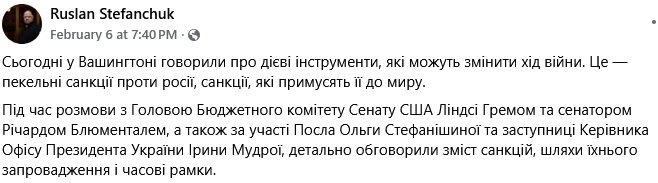
February 6 (2). Ukraine already has negative experience with the Budapest Memorandum. We need binding security guarantees, which we are ready to ratify both in Congress and in the Verkhovna Rada.

February 9. Quoted the results of negotiations: A just and lasting peace is possible only on conditions accepted by the Ukrainian people without loss of sovereignty and territories, with full responsibility of the aggressor. Precisely such a position I heard during the meeting with the President of the Senate of the Kingdom of Spain, Pedro Rollán. (…) He emphasized: frozen Russian assets must become the source of Ukraine’s recovery. The restoration of our state must become a success story for all of Europe, and the participation of Spanish business in this process is important.
February 10. Ukrainians are under shelling every night. That is precisely why we strive for peace – but a just and lasting one, with reliable safeguards against new Russian aggression. This was discussed during the meeting in Madrid with President of the NATO Parliamentary Assembly Marcos Perestrello and representatives of Spain in the Assembly. (…) Peace in Europe is possible only when aggression does not remain unpunished, and security is based on the strength of law, not on right-wing forces.
February 16. Chairman of the Verkhovna Rada of Ukraine Ruslan Stefanchuk held a meeting with Alain Berset, Secretary General of the Council of Europe, who was on a visit to Ukraine. During the conversation the sides emphasized: a just and lasting peace is possible only with observance of norms of international law, inevitability of responsibility of the aggressor state, and the presence of effective security guarantees. Special attention was given to the creation of a Special Tribunal for the crime of aggression against Ukraine and the launch of an international compensation mechanism. This concerns an instrument that must ensure the restoration of justice – so that the damage caused by Russian aggression is compensated at the expense of assets of the aggressor state, not the funds of Ukrainian citizens or international partners. Ruslan Stefanchuk emphasized that the Verkhovna Rada is ready to provide all necessary legislative decisions for full implementation of these initiatives.
February 19. Ruslan Stefanchuk at the winter session of the OSCE Parliamentary Assembly: peace must force Russia to stop aggression and answer for crimes. He also emphasized that Russia must be politically and economically isolated. It must not be given a place in international organizations, nor at the Olympic or Paralympic Games. The Chairman of the Verkhovna Rada called on partners to force Russia to stop aggression and achieve a just and lasting peace. “I ask for the adoption of swift and effective decisions. This is not only about weapons, support for our energy sector and economy. This is about consolidated political support, effective sanctions policy. Sanctions must be unified and strike at the economic heart of the Russian Federation. This is about creating a strong and united security architecture in Europe and the world. This is about reliable security guarantees for Ukraine,” he noted.
9. Statements of Davyd Arakhamia:
January 3. Presidential elections and a referendum on the conditions for ending the war may take place simultaneously, but only on the condition that the peace plan itself has already been agreed upon by all sides. (…) According to him, a special law on holding elections should be prepared by the working group approximately at the end of February, after which the document will be submitted for consideration by the Verkhovna Rada. In the opinion of the MP, these elections will likely be held together with the referendum. (…) He also reminded that by law the results of a referendum are considered valid if at least 50% of voters take part in the vote, which will be extremely difficult to achieve under current conditions, when millions of people are under occupation or abroad. And since presidential elections traditionally have good turnout, the idea arose to hold the referendum together with the presidential elections, noted the MP. At the same time, the head of “Servants” emphasized that both elections and the referendum are possible only with a ceasefire regime and a fully agreed draft peace treaty approved by Ukraine, the United States, the Russian Federation, and other participants in the process. And as long as such a document does not exist, there will be neither a ceasefire during elections and referendum, nor the elections with the referendum themselves.
January 3 (2). The decision on the peace agreement must be made by the nation.
10. Statements of Mykhailo Podolyak:
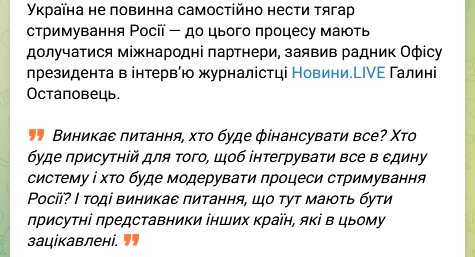
December 25, 2025. Ukraine should not bear the burden of deterring Russia alone – international partners must join this process. “The question arises, who will finance everything? Who will be present to integrate everything into a single system and who will moderate the processes of deterring Russia? And then the question arises that representatives of other countries interested in this must be present here.”
February 3. Podolyak believes that changing the composition of the negotiating group does not guarantee results if the United States does not change its approach to assessing Russia’s actions – not only at the negotiating table, but also in its real actions. “Everything can change only on the condition that the United States objectively evaluates what Russia is doing – not only at the negotiating table, but also in how it reacts to agreements. If these agreements are violated, the United States will have to respond to show that they are indeed moderating the process.”
February 10. In my view, any negotiations are useful, so it is good that they are taking place. (…) Currently three packages are being worked on. The only package in which these negotiations were not particularly successful and where we have not advanced far is the one concerning the formula for ending the war. The other two packages – security guarantees for Ukraine and Ukraine’s recovery – have been worked through quite successfully, and the situation with them is good. (…) But returning to the negotiations: they are good for fixing the positions of all sides and forcing all sides, including Russia, to accept certain conditions. At the same time we still face absolutely unrealistic positions from Russia, because they see results for themselves in this war. And we still understand that they will not make a decision to end the war until pressure is applied to them. (…) Because the price of war for Russia is not high enough – it must rise. Russia is still fairly comfortable waging war. They can still receive income by selling their goods and raw materials on world markets, and not only there. We see now that the war brings them more profit than loss, and at the same time they are increasing their global influence. This must stop.
Russia will not agree to any settlement unless serious pressure is applied to it. They will only continue to raise the stakes and put forward increasingly unrealistic demands, because as long as this war is economically profitable and brings income, they will not abandon it. We need stronger sanctions, and we also urgently need larger military supplies if we want this process to truly move forward. In any case we must continue these negotiations. We have a very active and strong mediator in this process – the United States, and Ukraine must continue to state its position in this process. (…)
The United States is not playing on Russia’s side. Yes, we may sometimes hear certain rhetoric from them, but the actions of the United States show something completely different. We see that the United States is actively working to reduce Russia’s influence in many regions of the world. We see this in South America, for example, speaking about Venezuela and Cuba, in the Middle East in the context of Lebanon, Iran, and Syria, as well as in Central and Eastern Africa.
They were the first to begin arresting oil tankers of Russia’s so-called shadow fleet. Also many American actions in Greenland are aimed at reducing Russia’s influence in the Arctic, where Russia has recently built several dozen bases. Russia wants to control the Northern Sea Route and trade there. The United States does not want this, they want to limit Russia.
Another matter is the “soft diplomacy” practiced by the United States. They want to leave space for both Russia and Ukraine to continue dialogue, and this is a wise strategy. We all know that Putin fears only two countries in the world – China and the United States. Therefore, the United States continues to initiate these negotiations and leaves space where we can talk to each other.
February 11. Holding elections requires ending the active phase of the war and missile-drone strikes. If the active phase of the war is not ended, people will also not be able to exercise their right to run.
February 12. Adviser to the Office of the President of Ukraine Mykhailo Podolyak told Channel 24 that our government is now working on documents that must legally fix how Ukraine’s partner states will act in response to possible provocations from Russia. It is about concrete steps of specific countries if peace with Moscow is signed. Mykhailo Podolyak emphasized that the Ukrainian government wants to have legal documents of international level, in which the actions of Ukraine’s partners would be clearly outlined if Russia violates the conditions of the peace treaty. The Adviser to the Office of the President stressed that there will be several documents that can work within a single package of assistance for Ukraine. However, there will be different legal formats that will take into account all necessary security guarantees for our state from Europe and, likely, the United States.
2. Statements from official government websites.
Statements from the Cabinet of Ministers website:
January 7. Sybiha: “I also informed about recent peace efforts, including the results of the meeting in Paris, and Ukraine’s vision of the sequence of steps on the path to lasting peace. Political pressure on Russia, in particular through sanctions, as well as providing Ukraine with reliable security guarantees are key to achieving this goal.”
January 7 (2). Sybiha: “The key topic of our negotiations today was the path to lasting peace for Ukraine. I once again emphasized that Russia must be forced to end its aggression, and that Ukraine counts on international support in this matter.”
January 7 (3). Sybiha: “We discussed in detail the recent dynamics of the peace process. I informed about Ukraine’s approach and proposals, the leading role of the United States and the involvement of Europe in peace efforts, pressure on Russia, as well as the need for reliable security guarantees for Ukraine.”
January 13. “The Russian Federation has significantly increased the number of missiles and drones for attacks on Ukraine. This is direct evidence of Russia’s orientation exclusively toward further escalation. We need additional missiles for Patriot and NASAMS systems,” appealed Deputy Minister of Defense Serhii Boiev. He also emphasized that Russia’s use of a medium-range ballistic missile near NATO borders is another manifestation of its aggressive policy and complete lack of desire for peace.
January 23. Taras Kachka: “The process of joining the EU is one of the key pillars of Ukraine’s future economic recovery, and Ukraine’s economic recovery is a necessary condition for lasting peace throughout Europe.”
January 26. Serhii Boiev noted that strengthening support for Ukraine in 2026 is a necessary condition for deterring Russian aggression and creating prerequisites for achieving a just and lasting peace.
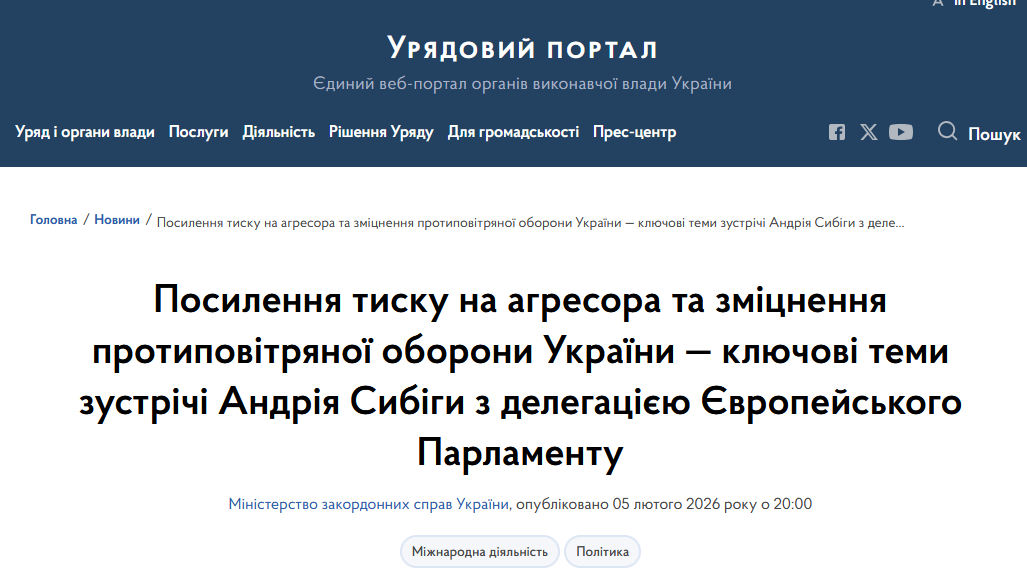
February 5. Strengthening pressure on the aggressor and reinforcing Ukraine’s air defense were the key topics of Andriy Sybiha’s meeting with the delegation of the European Parliament.
February 6. The heads of Ukrainian and Estonian diplomacy discussed peace efforts, the results of meetings in Abu Dhabi, and subsequent steps. The sides agreed that for diplomacy to succeed it is necessary to strengthen pressure on the aggressor.
February 12. “Today the people of Ukraine strive for peace more than anyone else. The diplomatic team led by President Volodymyr Zelenskyy works on this every day. Thanks to the United States, the EU, and partners who help us. The only one who does not want peace is Russia. Therefore, in parallel we need to strengthen our defense to force the enemy to peace,” reminded Mykhailo Fedorov.
3. Statements from “We Are Ukraine”:
January 5. The Russian strike on the American factory in Dnipro was deliberate.
January 6. Starmer noted that dictator Vladimir Putin “is not ready for peace.” “In recent weeks we have seen the opposite. Further terrible strikes on Ukraine, killings and injuries of civilians, and power outages for millions of people in the middle of winter.” Starmer promised to continue pressure on Russia and to support Ukraine. The United Kingdom will also take part in monitoring compliance with the ceasefire regime under U.S. leadership.
January 6 (2). Whitkoff: “We have achieved significant progress in several critically important areas of work, including our bilateral system of security guarantees and the prosperity plan. The Coalition also published a statement outlining its system of security guarantees. We agree with the Coalition that long-term security guarantees and reliable commitments to prosperity are important for a strong peace in Ukraine, and we will continue to work together on these efforts.”
January 8. In Vadym Denysenko’s material it is noted that the seizure of Russian ships under the Russian flag and Senator Lindsey Graham’s initiative to tighten sanctions show: a quick peace should not be expected. It is emphasized that the war will continue as long as Russia retains resources to wage it, which means that the key condition of the peace process remains pressure and limiting the Kremlin’s capabilities.
January 13. Sybiha: There has not been and will not be any pauses in pressure on Russia.
January 15. Tusk responded to Trump’s words: the U.S. peace plan was rejected by Russia, not Ukraine.
January 16. Britain called for increasing pressure on the Russian Federation instead of resuming dialogue with Putin.
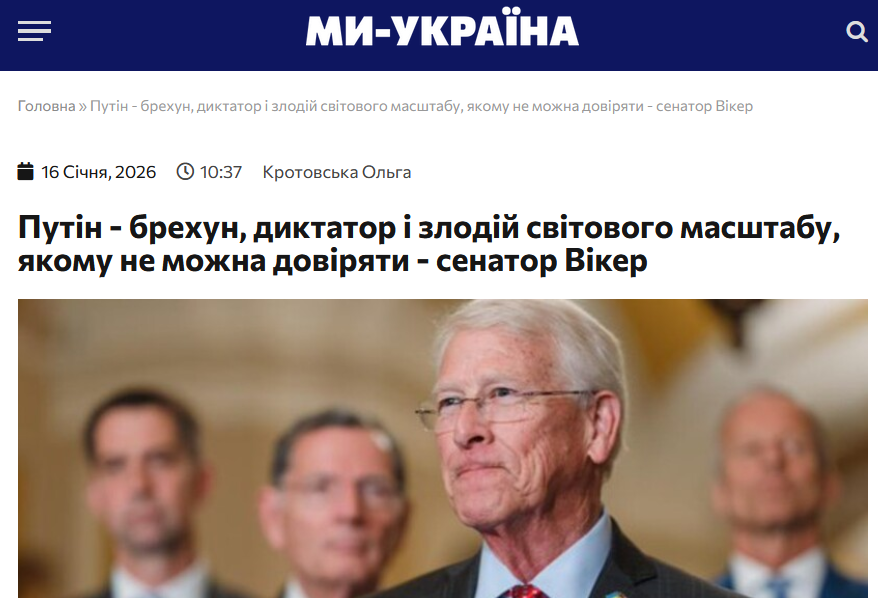
January 16 (2). Putin is a liar, dictator, and thief of global scale who cannot be trusted – Senator Wicker.
January 22. Trump stated that failure to conclude an agreement between Ukraine and Russia would be “a disgrace.”
January 22 (2). The peace process continues, but Ukraine needs weapons right now – Rutte.
January 24. Leshchenko: “Ukraine expects that negotiations on ending the war are approaching the final stage, however the key responsibility for stopping hostilities remains on Russia’s side.”
January 25. Taras Zahorodniy: “Negotiations between Ukraine and Russia in Abu Dhabi will not yield results, since Moscow’s position remains unchanged and is based on ultimatums.” “Of course, they will tell Whitkoff there that everything is ‘fine,’ that everything is moving constructively. But we already went through this story in the spring of this year. Now the main goal of the Russians is by any means to pressure Ukraine so that Ukraine retreats somewhere without a fight. In order then to accuse the Ukrainian authorities of treason and destabilize Ukraine from within.”
January 26. Vadym Denysenko, commenting on the negotiations in Abu Dhabi, noted that the American side is trying to propose a “council of peace,” but in fact it is about a war of attrition. According to him, Russia is not ready for real agreements, and the peace process is possible only under the condition of pressure and raising the cost of war for the Kremlin. In the context of Trump’s peace plan this means that any U.S. initiatives will be perceived in Ukraine only as an instrument if they are backed by sanctions, military support, and legal guarantees, and not as declarative compromises.
January 31. Sikorski on the Nobel Peace Prize for Trump: “If President Trump ensures a just peace for Ukraine, then I too will sign such a nomination. My position is unchanged: we want peace, but it must be a just peace. If he achieves this – he deserves recognition from the whole world.”
February 1. There is no ceasefire, Russia does not respect agreements – Ambassador of Ukraine to the EU.
February 3. Republican Senator Lindsey Graham called on President Donald Trump to start transferring Tomahawk cruise missiles to Ukraine. In his opinion, this could change the rules of the game in the war with Russia. “Obviously, the pressure we are putting on Putin to sit at the peace negotiation table and stop massive attacks on Ukraine is not working,” he noted.
February 5. Whitkoff on prisoner exchange: “This result was achieved thanks to thoroughly worked out and productive peace negotiations. Although much work still lies ahead, such steps demonstrate that constant diplomatic efforts yield tangible results and contribute to ending the war in Ukraine.”
February 7. Leshchenko: “For the Ukrainian side the main thing is always to be in a position open to negotiations, so that no one can ever say that Ukraine does not want peace.” Leshchenko added that Ukraine must demonstrate the class of negotiation diplomacy and open itself to negotiations on all proposals from partners.
February 7 (2). Zelenskyy emphasized that for Ukraine the result of negotiations is fundamentally important, and one of the key prerequisites for achieving a just peace is reliable and effective security guarantees. The President stressed that Ukraine did not start this war, and it is Moscow that must end it. The Head of State also noted that it is important for international partners to remain active, to work together on achieving peace, and to seriously consider all realistic proposals. Separately, Zelenskyy thanked the United States for readiness to continue providing support.
February 10. Kallas: “Everyone sitting at the negotiation table, including Russians and Americans, must understand that for a decision to be made the consent of Europeans is needed. And for this we also have conditions. And these conditions we must put forward not to Ukrainians, who are already under strong pressure, but to Russians.” “If we do not defend our interests, then there is no point in sitting at the negotiation table. It is necessary to clearly discuss what concessions we expect from Russia in order to achieve lasting peace.”
February 10 (2). Ihor Petrenko: “President Zelenskyy is now actively promoting the idea of fixing the date ‘January 1, 2027’ as part of a major peace agreement, and despite resistance from some capitals, Brussels is beginning to perceive this as a working scenario. For us this means access to markets, structural funds, and most importantly, ironclad guarantees that there will be no more ‘gray zone.’ And this is the most important thing!”
February 11. Zelenskyy named several steps that must precede a possible ceasefire. Among them – the signing of security guarantees between Ukraine and the United States, the signing of Ukraine’s “prosperity plan,” on which the country’s post-war recovery depends, agreement on the peace plan, resolution of the issue of the future of Donetsk region, and submission of the peace plan to a referendum.
February 13. Merz stated that the war in Ukraine will end only when Russia stops aggression and withdraws its troops. According to him, any negotiations make sense only under the condition of real pressure on Moscow and raising the cost of war for the Kremlin. He emphasized: lasting peace is possible only with preservation of Ukraine’s independence and security.
February 13 (2). Sikorski emphasized that Europe is already paying a high price for the war and therefore must be a full participant in negotiations on Ukraine. According to him, without European presence at the table it is impossible to build a lasting architecture of peace and security. “Ukraine will not lose this war; Ukraine is inflicting huge losses on Russia. Russia’s capabilities are not what we thought – they will not be able to win in Donbas – but their intentions are much worse,” said the minister.
February 14. Europe must take direct part in negotiations on the war in Ukraine, and not remain a side observer. This was stated by China’s Foreign Minister Wang Yi.
February 15. Analysis by Olesya Yakhno. Key points: In Geneva on February 17–18 another round of negotiations took place, where four possible directions were considered. The first – delaying the process and imitating dialogue by the Russian delegation. The second – limited decisions in the humanitarian sphere and technical negotiations. The third – a comprehensive military ceasefire as a step toward peace, which Ukraine and its partners support, but Russia blocks. The fourth – a set of Moscow’s political demands aimed not at peace, but at control over Ukraine and weakening Europe.
February 16. Tsahkna criticized the idea of negotiations with Russian dictator Vladimir Putin without a clear plan. “We have pursued such a policy in Europe for several decades. And what is the result? The result – still more wars, an even more aggressive Russia. Therefore, now it is absolutely wrong to begin searching for a special envoy for the European Union, sending him to the Kremlin, because he will return in a humiliated position, even weaker, and will also weaken Ukraine’s positions.”
February 17. Sybiha: Russia deliberately strikes American enterprises in Ukraine, including the Boeing office in Kyiv, the Flex plant in Mukachevo, and the Bunge enterprise in Dnipro. Russia attacks not only the Ukrainian people, but also American taxpayers.
February 18. Zelenskyy noted that the negotiations were difficult, and there are grounds to believe that the Kremlin is trying to delay the process, which could already have moved to the final stage. He thanked the American side for attention to detail and endurance during negotiations with Russian representatives. The Head of State set a clear task for the Ukrainian delegation – to do everything possible so that the negotiations yield concrete results and open the way to peaceful solutions. Among the key topics of today’s agenda – the humanitarian block, in particular, issues of prisoner exchange and release of civilians. The President emphasized that Ukraine strives for guaranteed security and lasting peace, and it is precisely for this that the delegation is working.
February 19. Headline: “I will never trust him”: Zelenskyy in an interview with Morgan about Putin, Trump, and peace negotiations.
Zelenskyy: I think that our partners must answer one question – what do they want, do they want elections or do they just want to replace me. I think that the Russians just want to replace me, and they have somewhat used – what you mentioned – to replace me physically (referring to assassination attempts on the President – ed.) and other steps. But there is a civilized way – this is elections. At the same time, it is impossible to influence the peoples of other nations, they themselves must choose with whom they want to live. But I said that I will never exclude any proposals from the Americans if they can bring us peace. So, if we can have two months of ceasefire for elections – I will do everything possible for this.
Statements from the Verkhovna Rada website:
January 12. “The use of this weapon (‘Oreshnik’), capable of carrying nuclear charges, is a clear demonstration of Russia’s unwillingness to negotiate peace. This is a signal of further escalation and continuation of the war. The strike near the border with Poland was deliberate, so that this signal would be heard in Warsaw, Brussels, Berlin, Paris, Washington. This was a shot not only at Ukraine, but at Europe, Poland, and the United States,” emphasized Olena Kondratiuk.
January 27. Co-chairs of UNIC: strengthening Ukraine’s defense is extremely important for a just and lasting peace. Opening the meeting, President of the NATO Parliamentary Assembly Marcos Perestrello emphasized that “the position of the NATO PA has been consistent and principled: peace cannot be achieved by rewarding aggression. A just and lasting peace can only be achieved through strength.”
February 3. Oleksandr Korniyenko: “Regarding achieving a just peace in Ukraine, the sides discussed security guarantees, Ukraine’s recovery package, and organizational issues of possible elections or referendum, including procedural aspects and consideration of the opinions of parliamentary groups.”
February 18. Oleksandr Korniyenko: “Ukraine is fully committed to restoring a comprehensive, just, and lasting peace, which must be based on international law, the UN Charter, and respect for the sovereignty and territorial integrity of states.”
4. Position of key media.
1. Statements and headlines from RBC-Ukraine:
January 2. “It should be noted that after the meeting with Zelenskyy on December 29, Trump stated about the alleged ‘great progress’ of Russian dictator Vladimir Putin regarding the Zaporizhzhia Nuclear Power Plant. Supposedly, a great achievement that the dictator ‘is not targeting bombs’ at the plant.”
January 3. “Sanctions and weapons instead of talks: Ukraine has defined the path to compromises with the Russian Federation.”
January 6. “The Russian Federation cares only about territory: RBC-Ukraine found out Moscow’s position on peace negotiations.”
January 6 (2). “Zelenskyy’s statements about ending the war are becoming increasingly grim: NYT named the reason.”
January 10. “Zelenskyy is waiting for a signal. The main points about peace negotiations for the week.” Journalists note: Kyiv has no direct dialogue with Moscow, all contacts go through Washington, and Trump’s peace plan itself is perceived more as external pressure than as a real guarantee of a just settlement.
January 12. “‘Reward for the aggressor’: Croatia called on Ukraine to avoid territorial concessions.”
January 12 (2). “Trump about Zelenskyy: ‘He has no cards, only me.’”
January 14. “G7 leaders will persuade Trump to support security guarantees for Ukraine, – FT.”
January 15. “Trump stated that Ukraine, not Russia, is delaying the peace agreement.”
January 20. “Membership fee – a billion dollars. Why Trump needs the Council of Peace and whether Ukraine is invited.” Journalists note that the initiative is embedded in his peace plan for Ukraine, but raises doubts: the new body may become an instrument of pressure by the U.S. and Russia, rather than a platform for a just settlement. The publication emphasizes that for Kyiv the key issue remains legitimacy and guarantees, while the ‘Council of Peace’ looks more like Trump’s political project than a real mechanism of peace.
January 20 (2). “Trump named the reason why he cannot end the war in Ukraine.” According to journalists, despite Trump’s statements about personal successes in ending wars, his plan in the Ukrainian context looks like an instrument of pressure and remains far from real settlement.
January 22. “Trump’s Council of Peace: why it was created and what it means for Ukraine.” Journalists note that the initiative is embedded in his peace plan for Ukraine and is presented as an alternative to the UN, but raises doubts about real effectiveness and legitimacy. The position of the publication emphasizes that the new body may become an instrument of political influence of the U.S. and Russia, rather than a platform for a just settlement, and therefore is perceived more as Trump’s political project than as a reliable mechanism of peace.
January 28. “Putin sees ‘progress’ in trilateral negotiations on Ukraine.” The position of the publication: Trump’s plan so far gives no grounds to speak of real peace, but is rather used by Russia for informational pressure.
January 30. “Putin’s envoy flies to Miami for negotiations with Trump’s team, – Reuters.” Journalists write that the visit of Putin’s envoy to the U.S. indicates Moscow’s attempt to embed itself in the negotiation process, but at the same time the key conditions remain non-transparent and may be used by the Kremlin to pressure Kyiv. The position of the publication is skeptical: Trump’s plan is considered more as a bargaining tool between Washington and Moscow than as a real guarantee of a just peace for Ukraine. Quotes: “The very fact of the Russian envoy’s trip to the U.S. attracted attention due to the absence of publicly announced diplomatic contacts between the countries at a high level”; “Allegedly, the possibility of joint control over the plant by U.S. and Russia without Ukraine’s participation was considered”; “Zelenskyy noted that he was not informed of any agreements between the U.S. and Russia during this meeting, and there are also no official confirmations.”
February 1. “Concessions in Donbas will not stop Russia, but will become preparation for an offensive deeper into Ukraine, – NYT.”
February 4. “Negotiations in Abu Dhabi are already underway: what Ukraine, Russia, and the U.S. are discussing today.” The editorial shows a cautious-skeptical position regarding Trump’s peace plan. Journalists note that discussion of the 20-point document is taking place in a trilateral format, but the issue of territories remains unresolved, and Moscow continues military attacks, violating even declared pauses. The article emphasizes: Kyiv is ready to support U.S. de-escalation initiatives, however it does not intend to concede its positions, and therefore the prospects for implementing the plan look extremely uncertain.
February 5. “Peace without control. How Putin and Trump untie the hands of the nuclear arsenals of the U.S. and Russia.” The editorial emphasizes that Trump’s peace plan in the Ukrainian context cannot be considered in isolation: it fits into a broader U.S. – Russia strategy on arms control. The article notes that negotiations around New START are becoming an instrument of pressure and bargaining, where the U.S. and Russia are trying to link issues of nuclear balance with settlement of the war in Ukraine. Thus, the editorial position is skeptical: Trump’s plan does not look like an independent peace initiative, but rather as an element of a big security deal, where Ukraine’s fate risks becoming a bargaining chip.
February 7. “The U.S. wants the war in Ukraine ended by June and will exert pressure: Zelenskyy explained why.”
February 10. The editorial in the article shows the following view: journalists note that Trump’s peace plan is accompanied by pressure on Kyiv and the U.S. desire to accelerate the end of the war, but for Zelenskyy this means the risk of unacceptable concessions. The main emphasis is on the difficult balance between maintaining Washington’s support and the inadmissibility of steps that society would perceive as capitulation.
February 11. “Negotiations with Russia: Zelenskyy named the U.S. proposal that no one is enthusiastic about.” The article describes Zelenskyy’s reaction to the U.S. proposal to create a free economic zone in Donbas. The President noted that neither Ukraine nor Russia supports this idea: Kyiv insists on a ceasefire along the current line of demarcation, while Moscow demands full control over Donetsk and Luhansk regions and their recognition. Journalists conclude that such an element of the plan is not perceived as a real compromise and only underscores the depth of disagreements between the sides.
February 12. “Zelenskyy’s difficult choice: why the White House is pushing Ukraine toward elections in the midst of war.” Journalists write that Trump’s peace plan presents Zelenskyy with an extremely difficult choice: the White House insists on an early end to the war, offering compromise conditions that may include territorial concessions, while Kyiv fears that such steps would in fact cement the division of the country and weaken its positions. The article emphasizes that pressure from Washington is increasing, but Zelenskyy is trying to balance between the need to maintain U.S. support and the inadmissibility of decisions that Ukrainian society would perceive as capitulation.
2. Statements and headlines from Ukrinform:
January 3. There is no alternative to active U.S. participation in the peace dialogue. “To talk not just on the phone, but to talk with sanctions, to talk with military support for Ukraine. Many processes are slowed down, concerning air defense, for example. The ‘Russians’ know this perfectly well; they see many things. I want the United States of America to exert stronger pressure,” said the President.
January 3 (2). Zelenskyy emphasized that Russia has not shown genuine desire for peace, but continues its aggressive war, violence, and instability, using negotiations as a tactic to buy time, resorting to provocations and manipulations to disrupt the peace process. Only strong joint pressure from the U.S. and Europe can change the calculations of the aggressor state.
January 5. Former Ambassador of Ukraine to the U.S. and France Oleh Shamshur stated that the idea of a “Trump–Putin deal to divide the world” is unlikely. According to him, after the events in Venezuela, discussions about possible non-interference of the U.S. and Russia in each other’s spheres of influence have no practical meaning, since U.S. – Russia interaction regarding the war against Ukraine is already built on previously reached agreements. Shamshur emphasized that the tactic of interaction was in fact developed back in Anchorage, and therefore a new “global deal” is unnecessary and does not meet Trump’s interests.
January 7. Patrick Bolder: “European partners and the Coalition will not be able to provide real security guarantees for Ukraine without active U.S. support.”
January 11. Kubilius: “There are still no signs that Putin will agree to the peace plan. In this case, simply continuing our support for Ukraine at the same level risks worsening the situation in Ukraine and, ultimately, carries the risk that Putin will win. We need a clear answer: how will the European Union change this scenario? And that is precisely why the European Security Council is needed now.”
January 15. Tusk responded to Trump’s words: Russia rejected the American peace plan, not Ukraine.
January 16. Ukraine is ready for painful concessions for peace, now it is necessary to jointly pressure Russia – President of the Czech Republic. In this context, Pavel predicted that Russia will reject proposed solutions “until we begin to exert pressure together.” “This pressure may be economic and political, but we must work in coordination together with the U.S.,” he emphasized.
January 16 (2). Zelenskyy emphasized that Ukraine, like the United States, is interested in ending the war and seeks to do so as quickly as possible. Russia is slowing down peace processes, starting with the humanitarian track.
January 16 (3). The majority of Ukrainians – 77% – believe that Ukraine is capable of continuing to resist Russia, because although the aggressor is advancing on the front, it is slow and with heavy losses.
January 20. President of Lithuania Gitanas Nausėda believes that Russia is not ready for peace negotiations and will not abandon its imperial ambitions, even if a peace agreement is concluded.
January 22. Kellogg expressed hope for a “good result,” since “we are approaching, possibly, the final stages of peace negotiations.” According to Kellogg, the obstacle is not Ukraine, but Putin: “He has reached such a psychological moment when he really cannot retreat, because if he does, he will admit that he has been defeated. And what he has done is a failure.” Looking at the territory that the Russians have captured, it is indeed minimal, he added. After the end of the war, Kellogg believes, it will be possible to begin the restoration of Ukraine. “Peace may reign in Ukraine. And I hope that by Independence Day this summer there will be peace on this land,” summarized the former special envoy.
January 24. The leadership of the Russian Federation is trying to force U.S. President Donald Trump to abandon the negotiation process with Ukraine and Europe, as well as to make concessions to Moscow’s demands put forward at the summit in August 2025 in Anchorage, Alaska. (…) At the same time, ISW notes that in recent weeks Trump has conducted negotiations with Ukraine and Europe, which led to significant progress in defining the conditions necessary to ensure strong and reliable peace in Ukraine. Trump also cooperated with Ukraine and Europe to change the original U.S.-proposed peace plan of 28 points to the latest version of the plan of 20 points, which signals the commitment of the Trump administration to cooperate with Ukraine and Europe to ensure a just end to the war.
January 27. Sybiha: President Zelenskyy is ready for a personal meeting with Vladimir Putin to resolve the most sensitive issues of the peace plan – territories and the Zaporizhzhia Nuclear Power Plant, however the key obstacle to the peace process remains Russia. The head of Ukrainian diplomacy noted that Ukraine counts on signing the 20-point peace plan provided that it is agreed upon, because the most sensitive issues – territories and the ZNPP – remain unresolved. “It is precisely for their resolution that the President is ready to meet with Putin and discuss this. However, the obstacle in the peace process still remains Russia,” said Sybiha.
January 27 (2). In additional materials to the article about the Pope it is stated: As reported by Ukrinform, Pope Leo XIV views Russia’s war against Ukraine through the prism of European security and emphasizes the inadmissibility of seeking “peace plans” without respect for the Constitution of Ukraine. This reference is present in all materials about the Pope.
February 2. 52% of respondents personally consider it categorically unacceptable to hand over the entire Donbas under Russia’s control in exchange for security guarantees. At the same time, 40% are ready for such a concession (although most of them admit that this is a difficult condition). Another 7% could not determine their opinion
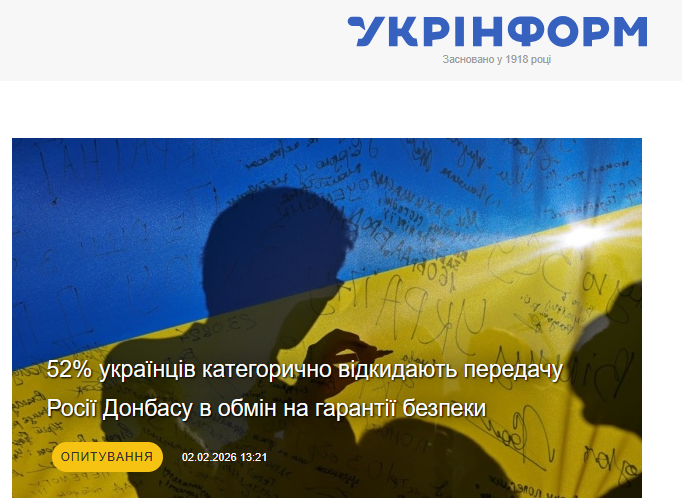
February 2 (2). Headline: “The Kremlin wants concessions from the U.S. that would be strategically harmful for Ukraine.” This is a translation of an analytical report. The Institute for the Study of War (ISW) in its latest report notes that the Kremlin is trying to obtain concessions from Donald Trump’s administration that would be strategically harmful for Ukraine. Moscow uses topics not directly related to the war to impose bilateral economic and trade projects on the U.S. and to present itself as a world power equal to Washington. Analysts emphasize: such concessions would in fact mean recognition of Russia in the status of a superpower and weakening of Ukraine’s position in negotiations.
February 8. Sybiha: “Only U.S. President Donald Trump can suspend the Russian–Ukrainian war.”
5. Position of government Telegram channels.
1. Statements from “Ukraine Now”:
January 2. We are closer to peace than ever during the war in Ukraine, but at the same time we cannot be sure whether Russia is ready for peace, – President of Finland Stubb. Peace most often is a compromise, and we must prepare for the fact that not all parts of the peace agreement will likely correspond to our sense of justice. However, we will do everything possible to preserve the independence, sovereignty, and territorial integrity of Ukraine.
January 6. All peace agreements signed by Russia over the past 15 years have been violated: in Moldova, Georgia, and Ukraine. Based on this experience, we want guarantees of peace.
January 10. Trump considers Putin an obstacle to peace and is tired of his games, – The Telegraph.
January 15. Putin declares that “difficulties and troubles will remain in the past,” but at the same time emphasizes the continuation of Russian goals in Ukraine, the need for a new security architecture, and hope for a “stable peace” provided Kyiv agrees. He also describes the worsening of the international situation and the suffering of dozens of countries from chaos and lawlessness.
January 15 (2). It was Russia that rejected the U.S.-prepared plan, not Zelenskyy, – Prime Minister of Poland Donald Tusk. This was his reaction to Trump’s statement that Ukraine is delaying the peace negotiation process, not Russia.
January 16. Ukraine must make painful concessions to achieve peace, – President of the Czech Republic Petr Pavel. He added that Europe must make maximum efforts so that the work done on the agreement is not in vain. After all, Russia will reject any agreements until it feels sufficient pressure.
January 16 (2). Putin gives “lip service” to peace negotiations. But his actions show complete lack of interest, – Chairman of the U.S. Senate Armed Services Committee, Republican Roger Wicker.
January 21. Our task is to accumulate all forces, mobilize, and bring the matter to completion. We need peace, security guarantees, and a clear plan for Ukraine’s recovery – Head of the Presidential Office Budanov.
January 21 (2). I understand that winter is harsh. But if Ukraine survives this winter – January, February – and lives until March, April, the advantage will be on Ukraine’s side, not Russia’s, – Keith Kellogg. He emphasized that the obstacle to peace is not Ukraine, but the Russian dictator.
January 26. The channel comments on Peskov’s statement: Of course, there will be no effectiveness when the Russians are not set on peace 🤦♂️
February 4. A Republican U.S. foreign policy expert stated that for the first time in a long while he sees truly constructive negotiations. The Russian side has become more pragmatic and focused on details rather than propaganda. However, doubts remain: the Kremlin may only be imitating readiness for peace, trying to buy time and retain Trump’s favor. It is difficult for Putin to agree to a deal without victory, which creates the risk of breakdown of agreements.
February 4 (2). Ukraine will be able to double its GDP within the next decade, – Rubio. A prosperous Ukraine is an important component of lasting peace, therefore plans for its recovery and development are being prepared in advance, to be launched immediately after the end of the war.
February 5. 🤡 Russia has put forward a new condition for peace: it insists not only on the transfer of Donbas, but also on its official recognition by “all countries” participating in the negotiations – Russian media.
February 10. Terekhov: Security guarantees are needed not for 2027 or two years after that, but for at least a century. Ukraine must receive long-term security guarantees, the duration of which will be measured in a century, not just in the next few years.
February 13. 75% of Ukrainians believe that Russia will attack again after signing peace, – polls. This is the highest figure for the entire period of observations.
February 14. We are ready for an agreement that will bring real peace. We believe that it is possible to end this war, – Zelenskyy.
February 15. 90% of Ukrainians are against elections now, – Zelenskyy. “If Trump forces Putin to declare a ceasefire for 2–3 months, we will hold elections,” said the President. Zelenskyy also emphasized that no one in Ukraine wants to fight for years, but it is important to achieve a just peace.
February 19. Kim in an interview with foreign media stated that people are more important than territory, and added that people are afraid to say this out loud. The hint here, of course, is about giving up Donbas in exchange for peace.
2. Statements from the channel “Card Office”:
January 1. We recommend recalling yesterday’s statement by Trump about Russia, which lies about an attack on Putin in order to disrupt peace. Very interesting events are about to begin.
January 23. The new tool of the Russians is a Ukrainian-language party of peace. Razumkov, Honcharenko, Hetmantsev, Shuliak, Skorokhod and another dozen MPs are already working off Russian money by intensifying irritation with “criticism” of the authorities, raising taxes, etc. A separate story is the work of NABU and its agents in the Rada. But more on that later and in detail.
January 27. We already see colossal new problems for the Russians with the federal budget, as well as with inflation and economic indicators. All this is good, correct signals that peace will eventually come. The harder it is for Russia – the closer peace is,– President Zelenskyy.
February 15. According to our information, the Russians are considering Hetmantsev as the head of the “PEACE” party with financing from Novinskyi.
February 16. Soon we will mark already a year of the most active diplomacy undertaken by Ukraine. We agreed to all realistic proposals of America, starting with the proposal of a ceasefire. Russia rejects this, continues assaults on the front and strikes on our cities, on energy. We expect that partners will act so that coercion of the aggressor to peace really works, – President Zelenskyy.
February 18. “It is important when all of us in Ukraine work so that our country withstands, defends itself, achieves a worthy peace. Any other politics in Ukraine now is absolutely unnecessary. This is the time of war, of defending our state, of defending our people. Personal matters – later,” – President Zelenskyy.